A complete look at the PAtopia question bank and study libraries — plus free faculty access and program-wide licensing.
If you direct, coordinate, or teach in a PA program, you already know what this year looks like. PAEA published new versions of six End of Rotation exams on July 27, 2026 — Emergency Medicine, Family Medicine, Internal Medicine, Pediatrics, Psychiatric & Behavioral Health, and the newly renamed Gynecologic, Sexual, and Reproductive Health exam. Surgery was rebuilt back in September 2024. Legacy forms remain available for a while yet, which means most programs are running a class that straddles two blueprints while trying to keep remediation, benchmarking, and PANCE readiness on track.
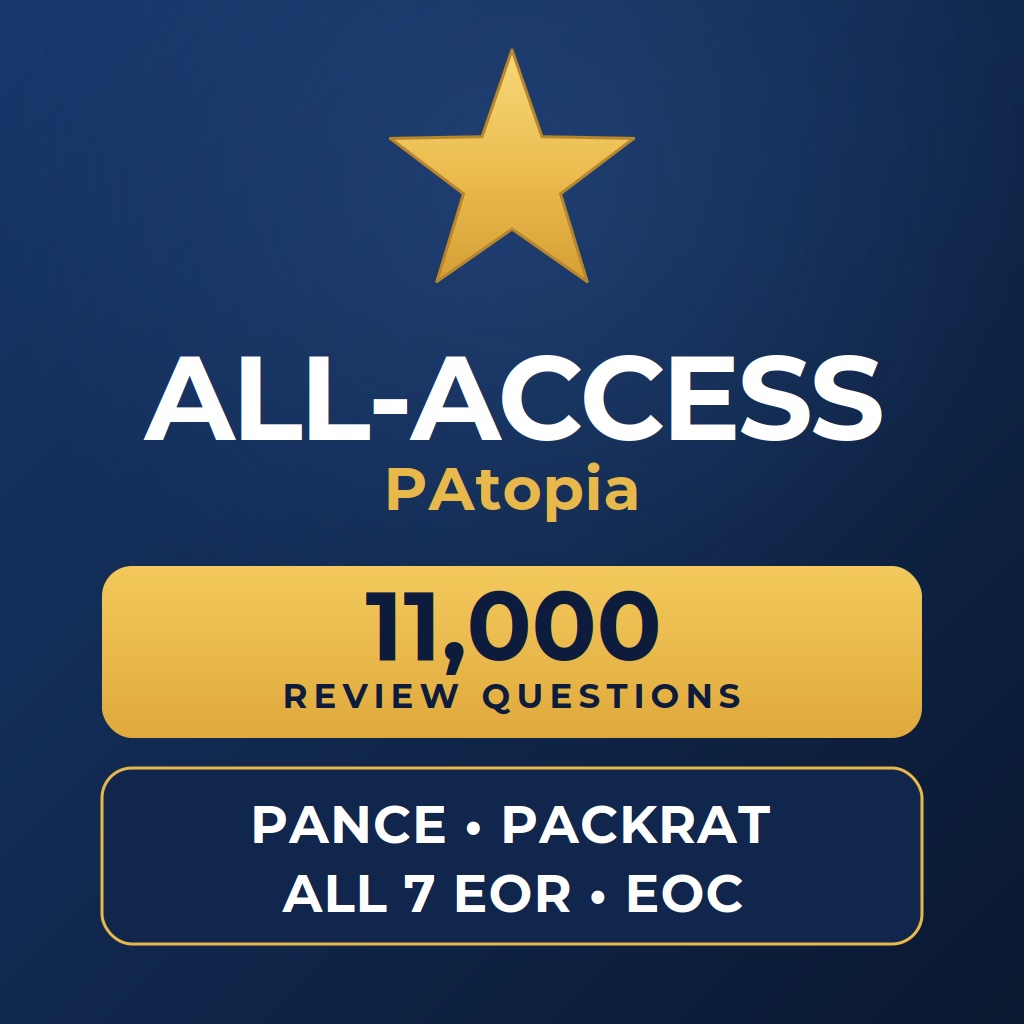
PAtopia was built for exactly that stretch of PA school. It is a single question bank and study library covering every standardized exam a PA student takes between the mid-program checkpoint and certification: PACKRAT, all seven End of Rotation exams, the End of Curriculum exam, and the PANCE. Roughly 11,300 board-style questions and 60 full-length practice exams, all written and maintained by one practicing emergency medicine PA-C rather than assembled by committee.
What follows is a detailed breakdown of what is actually inside it — especially the EOR content, since that is where most programs feel the pressure first.
How the question bank works
Every question in PAtopia, in every course, is built the same way. Students see a clinical vignette written in board style with five answer choices. Every question carries a full explanation — not just why the correct answer is correct, but why the distractors are not — and clickable citations to peer-reviewed references so a student who misses a question can go read the source rather than take our word for it.
A few design choices matter for programs specifically:
Questions reshuffle and answer choices randomize on every attempt, so a student who takes the same practice exam twice cannot pattern-match answer positions. Students see a live correct-versus-attempted tally as they work, so they are never guessing at where they stand. At the end of an exam, they get analytics broken down by organ system and content area, which turns a bare score into an actual study plan. When a student crosses 75 percent, they get an “on track to pass” readout — a benchmark that maps to how most programs think about EOR and EOC readiness. Students can flag hard questions to revisit, and the app remembers where they left off, so a review session can happen in fifteen minutes between patients on a clinical day.
Alongside the questions, each course includes a cited study library: presentation, diagnosis, workup, treatment, and high-yield pearls organized by topic. Students who need to learn material rather than test on it can start there and use the question bank to check themselves.
The End of Rotation core: all seven rotations
Each rotation module contains 600 practice questions and five full-length practice exams of 120 questions each, matching the format of the real thing — 120 items, two hours — plus a full study library for that rotation. Across all seven rotations, that is 4,200 questions and 35 full-length exams. Content is organized against the PAEA blueprint structure for each rotation, both the organ system and task area dimensions, so when a student’s score report says “diagnostic studies” or “pharmaceutical therapeutics,” they know exactly where to go.
Here is what each rotation covers.
Emergency Medicine EOR
The EM module works through the undifferentiated presentations that define the rotation: chest pain, shortness of breath, abdominal pain, headache, altered mental status, syncope, and the traumatic and toxicologic presentations that do not fit neatly into an organ system. Students get heavy coverage of resuscitation and shock states, ACS and dysrhythmias with EKG interpretation, airway and respiratory emergencies, acute abdomen, environmental and toxicologic emergencies, procedural sedation and common ED procedures, and — importantly — disposition decision-making, which is where clinical-year students most often lose points. This is the module written closest to the author’s own daily practice.
See the Emergency Medicine EOR module · free sample quiz and study library preview
Family Medicine EOR
Family Medicine is the broadest blueprint of the seven, and the module is built to match: primary care across the entire lifespan, from well-child and adolescent visits through adult chronic disease and geriatric care. Coverage runs through hypertension, diabetes, dyslipidemia, thyroid disease, asthma and COPD, common musculoskeletal and dermatologic complaints, EENT and genitourinary problems, and behavioral health as it presents in the primary care office. Preventive medicine gets real weight — screening intervals, immunization schedules, counseling, and health maintenance — because the blueprint weights it. Note for programs tracking the 2026 revision: urgent care was retired as a standalone content area and those topics were redistributed across the organ systems, and this module reflects that structure.
See the Family Medicine EOR module · free sample quiz and study library preview
Internal Medicine EOR
The IM module covers adult medicine in both the inpatient and ambulatory setting: cardiology, pulmonology, gastroenterology and hepatology, nephrology and acid-base and electrolyte disorders, endocrinology, hematology and oncology, infectious disease, and rheumatology. The emphasis throughout is on diagnostic reasoning and workup sequencing — which lab, which imaging study, in which order — along with interpretation of results and pharmacologic management including monitoring and adverse effects. This is the module students most often use as their bridge between the rotation exam and PANCE-level internal medicine.
See the Internal Medicine EOR module · free sample quiz and study library preview
Pediatrics EOR
The Pediatrics module runs newborn through adolescence. It covers normal growth and developmental milestones, newborn care and neonatal problems, congenital and genetic conditions, the pediatric infectious disease set, respiratory illness including bronchiolitis, croup, and asthma, gastrointestinal and nutritional issues, pediatric dermatology and musculoskeletal complaints, and behavioral and developmental concerns. Immunization schedules, anticipatory guidance, and weight-based dosing appear throughout, since those are consistently tested and consistently underprepared. Growth and development is an area PAEA has given increased attention, and the module weights it accordingly.
See the Pediatrics EOR module · free sample quiz and study library preview
Psychiatry & Behavioral Health EOR
The Psychiatry module is organized around current diagnostic criteria across the major categories: mood disorders, anxiety disorders, psychotic disorders, trauma- and stressor-related disorders, substance use disorders, neurodevelopmental disorders, personality disorders, eating disorders, somatic symptom disorders, and sleep disorders. Beyond diagnosis, it covers psychopharmacology in depth — mechanism, indication, adverse effect profile, and required monitoring — along with risk assessment for suicide and violence, the major psychotherapy modalities, and the legal and ethical questions around capacity and involuntary treatment. The 2026 revision increased the share of clinical intervention content, and the module is weighted to reflect that shift.
See the Psychiatry & Behavioral Health EOR module · free sample quiz and study library preview
Surgery EOR
Surgery was updated ahead of the others, in September 2024, and the module follows that revised blueprint. It is not a general-surgery-only review: coverage spans preoperative evaluation and risk assessment, intraoperative principles, postoperative care and complications, wound management, fluid, electrolyte, and nutritional management of the surgical patient, and the acute abdomen — plus surgical conditions across general, vascular, thoracic, urologic, orthopedic, and otolaryngologic surgery, along with trauma and burn management. Perioperative pharmacology and anesthesia basics are included, since students routinely see them on the exam and rarely see them taught.
See the Surgery EOR module · free sample quiz and study library preview
Gynecologic, Sexual, and Reproductive Health (GSR) EOR
This is the exam formerly called Women’s Health, renamed and substantially restructured for 2026. The module covers the obstetric arc — preconception counseling, routine prenatal care, complications of pregnancy, labor and delivery, and postpartum care and complications — alongside the gynecologic content: menstrual disorders, abnormal uterine bleeding, contraception, infertility, pelvic pain, endometriosis, vaginitis and pelvic infections, sexually transmitted infections, menopause, and breast and gynecologic oncology. The restructured blueprint gives more room to sexual health and reproductive health broadly, and the module was rebuilt to that structure rather than relabeled.
See the GSR EOR module · free sample quiz and study library preview
Beyond the EORs: PACKRAT, EOC, and PANCE
Most programs need more than rotation exams, so PAtopia includes the rest of the sequence in the same platform.
PACKRAT Review gives students five full-length practice exams of 225 questions each — 1,125 questions in all — organized against the PACKRAT blueprint’s organ systems and task areas. Useful for the mid-program checkpoint and for programs that use PACKRAT as an early predictor.
End of Curriculum Review provides five full-length 300-question practice exams — 1,500 questions — plus a thirteen-chapter study library, built to the EOC blueprint and its 250-scored-item format. This is the module programs tend to use as a summative readiness check in the last months of the clinical year.
PANCE Review is the largest: 4,500 questions across fifteen full-length 300-question exams, weighted to the current NCCPA blueprint across all organ systems and task areas, with an eighteen-chapter study library. Students who finish the program with this still in hand have a complete board review already loaded.
Students can use PAtopia on the web at cmereviewcourses.com or in the PAtopia app on iPhone and iPad, Google Play, and the Amazon Appstore. The mobile app requires no account and no sign-in — a student can open it on a clinical day and start a practice block in seconds.
PA faculty: contact us for free access
We would rather you evaluate this yourself than take a description at face value.
Any PA program faculty member can request free full access to PAtopia to see whether it fits your program. Not a demo, not a sample set — real access to the full question bank and study libraries, so you can read the questions, check the citations, look at how the blueprint weighting actually falls, and decide whether it belongs in your curriculum.
Email info@cmereviewcourses.com from your institutional address with your name, title, and program, and we will set you up. If you want to route it through your clinical coordinator or your assessment committee first, we are happy to provide access for multiple faculty reviewers.
Bulk rates for PA programs — one price, the whole program
Individually, students pay $39.99 for a single EOR rotation, $199.99 for the all-seven EOR bundle, $99.99 for the PANCE Review Course, $69.99 for EOC, $49.99 for PACKRAT, and $229.99 for the All-Access Pass that includes everything.
For PA programs, we offer bulk rates — and that price covers your entire program. Not a per-seat license that you have to reconcile against enrollment, and not a headcount you have to true up mid-year. You buy access for the program, and every student in that class has it.
Pricing is quoted per class rather than per student, so what you pay does not change if your cohort is a few students larger than you projected. Email info@cmereviewcourses.com with your program name and approximate class size and we will send a quote. If you want to start with a single rotation or with EOC only rather than the full catalog, that works too.
Only a few students need help? For students in remediation after a failed End of Rotation exam or a low PACKRAT score, the PAtopia Remediation Pack provides 5 named seats for $999 or 10 for $1,799, with a test-by-test faculty report for each student. See both options for PA programs side by side.
Common questions from faculty
Who writes the questions? Jeremy Boroff, MPAS, PA-C — an emergency medicine PA with 24 years of clinical experience and more than 20 years as APC Director of an emergency department. He is the author of Emergency Medicine End of Rotation (EOR) Exam Review and Test Prep, Ace the Psychiatry & Behavioral Health EOR, and Gynecologic, Sexual, and Reproductive Health End of Rotation (EOR) Exam Review. Every question is written and reviewed by a practicing clinician, not crowdsourced.
Are these actual retired exam items? No. These are original questions written to the published blueprint structure. No PAEA or NCCPA exam content is used, and none of it is reproduced.
Is the content updated for the 2026 blueprints? Yes. Content is maintained against the current published blueprints, including the July 2026 revisions to the six updated EOR exams and the 2024 Surgery revision.
Can students use it on their phones? Yes — iOS, Google Play, and Amazon Appstore, in addition to the web version.
How long does access last? Retail student purchases include 27 months of access on the web courses. Program licensing terms are set per agreement.
Start with a look
The fastest way to evaluate PAtopia is to open it. Every course has a free sample quiz and unlocked study library chapters on the website — no account, no email required — and the mobile app unlocks everything free for three days.
Then email info@cmereviewcourses.com for free faculty access, and we will talk about what a program-wide license looks like for your class.
PAtopia and CME Review Courses are not sponsored by, endorsed by, or affiliated with PAEA or NCCPA. End of Rotation™, PACKRAT®, and End of Curriculum™ are trademarks of the Physician Assistant Education Association. PANCE® and PANRE® are trademarks of the National Commission on Certification of Physician Assistants.