
Posted on

How to Study for the PACKRAT: Turn Your Score Into a Weak-Area Map

PAtopia PACKRAT Review Course

The PACKRAT isn’t the exam that licenses you — it’s the one that tells you whether you’re on track to pass the one that does. Taken twice a few months apart, the jump between your two scores is the clearest early read you’ll get on your PANCE trajectory.

Most students take it, glance at the scaled score, feel relieved or rattled, and move on. That throws away the most useful thing the PACKRAT gives you: a content-area map of your weak spots while there’s still a whole semester left to fix them. The trick is to treat it as a loop you run, not a score you receive: Watch · Test · Target · Repeat.

PAtopia PACKRAT Review app

1. Watch — build the map before you test

Before your next PACKRAT attempt, make one full pass through the review videos — every content area of the PAEA PACKRAT Blueprint, in order. You’re not memorizing yet; you’re building a mental map of what the exam covers and how much weight each area carries, so your practice score measures knowledge instead of surprise.

2. Test — take a full-length exam that feels real

Sit a full-length, timed, blueprint-weighted practice exam in one go — the way the real PACKRAT comes at you. Two things matter: the exam should be weighted to the blueprint, and it should not show you topic labels while you answer, because a visible “Cardiology” tag hands you the category the real test makes you work out. Treat this first run as a baseline, not a verdict.

3. Target — let the analytics tell you where you’re weak

Skip the overall number and read the breakdown by content area. Maybe you’re solid in dermatology and EENT but bleeding points in cardiology and pulmonology. “Study for the PACKRAT” just became “fix two areas” — a focused week, not a vague scramble. Write down your two or three weakest areas; that’s the whole assignment.

4. Repeat — remediate, then re-test

Go back only to what the data flagged: re-watch those lectures, run blueprint-weighted flashcards on those topics, then take another full-length exam and compare. The targeted areas climb, a smaller set of weak spots surfaces, and you run the loop again. Each pass is shorter than the last, so by your next real PACKRAT the improvement isn’t luck — it’s the loop.

Why the loop beats cramming

Binge-watching lectures covers everything and confirms nothing; grinding random questions tests you constantly but never tells you what to fix. The loop connects all four moves — frame it, measure it, fix it, re-measure — so no area gets studied twice for no reason and no weak spot gets ignored.

For faculty: PACKRAT is your remediation trigger

The PACKRAT is often where a program first spots an at-risk student. The same loop is the remediation plan: the content-area breakdown tells you and the student exactly which areas to assign videos and flashcards for, and the next attempt shows whether it worked — a documentable before-and-after instead of “study harder.”

The tool built to run the loop

The friction of stitching this together from scattered resources is what usually kills it. PAtopia PACKRAT Premium puts all four pieces in one place: the full video library across every PACKRAT content area, full-length blueprint-weighted PACKRAT exams, analytics that break results down by content area test by test, and blueprint-weighted flashcards you can aim straight at your weak spots — on your phone or laptop. (Just want the question bank? Standard has the exams; Premium adds the videos and flashcards that close the loop.)
CME Review Courses

#PACKRAT #PACKRATprep #PAschool #PAstudent #PhysicianAssistant #PAfaculty #PAeducator

CME Review Courses and PAtopia are independent study resources and are not affiliated with, endorsed by, or sponsored by PAEA or the NCCPA. PACKRAT is a trademark of the Physician Assistant Education Association (PAEA).

Posted on

A Low PACKRAT Score Is an Early Warning. Here Is What Faculty Can Do With It

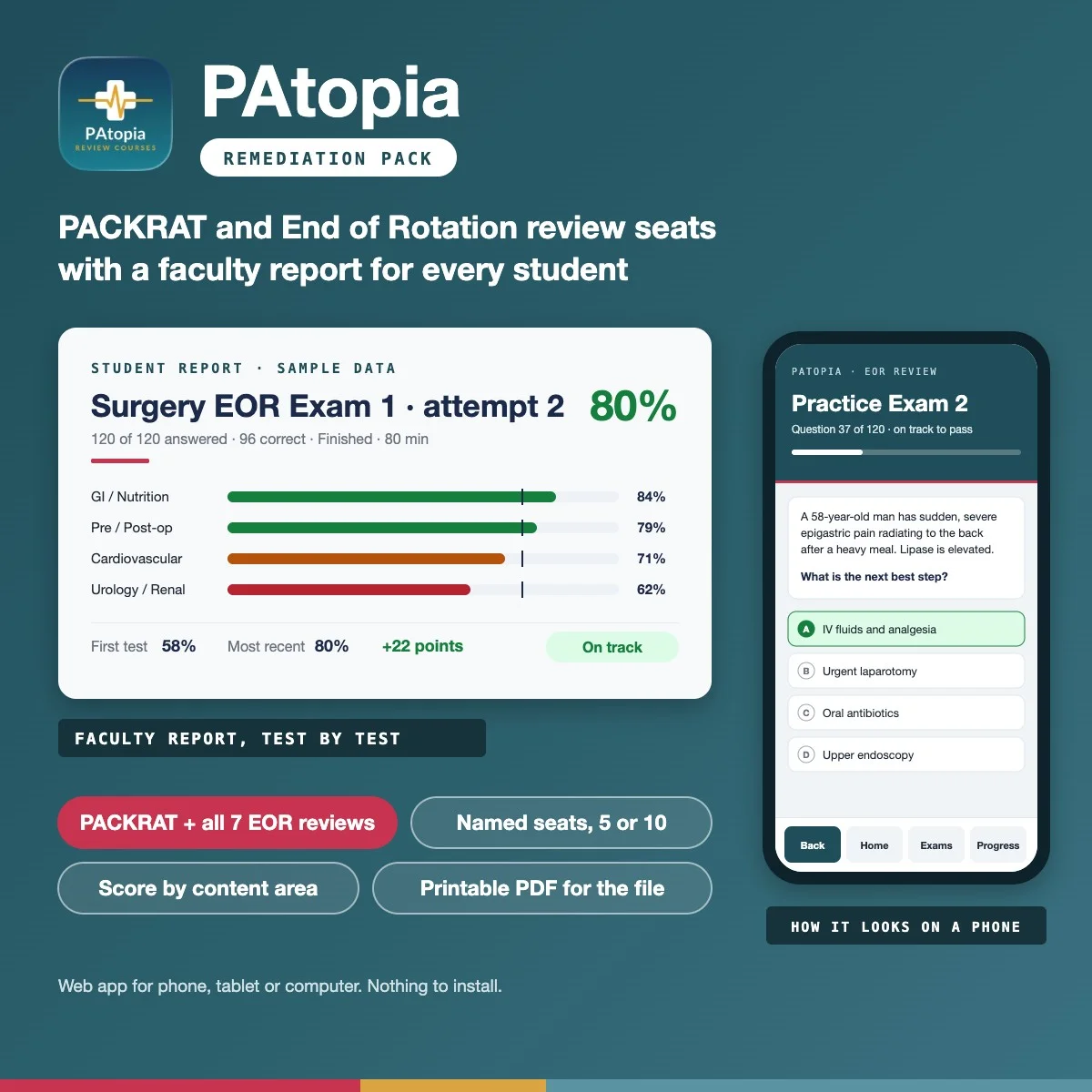
PAtopia Remediation Pack preview: a faculty report for one practice test and how the web app looks on a phone

The PACKRAT is a self-assessment, and nobody passes or fails it. That is why a low score is easy to set aside. It is also the earliest broad signal a program gets about how a student will handle a comprehensive exam, and it arrives while there is still time to act.

Decide what “low” means for your program

Programs that use PACKRAT results well pick a threshold in advance, based on how their own past students performed, and apply it the same way every year. The threshold matters less than having one. Without it, the conversation with a student becomes a judgment call, and judgment calls get postponed.

Look past the total

The report breaks performance down by content area and task area. Two students with the same total can have very different profiles. One is a little below average everywhere. The other is fine in most areas and far behind in two. The second student is the easier one to help, because the assignment is obvious.

Give the student a plan with dates

A flagged student should leave the advising meeting with a schedule: full-length practice exams on set dates, review of the weakest areas in between, and a check-in. Clinical year makes open-ended plans disappear. A dated plan with a visible record survives a hard rotation.

PAtopia Remediation Pack: a sample faculty report for one practice test and a practice question on a phone

Watch the rotation exams too

The students flagged by PACKRAT are often the same ones who struggle on End of Rotation exams. Giving them rotation-specific practice ahead of each exam is cheaper than remediating a failure afterward. That is the reason the Remediation Pack pairs the PACKRAT review with all 7 rotation reviews in one seat.

Make the conversation routine

Students take a PACKRAT flag better when it is clearly a standard process and not a verdict about them. Tell the class in advance what the threshold is and what happens if they fall under it. Then the meeting is about the plan. A student who knows that every flagged classmate gets the same seat and the same schedule is more likely to use them.

Check in on a schedule, not on a feeling

Set two or three check-in dates when the plan is made. Before each one, open the student’s report and look at three things: whether they have started, how many full-length tests are finished, and whether the weakest content areas have moved. Ten minutes of preparation makes a fifteen-minute meeting useful. If nothing has been done by the first check-in, that is the moment to find out why, while there is still most of the year left.

Keep the record in one place

When a student’s file is reviewed later, you want the PACKRAT flag, the plan, the practice results and the follow-up together. A dated report for each student, printed or saved as a PDF at each check-in, does that with very little faculty time.

Seats for the students who need them

The PAtopia Remediation Pack gives a PA program 5 named seats for $999 or 10 for $1,799. Each seat covers the PACKRAT review and all 7 End of Rotation reviews for 12 months from the day it is assigned. A set of 10 single-rotation retake seats is $399. Faculty get a dashboard and a test-by-test report for every student, and the dashboard link arrives in the order confirmation email.

See the Remediation Pack

PACKRAT® and End of Rotation™ are trademarks of the Physician Assistant Education Association (PAEA). CME Review Courses and PAtopia are not affiliated with or endorsed by PAEA. Practice scores are not official exam results. Your program’s own policies decide what counts as passing and what remediation requires.
Posted on

A Program Director’s Checklist for Buying a PAtopia Program License

You have seen the question bank, you like the per-class pricing, and now you need to get it approved and in front of students. This checklist walks through the whole process for the PAtopia Program License, from the first faculty preview to students logging in.

Step 1: Evaluate it with your faculty

  • Email info@cmereviewcourses.com to request faculty preview access.
  • Have a didactic faculty member and a clinical coordinator each work through a few exams, paying attention to question style and the quality of the rationales.
  • Share the free sample quiz and library preview with anyone else on the decision, such as your curriculum committee or a student representative.

Step 2: Confirm what your cohort gets

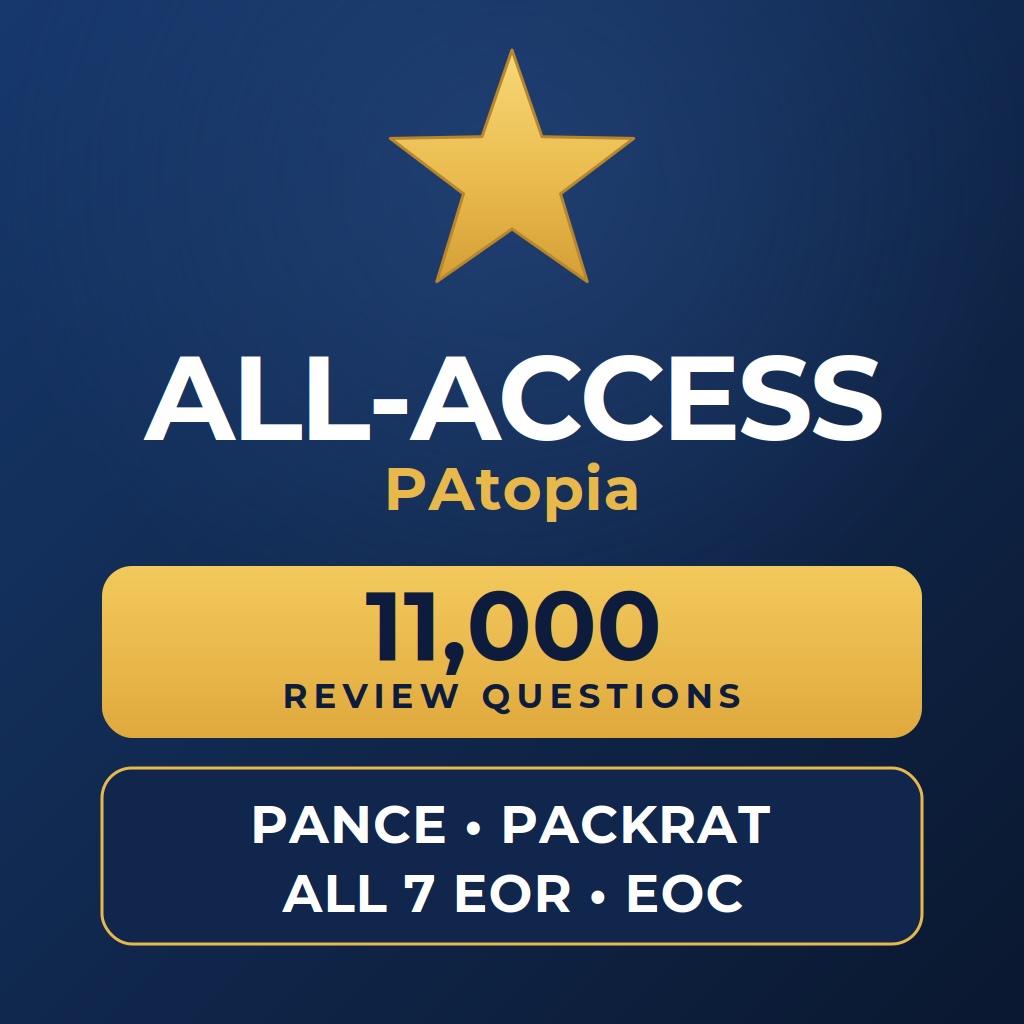
Every student on the license receives full PAtopia All-Access for 27 months:

  • 15 full-length PANCE practice exams (4,500 questions)
  • 35 full-length End of Rotation exams across all seven core rotations
  • 5 full-length PACKRAT exams and 5 full-length End of Curriculum exams
  • More than 11,000 questions and 60 full-length exams in total, each with rationales and references
  • Browser-based access on any device, including phones

Step 3: Choose your tier

Pick the tier that matches the number of students in the matriculating cohort:

Class sizePrice per class (27 months)
Up to 40 students$3,750
41–60 students$6,000
61–85 students$8,750
86+ students$12,500

One license covers one cohort. Each incoming class is licensed separately, so every class gets a full 27-month term.

Step 4: Decide how to pay

  • Online checkout. Select your class size on the product page and pay by card.
  • Purchase order or invoice. If your institution requires a PO or direct invoicing, email info@cmereviewcourses.com or call (419) 203-8154 and we will set it up.

Step 5: Send your class roster

After purchase, email your class roster to info@cmereviewcourses.com. Include each student’s name and the email address they should use to log in.

Step 6: Students get their named logins

Each student receives an individual login tied to their name. Logins are not shared codes, so access stays with your cohort. Students can start right away in the browser on a laptop, tablet or phone.

Step 7: Build it into your curriculum

Decide where practice exams fit: a PACKRAT practice exam at the end of didactics, EOR practice exams at the start of each rotation, and PANCE practice exams in the final months. Our earlier posts on the 27-month curriculum fit and using practice exams as an early-warning system have ready-made checkpoint plans.

Questions before you start?

Email info@cmereviewcourses.com or call (419) 203-8154. We are happy to talk through timing, procurement or anything else your program needs.

Ready when you are. Get the PAtopia Program License.

PAtopia is an independent exam-preparation resource and is not affiliated with or endorsed by the NCCPA or PAEA.

Posted on

How to Study for the PANCE: The Weak-Area Loop That Beats Grinding Questions

PAtopia PANCE Review Course

Most people study for the PANCE one of two ways, and both of them waste time.

The first is the lecture binge: watch hours of review videos, feel productive, and walk into test day with no real idea of what actually stuck. The second is the question grind: do thousands of practice questions, chase the percentage up, and never step back to ask which topics are quietly costing you points. Both feel like work. Neither tells you what to study next.

There’s a better way to spend the weeks before your exam, and it’s not complicated. It’s a loop: Watch · Test · Target · Repeat. Run it a few times and your studying stops being a vague slog and becomes a short, honest to-do list that gets shorter every week.

PAtopia PANCE Review app

1. Watch — build the map before you test

Before you take a single practice exam, go through the full set of review videos once, start to finish — every content area of the NCCPA PANCE Blueprint, in order.

This feels slow, and your instinct will be to skip it and jump straight to questions. Don’t. A first full pass isn’t about memorizing — it’s about building a map. You’re learning the shape of the exam: that cardiology carries the heaviest weight, that pulmonary and GI are close behind, and where the high-yield material lives. When you sit down for your first practice exam a few days later, you’re not seeing the blueprint for the first time under a timer. You’re confirming what you already framed.

2. Test — take a full-length exam that feels real

Now test yourself, and do it properly: a full-length, timed, blueprint-weighted practice exam. Not a 10-question warm-up. The whole thing, in one sitting, the way the real exam comes at you.

Two details matter more than people realize. First, the exam should be weighted to the blueprint — if the real PANCE is heavy on cardiovascular and pulmonary, your practice exam should be too, or your score is measuring the wrong thing. Second, the questions should not show you topic labels while you answer. If a question is tagged “Cardiology: Heart Failure” before you’ve read the stem, your brain has already narrowed the diagnosis and the question stops testing what the real exam tests. Treat the first exam as a baseline, not a verdict. You’re not trying to pass it — you’re generating data.

3. Target — let the analytics tell you where you’re weak

This is the step that makes the whole loop worth it, and the one most study plans skip.

When the exam is scored, don’t just look at the number. Look at the breakdown by content area. Strong in dermatology, shaky in endocrine, bleeding points in cardiology. Suddenly “study for the PANCE” — an impossible, infinite task — becomes “fix three systems.” That’s a weekend, not a mountain. Write down your two or three weakest areas. Those are your entire job for the next few days.

4. Repeat — remediate the weak areas, then test again

Now go back — but only to what the analytics flagged. Re-watch the lectures for your weak systems. Run blueprint-weighted flashcards on those topics; spaced repetition is built for exactly this. Then take another full-length exam and compare the breakdown to your baseline.

You’ll usually see two things happen. The systems you targeted jump, and a new, smaller set of weak spots surfaces that the first exam’s noise was hiding. That’s not failure — that’s the loop working. Each pass is shorter than the last, because the pile of “stuff I don’t know” keeps shrinking toward zero. Run it until your breakdowns are consistently above passing across every system. When they are, you’re not hoping you’re ready — you’ve got the receipts.

Why the loop beats the alternatives

The lecture binge skips steps 2 through 4 — you cover everything and confirm nothing. The question grind skips steps 1 and 3 — you test constantly but never frame the material first or act on what the results tell you. The loop is strong precisely because it connects all four: you frame it, you measure it, you fix what’s broken, and you re-measure. It also fixes the worst part of board prep — the anxiety of not knowing whether you’re ready. When your study list comes from your own exam analytics instead of your gut, the guesswork is gone.

For faculty: the same loop is a remediation plan

If you teach or run a PA program, this is also the cleanest way to remediate a struggling student. Instead of telling them to “study harder,” have them take a diagnostic exam, review the content-area breakdown together, and assign targeted videos and flashcards for the two or three areas that are actually failing — then re-test. The analytics turn a vague worry into a specific, documentable plan, and the student can see their own progress between attempts.

The tool built to run the loop

You can assemble this yourself from scattered resources, but the friction usually kills it — your videos are in one place, your question bank in another, and nothing talks to each other, so step 3 never happens.

That’s exactly what PAtopia PANCE Premium is built for. It puts all four pieces in one place: the full video library for every content area, full-length blueprint-weighted practice exams, analytics that break your results down by content area test by test, and blueprint-weighted flashcards you can point straight at your weak spots. Watch, test, target, repeat — without ever leaving the app, on your phone or your laptop. (Prefer just the question bank? Standard has the exams; Premium adds the videos and flashcards that close the loop.)

CME Review Courses

#PANCE #PANCEprep #PAschool #PAstudent #PhysicianAssistant #PAfaculty #PAeducator #BoardReview

CME Review Courses and PAtopia are independent study resources and are not affiliated with, endorsed by, or sponsored by the NCCPA or PAEA. PANCE is a registered trademark of the NCCPA.

Posted on

A 3-Week Retake Plan for a Failed End of Rotation Exam

You have a retake date, a new rotation that started Monday, and about three weeks. That is enough time if you use it on the right things. This plan assumes one to two hours on weekdays and a longer block on one weekend day.

Week 1: find out where you stand

Take one full-length practice exam under timed conditions in the first three days. Do not study first. You need an honest baseline. Then go through every question you missed or guessed, and read the rationale for each one. Sort your misses by content area and pick the three weakest. Those three areas are your week.

Week 2: fix the weak areas

Spend weekdays on the three weak areas. Do questions first and read second: the questions tell you what you do not know, and the reading fills that specific gap. At the end of the week take a second full-length exam. Compare it to the first, area by area. If a weak area has not moved, it stays on the list. If it has, replace it with the next weakest.

Week 3: pace and polish

Early in the week, take a third full-length exam, timed, in one sitting. This one is about pacing and stamina as much as content. Use the remaining days for your remaining weak areas and for the questions you flagged. Stop heavy studying the night before. Sleep matters more than one more chapter.

What a good review session looks like

Pick one weak area. Do 20 to 30 questions in it without looking anything up. Read the rationale for every question, including the ones you got right, because a lucky guess is still a gap. For each miss, write one line on why the right answer is right and why you chose the wrong one. Then read the short section of your notes or the study library that covers that gap. An hour of this does more than an evening of rereading a chapter.

How to fit it around the new rotation

Do questions on weekdays, when you have an hour and limited energy. Save full-length exams for the weekend day, when you can sit for the whole thing without interruption. Keep a small share of your time for the rotation you are on now. Its exam is coming too, and you do not want to trade one retake for another.

Rules that make the plan work

  1. Take every practice exam timed and in one sitting.
  2. Review every missed question the same day.
  3. Track your score by content area, not only the total.
  4. Show your advisor your numbers at the midpoint.

If the numbers are not moving

If your second exam looks like your first, tell your advisor then. A later retake date, or a different approach to a content area, is easier to arrange in week two than the day before the exam.

Where to practice

PAtopia has 5 full-length practice exams and 600 questions for each rotation, with a rationale and references on every question. You can start with the free Test Drive, then pick up the End of Rotation reviews or the PACKRAT review. If your program is setting up remediation for you, ask whether it uses the PAtopia Remediation Pack: a seat costs you nothing, and your faculty can see the work you put in.

Try the free Test Drive

PACKRAT® and End of Rotation™ are trademarks of the Physician Assistant Education Association (PAEA). CME Review Courses and PAtopia are not affiliated with or endorsed by PAEA. Practice scores are not official exam results. Your program’s own policies decide what counts as passing and what remediation requires.

Posted on

Practice Exams as an Early-Warning System for PA Programs

The hardest academic conversations in a PA program are the late ones: a student who fails an EOR, or who reaches the end of the program with a readiness gap nobody saw coming. Most of those students gave off signals months earlier. The challenge is having a consistent way to see them.

Scheduled full-length practice exams are one of the simplest early-warning tools a program can use, and they work best when every student is practicing on the same material. That is exactly what the PAtopia Program License provides.

Why a shared platform makes the signal clearer

When students use different question banks, their practice scores are hard to compare. A 70% on one product and a 70% on another may mean very different things. When the whole cohort uses PAtopia, a practice exam score means the same thing for every student, and faculty can talk about readiness in shared terms.

A simple checkpoint plan

Programs do not need new software to put this into practice. A few scheduled checkpoints, with students reporting their scores to their advisor, are enough to surface concerns early:

  1. End of didactic year. Every student takes a full-length PACKRAT practice exam and shares the result with their advisor.
  2. First week of each rotation. Students take one full-length EOR practice exam for that specialty, so weak areas show up before the real EOR, not after.
  3. Midpoint of the clinical year. A full-length PANCE practice exam gives a broad, cross-system view of where each student stands.
  4. Before the End of Curriculum exam. A full-length EOC practice exam confirms readiness for the program’s summative evaluation.

A student who scores well below classmates at any checkpoint is a candidate for an early advising conversation, while there is still time to change course.

Turning a flag into a plan

Identifying a struggling student is only useful if there is somewhere to send them next. Because every PAtopia question includes a detailed rationale and references, and each exam area has a matching study library, a student can move straight from a weak practice score to focused review of the same material. Advisors can then check progress with a follow-up practice exam a few weeks later.

With five full-length exams for each rotation, 15 for the PANCE and five each for PACKRAT and EOC, students have enough fresh exams to retest without simply repeating questions they have already seen.

Support that reaches every student

The students most likely to need help are often the least likely to buy extra resources on their own. A program-wide license removes that barrier entirely. Every student on the roster gets full access with a named login, from the day their logins are set up.

See the material for yourself

Faculty can request preview access at info@cmereviewcourses.com to evaluate the question quality and rationales before building a checkpoint plan around them. The free sample quiz and library preview is open to anyone.

Give every student the same early-warning system. View the PAtopia Program License.

PAtopia is an independent exam-preparation resource and is not affiliated with or endorsed by the NCCPA or PAEA.

Posted on

Remediation After a Failed End of Rotation Exam: What a Workable Plan Looks Like

PAtopia Remediation Pack preview: a faculty report for one practice test and how the web app looks on a phone

A student fails an End of Rotation exam on Friday. By Monday you need a plan that is specific enough to help, light enough to run alongside the next rotation, and documented well enough to stand up later. Many programs rebuild that plan from scratch each time. It does not have to be that way.

Start from the score report

The report shows performance by content area and task area. Use it to sort the student into one of two groups. The first missed narrowly across the board and usually needs pacing and volume. The second has one or two content areas far below the rest and needs targeted review. The assignment should look different for each.

Assign work you can see

“Review your weak areas” is not an assignment. A workable plan names the practice tests, the dates, and the target. For example: one full-length practice exam this week as a baseline, focused questions in the two weakest areas, a second full-length exam at the midpoint, and a third before the retake, with 75% as the goal.

Monitor without chasing

The plan fails when faculty have to ask the student for screenshots. You need to be able to open one page and see whether the student has started, how many tests are finished, and whether the weak areas are moving. If that takes more than a minute, it will not happen during a busy week.

PAtopia Remediation Pack: a sample faculty report for one practice test and a practice question on a phone

Document as you go

Accreditation standards expect programs to have remediation policies and to document what was done. The record should show what was assigned, what the student completed, and the result. A one-page report per student, dated and signed by the reviewing faculty member, covers that.

Fit the plan to the clinical schedule

The student is on a new rotation with a new preceptor and another exam at the end of it. A plan that needs three hours a night will be abandoned in a week. One to two hours on weekdays and one longer weekend block is realistic. Full-length practice tests belong on the weekend block, and targeted questions in the weak areas belong on weekdays. Say this out loud in the advising meeting, so the student does not try to do everything and finish nothing.

Decide the retake date with the data

If your policy allows any flexibility on timing, use the second practice exam to set the date. A student whose weak areas have moved toward the goal is ready. One whose numbers have not changed is better served by another week and a revised assignment than by a second failure on the record.

Close the loop

Meet once at the midpoint and once before the retake. Both meetings go faster when you and the student are looking at the same numbers. If the second practice exam has not moved, change the plan then, not after the retake.

Seats for the students who need them

The PAtopia Remediation Pack gives a PA program 5 named seats for $999 or 10 for $1,799. Each seat covers the PACKRAT review and all 7 End of Rotation reviews for 12 months from the day it is assigned. A set of 10 single-rotation retake seats is $399. Faculty get a dashboard and a test-by-test report for every student, and the dashboard link arrives in the order confirmation email.

See the Remediation Pack

PACKRAT® and End of Rotation™ are trademarks of the Physician Assistant Education Association (PAEA). CME Review Courses and PAtopia are not affiliated with or endorsed by PAEA. Practice scores are not official exam results. Your program’s own policies decide what counts as passing and what remediation requires.
Posted on

Mid-Year Check-In: Is Your Cohort on Track for the PANCE?

By the midpoint of the program, faculty have enough signal to answer a question that matters a great deal: is this cohort on track for the PANCE, and which students need support now rather than later? Waiting until the final months to find out is a missed opportunity — the students who most need help are exactly the ones who benefit from an early, specific intervention.

A useful mid-year check-in rests on a few data points. Benchmark assessments like PACKRAT give a norm-referenced snapshot. Full-length practice exam scores, broken down by content area, show where the class is strong and where it dips. And engagement — are students actually practicing, and in which areas? — often predicts trouble before scores do. Together these paint a picture that’s actionable, not just descriptive.

This is where a consistent practice platform helps the program as much as the student. When a cohort uses PAtopia across didactic and clinical year, faculty can look at blueprint-weighted practice results and see patterns: a content area where many students struggle points to a curriculum reinforcement opportunity; an individual lagging across the board points to a student who needs a conversation. The blueprint weighting matters here — because the practice mirrors the real exam’s distribution, the signal is meaningful.

The move at mid-year is simple: read the benchmarks by content area, identify the students and the topics that need attention, and build targeted review while there’s still runway. A cohort checked at halftime and supported early arrives at board day in far better shape than one that finds out too late.

Support your cohort’s PANCE readiness →

Posted on

Supporting Clinical-Year Students Across All Seven EOR Rotations

The clinical year is where exam preparation gets hardest to manage. Students are scattered across sites, working long shifts, and rotating through specialties on different schedules. Clinical coordinators need every student ready for an End of Rotation exam every few weeks, without being able to gather the class in one room.

The PAtopia Program License gives every student in the cohort the same EOR preparation for all seven core rotations, available wherever they are.

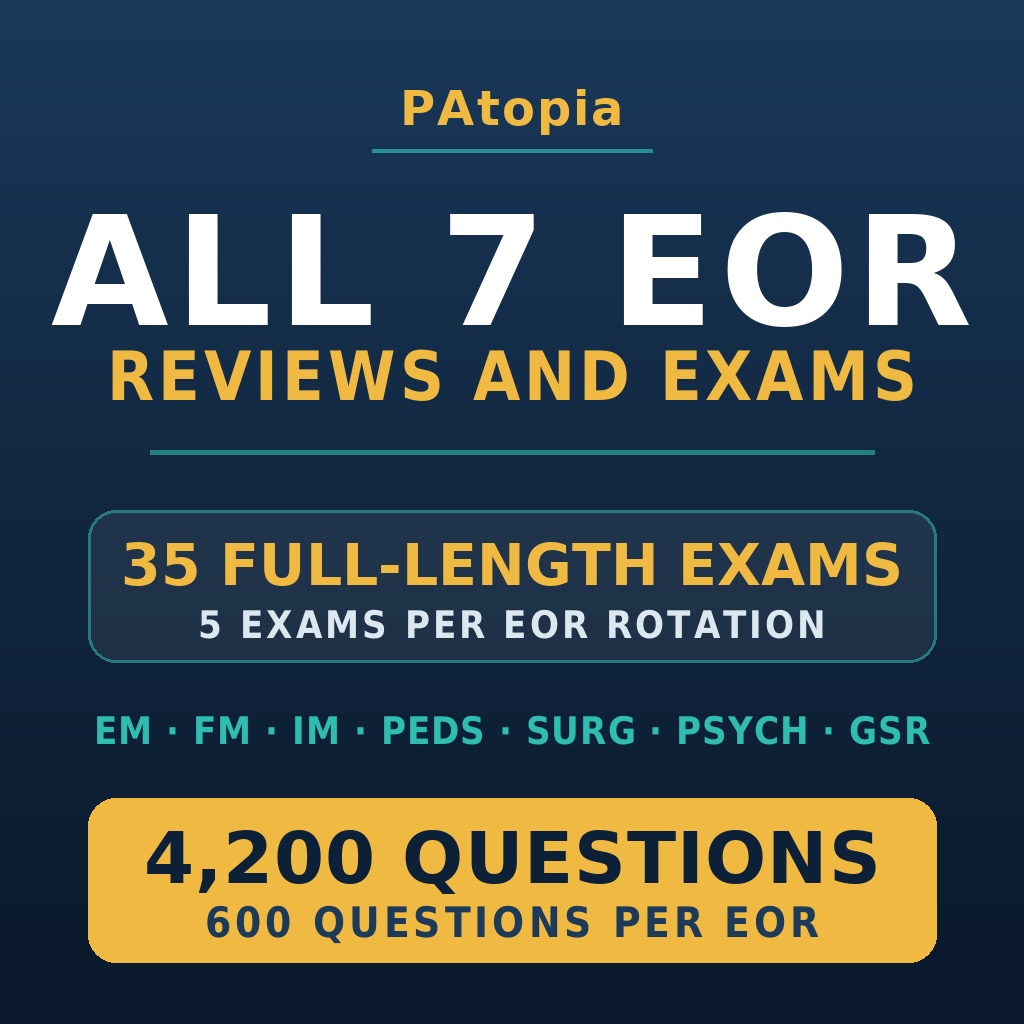
35 full-length EOR exams, five per rotation

Each rotation module includes 600 questions organized into five full-length exams, plus a study library for that specialty. Every question comes with a detailed rationale and references. The seven rotations covered are:

RotationFull-length examsQuestionsFree sample
Emergency Medicine5600Try it
Family Medicine5600Try it
Internal Medicine5600Try it
Pediatrics5600Try it
Surgery5600Try it
Psychiatry/Behavioral Health5600Try it
Women’s Health5600Try it

That is 4,200 EOR questions in total. For a rotation-by-rotation look at what each module covers, see PAtopia for PA Programs.

Built for students who are never at a desk

PAtopia runs in the browser on any device, including phones, with nothing to install. A student on a surgery rotation can work a short block of questions between cases, and a student on an outpatient family medicine rotation can take a full-length exam at home on a day off. Students can move freely through an exam and come back to it later, which fits the unpredictable rhythm of clinical training.

How clinical coordinators use it

Because every student has the same resource, coordinators can build it into the rotation itself:

  • Rotation kickoff. Ask students to take one full-length practice exam in the first week to see where they stand in that specialty.
  • Mid-rotation check. Assign a second exam halfway through, so students can target the areas their first attempt exposed.
  • Pre-EOR rehearsal. Encourage a final full-length exam in the last week, under timed conditions.
  • Post-EOR debrief. When a student struggles on an EOR, point them back to the same rotation’s study library and remaining practice exams before the retake.

None of this requires students to buy anything, because the program has already covered it.

Equal preparation at every site

Students at a large academic center and students at a rural clinic prepare with exactly the same material. That matters for fairness, and it matters for faculty, who can give the same advice to every student regardless of where they are placed.

Get your clinical year covered

The license includes all seven EOR modules along with PACKRAT, End of Curriculum and PANCE preparation, for one flat price per class starting at $3,750. Faculty can request preview access at info@cmereviewcourses.com.

Equip every student for every rotation. View the PAtopia Program License.

PAtopia is an independent exam-preparation resource and is not affiliated with or endorsed by the NCCPA or PAEA.

Posted on

27 Months, One Cohort: Exam Prep That Follows Your PA Curriculum

Most board-prep products are built around a single exam. PA programs are not. Your students sit a PACKRAT, seven End of Rotation exams, a summative or End of Curriculum exam and finally the PANCE, spread across more than two years. A resource that only covers one of those leaves faculty stitching together the rest.

The PAtopia Program License was designed around that arc. It runs for 27 months per cohort and includes every exam type your students will face along the way.

How the license maps to the PA program timeline

  1. Late didactic phase: PACKRAT. Five full-length PACKRAT exams give students a realistic rehearsal before the real thing, and a first look at which organ systems need work before clinical rotations begin.
  2. Clinical year: End of Rotation exams. Students get five full-length exams for each of the seven core rotations (Emergency Medicine, Family Medicine, Internal Medicine, Pediatrics, Surgery, Psychiatry/Behavioral Health and Women’s Health), 35 in all. They can work a rotation’s exams during that rotation, when the material is most relevant.
  3. End of the program: End of Curriculum. Five full-length EOC exams help students and faculty gauge readiness for the program’s summative evaluation.
  4. After graduation: PANCE. Fifteen full-length PANCE practice exams (4,500 questions), weighted across all NCCPA content areas, carry students through their final board preparation.

Throughout all four stages, students have the same study library and the same rationale-and-reference format for every question, so they are not learning a new platform each time the stakes change.

Why continuity matters

When the same platform follows a student from PACKRAT to PANCE, their practice builds on itself. A weak area flagged on a PACKRAT practice exam can be revisited during the matching rotation and checked again on a PANCE practice exam months later, all in one place and in one familiar format.

For faculty, continuity means one set of expectations. You can reference the same resource in didactic advising, clinical-year check-ins and board-prep sessions, and every student in the cohort knows exactly what you mean.

Access that goes where students go

Clinical-year students are rarely at a desk. PAtopia runs in the browser on any device, including phones, so students can work a block of questions between patients, on a commute, or the night before an EOR, with nothing to install.

Timing your license

The 27-month term starts when your students’ logins are set up, not on the day you check out, so your program decides when the clock begins. Each license covers one matriculating cohort, and each incoming class is licensed separately with its own full term. Tell us when you want access to start and we will set up the logins to line up with your curriculum: email info@cmereviewcourses.com.

Cover your whole cohort, start to finish. View the PAtopia Program License, or try the free sample quiz and library preview first.

PAtopia is an independent exam-preparation resource and is not affiliated with or endorsed by the NCCPA or PAEA.