 ▶ Test drive PAtopia free
Description
Full-length PACKRAT practice exams, blueprint-aligned questions, and a cited study library — built by a practicing PA-C for the exam your program is about to hand you.
Start with 25 free sample questions and free study library content. No credit card required.
Try 25 Free Questions
Get the Full Course
What Is the PACKRAT?
The PACKRAT — the Physician Assistant Clinical Knowledge Rating and Assessment Tool — is PAEA’s 225-question self-assessment exam. It runs three hours and 45 minutes, split into three 75-question sections with a 10-minute break between them. Questions are written as clinical vignettes, so the exam is testing whether you can reason through a patient presentation, not whether you memorized a chart.
Most programs administer it twice: once at the end of the didactic year, and again toward the end of the clinical year. It is a self-assessment, not a graded exam — but your program is watching it closely, because PACKRAT performance is one of the earliest signals of how a class will do on the PANCE.
That is exactly why it is worth preparing for. And it is why preparing against the PAEA blueprint beats rereading your didactic notes.
Try Before You Buy — 25 Free Questions
You don’t have to take our word for it. Work through 25 free PACKRAT-style sample questions, complete with the same detailed explanations and cited references you get in the full course. Free study library content is open as well, so you can see how the material is organized before you commit.
No account gymnastics, no credit card.
What’s Inside the PACKRAT Review Course
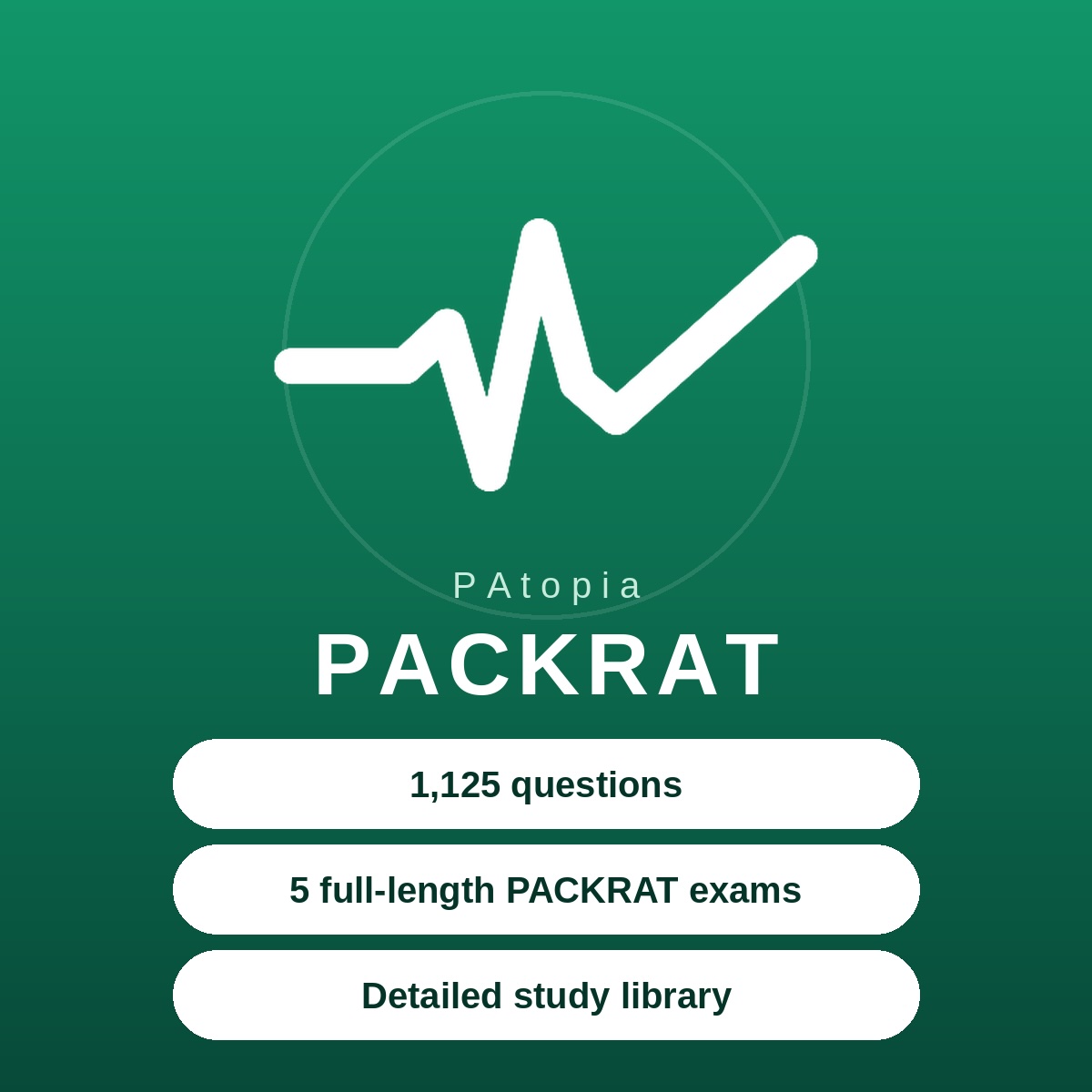
5 full-length practice exams
Five complete 225-question mock exams — 1,125 PACKRAT-style questions in all. Full-length matters here. The PACKRAT is a three-and-three-quarter-hour sitting in three blocks, and most students have never tested at that length before. Practicing full exams builds the stamina and pacing that a 20-question quiz never will.
Detailed explanations on every question
Every question comes with a full explanation — why the right answer is right and why each distractor is wrong. That second half is where the score improvement actually comes from.
Clickable, peer-reviewed citations
Every question and every study topic links out to its reference. When an explanation doesn’t click, you can go straight to the source instead of guessing.
A cited study library
Presentation, diagnosis, treatment, and high-yield pearls for each topic area — organized so you can go from a missed question to the underlying concept without leaving the course.
Questions that reshuffle every attempt
Question order and answer-choice order randomize on every run. You cannot memorize “it was C” — you have to actually know it. That means your fifth attempt still measures something real.
Analytics that tell you where to study
A live correct/attempted tally while you test, and an end-of-exam breakdown by organ system so you can see your weak areas instead of guessing at them. An “on track to pass” readout appears once you’re scoring 75% or higher.
Flag, review, resume
Flag the questions that gave you trouble, come back to them later, and pick up exactly where you left off when rotations interrupt you.
Prefer to Study on Your Phone? Get 3 Days Free in the App
The PACKRAT Review is also part of PAtopia, our iOS and Android app — and in the app, everything unlocks free for three days. No account, no sign-in. Open it and start a practice exam.
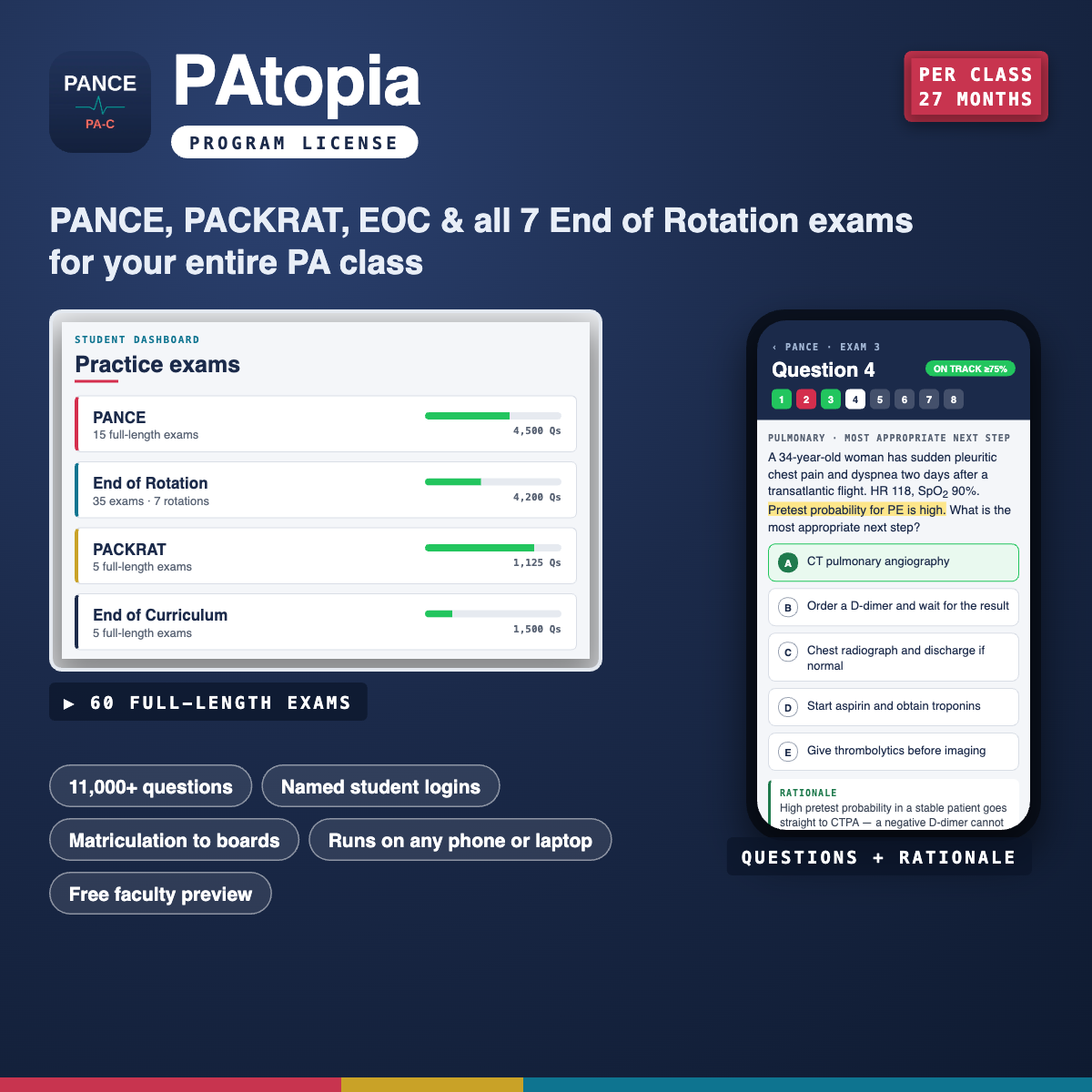
PAtopia puts every standardized exam in PA school in one place: PACKRAT, all seven PAEA End of Rotation exams, the End of Curriculum exam, and the PANCE — 11,000+ board-style questions with cited explanations.
Download PAtopia for iPhone & iPad
Get PAtopia on Google Play
After the free three days, unlock only what you need — PACKRAT on its own, a single EOR rotation, the all-seven EOR bundle, EOC, or PANCE — or take the one-year All-Access pass to everything.
What the PACKRAT Actually Covers
The PAEA PACKRAT blueprint spans the organ systems and task areas you’ll see again on the PANCE:
Organ systems — cardiovascular, pulmonary, gastrointestinal/nutritional, musculoskeletal, EENT, reproductive, endocrine, neurologic, psychiatric/behavioral, dermatologic, genitourinary/renal, infectious disease, and hematologic.
Task areas — history taking and physical examination, using diagnostic and laboratory studies, formulating the most likely diagnosis, health maintenance and patient education, clinical intervention, pharmaceutical therapeutics, and applying basic science concepts.
Content is organized against this structure, so when your score report says “cardiology” or “pharmaceutical therapeutics,” you know exactly where to go.
How to Study for the PACKRAT
6–8 weeks out
Take one full practice exam cold. Do not study for it. The score will be lower than you’d like and that’s the point — you now have a system-by-system map of what to fix. Work the study library on your two or three weakest systems.
4–5 weeks out
Second full exam, then targeted review. You should see movement in the areas you worked. Whatever hasn’t moved gets the next round of attention.
2–3 weeks out
Third and fourth exams, spaced apart. Start timing yourself in 75-question blocks to match the real section structure. Review every missed question and every question you guessed correctly on — guessed-right is a gap, not a win.
Final week
Fifth exam, then light review only. Pharmacology, health maintenance, and applied basic science tend to be the highest-yield last passes. Sleep more than you study the night before.
If you only have two weeks
Skip the cold exam. Go straight to timed blocks and live in the explanations. Volume of reviewed questions beats volume of read slides every time.
Who This Is For
- PA students facing the end-of-didactic PACKRAT
- PA students facing the end-of-clinical PACKRAT
- Students who came in under their program’s benchmark and need a structured way back
- Anyone who wants an early, low-pressure on-ramp to PANCE prep — the PACKRAT blueprint and the PANCE blueprint overlap heavily, so this work is not one-and-done
- PA programs looking for a class-wide resource
The 2026 PACKRAT Blueprint Update
PAEA has published a revised PACKRAT blueprint and topic list, with a new version of the exam built to the updated specifications scheduled for November 2026. PAEA has also published a crosswalk detailing the changes to exam content and task areas.
If you’re testing in late 2026 or after, study against the updated blueprint. Our content is reviewed against PAEA’s published topic list so you’re preparing for the exam you’ll actually sit.
Read: 5 Study Habits That Will Boost Your PACKRAT Score →
Ready to Start?
Work the 25 free sample questions and the open study library content, then unlock the full PACKRAT Review Course when you’re ready. Studying on your phone instead? Grab the PAtopia app and get three days of everything free.
Try 25 Free Questions
Get the Full Course
Study on Your Phone: The PAtopia Web App
PAtopia PACKRAT Review Course is available as a web app. Open it in your phone’s browser, add it to your home screen, and it works like an app — your full-length practice exams, blueprint topic checklists and study library in one place, with no download or app store needed. It works just as well on a tablet or computer.
After purchase you’ll receive an email with your access link and step-by-step setup for iPhone and Android.
▶ Test drive the PAtopia web app free
Spaced-Repetition Flashcards Included
This course includes 457 flashcards built from the PACKRAT question bank and organized into 12 decks by PACKRAT blueprint content area, so your study time matches where the points are. Ten minutes a day: cards you know come back less often, cards you miss come back tomorrow, and new cards rotate across the content areas by blueprint weight.
- Question, fill-in-the-blank and classic-presentation cards, each written from the explanation of a question in the bank
- A short daily session (cards due plus 10 new), a study streak and a pharmacology-only filter
- Progress saves to your account and follows you to any device
- Open them from the Flashcards section of the PACKRAT page in the PAtopia web app
Frequently Asked Questions
Is there a free PACKRAT practice test?
Yes — 25 free sample questions with full explanations and cited references, plus free study library content. No credit card required. The PAtopia iOS and Android app also unlocks everything free for three days.
How many practice questions are in the PACKRAT review course?
Five full-length practice exams of 225 questions each — 1,125 PACKRAT-style questions, all with detailed explanations and cited references.
How long is the PACKRAT exam?
Three hours and 45 minutes: three 75-question sections, 225 questions total, with a 10-minute break between sections.
What is a good PACKRAT score?
PAEA publishes a rolling national average that updates as more students test each year. Most programs set their own internal benchmark, so ask yours — but the more useful number is the gap between your first practice exam and your last.
When do PA students take the PACKRAT?
Most programs administer it at the end of the didactic year and again near the end of the clinical year.
Does the PACKRAT count toward my grade?
No. PACKRAT is a self-assessment and is not intended for grading purposes. Programs use it for formative feedback and curricular evaluation.
Does studying for the PACKRAT help with the PANCE?
Yes. The blueprints overlap substantially in both organ systems and task areas. PACKRAT prep is early PANCE prep.
Can I study on my phone?
Yes. The web course is mobile-friendly, and the PAtopia app is built for iPhone, iPad, and Android.
Do you offer program or group pricing?
Yes. PA programs can license PAtopia for a whole class with the Program License (one flat price per cohort, from $3,750), or buy a Remediation Pack of named seats for a few students (5 seats $999). Both include every video library and a faculty report for each student. Compare the two options, or email info@cmereviewcourses.com for faculty preview access or a purchase order.
PACKRAT® and PAEA® are registered trademarks of the Physician Assistant Education Association. This course is not affiliated with, endorsed by, or sponsored by PAEA. PACKRAT questions in this course are original, blueprint-aligned practice items — not actual exam content.