







Most programs are good at deciding that a student needs remediation. Fewer are good at showing, a year later, what that remediation consisted of. The record matters for accreditation, for progression decisions, and for the student, who deserves a clear account of what was asked and what they did.
The four things a record should show
- The trigger. The exam, the date and the score that started the process.
- The plan. What was assigned, with dates and a target.
- The work. What the student completed, with dates and results.
- The outcome. The retake result or the follow-up decision, and who reviewed it.
The first and last are easy, because they come from exam results. The middle two are where records go thin.
Why the middle goes missing
Assignments are often given verbally. Students study from several sources and report back in an email. Faculty intend to write a note and the next rotation starts. None of this reflects poor remediation. It reflects a process that depends on someone finding time to write it down.
Let the practice platform keep the record
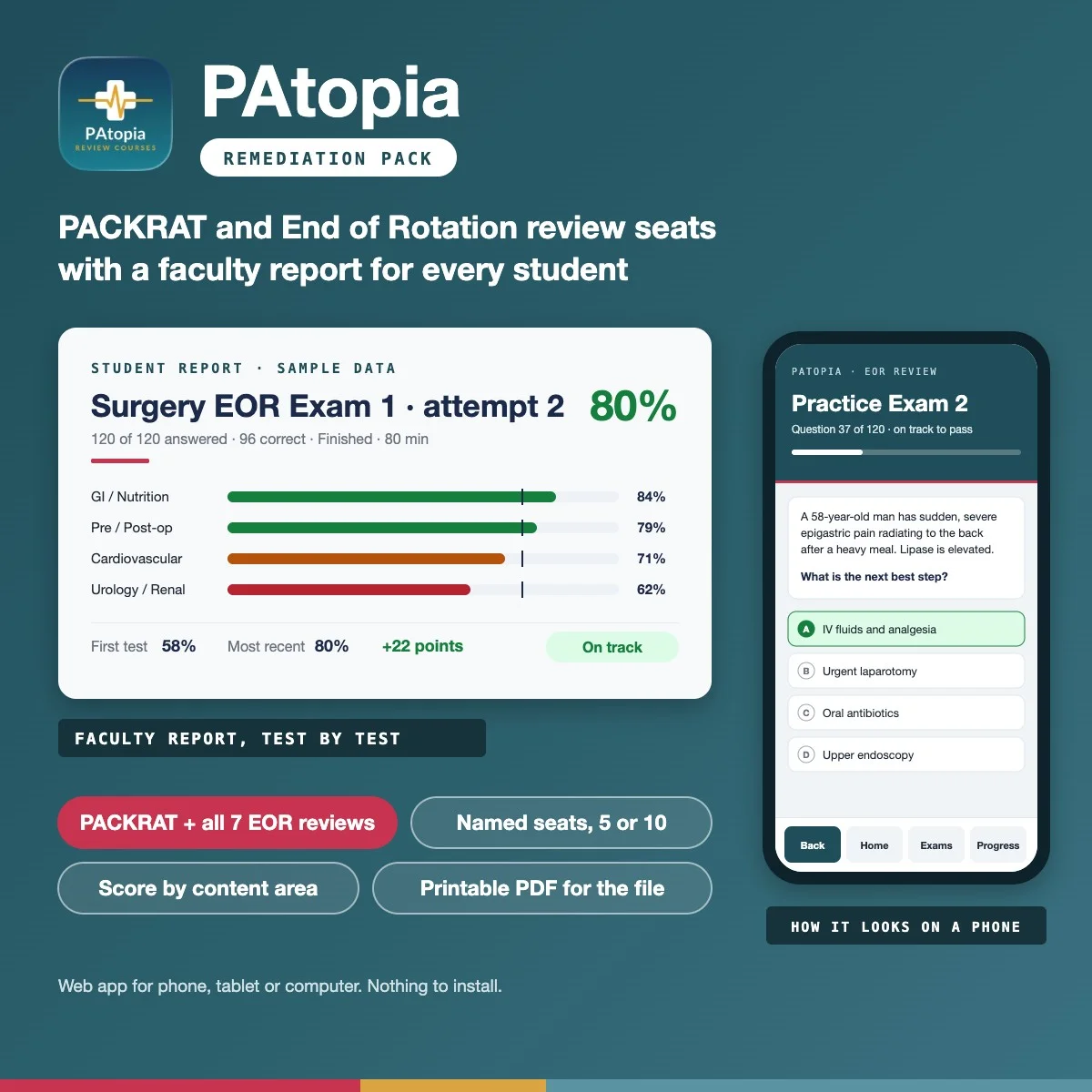
If the student’s assigned work is a set of practice tests on one platform, the record writes itself. Each test has a date, a score, the number of questions answered, the time spent, and a score for each content area. A retake of the same test shows as a second attempt, so improvement is visible.

What the PAtopia report contains
For each student, faculty can open a one-page report showing every practice test started, the score and content-area breakdown for each, a before-and-after comparison, and time on task. It prints or saves as a PDF with a line for the reviewer’s signature and date. A spreadsheet export covers the whole group, either one row per student or one row per test.
Write the plan so it can be checked
A plan that says “improve in weak areas” cannot be marked complete. A plan that says “three full-length Surgery practice exams by the dates below, with a goal of 75%, and focused questions in the two lowest content areas” can. When the assignment is that specific, the record of the work and the record of the plan line up, and anyone reading the file later can see whether the student did what was asked.
Give the student the same record
Students in remediation often feel they are being judged on things they cannot see. When the student has the same report the faculty member has, the process is clearer to both. It also means the student arrives at the check-in already knowing what the numbers say, and the meeting can be spent on what to change.
A simple routine
Save the report at three points: when the plan is assigned, at the midpoint check-in, and before the retake. Three dated PDFs in the student file, plus the retake result, is a complete record that took a few minutes to produce.
Seats for the students who need them
The PAtopia Remediation Pack gives a PA program 5 named seats for $999 or 10 for $1,799. Each seat covers the PACKRAT review and all 7 End of Rotation reviews for 12 months from the day it is assigned. A set of 10 single-rotation retake seats is $399. Faculty get a dashboard and a test-by-test report for every student, and the dashboard link arrives in the order confirmation email.
PACKRAT® and End of Rotation™ are trademarks of the Physician Assistant Education Association (PAEA). CME Review Courses and PAtopia are not affiliated with or endorsed by PAEA. Practice scores are not official exam results. Your program’s own policies decide what counts as passing and what remediation requires.