








Here is something most practicing clinicians will admit privately and almost never out loud: their EKG skills peaked somewhere around the week of their board exam, and have been quietly eroding ever since.
This is not a character flaw. It is what happens to any skill that gets partially outsourced. The machine prints an interpretation at the top. A cardiologist overreads eventually. In most settings there is someone further down the hall who can be asked. So the muscle that got built during training — the one that looked at a strip and produced an answer without help — gets used less, and like any muscle, it goes.
Most of the time that is survivable. The problem is the shifts where it is not: the department is full, the overread is hours away, the machine’s interpretation is wrong in the specific way machine interpretations are wrong, and the disposition decision is yours in the next four minutes.
Where the erosion actually shows up
It is rarely the dramatic findings that go first. A big anterior STEMI still announces itself to almost anyone. What erodes is the middle band — the findings that are subtle, the ones that require you to have the criteria cold rather than approximately.
Distinguishing Mobitz I from Mobitz II when the conduction ratio makes it ambiguous. Taking a wide-complex tachycardia seriously instead of reaching for the comfortable assumption of aberrancy. Recognizing the patterns that signal risk in a patient who currently looks well. Noticing that a finding is new, which requires actually pulling the prior rather than intending to. Catching the look-alike — because the overwhelming majority of EKG errors in practice are not knowledge gaps but confusions between two things that resemble each other on paper.
Those are also the findings where being wrong costs the most, which is an unpleasant symmetry.
Why the usual fixes do not fix it
The standard response is to attend a lecture. An hour of EKG content at a conference, an online module, a grand rounds. These are not useless — but passively watching tracings being interpreted by someone else builds very little. You leave feeling refreshed, and three weeks later the strip in your hand is just as hard as it was before, because recognition was never the thing being trained. Recall was, and recall is only built by being asked and being wrong.
The other standard response is to read a book. Books are excellent references and poor trainers, for the same reason. The gap between “I understand this explanation” and “I can produce this answer in four minutes under pressure” is enormous, and reading does not cross it.
What closes it is volume with immediate feedback. Hundreds of tracings. Say what you think it is. Find out instantly whether you were right and, when you were not, exactly which feature you misread.
What we built
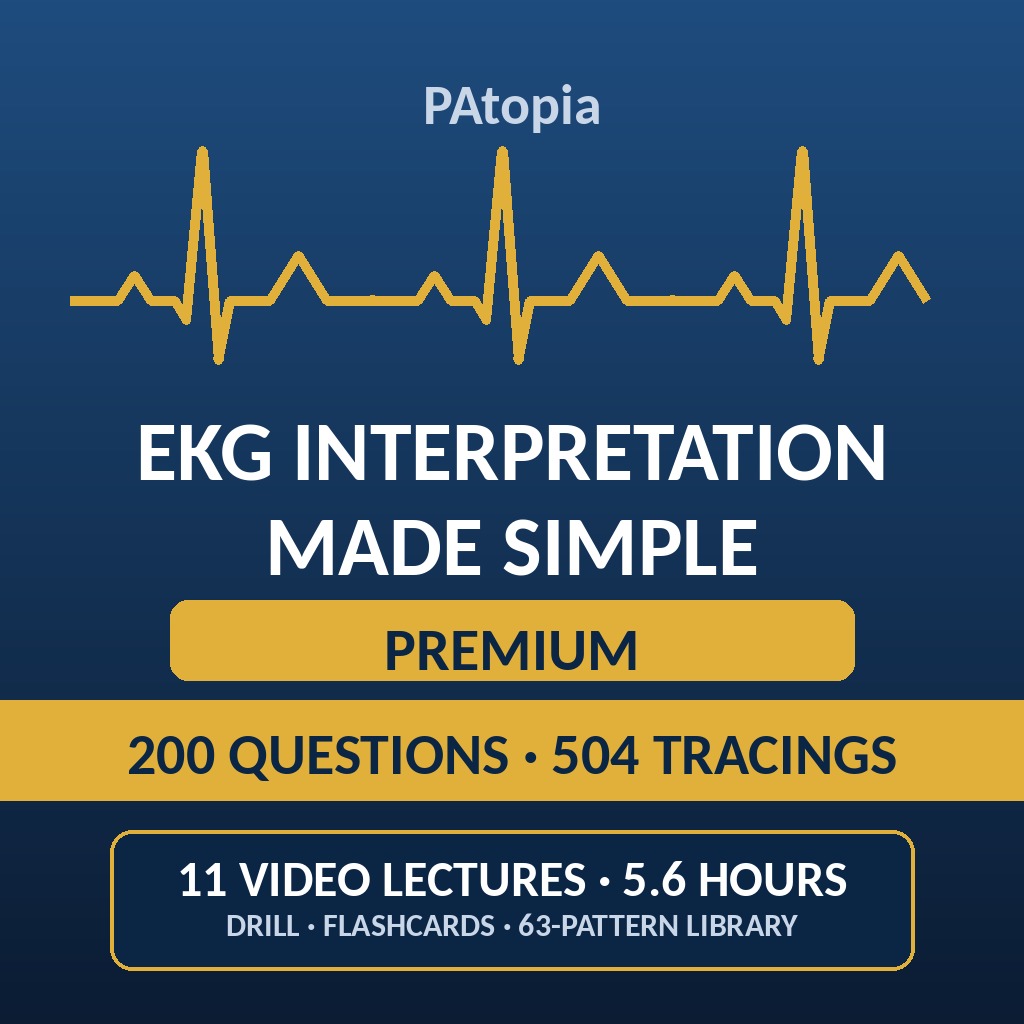
EKG Interpretation Made Simple is structured around that premise. Two hundred board-style questions, 161 of them built around an actual tracing, delivered in four 50-question tests. A rapid-fire drill that tracks which patterns you miss and gives you more of them — so your weak spots get the repetitions instead of your strong ones. Flashcards on spaced repetition for the numbers and rules that have to be cold rather than approximate. And a 63-pattern library organized with the look-alikes placed next to each other, because that is where the errors actually live.
Explanations are sourced to AHA, ACC, and ESC guidelines, which matters more for experienced clinicians than for students. If you trained a decade or two ago, some of what you learned has been revised, and you will not discover which parts by consulting your own memory.
For practicing clinicians, Premium is usually the right call
We sell two versions. Standard, at $49.99, is the full question bank, drill, flashcards, and library. Premium, at $99.99, adds 11 narrated video lectures running five hours and thirty-eight minutes.
For students, I genuinely do not push one over the other — it depends on how they learn. For someone five or fifteen years out of training, I think Premium is usually the better purchase, and the reason is specific. A student’s gaps are gaps: material never learned. An experienced clinician’s gaps are more often drift: things learned correctly once, then slowly bent out of shape by habit, or quietly superseded by a guideline revision nobody announced to you. Questions alone will show you that you are getting something wrong. The lectures are what tell you where the drift started, which is the part you cannot reconstruct on your own.
The lectures also work in the way a working clinician’s time actually works — in pieces, on a phone, between other things. Access runs 27 months and your progress is saved to your account, so you can leave it for a month and pick it up where you left off.
What this is
Worth saying plainly what EKG Interpretation Made Simple is: a practical skills course, priced accordingly. It exists to make you faster and more accurate in front of a tracing, and it is built and priced around that one job rather than around anything else.
Try it on a real tracing first
If you want to know honestly where your EKG skills sit, the fastest way is to be tested rather than to estimate. The free Test Drive gives you 10 questions, a slice of the pattern library, a sample of the drill and flashcards, and the first lecture in full.
Ten tracings is enough to find out whether the muscle is still there. Most people are a little surprised, in one direction or the other.
Questions about which version makes sense for your situation — email info@cmereviewcourses.com or call 419-203-8154.
Jeremy Boroff, MPAS, PA-C
Program Director, CME Review Courses