Posted on

All-Access, Explained: 11,000 Questions and 60 Full-Length Exams in One Platform

For students who know they’ll need coverage across the whole program, buying pieces separately eventually costs more than buying the whole thing. That’s what PAtopia’s All-Access tier is for — one purchase that spans every major assessment a PA student faces. Here’s what’s actually inside.

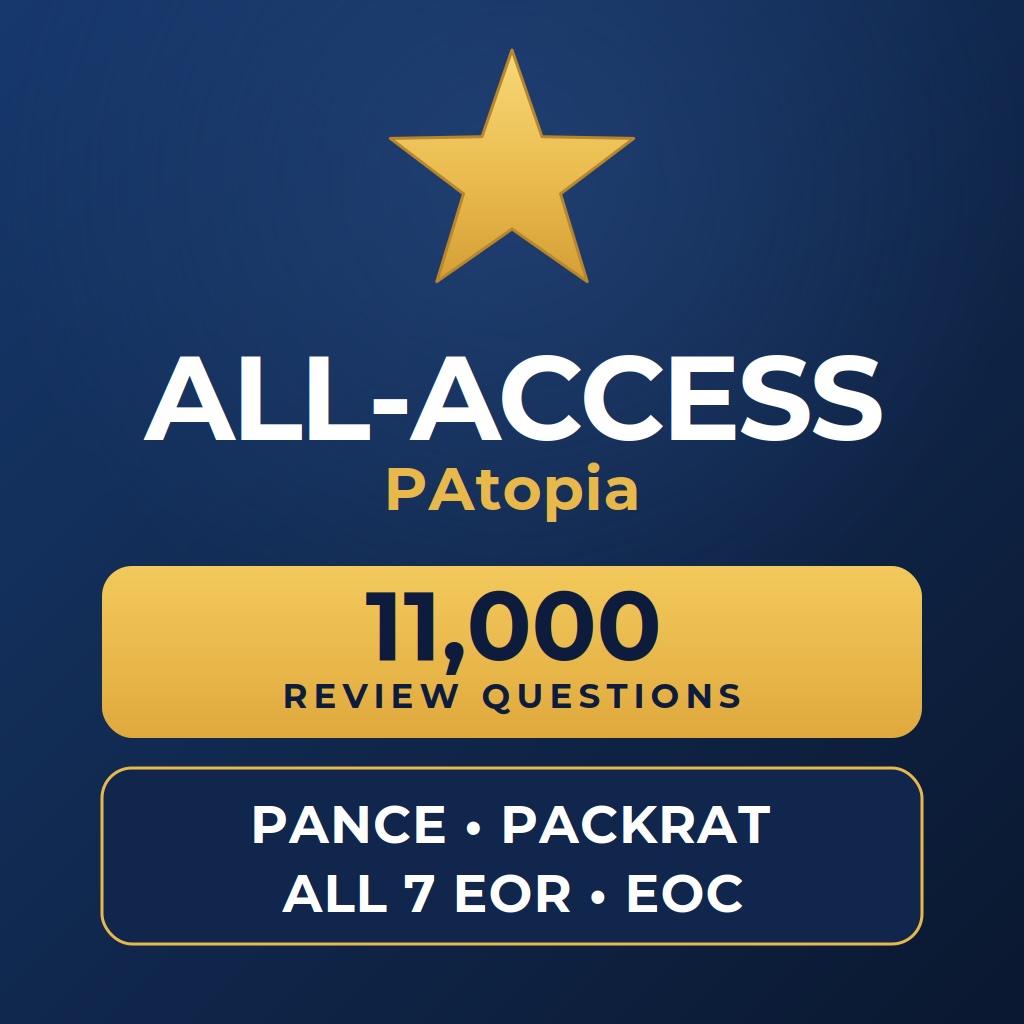
All-Access combines more than 11,000 review questions and 60 full-length exams: the 15 full-length PANCE exams, the 35 EOR exams (5 for each of the 7 rotations), 5 PACKRAT exams, and 5 EOC exams. In practice that means a single resource that follows a student from the first system in didactic year, through every end-of-rotation exam, past the PACKRAT and EOC checkpoints, and into final PANCE preparation — all blueprint-weighted, all with teaching explanations.

Who is it right for? The student who wants one decision made and done. Rather than buying an EOR bundle now, a PACKRAT pack later, and a PANCE bank at the end — remembering each time to purchase and re-orient — All-Access puts everything in place from the start. It also tends to be the best value: the bundled price sits well below the sum of the parts, and there’s no expiration mid-rotation to worry about.

Students who only need one slice — say, just their EOR rotations — can still buy those individually at $39.99 each. But for anyone planning the full two-year arc, All-Access is the clean, economical choice, available across iOS, Android, and Amazon. One platform, every exam, no gaps.

Explore PAtopia All-Access →

Posted on

I Failed My End of Rotation Exam. Now What?

You opened the score and it was below your program’s cutoff. It feels like the worst moment of clinical year, and it is also one of the most common. Most PA programs see a few failed End of Rotation exams every year, and most of those students pass the retake and graduate on time. What you do in the next week matters more than the score itself.

First, read your program’s policy

Each program sets its own passing standard and its own rules for what happens next. Some allow one retake per rotation. Some cap the number of retakes across the clinical year. Some require a formal remediation plan before you can sit again. Find the policy in your handbook before you talk to anyone, so you know what you are being asked to do and by when.

Then read the score report properly

Your report breaks your performance down by content area and by task area. That breakdown is the most useful thing you have. A student who missed the cutoff by a little across every area needs a different plan from one who was strong everywhere except two organ systems. Write down your three weakest areas before you open a single book.

Meet your advisor early

Go to the meeting with your weak areas listed and a draft plan. Faculty respond well to a student who shows up with a plan, and they often have options you did not know about, including paid review seats, protected study time, or a later retake date. Ask directly what they need to see from you before the retake.

Build the retake plan around full-length practice

Rereading notes feels productive and changes little. Timed, full-length practice exams do three things rereading cannot: they show whether your weak areas are improving, they rebuild your pacing, and they give you something concrete to show your advisor. A simple plan is one full-length exam at the start, focused review of the weakest areas, a second exam to check progress, and a final exam a few days before the retake.

Protect the rotation you are on now

The retake does not pause clinical year. You are already on the next rotation, with its own exam coming. Split your study time on purpose: most of it on the retake until that date passes, and a steady smaller share on the current rotation so you are not starting from zero afterward. Tell your preceptor you have a retake scheduled if your program allows it. Most will help you find an hour in the day.

Common mistakes after a failed exam

The first is studying everything again from the beginning, which spends most of your time on content you already know. The second is avoiding timed practice because the last timed exam went badly. The third is waiting until the week of the retake to check whether the plan is working. A baseline practice exam in the first few days prevents all three, because it tells you what to study and gives you a number to beat.

Keep a record

Save your practice scores by date. If your program asks for evidence that you completed remediation, you will have it. If you are using PAtopia, your My PAtopia Progress page keeps that record for you, test by test, with a score for each content area.

Where to practice

PAtopia has 5 full-length practice exams and 600 questions for each rotation, with a rationale and references on every question. You can start with the free Test Drive, then pick up the End of Rotation reviews or the PACKRAT review. If your program is setting up remediation for you, ask whether it uses the PAtopia Remediation Pack: a seat costs you nothing, and your faculty can see the work you put in.

Try the free Test Drive

PACKRAT® and End of Rotation™ are trademarks of the Physician Assistant Education Association (PAEA). CME Review Courses and PAtopia are not affiliated with or endorsed by PAEA. Practice scores are not official exam results. Your program’s own policies decide what counts as passing and what remediation requires.

Posted on

What a PAtopia Program License Costs Per Student

When a program director brings a new resource to a budget meeting, the first question is almost always the same: what does it cost per student? This post answers that for the PAtopia Program License, with the numbers laid out so you can drop them straight into a proposal.

The four tiers

The license is a flat price per class, covering one matriculating cohort for 27 months:

Class sizePrice per class (27 months)
Up to 40 students$3,750
41–60 students$6,000
61–85 students$8,750
86+ students$12,500

What that means per student

Because the price is flat within each tier, the per-student cost falls as the class fills the tier. Here is what it looks like at common class sizes:

Class sizeLicense tierCost per studentCost per student per month (27 mo)
30Up to 40$125.00$4.63
40Up to 40$93.75$3.47
5041–60$120.00$4.44
6041–60$100.00$3.70
7561–85$116.67$4.32
8561–85$102.94$3.81
10086+$125.00$4.63

At these class sizes, the cost runs from about $94 to $125 per student for more than two years of access.

How that compares with students buying on their own

Each licensed seat matches PAtopia All-Access Premium, which an individual student pays $349.99 for over the same 27 months: every exam, the OSCE Patient, flashcards and all 118 video lectures. A student who buys the Premium pieces separately (PANCE Premium at $179.99, All 7 EOR Premium at $299.99, PACKRAT Premium at $99.99, EOC Premium at $149.99 and the OSCE Patient at $49.99) pays $779.95.

That means a program license at 40 students delivers the complete platform for about 27% of the individual All-Access Premium price, and about an eighth of the piece-by-piece total. More importantly, it delivers it to every student, not just the ones who choose to buy.

What the price includes

Every student on the roster receives full All-Access Premium, with no content held back for an upsell:

  • 15 full-length PANCE practice exams (4,500 questions)
  • Every video library: 118 narrated lectures, 58 hours (PANCE, PACKRAT, EOC and all 7 End of Rotation exams)
  • 5,104 spaced-repetition flashcards and the OSCE Patient (40 AI standardized-patient stations)
  • 35 full-length End of Rotation exams across all seven core rotations
  • 5 full-length PACKRAT exams and 5 full-length End of Curriculum exams
  • More than 11,000 questions and 60 full-length exams in total, each with a detailed rationale and references
  • A study library and browser-based access on any device

Paying for it

Programs can check out online, or pay by purchase order or direct invoice if your institution’s procurement process requires it. Many programs fund board-preparation resources from student fees, program operating budgets or institutional student-success funds; your business office will know which applies to you.

There are no per-seat add-ons and no annual renewal inside the 27-month term. A new incoming class gets its own license.

Try it before you budget for it

Faculty can request preview access by emailing info@cmereviewcourses.com. You can also open the free sample quiz and library preview today to see the question style and rationales for yourself.

Put the numbers in front of your committee. See the PAtopia Program License, or call (419) 203-8154 with procurement questions.

PAtopia is an independent exam-preparation resource and is not affiliated with or endorsed by the NCCPA or PAEA.

Posted on

From Orientation to the PANCE: A 24-Month Study Arc With PAtopia

Two years feels like forever on orientation day and like no time at all by graduation. Students who map the arc early — knowing roughly what to study when — arrive at the PANCE far less frantic than those who improvise. Here’s how one platform can carry a student the whole way.

Didactic year is for building foundations. As each system is taught, students reinforce it with blueprint-weighted questions and start getting comfortable with board-style stems. The goal isn’t cramming; it’s turning lecture content into retrievable knowledge, one content area at a time, using the PANCE library as a running study companion.

Clinical year shifts to rotations. Now the EOR package earns its keep — 600 questions and 5 full-length exams per rotation, so each end-of-rotation exam gets targeted practice. Somewhere in the middle, PACKRAT arrives; a practice exam or two beforehand turns it into a clean benchmark rather than a surprise. Toward the end, EOC checks readiness across the whole curriculum.

The final stretch is PANCE consolidation: full-length, timed exams to build stamina and pacing, plus focused review of the content areas that have stayed soft. Because it’s all been the same platform, there’s no new tool to learn at the worst possible moment — just a familiar app the student already trusts.

The value of a single, consistent resource across 24 months is continuity: momentum carries, pacing improves, and the student walks in on board day having practiced the whole arc. Faculty can hand incoming students this map on day one, and PAtopia’s All-Access tier covers every stage of it in one purchase.

See the full PAtopia study arc →

Posted on

One License, One Standard: Why PA Programs Are Buying Exam Prep for the Whole Class

Every PA program director has seen the same pattern. A few students arrive at the clinical year with a stack of paid question banks. Others are working from free flashcards and a borrowed login. By the time the first End of Rotation exam comes around, the gap in preparation has very little to do with ability and a lot to do with who could afford what.

A program-wide license closes that gap. Instead of leaving board prep to individual budgets, the program buys one resource for the entire class, and every student starts with the same tools on the same day.

What the PAtopia Program License is

The PAtopia Program License covers one matriculating cohort for 27 months. Every student in that class gets their own named login to PAtopia All-Access, the complete version of the platform. That includes:

  • 15 full-length PANCE practice exams (4,500 questions), weighted to the NCCPA content blueprint
  • 35 full-length End of Rotation exams, five for each of the seven core rotations
  • 5 full-length PACKRAT exams
  • 5 full-length End of Curriculum exams
  • A study library, with more than 11,000 questions and 60 full-length exams in total
  • Detailed rationales and references for every question
  • Browser-based access on any device, including the student’s phone

Why a single license beats a patchwork

The first reason is equity. When the program provides the resource, no student is at a disadvantage because they could not buy a second or third question bank. Everyone practices against the same material, and faculty can assume a shared baseline when they talk about exam readiness.

The second reason is consistency. When every student uses the same platform, faculty can point the whole class to the same exam before a rotation starts, reference the same rationales in a debrief, and give advice that applies to everyone in the room. A patchwork of personal subscriptions makes that impossible.

The third reason is simplicity. Programs deal with one invoice, one vendor contact and one renewal decision per class, instead of fielding questions about which product a student should buy. Purchase orders and direct invoicing are supported.

Flat pricing per class, not per seat

The license is priced by class size, with four tiers:

Class sizePrice per class (27 months)
Up to 40 students$3,750
41–60 students$6,000
61–85 students$8,750
86+ students$12,500

Because the price is flat within each tier, adding a student mid-tier does not change the cost. A 40-student class works out to under $94 per student for the full 27 months, compared with $349.99 for an individual All-Access Premium purchase, which is exactly what each licensed seat includes. We walk through the per-student math in detail in the next post in this series.

Named logins, not shared codes

Each student gets an individual login tied to their name on the class roster. That protects the program’s investment, because access cannot be passed along to students outside the cohort, and it keeps each student’s practice history their own.

See it before you buy

Faculty preview access is available on request, so you can work through the question bank yourself before bringing it to a curriculum committee. Anyone can also try the free sample quiz and library preview right now, no account needed.

Ready to equip your whole class? View the PAtopia Program License, or email info@cmereviewcourses.com to request faculty access.

PAtopia is an independent exam-preparation resource and is not affiliated with or endorsed by the NCCPA or PAEA.

Posted on

Privacy and Student Data: Why On-Device Practice Matters for PA Programs

Programs are rightly more careful than they used to be about the tools they recommend. Every app a student is asked to use is another place their data can go, and educational technology has not always earned trust on that front — accounts that harvest more than they need, progress data monetized in ways students never see, terms that change quietly. For a program that takes its duty to students seriously, “what happens to their data?” is a fair question to ask of any resource.

PAtopia answers it with a deliberately simple architecture: the native app stores a student’s progress on their own device. There’s no required central account collecting study behavior, no profile being built in the background, no third party in the middle. A student practices, the app tracks it locally, and that information stays where it belongs — with the student.

That design is partly philosophical and partly practical. Practically, it means a student can start drilling immediately without handing over personal information, and a program can recommend the tool without vetting a data-sharing agreement. Philosophically, it reflects a view that a study app’s job is to help someone learn, not to become another data pipeline.

None of this comes at the cost of capability — the libraries are deep, blueprint-weighted, and available across iOS, Android, and Amazon. It simply means the coverage students need doesn’t arrive bundled with data practices a program would rather avoid. When privacy is part of your evaluation criteria, on-device by design is a meaningful point in a resource’s favor.

Learn how PAtopia handles student data →

Posted on

PACKRAT Is Coming: How to Benchmark Your Class Before It Counts

PACKRAT occupies a useful place in the PA curriculum: it’s a low-stakes snapshot that predicts higher-stakes outcomes. Used well, it tells a program which students are on track and which content areas need attention — early enough to do something about it. Used poorly, it’s just a number that arrives and then gets filed away.

The difference is preparation and follow-through. Students who have practiced with PACKRAT-style questions before the real thing produce a cleaner signal — their score reflects knowledge rather than unfamiliarity with the format. And a program that can break results down by content area can target remediation precisely instead of telling a struggling student to simply “study more.”

PAtopia’s PACKRAT package supports both ends of that. It offers 1,125 questions and 5 full-length practice exams built to mirror the assessment’s structure, so students arrive familiar with the pacing and the question style. Faculty can encourage a practice exam a few weeks out as a dry run, then use the areas where the class dips as a guide for review sessions. Because it’s the same platform students already use for EOR and PANCE prep, there’s no new tool to introduce mid-year.

Treated as a benchmark rather than a verdict, PACKRAT becomes one of the most actionable data points a program gets before the PANCE. Give students a way to practice it, read the results by content area, and intervene while there’s still runway — that’s how a checkpoint turns into better board outcomes.

Explore PAtopia’s PACKRAT prep →

Posted on

Recommending Board-Prep Resources Without Breaking Your Students’ Budgets

Faculty feel the tension every time a student asks what to buy. The best-known prep resources are effective — and expensive, often several hundred dollars each, and a student trying to cover PANCE plus every EOR can end up staring at a four-figure total on top of tuition and loans. So they cut corners, share logins, or simply go without. None of that serves them well.

That’s the quiet case for affordable prep: the resource a student actually buys and uses beats the premium one they can’t justify. PAtopia was priced with that reality in mind. Individual EOR rotation modules are $39.99 each, and one-time bundles cover the whole program for far less than assembling separate subscriptions — the All-Access tier puts 11,000+ questions and 60 full-length exams in one purchase that doesn’t expire mid-rotation.

Affordable doesn’t have to mean thin. PAtopia’s libraries are blueprint-weighted and built by a practicing PA educator, with teaching explanations on every question. The difference is a pricing model aimed at students rather than institutions — no per-seat licensing, no annual renewal trap, just apps on iOS, Android, and Amazon that a student owns and uses.

When you point a class toward resources, cost belongs in the calculus alongside quality, because a recommendation a student can afford is one they’ll follow. PAtopia lets you send them toward full, blueprint-aligned coverage without asking them to choose between good preparation and rent. That’s a recommendation you can make without a second thought.

See PAtopia’s student pricing →

Posted on

Free for Faculty, Priced for the Whole Cohort: A Look Inside PAtopia

Most PA programs end up buying exam prep twice. The program licenses something institutional, and then students go out and buy a second question bank on their own because the first one didn’t cover the rotation they were sweating. PAtopia was built to be the one that covers everything a PA student sits for between their first End of Rotation exam and the PANCE.

This post walks through what is actually in it, how faculty can evaluate it at no cost, and how cohort licensing works for programs that decide to bring it in for a whole class.

PAtopia All-Access: 11,000 review questions and 60 full-length exams for PA students

What PAtopia is

PAtopia is a question-bank and study-library platform for PA students. It runs on the web and as a native app on iOS, Google Play, and the Amazon Appstore, so a student who studies on a laptop at home can pick the same material back up on a phone between patients.

The content spans the four things a PA student is tested on during the program and at the end of it.

End of Rotation exams. All seven rotations — Emergency Medicine, Family Medicine, Internal Medicine, Pediatrics, Psychiatry and Behavioral Health, Surgery, and Women’s Health (GSR). Each rotation module carries 600 questions and five full-length practice exams, written against the current PAEA topic lists as revised July 27, 2026. That is 4,200 questions and 35 full-length exams across the seven.
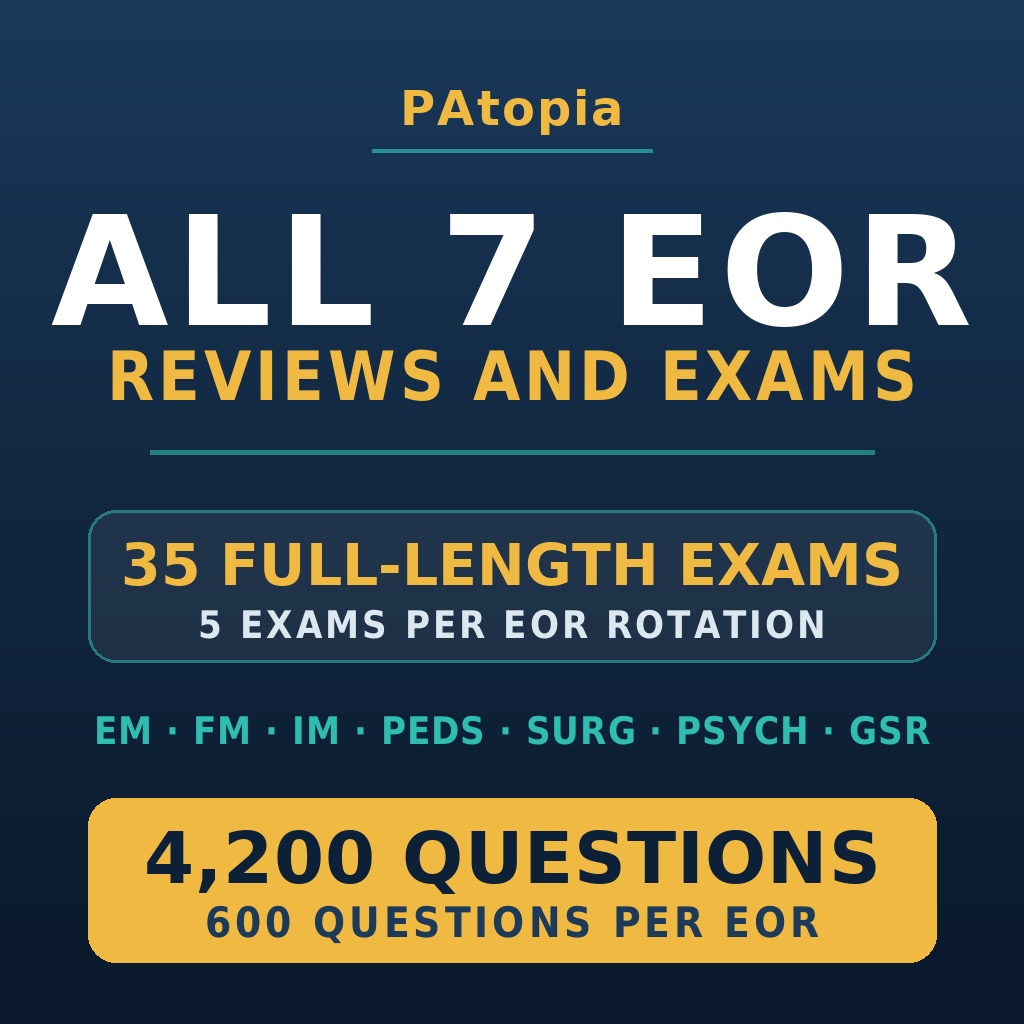
PAtopia All 7 EOR bundle: 35 full-length exams, 4,200 questions across all seven rotations

PACKRAT. 1,125 questions and five full-length practice exams, built to the same content proportions students see on the real thing.

End of Curriculum. 1,500 questions and five full-length exams for the exit assessment.

PANCE. 4,500 questions and fifteen full-length 300-question exams, weighted to match the NCCPA blueprint across all fifteen content areas — so a student practicing on it is spending time in roughly the proportion the exam actually tests.

Every question carries a full rationale, not just a correct letter, and each module ships with a reference library students can read straight through when a rationale exposes a gap rather than a slip.

The All-Access package puts all of it together: about 11,000 review questions and 60 full-length exams, with 27 months of access — long enough to carry a student from didactic year through the PANCE without a renewal in the middle of board prep.

If you want the rotation-by-rotation detail, we covered each of the seven EOR modules individually in PAtopia for PA Programs.

Faculty can try the whole thing free

We would rather you evaluate this yourself than take a sales page’s word for it.

Any PA program faculty member or program director can request free full access to PAtopia — the complete question banks and reference libraries, not a trimmed demo — to review the content, check it against your own curriculum map, and decide whether it fits before any money changes hands. Email info@cmereviewcourses.com from your institutional address and tell us which program you’re with. There is no trial clock to beat and nothing to cancel.

If you want to look at something in the next five minutes instead, every product has a free sample preview open to anyone: a 25-question quiz plus a slice of the reference library, no account required. Start with the PANCE sample, the EM End of Rotation sample, or the PACKRAT sample. There are twelve of them, one per product, linked from each product page.

Cohort licensing: one flat price for the class

Individually, students pay $39.99 for a single EOR rotation, $199.99 for all seven, $49.99 for PACKRAT, $69.99 for End of Curriculum, $99.99 for the PANCE course, and $229.99 for All-Access. Those are the retail prices, and they are deliberately below what the large legacy banks charge.

For programs, we don’t price per seat. Institutional licensing is a flat annual fee that covers your entire incoming class — one number, budgeted once, whether your cohort is eighteen students or forty. Nobody has to count heads at matriculation, nobody gets left off the list because they started late, and the per-student cost drops as your class grows rather than rising.

Two reasons we do it that way. First, per-seat pricing punishes programs for enrolling students, which is backwards. Second, it makes the budget line predictable — you can put the same figure in next year’s request and know it will still be right.

Cohort licenses are quoted directly. Email info@cmereviewcourses.com with your program name and approximate class size and we’ll send you a number, along with faculty access so you can review the content while you’re deciding. We are a small operation run by a practicing clinician, not a sales floor — you will get an answer from a person, and you will not be handed to an account executive.

Who is behind it

PAtopia is built and maintained by CME Review Courses. The questions are written and edited by a practicing emergency medicine PA with more than two decades of clinical experience and two decades directing an ED advanced practice group — not outsourced to a content mill. When PAEA revised the End of Rotation topic lists in July 2026, the affected modules were rewritten rather than relabeled.

Only a few students need help? For students in remediation after a failed End of Rotation exam or a low PACKRAT score, the PAtopia Remediation Pack provides 5 named seats for $999 or 10 for $1,799, with a test-by-test faculty report for each student. See both options for PA programs side by side.

Start here

PAtopia and CME Review Courses are not affiliated with, endorsed by, or sponsored by the National Commission on Certification of Physician Assistants (NCCPA) or the Physician Assistant Education Association (PAEA). PANCE and PANRE are registered marks of the NCCPA. PACKRAT, End of Rotation, and End of Curriculum are marks of the PAEA. All practice material is independently written.

Posted on

EOR Season Survival: How PAtopia Covers All Seven Rotations

Clinical year has a rhythm all its own: just as a student finds their footing on a rotation, the end-of-rotation exam arrives, and then they’re onto the next specialty starting from scratch. Seven rotations, seven exams, each with its own blueprint — it’s a relentless cadence, and the students who thrive are the ones with a consistent way to practice for each one.

PAtopia’s All 7 EOR Reviews package is built for exactly that grind: 4,200 questions and 35 full-length exams — 5 per rotation — across Emergency Medicine, Family Medicine, Internal Medicine, Pediatrics, Surgery, Psychiatry/Behavioral Health, and Women’s Health. Each rotation carries 600 questions weighted to that specialty’s content, so a student rotating through pediatrics practices pediatrics, not a generic mix.

The advantage of one platform across all seven is continuity. A student doesn’t relearn a new interface or hunt for a new resource every few weeks — they open the same app, switch to the current rotation, and go. Progress and pacing carry across the year. And because it’s a native app on iOS, Android, and Amazon, the studying happens in the gaps: between patients, on the commute, during downtime on shift.

For students who also want PACKRAT, EOC, and PANCE material, the individual EOR bundle rolls up into All-Access — but plenty of clinical-year students just want their rotations covered, and the EOR package does that cleanly. Rotation modules are $39.99 each, with the full seven bundled for far less than buying them apart. When EOR season hits, having one reliable, blueprint-matched resource for every rotation is the difference between staying ahead and constantly catching up.

Explore the PAtopia EOR bundle →