Most board-prep products are built around a single exam. PA programs are not. Your students sit a PACKRAT, seven End of Rotation exams, a summative or End of Curriculum exam and finally the PANCE, spread across more than two years. A resource that only covers one of those leaves faculty stitching together the rest.
The PAtopia Program License was designed around that arc. It runs for 27 months per cohort and includes every exam type your students will face along the way.
How the license maps to the PA program timeline
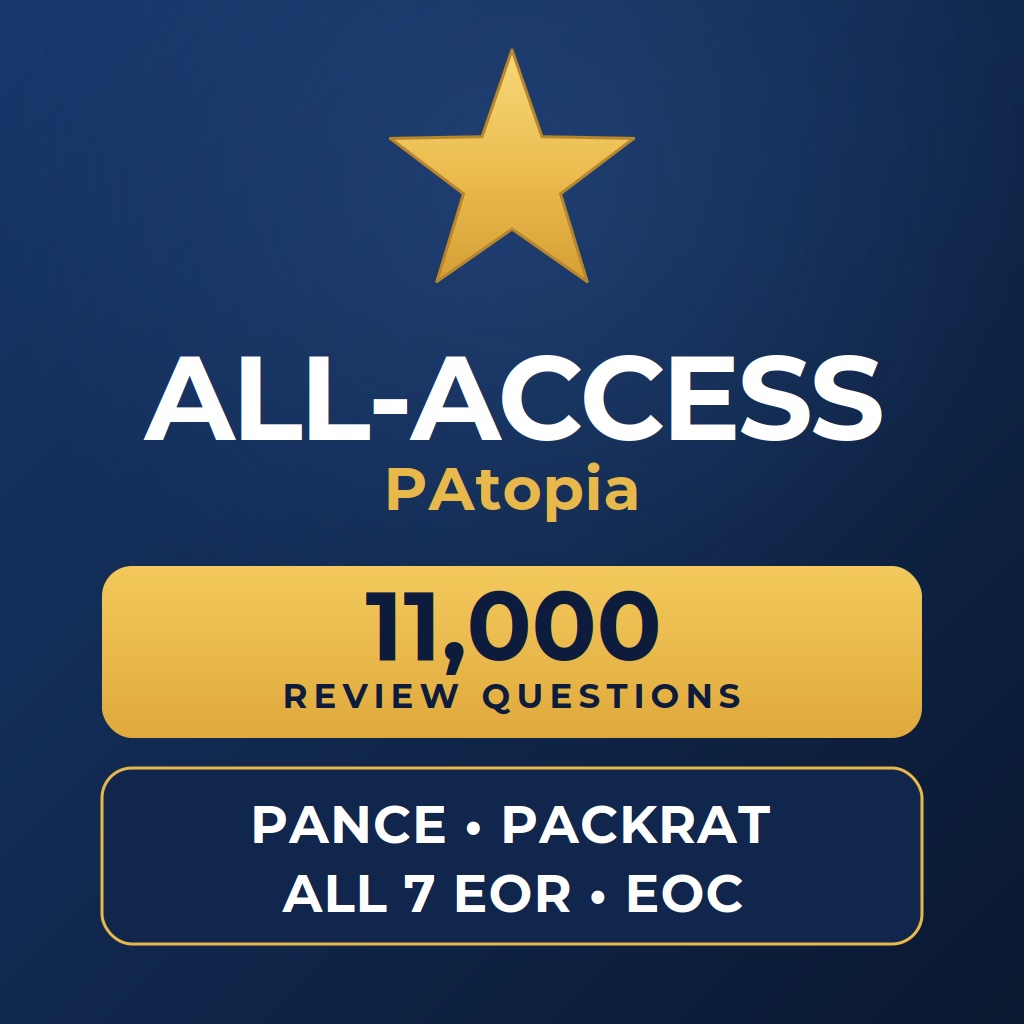
- Late didactic phase: PACKRAT. Five full-length PACKRAT exams give students a realistic rehearsal before the real thing, and a first look at which organ systems need work before clinical rotations begin.
- Clinical year: End of Rotation exams. Students get five full-length exams for each of the seven core rotations (Emergency Medicine, Family Medicine, Internal Medicine, Pediatrics, Surgery, Psychiatry/Behavioral Health and Women’s Health), 35 in all. They can work a rotation’s exams during that rotation, when the material is most relevant.
- End of the program: End of Curriculum. Five full-length EOC exams help students and faculty gauge readiness for the program’s summative evaluation.
- After graduation: PANCE. Fifteen full-length PANCE practice exams (4,500 questions), weighted across all NCCPA content areas, carry students through their final board preparation.
Throughout all four stages, students have the same study library and the same rationale-and-reference format for every question, so they are not learning a new platform each time the stakes change.
Why continuity matters
When the same platform follows a student from PACKRAT to PANCE, their practice builds on itself. A weak area flagged on a PACKRAT practice exam can be revisited during the matching rotation and checked again on a PANCE practice exam months later, all in one place and in one familiar format.
For faculty, continuity means one set of expectations. You can reference the same resource in didactic advising, clinical-year check-ins and board-prep sessions, and every student in the cohort knows exactly what you mean.
Access that goes where students go
Clinical-year students are rarely at a desk. PAtopia runs in the browser on any device, including phones, so students can work a block of questions between patients, on a commute, or the night before an EOR, with nothing to install.
Timing your license
The 27-month term starts when your students’ logins are set up, not on the day you check out, so your program decides when the clock begins. Each license covers one matriculating cohort, and each incoming class is licensed separately with its own full term. Tell us when you want access to start and we will set up the logins to line up with your curriculum: email info@cmereviewcourses.com.
Cover your whole cohort, start to finish. View the PAtopia Program License, or try the free sample quiz and library preview first.
PAtopia is an independent exam-preparation resource and is not affiliated with or endorsed by the NCCPA or PAEA.