










The PACKRAT is a self-assessment, and nobody passes or fails it. That is why a low score is easy to set aside. It is also the earliest broad signal a program gets about how a student will handle a comprehensive exam, and it arrives while there is still time to act.
Decide what “low” means for your program
Programs that use PACKRAT results well pick a threshold in advance, based on how their own past students performed, and apply it the same way every year. The threshold matters less than having one. Without it, the conversation with a student becomes a judgment call, and judgment calls get postponed.
Look past the total
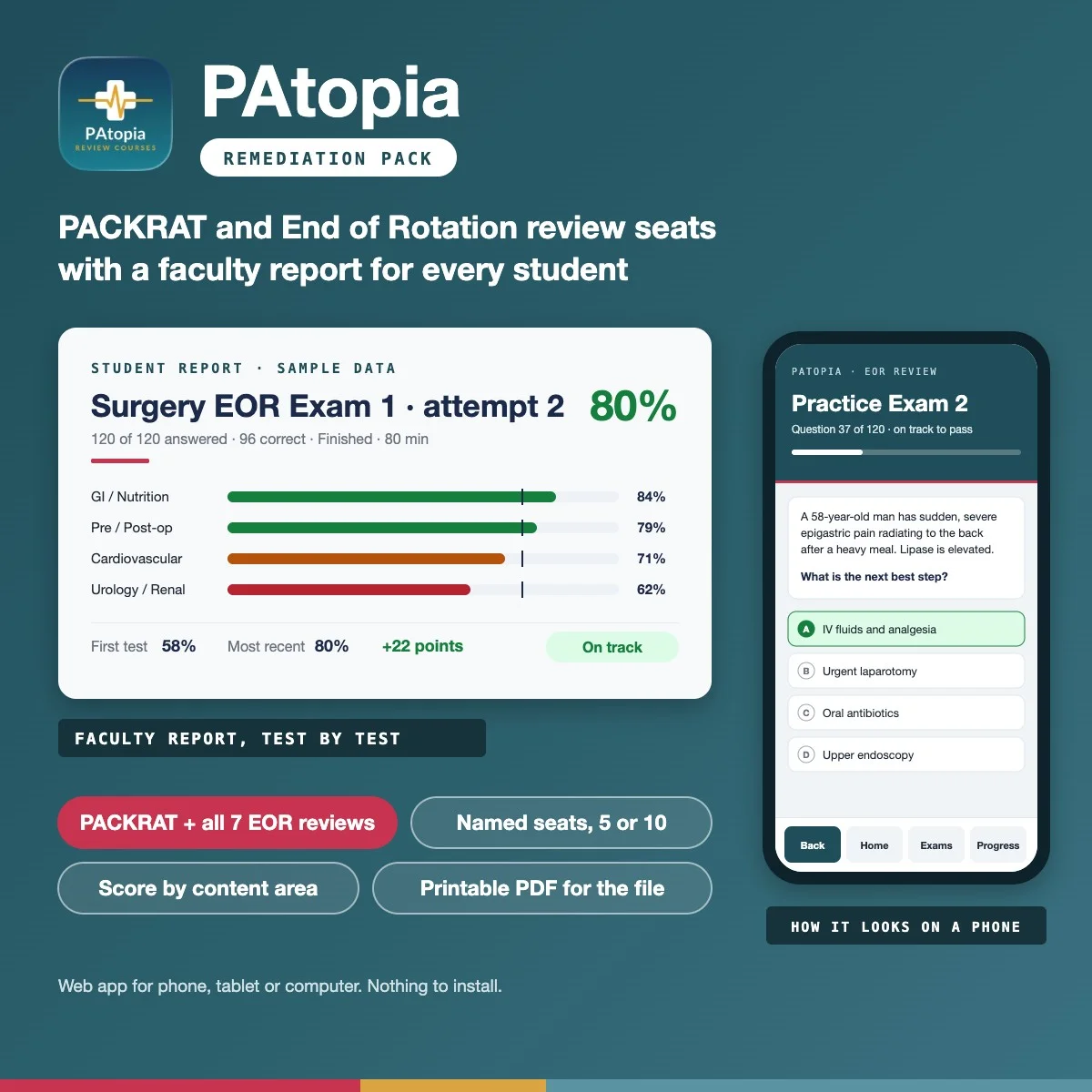
The report breaks performance down by content area and task area. Two students with the same total can have very different profiles. One is a little below average everywhere. The other is fine in most areas and far behind in two. The second student is the easier one to help, because the assignment is obvious.
Give the student a plan with dates
A flagged student should leave the advising meeting with a schedule: full-length practice exams on set dates, review of the weakest areas in between, and a check-in. Clinical year makes open-ended plans disappear. A dated plan with a visible record survives a hard rotation.

Watch the rotation exams too
The students flagged by PACKRAT are often the same ones who struggle on End of Rotation exams. Giving them rotation-specific practice ahead of each exam is cheaper than remediating a failure afterward. That is the reason the Remediation Pack pairs the PACKRAT review with all 7 rotation reviews in one seat.
Make the conversation routine
Students take a PACKRAT flag better when it is clearly a standard process and not a verdict about them. Tell the class in advance what the threshold is and what happens if they fall under it. Then the meeting is about the plan. A student who knows that every flagged classmate gets the same seat and the same schedule is more likely to use them.
Check in on a schedule, not on a feeling
Set two or three check-in dates when the plan is made. Before each one, open the student’s report and look at three things: whether they have started, how many full-length tests are finished, and whether the weakest content areas have moved. Ten minutes of preparation makes a fifteen-minute meeting useful. If nothing has been done by the first check-in, that is the moment to find out why, while there is still most of the year left.
Keep the record in one place
When a student’s file is reviewed later, you want the PACKRAT flag, the plan, the practice results and the follow-up together. A dated report for each student, printed or saved as a PDF at each check-in, does that with very little faculty time.
Seats for the students who need them
The PAtopia Remediation Pack gives a PA program 5 named seats for $999 or 10 for $1,799. Each seat covers the PACKRAT review and all 7 End of Rotation reviews for 12 months from the day it is assigned. A set of 10 single-rotation retake seats is $399. Faculty get a dashboard and a test-by-test report for every student, and the dashboard link arrives in the order confirmation email.
PACKRAT® and End of Rotation™ are trademarks of the Physician Assistant Education Association (PAEA). CME Review Courses and PAtopia are not affiliated with or endorsed by PAEA. Practice scores are not official exam results. Your program’s own policies decide what counts as passing and what remediation requires.