Course Details at a Glance
- Price: $499.99 for the full PANRE Review Course
- Access: 30 months
- Format: 100% online, self-paced, and mobile friendly
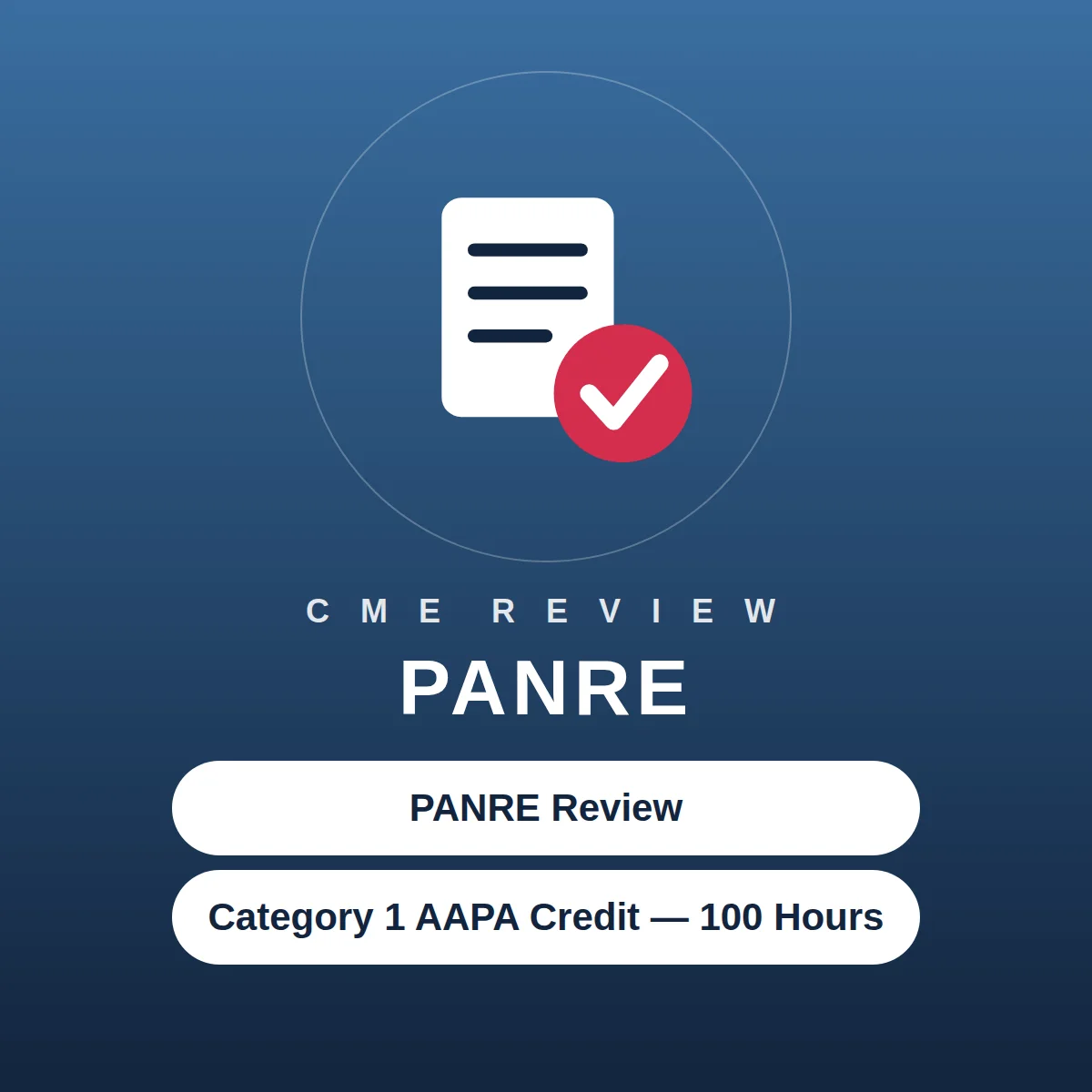
- CME: Up to 100 hours of AAPA Category 1 CME through the PANRE Clinical Review Module
- Practice content: Five full-length 240-question practice exams, 15 body-system question modules, and more than 2,500 total practice questions across the program
- Guarantee: Money-back guarantee for full-course purchasers who do not pass the PANRE on the first attempt; see the terms and conditions
The course is designed for PAs preparing for either the traditional PANRE or PANRE-LA. However, the exam formats differ, so your preparation plan should begin before you open a question bank.
These are five planning and purchasing mistakes that can increase your cost, reduce your study efficiency, or prevent you from claiming available CME.
1. Choosing a Study Resource Before Deciding Between Traditional PANRE and PANRE-LA
The traditional PANRE and PANRE-LA assess core medical knowledge, but the testing experience is different. The traditional PANRE is a scheduled, proctored examination. PANRE-LA is a longitudinal assessment completed over multiple quarters and permits the use of references under NCCPA rules.
Choosing a course before deciding which pathway fits your timeline can lead to inefficient preparation. A traditional PANRE plan should include timed, closed-book blocks and full-length simulations. A PANRE-LA plan should emphasize steady review, rapid reference use, and consistent quarterly participation.
Start with your certification timeline, preferred testing format, and ability to maintain a recurring study schedule. Review the current NCCPA PANRE-LA information before making a final decision.
The PANRE Review Course with Gift Card covers the clinical content relevant to both pathways. You can then adjust how you use the questions:
- For traditional PANRE preparation, complete mixed blocks under timed, closed-book conditions.
- For PANRE-LA preparation, use shorter blocks, review rationales, and practice locating information efficiently.
The course also includes a money-back guarantee for full-course purchasers who do not pass on the first attempt, subject to the posted terms and conditions.
2. Buying a Course Without AAPA Category 1 Credit, or Assuming Pharmacology Includes the 100 Hours
Not every PANRE review resource provides AAPA Category 1 CME. Confirm the accreditation and the specific activity that awards credit before purchasing.
The PANRE Clinical Review Module provides up to 100 hours of AAPA Category 1 CME. Those 100 hours apply to the PANRE Review Course only. They do not apply to the separate Pharmacology course.
To earn the credit, you must:
- Review all content in the module.
- Pass the post-test with a score of 70% or higher.
- Complete the activity evaluation.
Missed post-test questions may be retaken. A certificate is issued after the required elements are completed, and you should claim only the amount of credit commensurate with your participation.
The approval is valid from August 26, 2026, through August 26, 2027. The AAPA reference number is CME-2016187.
The accreditation statement is written at the program level and designates 468.75 AAPA Category 1 credits across the 14-module program. That program-level number should not be confused with the 100 hours assigned to the individual PANRE Clinical Review Module.
PAs may log AAPA Category 1 CME toward NCCPA requirements as permitted by NCCPA policy. Physicians earn Category 2, not Category 1, for this activity. Nurse practitioner acceptance of AAPA Category 1 credit varies by state, so NPs should verify requirements with their state board of nursing before purchase.
3. Paying Out of Pocket When an Employer CME Allowance Could Cover the Purchase
Before using personal funds, check your employer’s CME policy, annual allowance, and eligible expense rules. A $499.99 course may be a qualifying professional education expense, but each employer determines what it will reimburse.
The course also offers optional cme gift cards at checkout:
- Amazon or Apple gift cards
- Amounts from $100 to $1,500
- Tiered in $100 increments
- Emailed within two to three business days of purchase
These are paid add-ons included in the total purchase price. They are not free gifts, rebates, or discounts, and they do not provide additional CME credits. Gift cards are non-refundable, and CME Review Courses is not affiliated with Amazon or Apple.
If your employer permits this type of CME purchase, select an add-on that fits your available allowance. If the policy excludes gift cards or similar items, purchase the course without an add-on.

4. Planning Around Your Specialty Instead of the NCCPA PANRE Content Blueprint
Your clinical specialty is not the same as the PANRE content distribution. Emergency medicine, family medicine, internal medicine, orthopedics, and other specialty experience can create blind spots when you routinely study only familiar problems.
The NCCPA PANRE/PANRE-LA Content Blueprint organizes the assessment by organ system and performance expectation. The current allocations include cardiovascular, pulmonary, gastrointestinal, endocrine, musculoskeletal, EENT, infectious disease, psychiatry, neurology, reproductive, dermatologic, genitourinary, renal, and hematologic content, along with emergent legal, ethical, and DEI topics.
The PANRE Review Course follows this structure with:
- Five full-length practice exams of 240 questions each
- Five answer options per question
- Per-question rationales with cited sources
- 15 body-system question modules
- More than 2,500 total practice questions across the full program
- A PANRE Study Library
- High-yield video lectures and downloadable slides
Use your first mixed exam as a diagnostic. Then allocate study time according to both the NCCPA PANRE Content Blueprint and your performance data. Do not allow a strong score in your specialty to substitute for broad generalist review.

5. Failing to Calendar the Post-Test and Evaluation
Completing the educational content is not the same as claiming CME. The post-test and evaluation are required steps. If you leave them for “later,” they may be delayed or forgotten, and your 100 hours may never be documented.
When you begin the course, schedule:
- A target date to complete all module content
- A post-test date
- Time to retake missed questions if needed
- The activity evaluation
- Time to download or record your certificate according to your CME process
The course provides 30 months of access, so you can plan CME completion around your PANRE or PANRE-LA timeline rather than cram everything into the final weeks.
PANRE-Style Practice Questions
Question 1: Acute Coronary Syndrome
Your patient is a 64-year-old man with 45 minutes of substernal chest pressure radiating to the left arm. He is diaphoretic and nauseated. HR is 98/min, BP is 148/88 mm Hg, and SaO₂ is 96% on room air. ECG demonstrates 2-mm ST-segment elevation in leads II, III, and aVF.
What is the most appropriate next step?
A. Schedule outpatient stress testing
B. Obtain CT angiography of the chest
C. Administer a proton pump inhibitor
D. Activate the cardiac catheterization pathway for emergent reperfusion
E. Observe for serial troponins before treatment
Correct answer: D. Activate the cardiac catheterization pathway for emergent reperfusion. Inferior STEMI requires immediate reperfusion planning; do not delay for CT, stress testing, or serial biomarkers. A proton pump inhibitor does not address the acute occlusion. Rapid activation reduces myocardial injury and avoids the cost and risk of unnecessary diagnostic delay.
Question 2: Pelvic Inflammatory Disease
Your patient is a 29-year-old woman with lower abdominal pain, fever, and mucopurulent cervical discharge. HR is 104/min, BP is 112/70 mm Hg, temperature is 38.2°C, and SaO₂ is 99% on room air. Examination shows cervical motion tenderness without a palpable adnexal mass.
What is the most appropriate outpatient treatment?
A. Oral azithromycin alone
B. Immediate diagnostic laparoscopy
C. Ceftriaxone plus doxycycline and metronidazole
D. Fluconazole and topical therapy
E. Reassurance and follow-up without antibiotics
Correct answer: C. Ceftriaxone plus doxycycline and metronidazole. This presentation meets the clinical threshold for empiric PID treatment. Azithromycin alone is inadequate, antifungal therapy does not treat PID, and delaying treatment increases the risk of infertility and chronic pelvic pain. Assess pregnancy status, provide partner management, and arrange close follow-up.
Question 3: Suspected Pulmonary Embolism
Your patient is a 45-year-old woman with sudden pleuritic chest pain and mild dyspnea after a long flight. HR is 106/min, BP is 126/78 mm Hg, and SaO₂ is 98% on room air. She has no hemoptysis, unilateral leg swelling, or prior VTE. Her Wells score indicates low-to-intermediate pretest probability, and D-dimer is elevated.
What is the next diagnostic step?
A. Begin anticoagulation without imaging
B. Order a noncontrast chest CT
C. Obtain CT pulmonary angiography
D. Perform immediate thrombolysis
E. Order outpatient pulmonary function testing
Correct answer: C. Obtain CT pulmonary angiography. An elevated D-dimer in a patient with sufficient pretest probability requires imaging confirmation. Noncontrast CT and pulmonary function testing are not diagnostic for PE. Anticoagulation or thrombolysis without confirmation is inappropriate in this stable patient. Consider renal function, contrast allergy, and radiation exposure when selecting imaging.
For PA Students: PAtopia
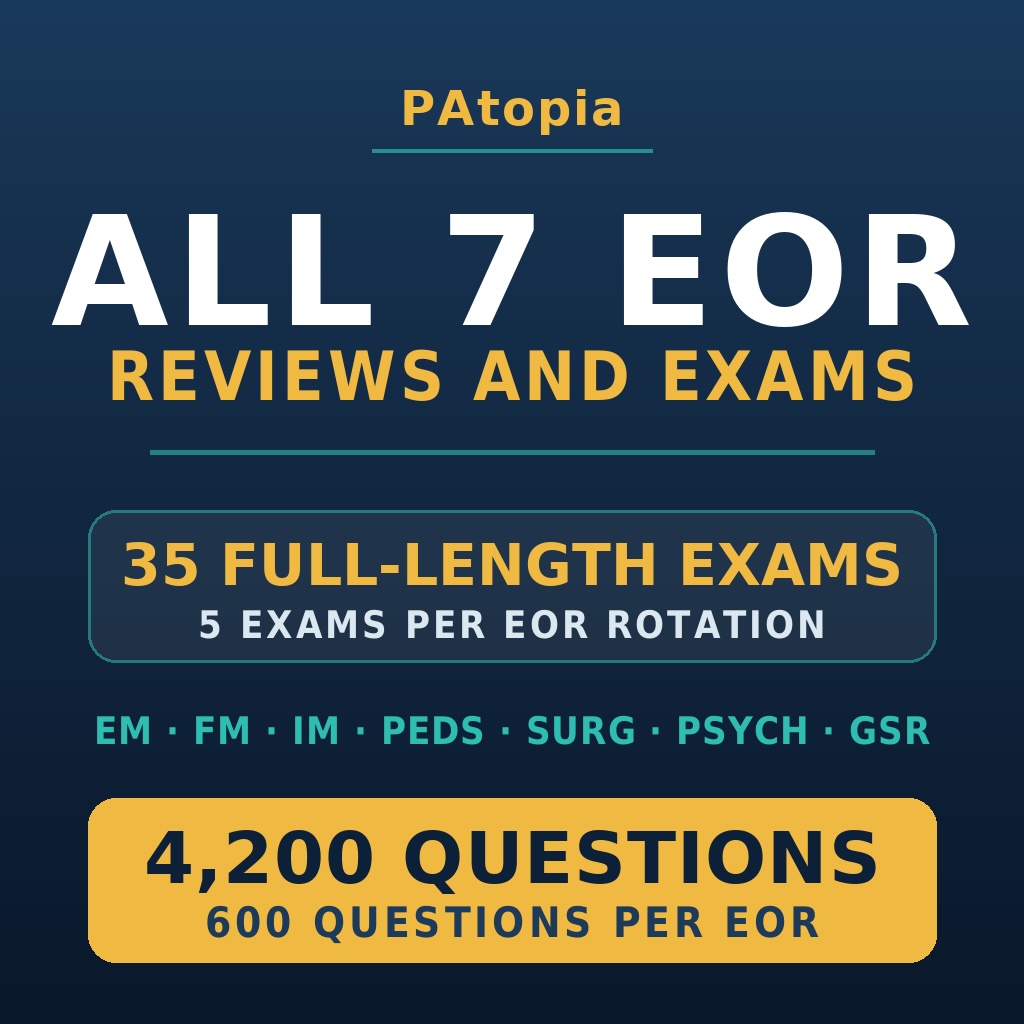
If you are still in PA school, PAtopia provides preparation for the PANCE, PACKRAT, End of Curriculum exam, and all seven EOR exams. It is available through the web version, the iOS app, and the Android app.
PAtopia is designed for PA students and does not carry the 100 AAPA Category 1 CME hours assigned to the PANRE Review Course.
Start Your PANRE Review Plan
The costliest PANRE mistakes often occur before studying begins: selecting the wrong assessment strategy, overlooking CME accreditation, missing an employer allowance, ignoring the NCCPA PANRE Content Blueprint, or failing to schedule course completion requirements.
Review the PANRE Review Course with Gift Card, confirm your employer’s policy, and build a calendar that includes both exam preparation and CME completion.
About the Author
Jeremy Boroff, MPAS, PA-C, is an emergency medicine PA with 24 years of Emergency Medicine experience. He is a PA educator, author, and CME developer who creates PANRE, PANCE, EOR, and specialty review content for practicing clinicians and PA students.
Educational content only. Confirm current PANRE, PANRE-LA, NCCPA, CME, and state licensing requirements with the appropriate organizations.