
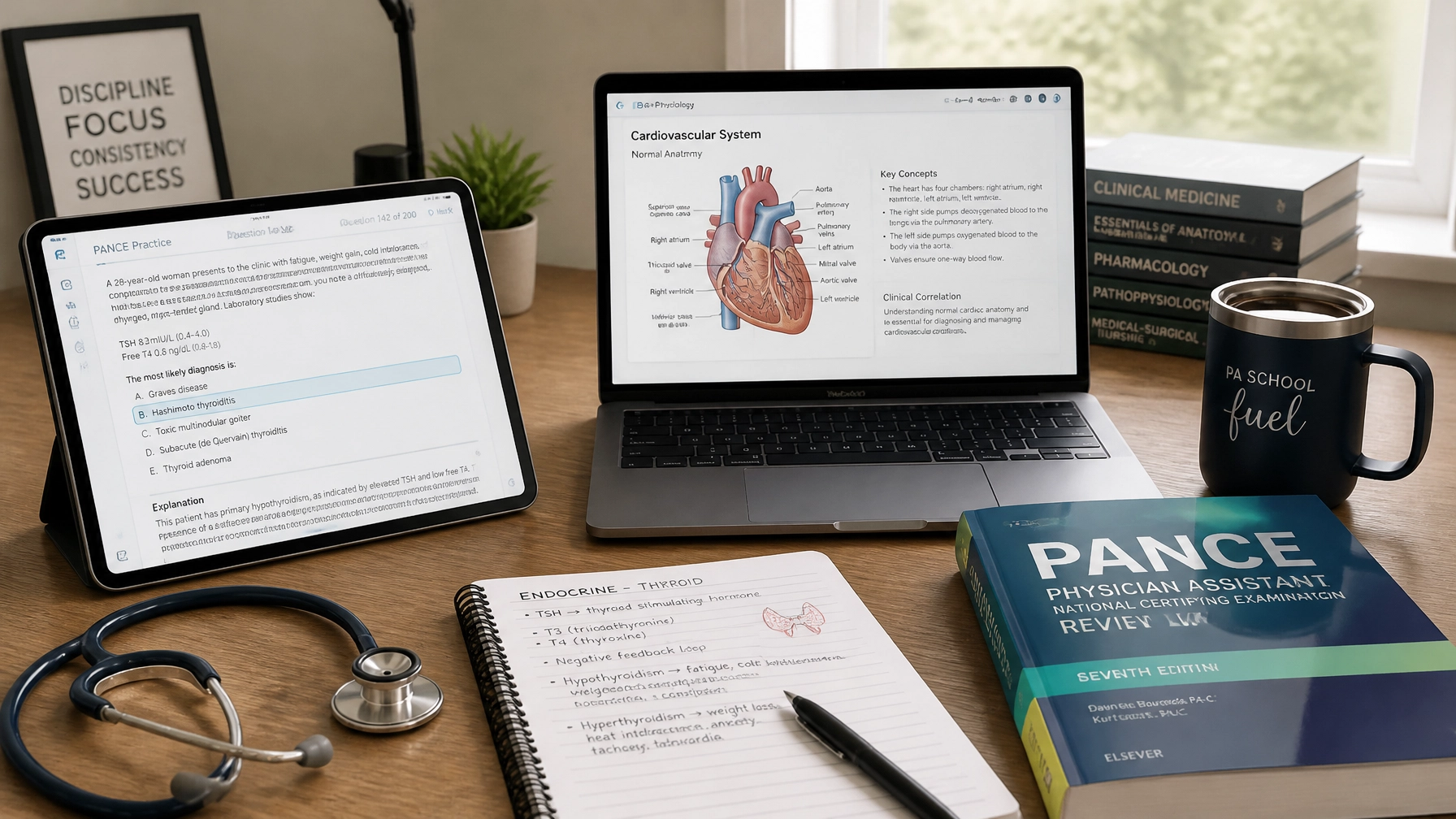
The landscape of Physician Assistant education is shifting. On July 27, 2026, PAEA will launch updated versions of six End of Rotation (EOR) exams. These updates are not minor; they represent a fundamental change in how students are assessed, emphasizing "Professional Practice" and "Diagnostic Studies" while de-emphasizing raw pathophysiology.
For students caught in the transition between legacy blueprints and the 2026 standards, the primary challenge is alignment. Your study resources must match the weightings of the exam you are actually sitting. PAtopia was designed to bridge this gap, offering over 11,000 board-style questions that are continuously updated to reflect the NCCPA and PAEA blueprint shifts.
Quick Stats for PAtopia:
- Total Questions: 11,000+ board-style questions with cited explanations.
- Access Duration: 27 months (covers clinical year and PANCE prep).
- Trial: Free 3-day full access (no account or credit card required).
- Platform: Web and App (iOS/Android).
Get Started with PAtopia Exam Prep →
The 2026 Rotation-by-Rotation Study Plan
The first step in your EOR study plan is to verify which blueprint your program is using. While the new exams launch in July 2026, legacy exams remain available through July 2027. Once you know your target, use the following rotation-specific guides to focus your efforts.
1. Emergency Medicine (EM)
Key Change: Diagnostic Studies has jumped from 10% to 15%. Diagnosis remains steady at 25%: the only exam to do so. A new "Infectious Disease" content area (4%) now stands alone, pulling topics like sepsis and meningitis into a dedicated category.
- PAtopia Focus: Use the EM module to drill Cardiovascular (18%) and Orthopedics (12%).
- Study Tip: Don't just name the disease; focus on the next best test. If a patient has a suspected PE, know when to order a D-dimer vs. a CTA.

2. Family Medicine (FM)
Key Change: EENOT (Eyes, Ears, Nose, Oropharynx, Throat) is now a massive 10% of the exam, making it the second-largest content area after Cardiovascular. Health Maintenance has also risen to 12%.
- PAtopia Focus: Utilize the "Health Maintenance" filter within the FM bank to practice screening guidelines and immunizations.
- Study Tip: Urgent care topics have been redistributed. Treat every minor illness in PAtopia as a potential FM exam question.

3. Internal Medicine (IM)
Key Change: Critical Care has been redistributed into organ systems. Endocrine, Neurology, and Renal have all jumped to 10% each. Psychiatry is now a required content area at 5%.
- PAtopia Focus: Pivot your focus away from Musculoskeletal (which dropped to 8%) and toward the "Big Three" 10% areas (Endocrine/Neuro/Renal).
- Study Tip: Because Psychiatry is now on the IM exam, ensure you are comfortable with the medical management of psychiatric patients (e.g., lithium toxicity, serotonin syndrome).
4. Pediatrics
Key Change: The single biggest change across all exams is the addition of Growth and Development as a 10% content area. History & Physical has also surged to 18%.
- PAtopia Focus: Drill the milestones and well-child check questions. These are now "free points" if you memorize the charts.
- Study Tip: The exam has moved away from Therapeutics (down 5%). Focus on "Normal vs. Abnormal" development rather than just drug dosing.
5. Psychiatric & Behavioral Health
Key Change: Health Maintenance is gone. Clinical Intervention has doubled from 10% to 20%. Sleep-wake disorders is a new content area at 7%.
- PAtopia Focus: The Psych EOR is no longer just about DSM-5 criteria. It’s about what you do. Practice questions on therapy selection and crisis management.
- Study Tip: Use PAtopia to master the 7% weight of Sleep-wake disorders early in the rotation.

6. Gynecologic, Sexual, and Reproductive Health (GSR)
Key Change: Formerly "Women's Health," this exam is completely restructured around anatomy (Uterine/Cervix, Breast, etc.) rather than the OB/GYN split. Fertility management (10%) and Sexual Health (10%) are new high-yield areas.
- PAtopia Focus: Focus on the new 26% of the exam covering Fertility, Sexual Health, and Psych.
- Study Tip: Traditional resources organized by "Prenatal vs. Gynecology" will leave gaps. PAtopia’s GSR module is built on the anatomical structure.

7. Surgery
Key Change: The Surgery EOR was updated in 2024 and serves as the model for the other 2026 changes. It already includes the Professional Practice task area.
- PAtopia Focus: Focus on Perioperative Care and Postoperative Complications.
- Study Tip: Surgery remains a "task-heavy" exam. Understand the process of surgical management, not just the diagnosis.

Clinical Practice Vignettes
To prepare for the increased focus on Diagnostic Studies and Professional Practice, test yourself with these vignettes.
Vignette 1: Emergency Medicine
Your patient is a 64-year-old male presenting with sudden onset tearing chest pain radiating to the back. HR is 112, BP is 180/100 in the right arm and 155/90 in the left arm.
Question: Which of the following is the most appropriate initial diagnostic study to confirm the suspected diagnosis?
A) Chest X-ray
B) Transesophageal echocardiogram (TEE)
C) CT Angiography (CTA) of the chest and abdomen
D) Electrocardiogram (EKG)
Answer: C) CT Angiography (CTA) of the chest and abdomen.
Explanation: CTA is the gold standard for diagnosing aortic dissection in hemodynamically stable patients due to its high sensitivity and specificity. While a Chest X-ray (A) may show a widened mediastinum, it is not confirmatory. TEE (B) is useful in unstable patients but CTA is generally preferred for mapping the extent of the dissection. An EKG (D) is necessary to rule out MI but does not confirm dissection.
Vignette 2: Family Medicine
Your patient is a 50-year-old female with a history of hypertension who presents for a routine wellness exam. She has no specific complaints.
Question: According to current USPSTF guidelines, which of the following screening tests should be ordered at this visit?
A) DXA scan for osteoporosis
B) Colonoscopy for colorectal cancer screening
C) Low-dose CT for lung cancer screening
D) Annual EKG
Answer: B) Colonoscopy for colorectal cancer screening.
Explanation: The USPSTF recommends colorectal cancer screening for all adults aged 45 to 75. DXA scans (A) typically begin at age 65 for women unless specific risk factors are present. Low-dose CT (C) is reserved for those with a significant smoking history. Annual EKGs (D) are not recommended for asymptomatic screening.
Vignette 3: Professional Practice (Universal)
Your patient is a 17-year-old female seeking contraception. She requests that her parents not be informed.
Question: Which of the following best describes the legal and ethical requirement in this scenario?
A) Parental consent is required for all minors.
B) The provider must notify the parents after the prescription is written.
C) In most states, minors can consent to reproductive health services without parental notification.
D) The provider should refuse care until the patient reaches age 18.
Answer: C) In most states, minors can consent to reproductive health services without parental notification.
Explanation: Most jurisdictions allow "mature minors" to consent to services related to sexual health, including contraception and STI treatment, to encourage access to care and maintain confidentiality.
Mastering the Exam with PAtopia Features
Studying for the End of Rotation Exam Review, PACKRAT Review, or PANCE Review requires more than just reading; it requires active recall.
- Spaced Repetition: PAtopia uses algorithms to re-present questions you missed at optimal intervals, ensuring long-term retention of difficult concepts like Pediatric milestones or GSR anatomical changes.
- Performance Analytics: The app tracks your performance by blueprint category. If you are hitting 80% in Cardiovascular but 40% in Professional Practice, you know exactly where to spend your next study hour.
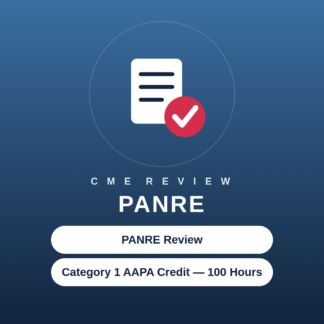
- AAPA Category 1 CME: For those who have already graduated, our PANRE Review courses offer up to 100 hours of AAPA Category 1 Credit, often with Amazon or Apple gift card add-ons to maximize your CME budget.
About the Author: Jeremy Boroff, MPAS, PA-C
Jeremy Boroff is a practicing Emergency Medicine Physician Assistant with 24 years of clinical experience. He is the founder of CME Review Courses and the creator of PAtopia. Having authored the definitive review books for the EM, Psych, and GSR EOR exams, Jeremy developed PAtopia to provide PA students with a high-fidelity, evidence-based study tool that reflects the actual rigor of the NCCPA and PAEA exams.