

Internal medicine remains the cornerstone of clinical practice for physician assistants, whether you are working in a specialty clinic, the hospital, or preparing for your next recertification cycle. Navigating the requirements for the NCCPA 2-year CME cycle often leads PAs to look for the most efficient way to maximize their time and educational budget.
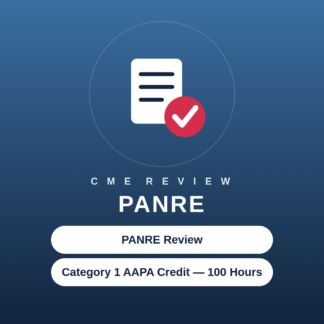
At CME Review Courses, we provide a streamlined solution designed by PAs for PAs. Our flagship PANRE Review Course is specifically built to address the broad spectrum of internal medicine topics while providing the maximum credit amount allowed.
Course Deliverables:
- Total Credits: 100 hours of AAPA Category 1 CME Credit.
- Price: $499.99.
- Access Duration: 30 Months of unlimited access.
- Question Bank: Over 1,000 board-style practice questions.
- Study Materials: Digital and physical review books available.
You can customize your experience by choosing our cme gift cards add-on options. We offer the ability to add an Amazon or Apple Gift Card ranging from $100 to $1,500 to your purchase. It is important to note that these gift cards are an add-on purchase designed to help you further enrich your educational library and are not a free gift.
Maximizing Your CME Efficiency
The panre review course is more than just a test-prep tool; it is a comprehensive clinical update. For those in Internal Medicine, the depth of cardiology, pulmonology, and endocrinology covered in this program serves as an essential refresher for daily practice. While physicians can find value in our packages for Category 2 credit, PAs and certain Nurse Practitioners can claim these high-value Category 1 AAPA credits to meet their state and national licensing requirements.

Clinical Application: Internal Medicine Vignettes
To understand the quality of our pance prep courses and PANRE review content, consider the following clinical scenarios. This is the direct, evidence-based approach we use throughout our curriculum.
Scenario 1: Cardiovascular Management
Your patient is a 64-year-old male with a history of HTN and Type 2 DM who presents for a routine follow-up. He reports recent onset of dyspnea on exertion. His vitals are stable, but physical exam reveals a 2/6 holosystolic murmur at the apex radiating to the axilla and trace peripheral edema. An echocardiogram shows an EF of 45% and moderate mitral regurgitation.
What is the most appropriate next step in the pharmacologic management of this patient’s heart failure?
A) Start Amlodipine
B) Initiate Lisinopril
C) Start Metoprolol Tartrate
D) Initiate Verapamil
The correct answer is B) Initiate Lisinopril. ACE inhibitors (or ARBs/ARNIs) are first-line therapy for patients with symptomatic heart failure and reduced ejection fraction (HFrEF) to reduce afterload and prevent cardiac remodeling. Amlodipine and Verapamil are calcium channel blockers that do not provide the same mortality benefit in HFrEF, and Verapamil is specifically contraindicated in patients with significant LV dysfunction due to its negative inotropic effects. Metoprolol Succinate is the preferred beta-blocker for heart failure, not the immediate-release Tartrate formulation.
Scenario 2: Endocrine Assessment
Your patient is a 52-year-old female with a BMI of 34 who presents with complaints of polyuria and fatigue. Her fasting plasma glucose is 138 mg/dL on two separate occasions. You diagnose her with Type 2 Diabetes Mellitus. Her current HbA1c is 7.4%.
Which of the following is the recommended initial monotherapy for this patient?
A) Glyburide
B) Metformin
C) Pioglitazone
D) Sitagliptin
The correct answer is B) Metformin. Metformin is the first-line medication for the treatment of T2DM due to its efficacy in lowering HbA1c, low risk of hypoglycemia, and weight-neutral or weight-loss benefits. Glyburide (a sulfonylurea) carries a higher risk of hypoglycemia and weight gain. Pioglitazone is associated with fluid retention and is not first-line. Sitagliptin (a DPP-4 inhibitor) is generally used as a second-line or add-on therapy when Metformin is insufficient or contraindicated.

Why PAs Choose Internal Medicine Focused CME
Choosing an internal medicine specialty focus for your panre review course allows you to stay current on the most common conditions seen in primary and acute care. Our courses cover Emergency Medicine, Family Medicine, Orthopedics, Dermatology, Psychiatry, Neurology, Cardiology, and OB/GYN, ensuring that your 100 hours of AAPA Category 1 credit are well-spent.
Scenario 3: Pulmonary Diagnostic
Your patient is a 68-year-old male smoker who presents with a chronic cough and progressive shortness of breath. You suspect Chronic Obstructive Pulmonary Disease (COPD). PFTs are performed.
Which of the following PFT findings is diagnostic of a persistent airflow limitation?
A) FEV1/FVC ratio > 0.70
B) FEV1/FVC ratio < 0.70 post-bronchodilator
C) Increased Total Lung Capacity (TLC)
D) Decreased Residual Volume (RV)
The correct answer is B) FEV1/FVC ratio < 0.70 post-bronchodilator. This specific ratio is the GOLD criteria standard for diagnosing COPD. While TLC may be increased in emphysema (hyperinflation), it is not the diagnostic metric for airflow limitation. Decreased RV is more typical of restrictive lung disease, not obstructive disease like COPD.
Strategic Use of CME Funds
Many employers provide an annual CME allowance. Utilizing this for the PANRE Review Course allows you to secure your required 100 Category 1 AAPA credits in one efficient program. By selecting the Amazon or Apple gift card add-on, you can further invest in your clinical tools, such as purchasing the latest medical texts or upgrading your tablet for patient education.

Final Clinical Thought: Dermatology in Internal Medicine
Your patient is a 45-year-old female presenting with a malar rash that spares the nasolabial folds. she also reports joint pain and sensitivity to sunlight.
Which laboratory test is most sensitive for the suspected diagnosis?
A) Anti-double-stranded DNA (anti-dsDNA)
B) Anti-Smith (anti-Sm)
C) Antinuclear antibody (ANA)
D) Rheumatoid Factor (RF)
The correct answer is C) Antinuclear antibody (ANA). In the context of suspected Systemic Lupus Erythematosus (SLE), the ANA is the most sensitive screening test, with over 95% of patients testing positive. Anti-dsDNA and Anti-Sm are more specific for SLE but lack the high sensitivity of the ANA. RF is more associated with Rheumatoid Arthritis, though it can be positive in various autoimmune conditions.
Conclusion
Investing in your education shouldn't be a bureaucratic hurdle. By choosing an Internal Medicine CME with Gift Card package, you are choosing a program that respects your time and your professional requirements. Whether you are preparing for the PANCE or the PANRE, or simply need to complete your bi-annual credits, our pance prep courses and review materials offer the most comprehensive path to success.
Explore our full range of products and the customizable cme gift cards add-ons at CME Review Courses.
And for PA students and new graduates preparing for the PANCE and EOR exams, PAtopia is your all-in-one app with 11,000+ board-style questions spanning every rotation — plus a 3-day free trial. Check it out at cmereviewcourses.com/patopia-new-student-section/.