Maintaining certification requires a strategic approach to Continuing Medical Education (CME). For Physician Assistants, the NCCPA provides a significant advantage for those who utilize self-assessment activities. Understanding how to leverage the 50% bonus credit is essential for clinical professionals aiming to meet the 100-hour requirement efficiently.
Price: $499.99
Duration of Access: 30 Months
Deliverables: 100 Hours of Category 1 AAPA CME Credit, thousands of practice questions, and specific specialty modules.
The Mechanics of the NCCPA 50% Bonus
The National Commission on Certification of Physician Assistants (NCCPA) recognizes the high educational value of self-assessment CME. Unlike standard Category 1 credits, self-assessment activities are weighted more heavily. Specifically, the NCCPA awards 50% additional credit for all activities designated for self-assessment Category 1 CME.
When you earn 20 credits through a self-assessment course, the NCCPA counts those as 30 credits toward your certification maintenance. This bonus is applied automatically within the NCCPA logging system. You must log the exact number of credits awarded by the provider (e.g., CME Review Courses); the portal then calculates the additional 50% on the back end. There is currently no stated cap for this bonus within a single cycle, unlike PI-CME which is limited to the first 20 credits.

Strategic CME Planning
For PAs in a two-year cycle, the requirement is 100 total CME credits, with a minimum of 50 being Category 1. By selecting a 100-hour self-assessment course like our PANRE Review Course, you are not just meeting the baseline requirement. With the 50% bonus, those 100 hours of Category 1 AAPA credit are recognized as 150 hours by the NCCPA. This provides a substantial buffer for your reporting cycle and allows you to focus more on clinical practice and less on tracking disparate credits.
Clinical Assessment: Test Your Knowledge
To demonstrate the depth of our educational content, evaluate the following clinical vignettes. These scenarios reflect the type of content found in our comprehensive review modules.
Case Study 1: Cardiovascular Medicine
Your patient is a 64-year-old male presenting with a 3-month history of exertional chest pain. He describes the pain as a "pressure" that radiates to his left jaw and subsides with rest. History includes hypertension and hyperlipidemia. Vital signs show HR 78 bpm, BP 142/88 mmHg, and SaO2 98% on room air. An EKG reveals no acute ST-segment changes but shows left ventricular hypertrophy. A stress test is ordered.
Which of the following is the most appropriate initial diagnostic step if the patient is unable to perform adequate exercise on a treadmill?
A) Dobutamine stress echocardiography
B) Exercise stress EKG
C) Coronary angiography
D) Pharmacologic nuclear stress test with regadenoson
Correct Answer: D) Pharmacologic nuclear stress test with regadenoson
A pharmacologic nuclear stress test is the preferred choice for patients who cannot achieve 85% of their predicted maximum heart rate through physical exercise. Regadenoson acts as a vasodilator, allowing for the assessment of myocardial perfusion without physical exertion. Dobutamine stress echocardiography is a valid alternative but is generally reserved for patients with contraindications to vasodilators, such as severe asthma or advanced heart block. Coronary angiography is an invasive procedure typically reserved for patients with positive non-invasive tests or acute coronary syndromes.
Case Study 2: Internal Medicine / Pulmonary
Your patient is a 24-year-old female with a known history of asthma presenting with increased wheezing and cough over the last week. She has been using her albuterol inhaler four times daily. Peak flow is 65% of her personal best. Physical exam shows bilateral expiratory wheezing and a respiratory rate of 20 breaths per minute.
According to the current guidelines, what is the most appropriate addition to her current regimen?
A) Long-acting beta-agonist (LABA) monotherapy
B) Low-dose inhaled corticosteroid (ICS)
C) Oral prednisone for 5 days
D) Increased frequency of SABA use only
Correct Answer: B) Low-dose inhaled corticosteroid (ICS)
The patient’s asthma is currently categorized as persistent. Inhaled corticosteroids are the primary maintenance therapy for reducing airway inflammation and preventing further exacerbations. LABA monotherapy is contraindicated in asthma due to increased risk of mortality; it must always be paired with an ICS. While oral steroids may be used for acute flares, the introduction of a daily ICS is the standard for long-term management in patients needing frequent SABA use.
Maximizing Your CME Budget with Gift Card Add-Ons
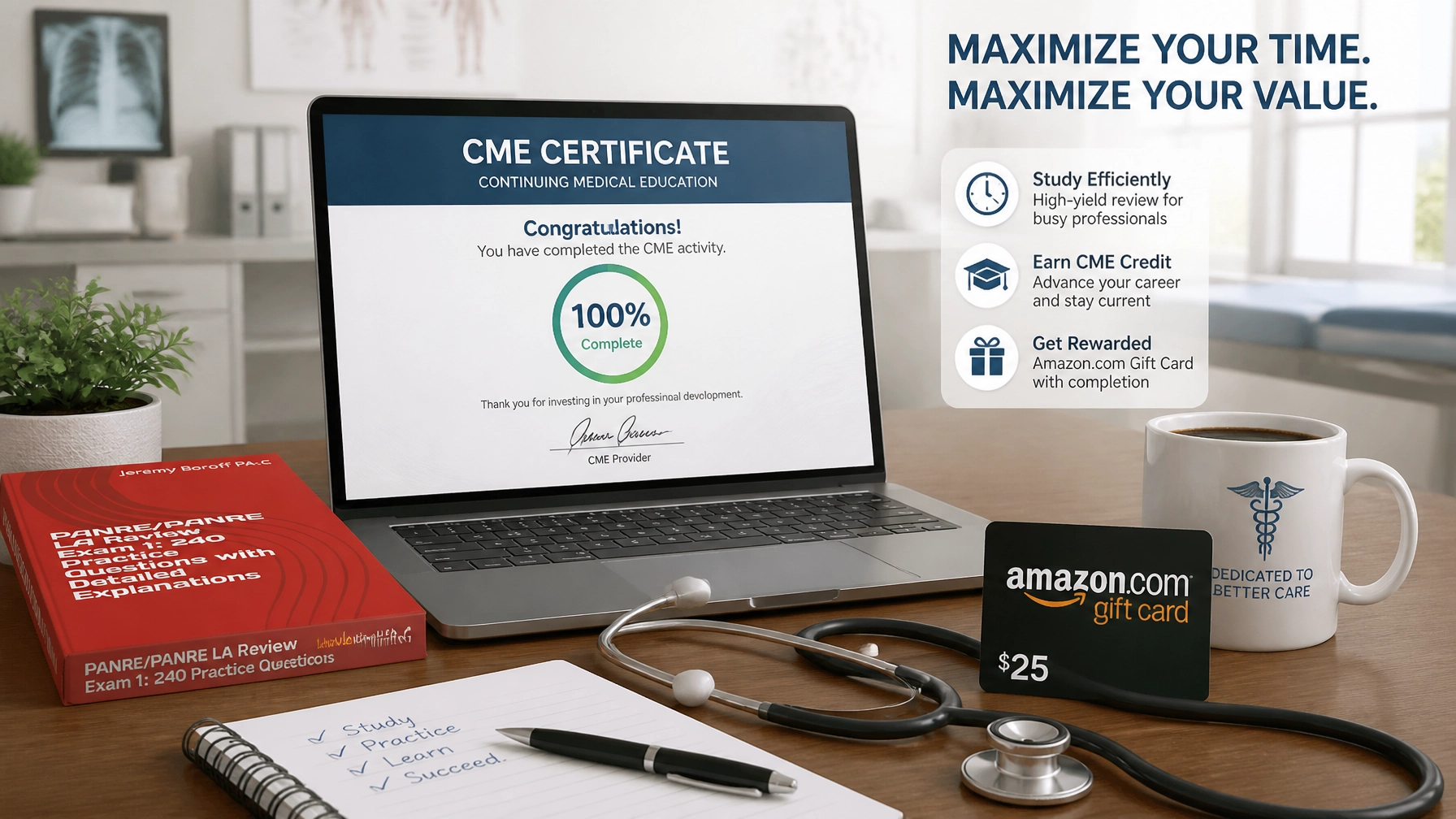
CME Review Courses offers a unique way to utilize your employer-provided CME allowance. When purchasing the PANRE Review Course or any of our specialty packages, you can include an Amazon or Apple gift card ranging from $100 to $1500. This allows you to secure your required credits while obtaining tools like medical tablets or updated clinical references that further your professional development.
Our packages include content across various specialties:
- Emergency Medicine
- Family Medicine
- Internal Medicine Hospitalist
- Orthopedics
- Cardiology
- Dermatology

Why Physician Assistants Choose Our Courses
The content at CME Review Courses is designed by physician assistants for physician assistants. While the 100 hours of Category 1 AAPA credit applies directly to the PANRE Review Course, nurse practitioners and physicians also find value in our clinical modules. For physicians, these credits typically count as Category 2.
Our Pharmacology Course specifically provides AAPA Category 1 CME in Pharmacology, which is vital for state licensing requirements for many mid-level providers.
Case Study 3: Gastroenterology
Your patient is a 45-year-old female presenting with epigastric pain and dyspepsia. She reports that the pain is often relieved by eating. She has been taking OTC antacids with minimal relief. A urea breath test is positive for H. pylori.
Which of the following represents the current first-line quadruple therapy for this patient?
A) Omeprazole, Clarithromycin, Amoxicillin, and Tinidazole
B) Bismuth subsalicylate, Metronidazole, Tetracycline, and a Proton Pump Inhibitor (PPI)
C) Omeprazole and Amoxicillin dual therapy
D) Ranitidine, Tetracycline, and Metronidazole
Correct Answer: B) Bismuth subsalicylate, Metronidazole, Tetracycline, and a Proton Pump Inhibitor (PPI)
Due to rising resistance to clarithromycin, bismuth-based quadruple therapy is now recommended as a first-line treatment for H. pylori infection. This regimen is typically administered for 10 to 14 days. Dual therapy is insufficient for eradication, and H2 blockers like ranitidine are less effective than PPIs in promoting ulcer healing during treatment.
Finalizing Your CME Logistics
When you purchase a course, you receive immediate access for 30 months. This extended duration ensures you can complete the self-assessment modules at your own pace while remaining current with NCCPA cycles. Each course includes comprehensive question banks and evidence-based clinical reviews to ensure you are prepared for both the PANRE-LA and traditional PANRE formats.

The ability to boost your credit total by 50% via self-assessment is one of the most efficient tools in professional certification maintenance. By choosing a high-yield, comprehensive course, you streamline your administrative requirements while enhancing your clinical competency.