Maintaining your professional credentials as a physician assistant requires a strategic approach to Continuing Medical Education (CME). Every two years, PAs must earn 100 credits of CME, with at least 50 being Category 1. When the recertification cycle for the Physician Assistant National Recertification Exam (PANRE) or PANRE-LA arrives, the stakes for your education and your clinical practice are significantly higher.
Selecting a CME package that includes an Amazon or Apple gift card add-on is a common practice among modern clinicians. However, the decision to choose these packages should be based on educational value and the efficient utilization of your professional development allowance.
Logistics and Deliverables:
- Price: Starting at $499.99 (base course) with add-on options up to $1,500.
- Duration of Access: 30 Months.
- Educational Deliverable: 100 Hours of Category 1 AAPA Credit (for the PANRE Review Course).
- Content Coverage: Internal Medicine, Family Medicine, Emergency Medicine, Orthopedics, Cardiology, Dermatology, OB/GYN, and more.
The Financial Logic of Gift Card Add-Ons
Most physician assistants receive an annual CME stipend from their employer, often ranging from $1,500 to $3,000. This is typically a "use-it-or-lose-it" benefit. If you do not utilize the full amount within the fiscal year, the funds are forfeited back to the institution.
The gift card add-on model allows you to maximize this professional benefit. By choosing a package that bundles your required AAPA Category 1 credit with a gift card, you are effectively converting your employer-provided education funds into a flexible resource. This resource can then be used to purchase additional medical equipment, textbooks, or technology that further enriches your clinical education.

Educational Quality Must Come First
While the financial incentive is clear, the primary "truth" is that a gift card is only valuable if the CME content itself is rigorous and relevant. At CME Review Courses, our content is written by physician assistants for physician assistants. We focus on high-yield clinical information that aligns with the NCCPA Blueprint for the PANRE and PANRE-LA.
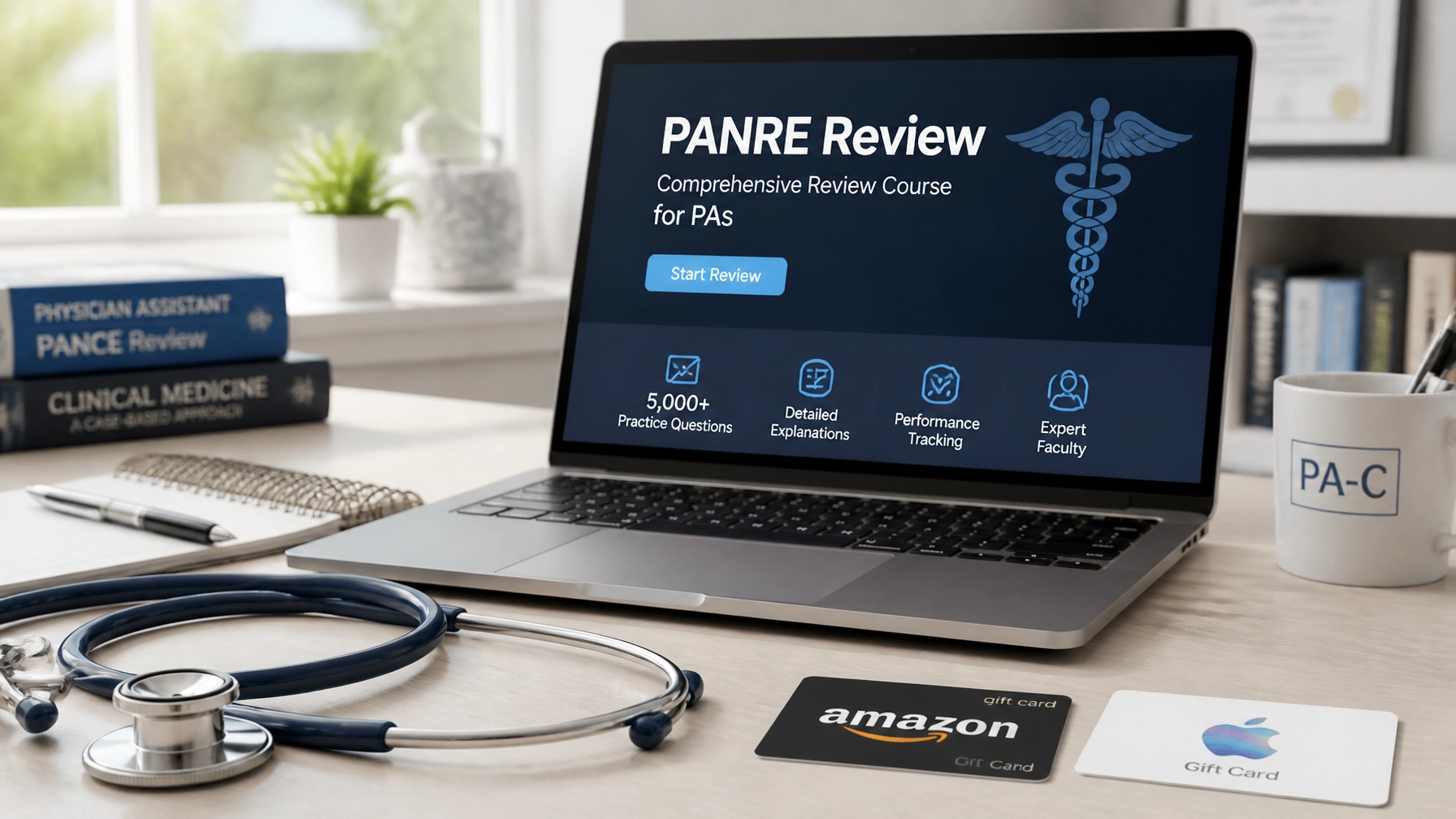
Our PANRE Review Course provides 100 hours of Category 1 AAPA credit. This single course can fulfill your entire Category 1 requirement for a two-year cycle while simultaneously preparing you for the most important exam of your professional career.
Clinical Assessment: Pulmonary Medicine
Your patient is a 64-year-old male presenting with a 3-month history of progressive dyspnea on exertion and a non-productive cough. He has a 40-pack-year smoking history but quit five years ago. Physical examination reveals fine inspiratory crackles (velcro-like) at the lung bases and digital clubbing. A high-resolution CT (HRCT) scan of the chest demonstrates subpleural reticular opacities and honeycombing in the lower lobes.
What is the most likely diagnosis?
A) Sarcoidosis
B) Idiopathic Pulmonary Fibrosis (IPF)
C) Hypersensitivity Pneumonitis
D) Asbestosis
Explanation:
The correct answer is B) Idiopathic Pulmonary Fibrosis (IPF). This patient presents with the classic clinical triad of chronic dyspnea, "velcro" crackles, and digital clubbing in an older former smoker. The HRCT findings of subpleural reticulation and honeycombing are pathognomonic for a Usual Interstitial Pneumonia (UIP) pattern, which characterizes IPF. Sarcoidosis (A) typically presents with bilateral hilar lymphadenopathy. Hypersensitivity Pneumonitis (C) usually has an identifiable environmental exposure and centrilobular nodules on CT. Asbestosis (D) would present with pleural plaques.

Understanding the Scope of Content
A comprehensive review course must bridge the gap between various specialties. PAs in specialized roles, such as Orthopedics or Neurosurgery, often find that their general medical knowledge atrophies over time. Our packages provide a focused update across the major medical disciplines:
- Emergency Medicine: Focus on ACLS, trauma, and acute cardiac events.
- Internal Medicine / Hospitalist: Mastery of chronic disease management and inpatient care.
- Cardiology: Advanced EKG interpretation and heart failure management.
- Orthopedics: Clinical evaluation of musculoskeletal injuries and radiographic correlations.
- Dermatology: Morphological identification of common and malignant skin lesions.
Clinical Assessment: Cardiology
Your patient is a 72-year-old female who was brought to the emergency department after a syncopal episode. She reports feeling lightheaded just before "passing out." She has a history of hypertension and takes lisinopril. Her heart rate is 42 bpm and blood pressure is 105/60 mmHg. An EKG is performed and shown below.
Which of the following EKG findings would most strongly indicate the need for a permanent pacemaker?
A) First-degree AV block
B) Mobitz Type I (Wenckebach) Second-degree AV block
C) Mobitz Type II Second-degree AV block
D) Sinus Bradycardia
Explanation:
The correct answer is C) Mobitz Type II Second-degree AV block. While all options represent forms of bradycardia or heart block, Mobitz Type II is characterized by a constant PR interval followed by a dropped QRS complex. This indicates a block within or below the Bundle of His and carries a high risk of progression to complete (third-degree) heart block. In a symptomatic patient with syncope, Mobitz Type II is a definitive indication for permanent pacing. First-degree block (A) and Mobitz I (B) are often benign and monitored unless symptoms are severe.

Who Can Claim This Credit?
The primary target for our PANRE Review Course is the physician assistant. However, other clinicians frequently find value in our curriculum:
- Nurse Practitioners (NPs): Many states and the AANP accept AAPA Category 1 CME credit for NP recertification. We recommend checking your specific state board requirements.
- Physicians (MD/DO): While these courses provide AAPA Category 1 credit, they count as Category 2 CME for physicians. Many physicians purchase our packages specifically for the clinical high-yield content in Internal Medicine and Cardiology, finding the gift card add-on to be a pragmatic way to utilize their departmental funds.
Why 30 Months of Access Matters
The standard CME cycle is two years, but clinical practice is continuous. We provide 30 months of access to our materials. This ensures that you have the content available not just for your immediate exam prep, but as a reference tool in your clinical practice long after you have submitted your credits to the NCCPA.
Whether you are preparing for the traditional PANRE or the newer PANRE-LA (Longitudinal Assessment), having a searchable, high-yield database of medical information is invaluable. The PANRE-LA specifically allows for the use of external resources; our review content is organized specifically to assist you in navigating those assessments efficiently.

The Verdict: Is It Worth It?
The "truth" about CME with an Amazon gift card is that it is a tool for efficiency. If you are a PA who:
- Needs to complete 100 hours of Category 1 CME.
- Is approaching a PANRE or PANRE-LA cycle.
- Has an employer-funded CME allowance that will otherwise go unused.
Then a gift card add-on is an excellent decision. It allows you to obtain the highest quality medical education, written by peers in your profession, while ensuring that your professional development funds are fully maximized.
Don't leave your CME money on the table. Invest in your education and your career with a package that recognizes the practical needs of the modern clinician.
Check out our CME with Gift Card Packages today and streamline your recertification process.