Posted on

Daily CME Tips: 5 PANRE Review Mistakes That Waste Your Study Time and CME Budget

Course price: $499.99
Access: 30 months
Practice content: More than 2,500 board-style questions
Full-length exams: Five 240-question practice exams
CME: Up to 100 AAPA Category 1 CME credits through the PANRE Clinical Review Module
Optional add-ons: Paid Amazon or Apple gift cards from $100 to $1,500

The gift card options are paid add-ons. They increase the total purchase price and are not free gifts, discounts, rebates, or additional CME. Review your employer’s CME policy before selecting an add-on.

Preparing for the PANRE while working full-time requires more than collecting review materials. You need a plan that matches your recertification pathway, identifies knowledge gaps, and uses your CME budget for a clinically relevant activity.

Below are five common PANRE review mistakes and the more efficient approach for avoiding each one.

Mistake 1: Using PANCE Preparation as Your Primary PANRE Strategy

PANCE preparation and PANRE preparation overlap clinically, but they serve different points in a PA’s career.

The PANCE is an initial certification examination for PA students and recent graduates. PANRE is a recertification assessment for practicing PAs. A PANCE resource may still help with foundational review, but relying on PANCE prep courses alone can leave your preparation poorly organized for recertification.

PANRE review should address broad clinical reasoning across the organ systems and task areas identified in the NCCPA Blueprint. This includes cardiovascular, pulmonary, gastrointestinal, endocrine, infectious disease, neurology, psychiatry, dermatology, musculoskeletal, renal, reproductive, hematologic, and emergency medicine topics.

Your clinical practice may be concentrated in one specialty. The PANRE is not. A PA practicing primarily in orthopedics may need to spend more time on cardiology, infectious disease, or endocrine management than on familiar musculoskeletal conditions.

Better approach

Begin with mixed board-style questions. Sort missed items by:

  • Organ system
  • Diagnosis versus management
  • Pharmacology
  • Diagnostic sequencing
  • Misread stem or incorrect prioritization

Then direct your study time toward weak areas rather than reviewing only familiar material.

PANRE review book for traditional PANRE and PANRE-LA preparation

Mistake 2: Relying on Passive Review

Reading notes can create a false sense of competence. Recognizing that you have seen information before does not confirm that you can retrieve and apply it under exam conditions.

PANRE questions require you to identify the key clinical finding, select the next best step, and distinguish the correct option from plausible distractors. Active recall is more efficient than repeated rereading.

A practical daily routine is:

  1. Complete 20 to 40 questions before viewing explanations.
  2. Mark questions answered incorrectly or by guessing.
  3. Read the rationale for the correct answer and each distractor.
  4. Record the clinical principle behind the error.
  5. Revisit the topic later in a mixed question set.

A question bank is most useful when the explanations teach decision-making. The goal is not merely to increase the number of questions completed. The goal is to improve your ability to recognize patterns and choose appropriate management.

PANRE-Style Clinical Vignette

Your patient is a 63-year-old man who is two days postoperative from total knee arthroplasty. He develops sudden dyspnea and pleuritic right-sided chest pain. His HR is 112/min, BP is 128/76 mm Hg, RR is 24/min, and SaO₂ is 91% on room air. Lung examination is clear. His left calf is swollen and tender. He has no known renal disease or contrast allergy.

Which diagnostic study is most appropriate next?

A. D-dimer assay
B. CT pulmonary angiography
C. Bilateral lower-extremity venous ultrasound only
D. Exercise stress testing
E. Transthoracic echocardiography as the first test

Correct answer: B. CT pulmonary angiography

CT pulmonary angiography is correct because this patient has a high pretest probability for acute pulmonary embolism based on recent surgery, tachycardia, hypoxemia, pleuritic chest pain, and unilateral leg findings. He is hemodynamically stable and has no stated contraindication to iodinated contrast.

D-dimer testing is less useful with high clinical suspicion and recent surgery. Lower-extremity ultrasound alone may identify DVT but does not directly assess the pulmonary vasculature. Exercise stress testing is inappropriate during an acute presentation concerning for PE. Transthoracic echocardiography may help evaluate right-heart strain, particularly in an unstable patient, but it is not the preferred initial confirmatory study here.

Mistake 3: Studying for PANRE and PANRE-LA With the Same Testing Strategy

Traditional PANRE and PANRE-LA assess overlapping clinical content, but the testing environments differ.

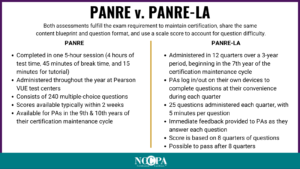
FeatureTraditional PANREPANRE-LA
FormatSingle, proctored examinationOnline longitudinal assessment
Questions240 questions in one testing session25 questions per quarter
ReferencesClosed-bookOpen-book, with permitted references
TimingConcentrated exam-day performanceRepeated quarterly participation
Preparation emphasisPacing, endurance, and mixed-system reviewConsistent review and efficient reference use

The traditional PANRE is generally taken during years 9 and 10 of the certification cycle. PANRE-LA is an alternative longitudinal pathway conducted over multiple quarters. Confirm your eligibility, deadlines, scoring requirements, and current policies directly with the NCCPA PANRE-LA information page.

PANRE-LA is not an open-book shortcut. Five minutes per question is limited when you must interpret a vignette, identify the relevant issue, search a reference, and make a decision. You still need a broad knowledge base.

Better approach

If you plan to take the traditional PANRE, use timed mixed blocks and full-length practice exams. Practice remaining focused across a long testing session.

If you plan to participate in PANRE-LA, establish a consistent weekly or monthly review routine. Use references selectively and practice identifying the central clinical problem before searching.

Mistake 4: Taking Full-Length Exams Too Late

A full-length exam should identify problems early enough for you to correct them. Waiting until the final week may reveal weaknesses without leaving sufficient time to address them.

The PANRE Review Course includes five full-length 240-question practice exams. Use them as progress checkpoints:

  • Exam 1: Establish a baseline.
  • Exam 2: Reassess your highest-priority weak areas.
  • Exam 3: Practice pacing across mixed systems.
  • Exam 4: Identify persistent errors.
  • Exam 5: Simulate test-day conditions.

Do not review only the total score. Analyze performance by organ system, question type, and timing. A missed question may reflect a knowledge gap, a misread stem, incorrect sequencing, or fatigue.

For traditional PANRE preparation, complete at least one simulation under closed-book, timed conditions. For PANRE-LA preparation, use the full-length exams to identify content gaps, then convert those gaps into shorter, focused question blocks.

Mistake 5: Separating PANRE Preparation From CME Planning

Purchasing one product for exam preparation and another for CME can increase cost and divide your attention. A focused activity can support both goals when its credit designation matches your needs.

The PANRE Review Course costs $499.99, includes 30 months of access, and provides more than 2,500 board-style questions. It also includes five full-length 240-question exams and a complete PANRE Study Library.

The up to 100 AAPA Category 1 CME credits apply specifically to the PANRE Clinical Review Module within the PANRE Review Course. They do not automatically apply to the separate Pharmacology Course or other CME products. To earn the available credit, complete the required educational content, pass the post-test, and complete the activity evaluation. Claim only the credit commensurate with your participation.

Optional cme gift cards are available through Amazon and Apple in amounts from $100 to $1,500. The selected amount is added to the course price.

For example:

  • Course only: $499.99
  • Course plus $100 add-on: $599.99
  • Course plus $500 add-on: $999.99
  • Course plus $1,500 add-on: $1,999.99

The gift card is a separate paid component. It does not increase the number of CME credits and is not a free gift, discount, or rebate. Confirm that your employer permits this type of purchase before using CME funds.


Amazon gift card add-on option

Apple gift card add-on option

A More Efficient Daily PANRE Routine

A short, consistent routine is more useful than irregular marathon sessions.

1. Complete a focused question block

Use 20 to 40 questions. Choose mixed topics for traditional PANRE preparation or shorter, system-based blocks when addressing a specific weakness.

2. Review errors immediately

Read the explanation even when you selected the correct answer by guessing. Identify why the correct option is preferred and why the distractors are less appropriate.

3. Reinforce one topic

Review one related section in the study library, then complete several new questions on that topic. Avoid opening multiple unrelated resources during the same session.

4. Reassess regularly

Use full-length exams to measure progress. Adjust your study plan based on performance data, not familiarity with the material.

PANCE Preparation Versus PANRE Preparation

PA students preparing for initial certification should use resources designed for the PANCE. PAtopia’s web version provides PANCE, PACKRAT, EOC, and EOR preparation resources.

PAtopia is also available through:

These resources are separate from the PANRE Review Course. PAtopia does not provide the up to 100 AAPA Category 1 CME credits associated with the PANRE Clinical Review Module.
PAtopia PA exam preparation platform

Final Checklist

Before purchasing or beginning your review plan, confirm:

  • Your certification-cycle year
  • Whether traditional PANRE or PANRE-LA fits your schedule
  • Your weakest organ systems and task areas
  • The required CME amount for your current cycle
  • The post-test and evaluation requirements
  • Your employer’s policy for paid add-ons
  • The total price after selecting a gift card
  • That the gift card does not provide additional CME

The PANRE Review Course provides a structured way to combine recertification preparation and CME planning: $499.99, 30 months of access, more than 2,500 board-style questions, five full-length 240-question exams, and up to 100 AAPA Category 1 CME credits through the PANRE Clinical Review Module.

Review the PANRE Review Course and optional gift card add-ons.

Author Box

Jeremy Boroff, MPAS, PA-C

Jeremy Boroff is a physician assistant, educator, CME developer, and founder of CME Review Courses with 24 years of Emergency Medicine experience. He develops PANRE, PANCE, EOR, and specialty review materials focused on practical clinical reasoning, board-style questions, and evidence-informed explanations.

Educational requirements and credit acceptance can change. Confirm current policies with NCCPA, AAPA, your employer, state licensing board, or certifying organization before claiming CME or using CME funds.
Posted on

Daily CME Tips: 5 Facts About AAPA Category 1 Credit Every PA Should Know Before PANRE

Price: $499.99 for the PANRE Review Course
Access: 30 months
CME: Up to 100 AAPA Category 1 CME credits through the PANRE Clinical Review Module
Practice questions: More than 2,500 board-style questions, including five full-length 240-question exams
Optional add-ons: Paid Amazon or Apple gift cards from $100 to $1,500

The Amazon and Apple gift card options are paid add-ons, not free gifts. The amount selected is added to the course price, and the gift card does not provide additional CME credit.

For PAs preparing for PANRE or PANRE-LA, AAPA Category 1 credit can support both exam preparation and NCCPA certification maintenance. However, the terms “Category 1,” “AAPA Category 1,” and “100 credits” should not be treated as interchangeable in every situation.

Here are five facts to review before selecting a PANRE Review Course.

AAPA Category 1 CME designation

Fact 1: AAPA Category 1 CME is accepted by NCCPA for Category 1 requirements

NCCPA accepts several recognized CME designations for certification maintenance, including AAPA Category 1 CME. This is why the accrediting organization and exact credit designation matter when you select a course.

For a PA who remains continuously certified, NCCPA generally requires:

  • 100 total CME credits every two-year cycle
  • At least 50 Category 1 CME credits
  • The remaining credits as Category 1, Category 2, or a combination

The current NCCPA continuing medical education requirements explain the applicable credit categories and logging requirements.

The PANRE Clinical Review Module within the PANRE Review Course is designated for up to 100 AAPA Category 1 CME credits. This can provide a substantial portion of a PA’s CME requirement while the PA reviews core medical knowledge for recertification.

That does not mean every PA must earn exactly 100 Category 1 credits in a routine cycle. It means the activity offers up to 100 credits that may be claimed based on completion and participation.

Fact 2: The 100-credit PANRE course is different from the routine 50-credit Category 1 minimum

A common misunderstanding is that every PA must earn 100 Category 1 credits during every two-year cycle. For most continuously certified PAs, the standard requirement is 100 total credits, including at least 50 Category 1 credits.

A separate 100-credit Category 1 requirement may apply to a PA who is attempting to regain certification after a lapse. If your certification has expired, review the applicable NCCPA policy before assuming that the routine maintenance rules apply.

The PANRE Review Course can still be useful under either situation because it provides up to 100 AAPA Category 1 CME credits through its PANRE Clinical Review Module. However, you are responsible for confirming:

  1. Your current certification status
  2. Your CME earning window
  3. The number and type of credits you still need
  4. Whether you are preparing for traditional PANRE or PANRE-LA
  5. Whether the course approval period covers your completion date

The course is listed under AAPA reference number CME-2016187, with approval valid from August 26, 2026, through August 26, 2027. Verify current approval details on the PANRE Review Course product page before beginning the activity.

Fact 3: Category 1 CME is not limited to one educational format

AAPA Category 1 CME may include standard educational activities, self-assessment activities, and performance-improvement activities. These formats have different structures and may receive different treatment when logged with NCCPA.

For example, NCCPA applies additional weighting to certain activities:

  • AAPA Category 1 Self-Assessment CME receives a 50% increase when logged with NCCPA.
  • The first 20 eligible PI-CME credits in a two-year cycle may be doubled.

The additional weighting applies to the NCCPA certification-maintenance calculation. It does not automatically change the number of credits awarded by the course provider or the number of credits accepted by a state licensing board.

The PANRE Review Course should be evaluated according to the designation stated for the specific activity. Do not assume that every question bank or exam-preparation product is automatically self-assessment CME. The course requirements, credit designation, and completion instructions control what you may claim.

PANRE exam review resource

Fact 4: You must complete the activity requirements before claiming the available credit

The PANRE Review Course provides educational content and practice questions, but selecting the course does not automatically award 100 CME credits.

To claim the available AAPA Category 1 CME through the PANRE Clinical Review Module, you must complete the required activity components. These include:

  • Reviewing the applicable course content
  • Completing the module post-test
  • Achieving the required passing score of at least 70%
  • Completing the activity evaluation
  • Claiming only the credit supported by your participation

This distinction is important when using an online PANRE review course. Access to a question bank is not the same as completion of an accredited CME activity.

After completing the activity, log the credit with NCCPA according to its current instructions. AAPA recommends having the program title, provider, number of credits, and sponsoring organization available when logging CME. Keep documentation of completed Category 1 activities for the period required by NCCPA in case of an audit.

The credit belongs to the educational activity. It does not come from the gift card add-on, the purchase transaction, or the number of dollars spent.

Fact 5: AAPA Category 1 credit may not satisfy every state or profession-specific requirement

AAPA Category 1 CME is designed primarily for physician assistant education and is accepted by NCCPA for PA certification maintenance. State licensing boards may apply additional or different requirements.

Nurse practitioners should confirm whether their state board of nursing or certifying organization accepts AAPA Category 1 credit. Acceptance varies by state and by the specific renewal requirement.

Physicians should also verify how the activity is classified under their applicable CME system. Clinical content may be useful, but AAPA Category 1 credit does not automatically satisfy a physician’s Category 1 requirement.

The same principle applies to employer reimbursement. Before purchase, confirm that your organization permits the course and any associated paid add-on.

What the PANRE Review Course includes

The PANRE Review Course is designed for practicing PAs preparing for broad recertification review. The course includes:

  • Up to 100 AAPA Category 1 CME credits through the PANRE Clinical Review Module
  • More than 2,500 board-style questions
  • Five full-length practice exams
  • 240 questions per full-length exam
  • Detailed rationales and cited sources
  • Organ-system review across the current NCCPA Blueprint
  • A PANRE study library
  • 30 months of access

The five full-length examinations provide 1,200 questions in a comprehensive testing format. The additional question bank allows you to focus on specific areas such as cardiology, pulmonary medicine, gastroenterology, neurology, dermatology, infectious disease, endocrinology, renal medicine, psychiatry, reproductive health, and emergency medicine.

How the paid CME gift card add-ons work

CME Review Courses offers optional cme gift cards through Amazon and Apple. Available amounts range from $100 to $1,500.

These are paid add-ons. They are not free gifts, rebates, discounts, or additional CME.

Examples include:

  • Course only: $499.99
  • Course plus $100 gift card: $599.99
  • Course plus $500 gift card: $999.99
  • Course plus $1,000 gift card: $1,499.99
  • Course plus $1,500 gift card: $1,999.99

The selected gift card amount increases the total purchase price. It does not increase the number of AAPA Category 1 credits, add practice questions, or alter the access period.

Amazon gift card add-on

Gift cards are generally processed and delivered by email within two to three business days. Gift card packages are nonrefundable after issuance. CME Review Courses is not affiliated with or sponsored by Amazon or Apple.

PANRE-style clinical practice question

Vignette

Your patient is a 64-year-old man who is two days postoperative from total knee arthroplasty. He develops sudden dyspnea and pleuritic right-sided chest pain. His HR is 114/min, BP is 126/78 mm Hg, RR is 25/min, and SaO₂ is 90% on room air. He has unilateral left calf swelling and tenderness. He is alert and hemodynamically stable, with no history of renal disease or contrast allergy.

Which diagnostic study is most appropriate next?

A. D-dimer assay
B. CT pulmonary angiography
C. Bilateral lower-extremity venous ultrasound only
D. Transthoracic echocardiography as the first test
E. Exercise stress testing

Answer and explanation

B. CT pulmonary angiography is correct. This patient has a high pretest probability for acute pulmonary embolism based on recent surgery, tachycardia, hypoxemia, pleuritic chest pain, and unilateral leg findings. He is stable and has no stated contraindication to iodinated contrast, making CT pulmonary angiography the appropriate next diagnostic study.

D-dimer testing is not useful when the clinical probability is high and postoperative elevation is expected. Lower-extremity ultrasound alone may identify DVT but does not directly evaluate the pulmonary circulation. Echocardiography is useful for assessing right-heart strain, especially in an unstable patient, but it is not the preferred initial confirmatory test here. Stress testing is inappropriate in an acute presentation concerning for PE.

Do not confuse PANCE prep courses with PANRE resources

PANCE prep courses are designed primarily for PA students preparing for initial certification. PANRE preparation is intended for practicing PAs completing recertification requirements.

The content overlaps because both examinations assess core medical knowledge. The preparation context differs. A PA preparing for PANRE should use resources that address broad review, recertification timing, full-length practice, and the current NCCPA Blueprint.

For PA students and recent graduates, PAtopia’s web version provides preparation for the PANCE, PACKRAT, EOC, and EOR examinations. PAtopia is also available through the PAtopia iOS app and PAtopia Android app.

PAtopia is separate from the PANRE Review Course and does not provide the 100 AAPA Category 1 CME credits associated with the PANRE Clinical Review Module.

Final checklist before purchasing

Before selecting a PANRE CME course, confirm:

  • The exact AAPA Category 1 credit designation
  • The number of credits available
  • Your current NCCPA cycle and certification status
  • The course completion requirements
  • The course approval period
  • Your employer’s reimbursement policy
  • Whether paid gift card add-ons are permitted
  • Whether you need PANRE or PANRE-LA preparation
  • Whether the course provides sufficient practice questions and full-length exams

The PANRE Review Course costs $499.99, provides 30 months of access, includes more than 2,500 board-style questions, and offers up to 100 AAPA Category 1 CME credits through the PANRE Clinical Review Module specifically.

Optional Amazon and Apple gift card add-ons range from $100 to $1,500. They are paid additions to the course price and do not provide additional CME.

Review the PANRE Review Course with gift card options or browse CME Review Courses.

Author Box

Jeremy Boroff, MPAS, PA-C

Jeremy Boroff is a physician assistant with 24 years of Emergency Medicine experience. He is an educator, author, CME developer, and founder of CME Review Courses. His review materials emphasize practical clinical reasoning, board-style vignettes, evidence-informed explanations, and efficient preparation for PA certification and recertification examinations.

CME requirements and credit acceptance can change. Verify current requirements with AAPA, NCCPA, your state licensing board, certifying organization, and employer before claiming CME or using CME funds.

Posted on

Daily CME Tips: PANRE-LA vs Traditional PANRE : How to Pick Your Path and Earn 100 Category 1 AAPA Credits

Price: $499.99 for the PANRE Review Course
Access: 30 months
CME: Up to 100 AAPA Category 1 CME credits through the PANRE Clinical Review Module
Practice questions: 1,200 board-style questions across five 240-question exams
Optional add-ons: Paid Amazon or Apple gift cards from $100 to $1,500

The gift cards are not free gifts. They are paid add-ons that increase the total purchase price, and they do not provide additional CME credit.

For a PA approaching recertification, the first decision is not which review book to open. It is which NCCPA recertification pathway fits your testing style, schedule, and current point in the 10-year certification cycle: the traditional PANRE or the PANRE Longitudinal Assessment, commonly called PANRE-LA.

Traditional PANRE vs PANRE-LA: The Essential Comparison

Both pathways assess core medical knowledge across the NCCPA Blueprint. The difference is how and when you demonstrate that knowledge.

FeatureTraditional PANREPANRE-LA
Testing windowYears 9–10 of the certification cycleQuestions administered during years 7–9
FormatSingle-day, closed-book, proctored examAt-home, online, open-book assessment
Question schedule240 questions in one sitting25 questions per quarter
Participation requirementOne examination attempt at a timeComplete at least 8 of up to 12 quarters
ScoringPassing scaled score of 379Best-8 cumulative score of 1150
Testing environmentProctored testing centerHome or another appropriate location using approved technology
Study approachConcentrated preparation before one high-stakes examRepeated preparation and review over multiple quarters

The NCCPA’s PANRE-LA information explains that PANRE-LA participants receive 25 questions each quarter, may use online or printed references, and can skip up to four quarters. Scores are recalculated using the best eight quarters.

The traditional PANRE remains a more concentrated assessment: 240 questions, closed-book, proctored, and completed in a single testing session. You generally take this route during years 9 or 10.

Which path is better for you?

Choose the traditional PANRE if you:

  • Prefer to prepare for one defined exam date.
  • Perform well in a proctored testing environment.
  • Want to complete the assessment in one sitting.
  • Are already in years 9–10 of your certification cycle.
  • Prefer not to manage quarterly deadlines.

Choose PANRE-LA if you:

  • Prefer shorter assessment periods distributed throughout the year.
  • Want to use references while answering questions.
  • Are eligible during the years 7–9 testing window.
  • Prefer ongoing feedback instead of one final exam score.
  • Can consistently dedicate time to quarterly preparation.

PANRE-LA is not an easier version of the traditional PANRE. It is a different assessment structure. You still need broad knowledge of the NCCPA Blueprint, including cardiovascular, pulmonary, infectious disease, neurology, psychiatry, dermatology, musculoskeletal, reproductive, gastrointestinal, renal, endocrine, hematology, and emergency medicine topics.

PANRE review exam preparation materials

Two Distinct CME Review Course Options

CME Review Courses offers two separate preparation products. Both are designed for practicing PAs and provide access for 30 months.

PANRE Review Course

The PANRE Review Course is designed for PAs preparing for the traditional PANRE while also supporting review for core medical content assessed by PANRE-LA.

The purchase includes:

  • $499.99 base price
  • 30 months of access
  • 1,200 board-style questions
  • Five 240-question practice examinations
  • Detailed rationales and cited sources
  • A comprehensive PANRE Study Library
  • Up to 100 AAPA Category 1 CME credits

The 100-credit designation applies specifically to the PANRE Clinical Review Module within the PANRE Review Course. It is not a blanket designation for unrelated courses, and it does not refer to the Pharmacology course.

PANRE-LA Review Course

The PANRE-LA Review Course is a separate course for PAs preparing for the longitudinal assessment.

It includes:

  • $499.99 base price
  • 30 months of access
  • 1,200 board-style questions
  • Five 240-question practice examinations
  • Organ-system review and cited rationales
  • PANRE-LA-focused study organization
  • Its own separate designation of up to 100 AAPA Category 1 CME credits

The PANRE Clinical Review Module and the PANRE-LA Module are distinct educational products. If you select the PANRE-LA course, the 100 AAPA Category 1 credits are attributed to the PANRE-LA Module, not the PANRE Clinical Review Module.

PANRE-LA review course and CME package

Use Your CME Allowance Efficiently

A recertifying PA often needs both exam preparation and a substantial amount of CME. A single purchase can address both needs when the course is completed according to the activity requirements.

The practical strategy is simple:

  1. Select the review course that matches your recertification pathway.
  2. Use the 30-month access period to build a sustained study schedule.
  3. Complete the educational content, post-test, and evaluation.
  4. Claim only the AAPA Category 1 credit that matches your participation.
  5. Apply the course purchase to your employer’s CME allowance if permitted by your workplace policy.

The base course is $499.99. You may also select an Amazon or Apple gift card add-on in amounts from $100 to $1,500. The add-on is included in the total package price, but it does not increase the CME credit awarded. It also should not be treated as a free promotional item. Confirm that your employer permits this type of CME package before purchase.

Gift cards are delivered by email after processing. CME credit is earned by completing the course requirements, not by selecting a gift card.

PAs should also confirm current NCCPA requirements and their employer’s reimbursement policy. Nurse practitioners may find value in the clinical content, but acceptance of AAPA Category 1 credit for NP licensure or certification varies by state. Physicians may use the clinical material as professional education, but they should verify how their own accrediting body classifies the activity.

PANRE-Style Practice Question

Clinical Vignette

Your patient is a 67-year-old man who presents with sudden-onset pleuritic chest pain and dyspnea. He underwent total knee replacement 10 days ago. His HR is 118/min, BP is 128/74 mm Hg, RR is 26/min, and SaO₂ is 92% on room air. He has no hemoptysis. His lungs are clear to auscultation, and his left calf is mildly swollen and tender.

Which of the following is the most appropriate next step?

A. D-dimer testing
B. Immediate systemic thrombolysis
C. CT pulmonary angiography
D. Outpatient venous duplex ultrasound only
E. Reassurance and follow-up with his surgeon

Correct Answer: C. CT pulmonary angiography

CT pulmonary angiography is correct because this patient has a high clinical suspicion for pulmonary embolism based on recent major surgery, tachycardia, hypoxemia, pleuritic chest pain, and unilateral calf findings. He is hemodynamically stable, so diagnostic imaging should be obtained promptly.

D-dimer testing is not useful when the pretest probability is high. Systemic thrombolysis is generally reserved for massive PE with hemodynamic instability. Venous duplex ultrasound alone does not adequately evaluate suspected pulmonary embolism, and reassurance is inappropriate.

This is the type of core medical knowledge tested across both traditional PANRE and PANRE-LA. A strong review plan should emphasize clinical reasoning, not only memorization of isolated facts.

PANCE Prep Courses Are Not the Same as PANRE Resources

The PANCE is the initial certification examination for PA students and recent graduates. PANCE prep courses are designed around that stage of training.

Practicing PAs preparing for recertification need PANRE-focused or PANRE-LA-focused resources. The exam timing, assessment format, and recertification context are different. If you are already certified and approaching the later years of your cycle, select materials organized for the traditional PANRE or PANRE-LA rather than relying only on an initial-certification review product.

For the current NCCPA topic structure, review the NCCPA PANRE/PANRE-LA core content document.

Bottom Line

Your choice should match your timeline and testing preferences:

  • Traditional PANRE: one-day, closed-book, proctored, 240-question exam with a passing scaled score of 379.
  • PANRE-LA: at-home, open-book, 25 questions per quarter, at least 8 of up to 12 quarters, with a best-8 cumulative passing score of 1150.
  • PANRE Review Course: $499.99, 30 months of access, 1,200 questions, and up to 100 AAPA Category 1 credits through the PANRE Clinical Review Module.
  • PANRE-LA Review Course: a separate $499.99 product with 30 months of access, 1,200 questions, and its own up to 100-credit AAPA Category 1 designation through the PANRE-LA Module.
  • CME gift cards: optional paid Amazon or Apple add-ons from $100 to $1,500 that increase the total price but do not add CME credit.

Plan around your certification year, then use your CME budget for a course that supports both your exam preparation and your continuing education requirements.

About the Author

Jeremy Boroff, MPAS, PA-C, is the founder of CME Review Courses, an author, educator, and practicing physician assistant with 24 years of emergency medicine experience. He develops board-style clinical education and CME review materials for physician assistants preparing for certification, recertification, and ongoing clinical practice.

Posted on

Daily CME Tips: Stretch Your CME Budget Further with Amazon and Apple Gift Card Add-Ons

Course price: $499.99
Access: 30 months
CME: Up to 100 AAPA Category 1 CME credits
Practice content: Five full-length exams with 1,200 board-style questions
Gift card options: Paid Amazon or Apple add-ons from $100 to $1,500

Daily CME Tip: Use Your CME Allowance Strategically

Many PAs receive a defined annual CME allowance. The challenge is using that budget for something that provides measurable professional value rather than spending it on disconnected courses that do not support your certification goals.

The PANRE Review Course with Gift Card combines structured PANRE preparation with up to 100 hours of AAPA Category 1 CME. You can then select a paid Amazon or Apple gift card add-on in an amount that fits your available CME budget.

The gift card is not a free gift, rebate, or discount. It is a separate paid add-on that increases the total package price. It also does not increase the number of CME credits awarded.

Review the current PANRE Review Course with Gift Card details before purchasing. Employer and institutional CME policies differ, so confirm that your organization permits this type of package.

What the PANRE Review Course Includes

The course is designed for practicing PAs preparing for the PANRE or PANRE-LA while completing CME requirements. It includes:

  • Up to 100 AAPA Category 1 CME credits for the PANRE Clinical Review Module
  • Five full-length practice examinations
  • 1,200 total board-style questions, with 240 questions per examination
  • Five answer choices per question
  • Written rationales and cited sources
  • A comprehensive PANRE Study Library
  • Online, self-paced access for 30 months
  • A post-test and evaluation required to claim CME credit

To earn the available CME, you must complete the course content, pass the post-test with a score of at least 70%, and complete the activity evaluation. Claim only the amount of credit that corresponds to your participation.

The NCCPA PANRE and PANRE-LA content document should remain your primary reference for current examination content. A review course is a preparation resource, not a replacement for official NCCPA information.

PANRE examination review book cover

How the Paid CME Gift Card Add-Ons Work

At checkout, you can select either an Amazon or Apple gift card. Available amounts range from $100 to $1,500, depending on the brand and tier selected.

Examples using the $499.99 base course price include:

SelectionTotal package price
PANRE Review Course only$499.99
Course + $100 gift card$599.99
Course + $500 gift card$999.99
Course + $1,000 gift card$1,499.99
Course + $1,500 gift card$1,999.99

These are paid CME gift cards. The selected amount is added to the course price. The card is not a bonus supplied at no cost, and purchasing a higher gift card amount does not provide additional CME hours.

Amazon and Apple gift cards are generally processed and sent by email within 2–3 business days. Gift card purchases are nonrefundable after processing. CME Review Courses is not affiliated with Amazon or Apple.

Choosing Between Amazon and Apple

Select the gift card based on how you expect to use it.

Amazon gift card option for CME package add-ons

Amazon Gift Card

An Amazon gift card may be useful for professional or educational purchases available through Amazon, such as:

  • Medical reference books
  • Desk or office equipment
  • Computer accessories
  • Organization and study supplies
  • Select clinical tools and technology

Confirm that any intended purchase is permitted under your employer’s CME policy. A CME allowance may cover education and related professional expenses, but not every organization treats gift card add-ons the same way.

Apple gift card option for CME package add-ons

Apple Gift Card

An Apple gift card may be appropriate if you plan to purchase:

  • Clinical reference applications
  • Educational applications
  • Apple accessories used for professional study
  • Tablet or device-related tools
  • Digital resources available through Apple services

Again, verify your organization’s rules before placing the order. The responsibility for determining whether the expense qualifies rests with the purchaser and the employer or institution providing the CME funds.

A Simple Budget Calculation

Suppose your annual CME allowance is $1,000. The PANRE Review Course costs $499.99. Adding a $500 paid gift card creates a total package price of $999.99.

That package provides:

  • A PANRE-focused review resource
  • Up to 100 AAPA Category 1 CME credits
  • 30 months of course access
  • A $500 Amazon or Apple gift card
  • A total cost that closely matches a $1,000 allowance

If your allowance is $2,000, the course plus a $1,500 gift card totals $1,999.99, using essentially the full allowance. Do not select an amount solely to spend the full allowance. First confirm that the course meets your certification needs and that the add-on is permitted by your CME policy.

This approach can be more practical than purchasing several unrelated activities simply because they are available. The course supports both PANRE preparation and CME completion, while the paid add-on gives you flexibility in how you use the remainder of your professional education budget.

PANRE Preparation Versus PANCE Prep Courses

Searches for PANCE prep courses often return resources intended for PA students preparing for initial certification. Those products may be useful for PANCE preparation, but the PANRE is a recertification examination for practicing PAs.

The PANRE Review Course is designed around recertification-level review across the organ systems and clinical areas assessed on the PANRE and PANRE-LA. If you are preparing for initial certification, use a PANCE-specific resource. If you are preparing for recertification, select a PANRE-focused course and confirm that it matches your examination pathway.

CME Review Courses also offers separate options, including PANRE/PANRE-LA review exams with a gift card add-on. Compare the included questions, examination format, CME designation, and access period before choosing.

Clinical Practice Question

Vignette

Your patient is a 58-year-old woman with 24 hours of fever, RUQ pain, jaundice, and vomiting. Her temperature is 39.3°C, HR 122/min, BP 88/54 mm Hg, and SaO₂ 97% on room air. Laboratory studies show leukocytosis, direct hyperbilirubinemia, and elevated alkaline phosphatase. RUQ ultrasonography demonstrates biliary ductal dilation and a common bile duct stone. After blood cultures and initial IV fluid resuscitation, which is the most appropriate next step?

A. Elective laparoscopic cholecystectomy
B. Urgent ERCP with biliary decompression
C. HIDA scan
D. MRCP before any intervention
E. Oral ursodeoxycholic acid

Answer

B. Urgent ERCP with biliary decompression

This patient has acute ascending cholangitis with sepsis caused by biliary obstruction. After cultures, broad-spectrum IV antibiotics and hemodynamic stabilization, urgent biliary drainage with ERCP is indicated.

Elective cholecystectomy does not address the immediate infected obstruction. HIDA scanning is unnecessary because the diagnosis is supported by the clinical findings and ultrasound. MRCP may define biliary anatomy but delays decompression in an unstable patient. Ursodeoxycholic acid is not appropriate for acute obstruction or sepsis.

Final CME Budget Checklist

Before purchasing, confirm the following:

  1. Your CME allowance and deadline
  2. Whether your employer permits paid gift card add-ons
  3. Whether you need PANRE preparation, general CME, or pharmacology-specific CME
  4. Whether you can use up to 100 AAPA Category 1 credits during your current cycle
  5. The gift card brand and amount that fit your planned use
  6. That the gift card amount is added to the course price
  7. That the gift card does not provide additional CME credit
  8. That you understand the gift card is nonrefundable after processing

For PAs who need substantial Category 1 credit and structured recertification preparation, the PANRE Review Course with Gift Card provides a single online package with 30 months of access, 1,200 practice questions, five full-length examinations, and up to 100 AAPA Category 1 CME credits.

If you need a different clinical focus, browse the complete CME with Amazon and Apple gift card package catalog. The catalog includes options in internal medicine, emergency medicine, family medicine, cardiology, orthopedics, dermatology, neurology, psychiatry, OB/GYN, and pharmacology. The Pharmacology CME Review Package offers a separate 12.5 AAPA Category 1 CME credits and should not be confused with the 100-credit PANRE course.

Posted on

Daily CME Tips: How to Avoid a CME Gift Card Add-On Mistake While Preparing for PANRE

Course price: $499.99
Access: 30 months
Question bank: 2,500+ board-style questions
Full-length exams: Five 240-question practice exams
CME: Up to 100 hours of AAPA Category 1 CME through the PANRE Clinical Review Module
Optional add-on: Amazon or Apple gift card from $100 to $1,500

A CME gift card add-on can be useful when it is evaluated correctly. The common mistake is treating the gift card as part of the educational value of the course rather than as a separate, optional purchase.

The Amazon and Apple add-ons are paid add-ons: not free gifts. The amount selected is added to the course price. A $500 Amazon gift card, for example, adds $500 to the $499.99 course price. The gift card also does not increase CME credit. It does not create additional AAPA Category 1 hours, and it should not be logged as a CME activity.

The correct way to evaluate the package is to assess the PANRE Review Course first, then decide whether the optional add-on fits your employer’s CME policy and your intended use.

1. Confirm What the Course Actually Delivers

The PANRE Clinical Review Module is the educational component that provides up to 100 hours of AAPA Category 1 CME. These hours apply specifically to the PANRE module.

The 100-hour figure does not apply to the separate Pharmacology course. Pharmacology is its own CME activity with its own credit amount. Do not combine the two courses when documenting or planning your CME.

To earn credit for the PANRE Clinical Review Module, you must complete the required educational content, pass the module post-test with a score of at least 70%, and complete the evaluation. You claim only the amount of credit that matches your participation.

For physician assistants, the course is designed to support both certification maintenance and exam preparation. Nurse practitioners should verify whether their state board or employer accepts AAPA Category 1 credit for their specific renewal requirements. Physicians should also verify how the activity applies to their individual CME requirements.

2. Evaluate the Question Volume and Exam Structure

A large question count is useful only when the questions are clinically relevant, organized, and supported by explanations.

This course includes 2,500+ board-style questions across the question bank and system-based review. It also includes five full-length practice examinations with 240 questions each, for 1,200 questions in the full-length exam set.

That distinction matters. The five 240-question exams provide repeated practice with exam-length sessions. The additional questions allow you to target specific organ systems and revisit weak areas without repeatedly taking the same comprehensive exam.

The material is organized around the current NCCPA Blueprint, including major clinical areas such as:

  • Cardiovascular medicine
  • Pulmonary disease
  • Gastroenterology and nutrition
  • Musculoskeletal conditions
  • Neurology
  • Psychiatry
  • Dermatology
  • Infectious disease
  • Reproductive health
  • Hematology
  • Endocrinology
  • Renal and genitourinary disease
  • Emergency medicine

Each question includes answer rationales and cited sources. This is important because a practice question should teach you how to reason through the diagnosis and management: not simply tell you whether your selection was correct.

A strong panre review course should help you identify why an answer is correct, why the alternatives are less appropriate, and what clinical feature changes the decision.

3. Check Whether the Access Period Matches Your Exam Timeline

The course includes 30 months of access. This is a meaningful feature if your PANRE preparation will extend over multiple study phases, work obligations, or testing windows.

You can begin with a baseline assessment, use the system modules to target deficiencies, and return later for full-length exams. The extended access period also allows you to use the course for continuing review instead of purchasing a separate resource every few months.

Before purchasing, compare the access period with your expected PANRE or PANRE-LA schedule. A course that expires before your planned testing window may have less practical value, even if the initial question count looks impressive.

The access period should support a structured plan:

  1. Take an initial practice exam.
  2. Review performance by organ system.
  3. Complete targeted system-based questions.
  4. Repeat missed or flagged questions.
  5. Take another full-length exam.
  6. Adjust your study plan based on performance rather than familiarity.

4. Separate Educational Value From the Gift Card Value

Amazon gift card add-on option

The Amazon and Apple options are simply payment add-ons attached to the purchase. They do not change the course content, access period, question count, exam structure, or CME amount.

Available add-ons range from $100 to $1,500. You choose the brand and amount during checkout. The selected amount is added to the course price, and the gift card is generally delivered by email within two to three business days.

Use this calculation before purchasing:

Total purchase price = $499.99 course price + selected gift card amount

Examples:

  • Course only: $499.99
  • Course plus $100 add-on: $599.99
  • Course plus $500 add-on: $999.99
  • Course plus $1,500 add-on: $1,999.99

The add-on may help you use available CME funds for eligible educational or professional purchases, depending on your employer’s rules. However, you should confirm your policy before selecting an amount. Some organizations restrict CME funds to courses, books, conferences, software, or other approved resources.

Do not assume that the gift card is free. Do not assume that a larger gift card means more CME. The educational deliverable remains the same whether you purchase the course alone or select the largest add-on.

5. Review the Completion Requirements Before You Buy

The value of a CME course depends on whether you can complete it and claim the credit appropriately.

Before checkout, confirm that you understand:

  • The PANRE Clinical Review Module provides up to 100 hours of AAPA Category 1 CME.
  • You must complete the required course material.
  • You must pass the post-test with at least 70%.
  • You must complete the activity evaluation.
  • You may claim only the credit commensurate with your participation.
  • The gift card itself provides no CME credit.
  • Gift card purchases are subject to the provider’s stated terms and refund policy.

This is also where you should verify your employer’s approval process. The relevant question is not whether the gift card increases the value of the CME activity. It does not. The question is whether your organization permits the selected package structure and the intended use of the add-on.

6. Look for Performance Feedback, Not Just More Questions

A question bank is more useful when it provides actionable performance information.

The PANRE review platform includes performance tracking by topic and organ system. Use those results to identify patterns. If your overall score is acceptable but your pulmonary and renal performance remains low, your next study block should address those areas directly.

Avoid spending most of your study time answering questions you already know. A more efficient approach is:

  • Flag questions you missed or answered by guessing.
  • Read the full rationale, including the distractors.
  • Record the clinical finding that should have guided your decision.
  • Review the relevant topic in the study library.
  • Retest the subject later in a mixed-question block.

This method is more useful than judging a course solely by its total number of questions. The goal is improved clinical reasoning across the NCCPA Blueprint, not simply completing a high volume of items.

A PANRE-Style Clinical Practice Question

Your patient is a 64-year-old man with a history of hypertension and hyperlipidemia who presents with 45 minutes of substernal chest pressure radiating to the left arm. He is diaphoretic and nauseated. Vital signs are BP 158/92 mm Hg, HR 104/min, RR 20/min, and SaO2 96% on room air. ECG shows 2-mm ST-segment elevations in leads II, III, and aVF with reciprocal ST depressions in leads I and aVL.

What is the most appropriate next step?

A. Administer IV alteplase immediately
B. Obtain a D-dimer level
C. Activate the cardiac catheterization laboratory for emergent PCI
D. Perform an exercise stress test
E. Administer a beta blocker and reassess in 6 hours

Correct answer: C. Activate the cardiac catheterization laboratory for emergent PCI.

This patient has an acute inferior STEMI with ongoing symptoms and diagnostic ST-segment elevation. Emergent PCI is the preferred reperfusion strategy when it can be performed promptly. Alteplase is considered when timely PCI is unavailable, but it is not the first choice when catheterization is accessible. D-dimer testing and exercise stress testing are inappropriate in a patient with diagnostic STEMI. A beta blocker does not replace immediate reperfusion and may be harmful in patients with hemodynamic compromise or certain conduction abnormalities.

The question tests recognition of the diagnosis, interpretation of the ECG, and selection of time-sensitive management. Those are the same decision-making skills you should expect from a clinically focused PANRE preparation resource.

Study Efficiently With Additional PA Resources

If you are also reviewing for the PANCE or supporting a PA student, PAtopia’s web version provides browser-based access to PA exam preparation resources. The platform covers the PACKRAT, all seven EOR exams, the EOC, and the PANCE.

You can also study with the PAtopia iOS app or the PAtopia Android app. These resources are separate from the PANRE CME activity and should not be used to represent the 100 AAPA Category 1 CME hours associated with the PANRE Clinical Review Module.

For a direct review of the five full-length exams, visit the PANRE Practice Exams page. To review the complete package and optional add-ons, see the PANRE Review Course with Gift Card.

Apple gift card add-on option

Final Pre-Purchase Checklist

Before selecting a CME gift card add-on, confirm each item:

  • Course price: The base PANRE course is $499.99.
  • Access: You receive 30 months of access.
  • Questions: The course includes 2,500+ questions.
  • Exams: You receive five 240-question practice exams.
  • CME: Up to 100 AAPA Category 1 hours apply to the PANRE Clinical Review Module.
  • Add-on cost: Amazon or Apple options range from $100 to $1,500.
  • Payment structure: The add-on is paid and added to the course price.
  • CME limitation: The gift card does not increase CME credit.
  • Policy: Your employer permits the selected purchase structure.
  • Completion: You understand the post-test and evaluation requirements.

AAPA Category 1 CME logo

The practical decision is straightforward: choose the PANRE course based on its CME, access period, question quality, exam structure, and performance tools. Consider the Amazon or Apple option only after confirming that the paid add-on fits your policy and intended use.

That approach prevents the most common misunderstanding: confusing a useful purchasing option with an educational deliverable.


About the Author

Jeremy Boroff, MPAS, PA-C, is the founder of CME Review Courses and PAtopia. He is an educator and practicing emergency medicine physician assistant with 24 years of Emergency Medicine experience. Jeremy has also served for more than 20 years as an APC director of an emergency department and has authored multiple PA exam review books and educational resources.

His clinical and teaching work focuses on practical exam preparation, evidence-based decision-making, and efficient continuing medical education for practicing physician assistants.

Posted on

Daily CME Tips: Facts About AAPA Category 1 Credit : and How to Make It Cover Your Recertification

Course price: $499.99
Access: 30 months from purchase
CME: Up to 100 hours of AAPA Category 1 CME through the PANRE Clinical Review Module
Study material: 2,500+ PANRE practice questions, including five full-length 240-question practice exams
Gift card options: Optional paid Amazon or Apple Gift Card add-ons from $100 to $1,500

If you are planning PANRE or PANRE-LA preparation, the type and amount of CME you complete matters. A course may provide useful clinical education without satisfying your Category 1 requirement. Before using your CME allowance, confirm the accreditation designation, number of credits, completion requirements, and whether the activity fits your current NCCPA certification cycle.

The PANRE Review Course from CME Review Courses combines recertification preparation with up to 100 hours of AAPA Category 1 CME. The 100 hours apply specifically to the PANRE Clinical Review Module, not automatically to other products such as the separate Pharmacology Review Course.

AAPA Category 1 CME designation

What AAPA Category 1 CME Means

AAPA Category 1 CME is formally reviewed educational activity intended to maintain or improve the knowledge, skills, and professional performance used in PA practice. The content should be relevant to patient care, healthcare systems, or the PA profession.

Category 1 CME is not simply any medical education you complete. The activity must have an identified credit designation and defined requirements for participation and completion.

For a self-assessment activity, requirements may include:

  • Multiple-choice questions
  • Explanations or rationales for the answers
  • References supporting the educational content
  • A graded post-test
  • A minimum passing score
  • An evaluation completed by the learner
  • Documentation of the credit awarded

For the PANRE Review Course, you must complete the course requirements, pass the post-test with a score of at least 70%, and complete the activity evaluation. Claim only the credit amount supported by your actual participation.

Review the AAPA CME FAQs and NCCPA continuing medical education requirements for current policies.

How Category 1 CME Applies to Recertification

For a PA who remains continuously certified, NCCPA generally requires:

  • 100 total CME credits during each two-year cycle
  • At least 50 Category 1 CME credits
  • The remaining credits may be Category 1, Category 2, or a combination
  • Completion of the applicable recertification examination requirement during the certification cycle

This means that 100 hours of accepted Category 1 CME can satisfy the total credit quantity for a routine two-year CME cycle, provided the activity is completed during the appropriate period and meets NCCPA requirements. It does not replace PANRE or PANRE-LA when an examination or longitudinal assessment is due.

The requirement is different for some PAs regaining certification after a lapse. NCCPA may require 100 Category 1 CME credits earned within the two-year period ending on the PANRE application date. If your certification has expired, review the specific NCCPA policy for regaining certification.

The practical point is simple: do not assume that every PA has the same CME requirement. Check your certification status, cycle dates, and NCCPA account before deciding how many credits you need.

What the PANRE Review Course Includes

The PANRE Review Course is designed for practicing PAs preparing for traditional PANRE or PANRE-LA. It includes:

  • More than 2,500 board-style questions
  • Five full-length practice examinations
  • 240 questions per full-length exam
  • 1,200 questions across the five exams
  • Questions covering the major organ systems and task areas in the NCCPA Blueprint
  • Detailed rationales and cited sources
  • A complete PANRE Study Library
  • Performance tracking and question flagging
  • 30 months of online access

The format supports several study approaches. You can begin with a full-length examination to establish a baseline, complete system-based modules to address knowledge gaps, and then return to full-length testing to assess pacing and endurance.

A comprehensive panre review course is particularly useful if your clinical practice is concentrated in one specialty. PANRE preparation requires broad review across cardiovascular, pulmonary, GI, endocrine, infectious disease, neurology, psychiatry, dermatology, musculoskeletal, reproductive, renal, hematologic, EENT, genitourinary, and professional practice content.

The 100 Hours Apply to the PANRE Review Course Specifically

The course’s 100 hours of AAPA Category 1 CME apply to the PANRE Clinical Review Module. They should not be attributed to every course offered by CME Review Courses.

For example, the Pharmacology Review Course has its own credit designation and should be evaluated separately. If you purchase multiple courses, document the credit amount assigned to each activity rather than combining them without supporting documentation.

The current PANRE Clinical Review Module is listed under AAPA reference number CME-2016187, with approval valid from August 26, 2026, through August 26, 2027. Verify current approval information on the product page before beginning an activity.

How CME Gift Cards Work

CME Review Courses offers optional cme gift cards through Amazon and Apple. Available add-on amounts range from $100 to $1,500.

These gift cards are paid add-ons, not free gifts. The selected amount is added to the base course price.

Examples include:

  • Course only: $499.99
  • Course plus $100 gift card: $599.99
  • Course plus $500 gift card: $999.99
  • Course plus $1,000 gift card: $1,499.99
  • Course plus $1,500 gift card: $1,999.99

The add-on does not increase the number of CME credits. The PANRE Review Course provides the up to 100 hours of AAPA Category 1 CME. The gift card is a separate paid component of the purchase.

Amazon gift card add-on for CME purchases

Before selecting an add-on, confirm that your employer or institution permits this type of bundled CME purchase. Policies may differ regarding online review courses, board-preparation materials, gift card add-ons, and the maximum amount reimbursed.

Amazon and Apple gift cards are processed by email, generally within two to three business days. Gift card packages are nonrefundable after issuance. CME Review Courses is not affiliated with or sponsored by Amazon or Apple.

Clinical Practice Question

Vignette

Your patient is a 63-year-old man who is two days postoperative from total knee arthroplasty. He develops sudden dyspnea and pleuritic right-sided chest pain. His HR is 114/min, BP is 126/78 mm Hg, RR is 25/min, and SaO₂ is 90% on room air. Examination demonstrates unilateral left calf swelling and tenderness. He is alert and hemodynamically stable. There is no history of renal disease or contrast allergy.

Which diagnostic study is most appropriate next?

A. D-dimer assay
B. CT pulmonary angiography
C. Bilateral lower-extremity venous ultrasound only
D. Exercise stress testing
E. Transthoracic echocardiography as the first test

Correct answer: B. CT pulmonary angiography.

This patient has a high pretest probability for acute pulmonary embolism based on recent surgery, tachycardia, hypoxemia, pleuritic chest pain, and unilateral leg findings. Because he is stable and has no stated contraindication to iodinated contrast, CT pulmonary angiography is the preferred next diagnostic study.

D-dimer testing is less useful when the clinical probability is high and is commonly elevated after surgery. Lower-extremity ultrasound may identify DVT but does not directly evaluate the pulmonary vasculature. Echocardiography is useful for assessing right-heart strain, particularly in an unstable patient, but it is not the preferred initial confirmatory study here. Stress testing is inappropriate in an acute presentation concerning for PE.

The management principle is to establish pretest probability, assess hemodynamic stability, and select the diagnostic test that provides the most useful information without unnecessary delay, cost, or radiation exposure.

PANRE and PANRE-LA full-length practice exams

Who Should Consider This Course?

The PANRE Review Course is intended primarily for physician assistants who need broad recertification preparation and Category 1 CME.

Nurse practitioners may find the clinical material useful, but acceptance of AAPA Category 1 credit varies by state board, employer, and certifying organization. NPs should verify requirements with their state board of nursing before purchasing.

Physicians may also find value in the clinical content. However, AAPA Category 1 credit does not automatically fulfill a physician’s Category 1 CME requirement. Physicians should confirm whether the activity can be reported under their applicable CME rules.

The course may be appropriate if you need:

  • A broad review of the current NCCPA Blueprint
  • Structured PANRE or PANRE-LA preparation
  • A substantial amount of Category 1 CME
  • Full-length practice examinations
  • Long-term access for a demanding clinical schedule
  • A way to use an approved CME allowance for education and an optional paid add-on

PANCE Prep Courses and PAtopia

If you are a PA student rather than a practicing PA preparing for recertification, you may need PANCE prep courses instead of a PANRE review product.

PAtopia is a separate PA exam-preparation platform covering the PANCE, PACKRAT, End of Curriculum examination, and all seven EOR exams. It includes board-style questions, study libraries, full-length practice exams, explanations, and cited references.

PAtopia is available through:

PAtopia is separate from the PANRE Review Course and does not provide the 100 hours of AAPA Category 1 CME discussed in this article.

Final CME Checklist

Before purchasing a CME course, confirm:

  1. The exact Category 1 designation
  2. The number of credits available
  3. Whether the activity falls within your CME cycle
  4. The post-test and evaluation requirements
  5. Whether your employer accepts the activity
  6. Whether a paid gift card add-on is permitted
  7. Whether the product is designed for PANRE, PANRE-LA, PANCE, or another exam

The PANRE Review Course is $499.99, includes 30 months of access, provides 2,500+ practice questions, and offers up to 100 hours of AAPA Category 1 CME through the PANRE Clinical Review Module. Optional Amazon and Apple gift card add-ons from $100 to $1,500 are paid additions to the package price and do not create additional CME credit.

Review the PANRE Review Course with Gift Card options or browse CME Review Courses.

Author Box

Jeremy Boroff, MPAS, PA-C

Jeremy Boroff is a physician assistant with 24 years of Emergency Medicine experience. He is an educator, author, CME developer, and founder of CME Review Courses. His clinical review materials emphasize practical decision-making, board-style clinical vignettes, evidence-informed explanations, and efficient preparation for PA certification and recertification examinations.

Educational requirements and credit acceptance can change. Verify current requirements with AAPA, NCCPA, your employer, state licensing board, or certifying organization before claiming CME or using CME funds.
Posted on

Daily CME Tips: 5 PANRE Review Mistakes That Can Cost You Time, Confidence, and CME Value

Preparing for recertification requires more than reviewing familiar diagnoses. You need a study plan that matches the exam format, targets your weak areas, and uses your CME budget efficiently.

Course price: $499.99 for the PANRE Review Course
Access: 30 months
Questions: 2,500+ board-style questions
Practice exams: Five full-length 240-question practice exams, totaling 1,200 questions
CME: Up to 100 hours of Category 1 AAPA CME through the PANRE Review Course specifically

The course is designed for PAs preparing for the traditional PANRE or PANRE-LA. Optional Amazon and Apple Gift Card add-ons are available in amounts from $100 to $1,500. These are paid add-ons that increase the total purchase price. They are not free gifts, rebates, discounts, or extra CME. Review your employer’s CME policy before using CME funds for any product or add-on.

The goal is simple: avoid common preparation errors that waste study time and reduce the value of your CME purchase.

PANRE and PANRE-LA full-length practice exam resource

Mistake 1: Using Generic PANCE Prep as Your Primary PANRE Strategy

Many PAs begin studying with old PANCE notes or broad pance prep courses. Those materials may contain useful clinical information, but they are not automatically organized for PANRE preparation.

PANRE review should cover the full range of adult medicine, emergency care, chronic disease management, pharmacology, diagnostic reasoning, and professional practice topics represented in the NCCPA Blueprint.

A PANCE resource may also be written for a learner who is still building a first-pass foundation. PANRE preparation is different. You are usually returning to material you have encountered clinically, but you may have gaps in areas outside your current practice setting.

Correct approach

Start with a PANRE-specific diagnostic block. Then divide your missed questions into categories:

  • Knowledge gap
  • Misread question
  • Incorrect diagnostic sequencing
  • Medication or guideline error
  • Changed answer after initially choosing correctly

Do not spend equal time on every topic. Your study plan should respond to performance data.

Mistake 2: Reading and Watching Without Testing Yourself

Passive review feels productive because the information is familiar. Recognition, however, is not the same as recall.

Reading a summary of adrenal insufficiency does not confirm that you can identify it in a patient with hypotension, hyponatremia, hyperkalemia, abdominal pain, and hypoglycemia. You need to retrieve the diagnosis and management plan from a clinical presentation.

Use questions early in your preparation, not only during the final week. After each question, identify why you selected your answer. Then read the explanation for the correct answer and the distractors.

Daily method

  1. Complete a defined question block.
  2. Answer before viewing the rationale.
  3. Record missed concepts by organ system.
  4. Write one sentence explaining the error.
  5. Reattempt the question after a delay.

This method is more efficient than repeatedly rereading the same notes. It also improves confidence because you can measure what you know instead of relying on familiarity.

Clinical vignette

Your patient is a 67-year-old man who is 2 days postoperative from total knee arthroplasty. He develops sudden dyspnea and pleuritic chest pain. His vital signs are HR 118, BP 128/76, RR 26, and SaO₂ 91% on room air. He is alert and not hypotensive.

What is the most appropriate next step?

A. D-dimer testing
B. CT pulmonary angiography
C. Lower-extremity venous duplex ultrasound only
D. Systemic thrombolysis
E. Chest radiography as the definitive test

Correct answer: B. CT pulmonary angiography

This patient has a high pretest probability for pulmonary embolism and is hemodynamically stable. CT pulmonary angiography is the appropriate diagnostic study when renal function and iodinated contrast are acceptable. A D-dimer is not useful in a patient with high clinical suspicion and recent surgery. Lower-extremity ultrasound may identify DVT but does not directly evaluate the pulmonary circulation. Thrombolysis is reserved for selected patients with hemodynamic compromise or other high-risk features. Chest radiography may evaluate alternative diagnoses but does not confirm PE.

Mistake 3: Studying for PANRE and PANRE-LA With the Same Strategy

The traditional PANRE and PANRE-LA require overlapping clinical knowledge, but preparation should account for their different testing environments.

For the traditional PANRE, you need to develop:

  • Timed-question pacing
  • Concentration over long testing blocks
  • Rapid movement between organ systems
  • Endurance during the final portion of the exam
  • A consistent process for answering unfamiliar questions

For PANRE-LA, the emphasis is more longitudinal. You need a repeatable routine for short question sets, careful reading, and efficient use of approved reference resources. The goal is not to spend unlimited time researching every item. The goal is to identify the clinical issue, use references selectively, and maintain consistent performance over the assessment period.

Practical adjustment

If you are preparing for the traditional PANRE, schedule mixed, timed blocks and full-length simulations.

If you are preparing for PANRE-LA, practice shorter timed sets. Before opening a reference, state the problem representation in one sentence:

“Older adult with acute dyspnea, tachycardia, recent surgery, and hypoxemia: high suspicion for PE.”

This prevents unfocused searching. Always verify current NCCPA policies, assessment windows, and permitted resources before beginning PANRE-LA.

Mistake 4: Taking Practice Exams Too Late: or Ignoring the Results

A full-length practice exam should not be reserved for the final days before your test date. By then, the score may identify a problem without leaving enough time to correct it.

The PANRE Review Course includes five full-length 240-question practice exams. Use them as checkpoints rather than simply as final tests.

A useful schedule is:

  • First exam: Establish a baseline.
  • Second exam: Confirm whether your first weak areas are improving.
  • Third exam: Practice pacing and mixed-system transitions.
  • Fourth exam: Reassess persistent gaps.
  • Fifth exam: Simulate exam-day conditions.

Do not focus only on the total score. Review:

  • Accuracy by organ system
  • Performance on diagnosis versus management questions
  • Questions missed because of timing
  • Questions changed from correct to incorrect
  • Performance during the final 60 questions

For the traditional PANRE, complete at least one simulation under realistic timing. For PANRE-LA, use the practice exams to strengthen broad clinical reasoning, then convert the findings into shorter, focused study blocks.

Mistake 5: Treating CME Completion and PANRE Review as Separate Projects

Buying one product for CME and another for exam preparation can divide your time, increase cost, and create two unrelated tracking systems.

The PANRE Review Course combines clinical review with up to 100 hours of Category 1 AAPA CME. The CME applies to the PANRE Review Course specifically. It does not mean that an optional gift card add-on provides additional CME, and it does not transfer Category 1 credit to a separate Pharmacology course.

To earn the applicable CME, complete the course requirements, including the content, post-test, and evaluation. Claim only the credit commensurate with your participation.

The course includes:

  • 2,500+ board-style questions
  • Five full-length 240-question practice exams
  • Detailed answer explanations
  • Coverage across the tested organ systems and task areas
  • A self-paced online format
  • 30 months of access

If you are comparing cme gift cards, understand the purchase structure. The base PANRE Review Course is $499.99. An optional Amazon or Apple Gift Card add-on costs an additional $100 to $1,500, depending on the amount selected. The add-on is not a rebate or a credit toward the course price. It is a separate paid component of the transaction, and it does not increase the number of CME hours.

Amazon Gift Card option for CME purchases

Apple Gift Card option for CME purchases

A More Efficient Daily PANRE Routine

A practical daily session can be completed in three phases:

1. Question block

Complete 20 to 40 questions. Use mixed topics if you are preparing for the traditional PANRE. Use shorter sets if you are building a PANRE-LA routine.

2. Error review

Read the entire rationale. Explain why the correct option is correct and why each distractor is wrong. Flag questions that represent a recurring gap.

3. Targeted reinforcement

Review one focused topic from your notes or study library. Avoid opening multiple unrelated resources. End by answering several new questions on the same topic.

This approach protects your time and creates a direct connection between study effort, exam performance, and CME completion.

Final Takeaway

The most expensive PANRE mistakes are usually process mistakes:

  1. Using generic PANCE material without a PANRE-specific plan
  2. Relying on passive review
  3. Ignoring the differences between traditional PANRE and PANRE-LA
  4. Delaying full-length practice or failing to analyze results
  5. Separating CME completion from exam preparation or misunderstanding paid gift card add-ons

The PANRE Review Course provides 30 months of access, 2,500+ questions, five full-length 240-question practice exams, and up to 100 hours of Category 1 AAPA CME through the PANRE Clinical Review Module. The course is available through CME Review Courses.

For PA students looking for earlier exam preparation, PAtopia for PA students on the web includes resources for the PANCE, PACKRAT, EOC, and EOR exams. PAtopia is also available on iOS and Android.

PAtopia PA exam preparation resources

About the Author

Jeremy Boroff, MPAS, PA-C, is an Emergency Medicine physician assistant with 24 years of Emergency Medicine experience. He is the founder and educator behind CME Review Courses and develops PANRE, PANCE, EOR, and specialty CME review content for physician assistants. He has also served as an APC director of an emergency department and is the author of multiple PA exam review resources.

Posted on

Daily CME Tips: PANRE-LA vs Traditional PANRE : What’s New in 2026 and How to Prepare for Either Path

Course price: $499.99 for the PANRE Review Course
Access: 30 months
CME: Up to 100 AAPA Category 1 CME credits through the PANRE Clinical Review Module
Practice material: 2,500+ questions, including five full-length 240-question practice exams
Gift card options: Paid Amazon or Apple Gift Card add-ons from $100 to $1,500

If you are approaching the recertification portion of your certification cycle in 2026, you have two exam pathways: the traditional PANRE or the PANRE-LA. Both assess core medical knowledge and use the same NCCPA Blueprint, but the testing experience, schedule, scoring system, and preparation strategy are different.

The important point is simple: choose the format that fits how you perform best, then prepare consistently for the content both assessments test.

PANRE vs PANRE-LA: The 2026 Comparison

FeatureTraditional PANREPANRE-LA
Testing formatSingle-day, closed-book examAt-home, open-book longitudinal assessment
Timing in certification cycleYears 9–10Years 7–9
Number of questions240 questions in one exam25 questions per quarter
Assessment windowOne scheduled testing appointmentUp to 12 quarters
Minimum participationOne exam attemptAt least 8 quarters
Final scoringScaled score of 379 requiredCumulative score of 1150 required
Final score calculationPerformance on the exam formBest 8 quarters
Testing environmentProctored test centerYour own device and location

NCCPA comparison graphic for PANRE and PANRE-LA

Traditional PANRE

The traditional PANRE is a single-day, closed-book, proctored examination taken at a Pearson VUE test center. It contains 240 questions, administered in four 60-question blocks. You receive 60 minutes for each block, with scheduled time for breaks and the examination tutorial.

Traditional PANRE eligibility occurs during years 9 and 10 of the certification maintenance cycle. A scaled score of 379 is required to pass. The PANRE score scale ranges from 200 to 800, so the passing score is not a percentage-correct calculation.

The main advantage is completion. You prepare, sit for one exam, and usually receive results within approximately two weeks. The main limitation is concentration. Your performance is concentrated into one testing day, and the exam is closed-book.

PANRE-LA

The PANRE-LA is an at-home, open-book longitudinal assessment. It provides 25 questions per quarter over a maximum 12-quarter window during years 7 through 9 of the certification cycle.

You must complete at least 8 quarters. Your final score is based on your best 8 quarters, and the cumulative passing score is 1150. You must participate at least once during year 7 and at least once during year 8. You may work through the questions at your own pace during each quarterly window, but all 25 questions for that quarter must be completed by the deadline.

The open-book format does not mean you can ask another person for help. You may use printed or online references, but you may not consult with others. Each question provides immediate feedback, including the correct response, explanation, and references.

The PANRE-LA can reduce the pressure of a single high-stakes exam day. However, it requires reliable follow-through over several years. Missing quarterly deadlines or postponing participation can create avoidable problems.

The two passing scores: 379 for PANRE and 1150 for PANRE-LA: are reported on different scales and are not directly comparable.

Which Path Is Better for You?

There is no universal best option. Your work habits, test-taking history, schedule, and preferred learning environment should guide the decision.

Traditional PANRE may fit you if:

  • You prefer to complete the recertification exam in one session.
  • You perform well under a defined deadline.
  • You want a clear separation between studying and testing.
  • You prefer a proctored, standardized environment.
  • You are comfortable taking a closed-book examination.

PANRE-LA may fit you if:

  • You prefer smaller assessment blocks over time.
  • You want to use references while answering questions.
  • You can reliably monitor quarterly deadlines.
  • You value immediate feedback and repeated exposure to core topics.
  • You want multiple opportunities to improve your cumulative performance.

Do not select PANRE-LA simply because it is open-book. The questions still require clinical reasoning, and the assessment continues across multiple quarters. Likewise, do not select traditional PANRE solely because it is familiar. A single 240-question exam requires sustained concentration and broad preparation.

How to Prepare for Either Assessment

Both options test the same core medical knowledge. Your preparation should therefore begin with the NCCPA Blueprint rather than with isolated specialty review.

A practical preparation plan includes four steps:

  1. Assess your baseline. Complete a diagnostic set of mixed questions. Do not focus only on your practice specialty. PANRE content covers multiple areas, including cardiovascular, pulmonary, GI, endocrine, infectious disease, neurology, psychiatry, dermatology, musculoskeletal, reproductive, and emergency topics.

  2. Identify weak systems. Track incorrect answers by organ system and task. A missed question may represent a knowledge gap, a diagnostic reasoning error, or a failure to identify the key detail in the vignette.

  3. Study the rationale. Correct answers are not enough. Review why the correct option is preferred and why the distractors are less appropriate. This approach is particularly important for PANRE-LA, where immediate feedback is part of the learning process.

  4. Use spaced repetition. For traditional PANRE, spaced study prevents a rushed final review. For PANRE-LA, a consistent weekly or monthly routine helps you remain prepared for each quarterly assessment.

The PANRE Review Course from CME Review Courses is designed for both pathways. It includes more than 2,500 board-style questions, five full-length 240-question practice examinations, system-based modules, cited explanations, and a complete PANRE study library. The content is delivered online and remains available for 30 months.

PANRE Review Course and CME package

Use PANRE Preparation to Complete CME Requirements

Passing PANRE or PANRE-LA is only one part of maintaining NCCPA certification. You must also meet the applicable CME requirements for your certification maintenance cycle.

The PANRE Clinical Review Module provides up to 100 AAPA Category 1 CME credits when you complete the required course content, post-test, and evaluation. These credits apply to the PANRE Review Course specifically. The separate Pharmacology Course has its own credit designation and should not be represented as providing the PANRE course’s 100 AAPA Category 1 credits.

The course is listed at $499.99 with 30 months of access. It can be used as a structured review program while also helping you apply your CME budget toward certification maintenance.

CME Gift Card Add-Ons

The course also offers optional cme gift cards through Amazon and Apple. These are paid add-ons, not free gifts. Available add-on amounts range from $100 to $1,500, and the selected gift card cost is added to the total package price.

Gift cards are generally delivered by email within two to three business days. Before purchasing, confirm that your employer or CME allowance permits this type of bundled expense. The gift card add-on is separate from the AAPA Category 1 CME credit.

Review the PANRE Review Course with Gift Card options

Practice Question: PANRE-Style Clinical Vignette

Your patient is a 64-year-old man with a history of hypertension and tobacco use who presents with sudden-onset substernal chest pressure that began 45 minutes ago. The pain radiates to his left arm. HR is 104/min, BP is 156/92 mm Hg, RR is 20/min, and SaO₂ is 96% on room air. ECG demonstrates ST-segment elevation in leads II, III, and aVF. The nearest percutaneous coronary intervention-capable facility is 35 minutes away.

What is the most appropriate next step?

A. Administer IV alteplase immediately
B. Administer aspirin and activate the cardiac catheterization laboratory
C. Obtain a CT angiogram of the chest
D. Perform a treadmill stress test
E. Administer warfarin and arrange outpatient cardiology follow-up

Correct answer: B. Administer aspirin and activate the cardiac catheterization laboratory.

This patient has an acute inferior STEMI. Give aspirin promptly and pursue emergent PCI when it can be performed within the appropriate treatment window. IV fibrinolysis is considered when timely PCI is not available, but a 35-minute transport time supports activating the PCI pathway rather than delaying for additional diagnostic testing. CT angiography and stress testing are inappropriate in a patient with diagnostic ECG findings and active ischemic symptoms. Warfarin has no role in immediate STEMI reperfusion.

When reviewing questions like this, focus on the decisive clinical information: ischemic symptoms, diagnostic ECG changes, and the time-to-reperfusion decision.

Author and Clinical Educator

Jeremy Boroff, MPAS, PA-C

Jeremy Boroff is a physician assistant with 24 years of emergency medicine experience. He is an author, educator, and founder of CME Review Courses. His review materials are written for physician assistants and emphasize practical clinical reasoning, board-style questions, current references, and efficient preparation for certification and recertification exams.

Frequently Asked Questions

Can I use the same study materials for PANRE and PANRE-LA?

Yes. Both assessments use the same NCCPA Blueprint and evaluate core medical knowledge. The format differs, so traditional PANRE candidates should add full-length timed practice exams, while PANRE-LA candidates should emphasize consistent quarterly review and explanation-based learning.

Is PANRE-LA easier because it is open-book?

Not necessarily. Open-book access allows you to verify information, but you still need to interpret clinical vignettes efficiently. The assessment also requires consistent participation over multiple quarters.

When should I start studying?

Start early enough to identify knowledge gaps before your testing window. Candidates for traditional PANRE should build a scheduled review plan before years 9–10. PANRE-LA participants should maintain regular study habits beginning before the first quarterly assessment in year 7.

Are PANCE prep courses useful for PANRE?

Some pance prep courses cover overlapping core medical content, but PANRE preparation should use resources designed for the recertification exam and its broader expectations for practicing PAs. PA students can explore PAtopia’s web-based review library for PANCE, PACKRAT, EOC, and EOR preparation.

Start Your Review Plan

For practicing PAs, the decision is between a concentrated, proctored exam and a structured longitudinal assessment. Review the official NCCPA PANRE and PANRE-LA requirements, confirm your certification-cycle timeline, and select the format that matches your strengths and schedule.

Then build a preparation routine that includes practice questions, system-based review, and repeated analysis of incorrect answers.

Posted on

Daily CME Tips: Make Your CME Dollars Do Double Duty with Gift Card Add-Ons : Plus 100 Category 1 AAPA Credits

Base price: $499.99
Access: 30 months
CME: Up to 100 Category 1 AAPA CME credits through the PANRE Clinical Review Module
Practice content: 2,500+ board-style questions, including five 240-question full-length practice exams

If you are responsible for completing a substantial amount of CME, your budget should support both your certification requirements and your ongoing professional needs. A well-selected PANRE review course can help you prepare for recertification while earning a large number of Category 1 AAPA credits.

CME Review Courses also offers optional cme gift cards from Amazon and Apple. These are paid add-ons, not free gifts. You select the gift card amount at checkout, and that amount is added to the total price of the CME package.

The result is a single CME purchase that combines structured clinical education, PANRE preparation, and a gift card option that may help you use your employer-provided CME allowance more efficiently.

1. Start with the CME requirement, not the gift card

The primary value of this package is the educational activity and the associated CME credit.

The PANRE Review Course with Gift Card includes the PANRE Clinical Review Module, an enduring online activity designated for up to 100 AAPA Category 1 CME credits. To earn credit, you must complete the course content, pass the post-test with a score of at least 70%, and complete the activity evaluation. You may retake missed questions as permitted by the course.

The current activity is listed with approval valid from August 26, 2026, through August 26, 2027, under AAPA reference number CME-2016187. Claim only the credit commensurate with your participation and completion.

The 100 Category 1 AAPA credits apply to the PANRE Clinical Review Module. They should not be attributed to the separate Pharmacology CME Review Course, which carries its own credit designation.

For many PAs, completing a single comprehensive activity can simplify CME planning. It also allows your study time to serve two purposes: reviewing clinical medicine and preparing for the PANRE or PANRE-LA.

PANRE Exam 1 review book cover

2. Confirm what the PANRE review course delivers

A course should be evaluated by its measurable deliverables. The PANRE Review Course includes:

  • Five full-length practice examinations
  • 240 board-style questions per examination
  • 1,200 questions across the five full-length exams
  • More than 2,500 interactive board-style questions overall
  • Question modules covering the 15 organ-system areas of the current NCCPA Blueprint
  • Detailed answer rationales and cited sources
  • A complete PANRE study library
  • Online, self-paced access for 30 months

This structure allows you to use the course in more than one way. You can complete a full-length examination to establish a baseline, work through individual organ-system modules, or return to difficult topics during the months leading up to your exam.

The longer access period is also relevant when you are managing a clinical schedule. You do not need to finish the course during a single weekend or conference period. You can distribute your study and CME work across the access period.

Review the full PANRE Review Course with Gift Card details before purchasing.

3. Understand how the Amazon and Apple gift card add-ons work

The gift card option is straightforward, but it should be described accurately.

You begin with the $499.99 course price. At checkout, you may select an optional Amazon or Apple gift card add-on in amounts ranging from $100 to $1,500. The selected gift card amount is added to the package price.

For example:

  • Course alone: $499.99
  • Course plus $100 gift card add-on: $599.99 before applicable taxes
  • Course plus $500 gift card add-on: $999.99 before applicable taxes
  • Course plus $1,500 gift card add-on: $1,999.99 before applicable taxes

The gift card is not included at no cost. It is a purchased add-on, and the entire transaction should be reviewed against your employer’s CME reimbursement policy before checkout. Some organizations restrict how CME funds may be used or require prior approval for specific package structures.

Amazon and Apple gift cards are processed by email within approximately two to three business days. Gift card packages are nonrefundable after the gift card has been issued. CME Review Courses is not affiliated with or sponsored by Amazon or Apple.

Amazon gift card option for CME packages

Apple gift card option for CME packages

You can compare the available Amazon gift card CME options and Apple gift card CME options.

4. Match the course to your professional role

The PANRE Review Course is designed primarily for physician assistants preparing for PANRE or PANRE-LA while completing CME requirements.

Nurse practitioners may find the clinical content useful, but acceptance of AAPA Category 1 credit for NP licensure or certification maintenance varies by state, employer, and certifying organization. NPs should verify eligibility with their state board of nursing and applicable credentialing organization before purchasing.

Physicians may also find value in the clinical review material. However, AAPA Category 1 credit does not automatically satisfy a physician’s Category 1 CME requirement. Physicians should confirm whether the activity may be reported under their applicable CME rules, including whether it qualifies as Category 2 credit.

The practical approach is to confirm three items before purchase:

  1. How many CME hours you still need
  2. Whether your employer or board accepts this credit
  3. Whether your CME allowance permits a package with a paid gift card add-on

5. Use the right resource for your exam stage

The PANRE Review Course is intended for practicing PAs and recertification preparation. PA students looking for pance prep courses may need a different resource.

PAtopia is a separate PA exam-preparation platform covering the PANCE, PACKRAT, End of Curriculum examination, and all seven PAEA End of Rotation exams. It includes board-style questions, full-length practice exams, study libraries, explanations, and cited references.

PAtopia is available through:

PAtopia is an exam-preparation resource. The 100 Category 1 AAPA credits discussed in this article belong to the PANRE Clinical Review Module, not to the standard PANCE review content in PAtopia.

PAtopia PA exam preparation platform

Clinical practice question: pulmonary embolism

Vignette

Your patient is a 63-year-old man who is two days postoperative from total knee arthroplasty. He reports sudden-onset dyspnea and pleuritic right-sided chest pain. His HR is 112/min, BP is 128/76 mm Hg, RR is 24/min, and SaO₂ is 91% on room air. Lung examination is clear. He has unilateral left calf swelling and tenderness. He has no history of contrast allergy or renal disease.

Which is the most appropriate next diagnostic step?

A. D-dimer assay
B. CT pulmonary angiography
C. Bilateral lower-extremity venous ultrasound only
D. Repeat examination in four hours
E. Exercise stress testing

Answer and explanation

B. CT pulmonary angiography is correct. This patient has a high pretest probability for acute pulmonary embolism based on recent surgery, tachycardia, hypoxemia, pleuritic chest pain, and unilateral leg findings. He is hemodynamically stable and has no contraindication to iodinated contrast, making CT pulmonary angiography the appropriate diagnostic study.

A is incorrect because D-dimer is most useful when the pretest probability is low or intermediate. In a postoperative patient with a high clinical suspicion, a positive result is expected and does not efficiently establish the diagnosis.

C is incorrect because lower-extremity ultrasound may identify DVT but does not directly evaluate the pulmonary vasculature. It may be useful when CT contrast is contraindicated, but it is not the preferred next test here.

D is incorrect because delaying evaluation risks progression of an untreated PE.

E is incorrect because stress testing does not evaluate the suspected acute thromboembolic process.

This type of question reflects the practical decision-making required for PANRE preparation: establish pretest probability, select the appropriate test, and account for contraindications, cost, and unnecessary radiation exposure.

Make the purchase serve a defined purpose

A CME package with a gift card add-on is not automatically the right choice for every clinician. It is most useful when the course meets your educational needs, the credit is accepted for your professional requirements, and the total purchase fits your employer’s policy.

For a PA preparing for PANRE or PANRE-LA, the combination is direct:

  • Up to 100 Category 1 AAPA CME credits
  • 2,500+ board-style questions
  • Five full-length practice exams
  • 30 months of access
  • An optional paid Amazon or Apple gift card add-on from $100 to $1,500

Explore the complete CME Review Courses catalog or review the PANRE Review Course with Gift Card before using your CME budget.

About the author

Jeremy Boroff, MPAS, PA-C, is a practicing emergency medicine physician assistant with 24 years of clinical experience and more than 20 years of experience as an APC director of an emergency department. He is the sole faculty member for the PANRE Clinical Review Module and has authored multiple PA exam-review resources. His content focuses on practical clinical reasoning, board-style assessment, and evidence-based explanations for physician assistants.

This article is for educational and planning purposes. Verify current CME requirements with AAPA, NCCPA, your state licensing board, certifying organization, and employer before claiming credit or using CME funds.

Posted on

Daily CME Tips: Make Your CME Budget Work Harder with Gift Card Add-Ons

Course price: $499.99 for the PANRE Review Course
Access: 30 months from purchase
CME deliverable: Up to 100 hours of AAPA Category 1 CME through the PANRE Clinical Review Module
Study deliverables: More than 2,500 board-style questions, five full-length 240-question practice exams, a PANRE Study Library, cited explanations, and downloadable slides
Gift card options: Paid Amazon and Apple add-ons from $100 to $1,500

A CME budget is most useful when it supports both your professional requirements and your actual study plan. For PAs preparing for recertification, the PANRE Review Course with Gift Card combines exam preparation with up to 100 hours of AAPA Category 1 CME.

The Amazon and Apple gift cards are optional paid add-ons. They are not free gifts, discounts, rebates, or complimentary items. The selected gift card amount is added to the course price and included in the total package cost. Confirm that your employer allows this type of bundled CME purchase before selecting an add-on.

Start with the CME and PANRE requirement

The most efficient approach is to choose the educational product first. The gift card should help you use an eligible remaining CME allowance; it should not determine whether the course is clinically appropriate for you.

The PANRE Review Course with Gift Card is designed for practicing PAs preparing for the PANRE or PANRE-LA. The course reviews the organ systems and task areas covered by the NCCPA Blueprint and uses board-style multiple-choice questions with five answer choices.

The 100 AAPA Category 1 CME hours apply specifically to the PANRE Review Course. They are earned by completing the required course content, passing the post-test with a score of at least 70%, and completing the evaluation. You should claim only the number of credits that corresponds to your actual participation.

The listed approval period for this activity is August 26, 2026, through August 26, 2027, under AAPA reference number CME-2016187. Verify your current NCCPA and employer requirements before purchasing.

Amazon gift card add-on for CME purchases

Calculate the remaining CME allowance

Before selecting an add-on, determine three numbers:

  1. How much CME funding remains in your current cycle?
  2. How many Category 1 credits do you still need?
  3. What types of educational purchases does your employer reimburse?

The base course is $499.99. Paid gift card add-ons range from $100 to $1,500, depending on the brand and amount selected. The total package price is the course price plus the selected gift card amount.

Examples:

  • Course only: $499.99
  • Course plus $100 Amazon or Apple gift card: $599.99
  • Course plus $500 Amazon or Apple gift card: $999.99
  • Course plus $1,500 Amazon or Apple gift card: $1,999.99

These calculations make it easier to match the purchase to a defined CME budget. Do not select an add-on that exceeds your allowance or violates your organization’s reimbursement policy.

Confirm your employer’s policy before checkout

CME policies differ by employer, health system, and practice. Some organizations cover online review courses and board-preparation materials. Others restrict reimbursement to specific categories or require prior authorization.

Ask whether your policy permits:

  • Online CME review courses
  • PANRE or recertification preparation
  • Bundled CME purchases with a paid Amazon or Apple gift card add-on
  • Reimbursement for the full package price
  • Gift card amounts within the $100-to-$1,500 range

The gift card is a paid component of the purchase. It does not create additional CME credit, and it does not change the number of credits assigned to the PANRE Review Course.

Amazon and Apple gift cards are processed separately and delivered by email within approximately two to three business days. Gift card packages are nonrefundable. CME Review Courses is not affiliated with or sponsored by Amazon or Apple.

Apple gift card add-on option for CME

Use the course deliverables as your study plan

The financial value of the course depends on whether you use the educational content. The PANRE Review Course includes:

  • More than 2,500 PANRE practice questions
  • Five full-length practice examinations
  • 240 questions per full-length exam
  • Five-answer multiple-choice formatting
  • Detailed rationales and cited sources
  • System-based question modules
  • A complete PANRE Study Library
  • A readiness dashboard with performance tracking and question flagging
  • Mobile-friendly access for 30 months

A practical schedule is to complete one system-based module at a time, review missed questions, and then use the full-length exams to assess pacing and endurance. Your score should identify where additional review is needed; it should not be treated as a substitute for completing the CME activity requirements.

A full-length examination also helps identify a common problem: recognizing a diagnosis but missing the next best step in management. The following vignette illustrates that distinction.

PANRE Practice Question

A 62-year-old woman presents to the emergency department with acute dyspnea and right-sided pleuritic chest pain that began two hours ago. She underwent total knee arthroplasty 10 days ago. HR is 112/min, BP is 128/76 mm Hg, RR is 24/min, and SaO₂ is 92% on room air. Her right calf is swollen and tender compared with the left. She is alert and has no hemoptysis. ECG shows sinus tachycardia without ST-segment elevation.

Which is the most appropriate next diagnostic step?

A. D-dimer assay
B. Lower-extremity venous ultrasound only
C. CT pulmonary angiography
D. Transthoracic echocardiography
E. Immediate systemic thrombolysis

Correct answer: C. CT pulmonary angiography.

This patient has a high pretest probability for pulmonary embolism based on recent surgery, tachycardia, hypoxemia, pleuritic chest pain, and unilateral calf findings. In a hemodynamically stable patient without a major contraindication to iodinated contrast, CT pulmonary angiography is the preferred diagnostic test.

A D-dimer is not useful when the pretest probability is high and is frequently elevated after surgery. Lower-extremity ultrasound may identify DVT but does not directly evaluate the pulmonary vasculature. Echocardiography is useful when assessing right-heart strain or an unstable patient but is not the preferred initial confirmatory study in this stable presentation. Thrombolysis is reserved for selected patients with hemodynamic compromise or other high-risk features. If contrast exposure or radiation is a significant concern, a V/Q scan may be considered when the chest radiograph and clinical context are appropriate.

This is the type of management distinction that repeated practice can reinforce: identify the syndrome, assess stability, and select the test that provides the most useful information with appropriate attention to cost, radiation exposure, renal function, and availability.

PANRE and PANRE-LA practice exam materials

Match the product to your career stage

The PANRE Review Course is intended for practicing PAs who need recertification preparation and Category 1 CME. PAs earlier in training may need a different type of question bank.

For students preparing for the PANCE, PACKRAT, EOR, or End of Curriculum examination, the PAtopia All-Access Pass includes 11,325 practice questions, 60 full-length exams, and 27 months of access. It covers PANCE, all seven EOR examinations, PACKRAT, and the End of Curriculum exam.

PAtopia is also available through mobile apps:

The PAtopia products are PANCE prep courses and are separate from the PANRE Review Course’s AAPA Category 1 CME designation.

PAtopia All-Access Pass for PANCE and PA school exam preparation

Author and Clinical Review

Jeremy Boroff, MPAS, PA-C
Jeremy Boroff is a physician assistant with 24 years of emergency medicine experience. He is an author, educator, and founder of CME Review Courses. His clinical and educational work focuses on practical board preparation, evidence-informed decision-making, and efficient CME for practicing PAs.

Final CME budget checklist

Before purchasing a CME package with a gift card add-on:

  • Confirm your remaining CME allowance.
  • Check how many Category 1 credits you still need.
  • Verify that PANRE preparation is an eligible expense.
  • Obtain employer approval for the full bundled purchase when required.
  • Remember that Amazon and Apple gift cards are paid add-ons, not free gifts.
  • Select an add-on amount that fits your approved budget.
  • Complete the PANRE Review Course requirements before claiming CME.
  • Claim only the AAPA Category 1 credit supported by your participation.

To review the current course options, visit CME Review Courses. For the primary PANRE and CME package, see the PANRE Review Course with Gift Card.