Price: $499.99
Access: 30 months
Practice questions: 2,500+ total, including five full-length 240-question mock exams
CME: Up to 100 AAPA Category 1 credits through the PANRE Clinical Review Module
A mock exam is useful when you treat its results as feedback, not a verdict. Your goal is to identify what to study next, check whether your knowledge is improving, and keep working on weaker areas even when a score looks reassuring.
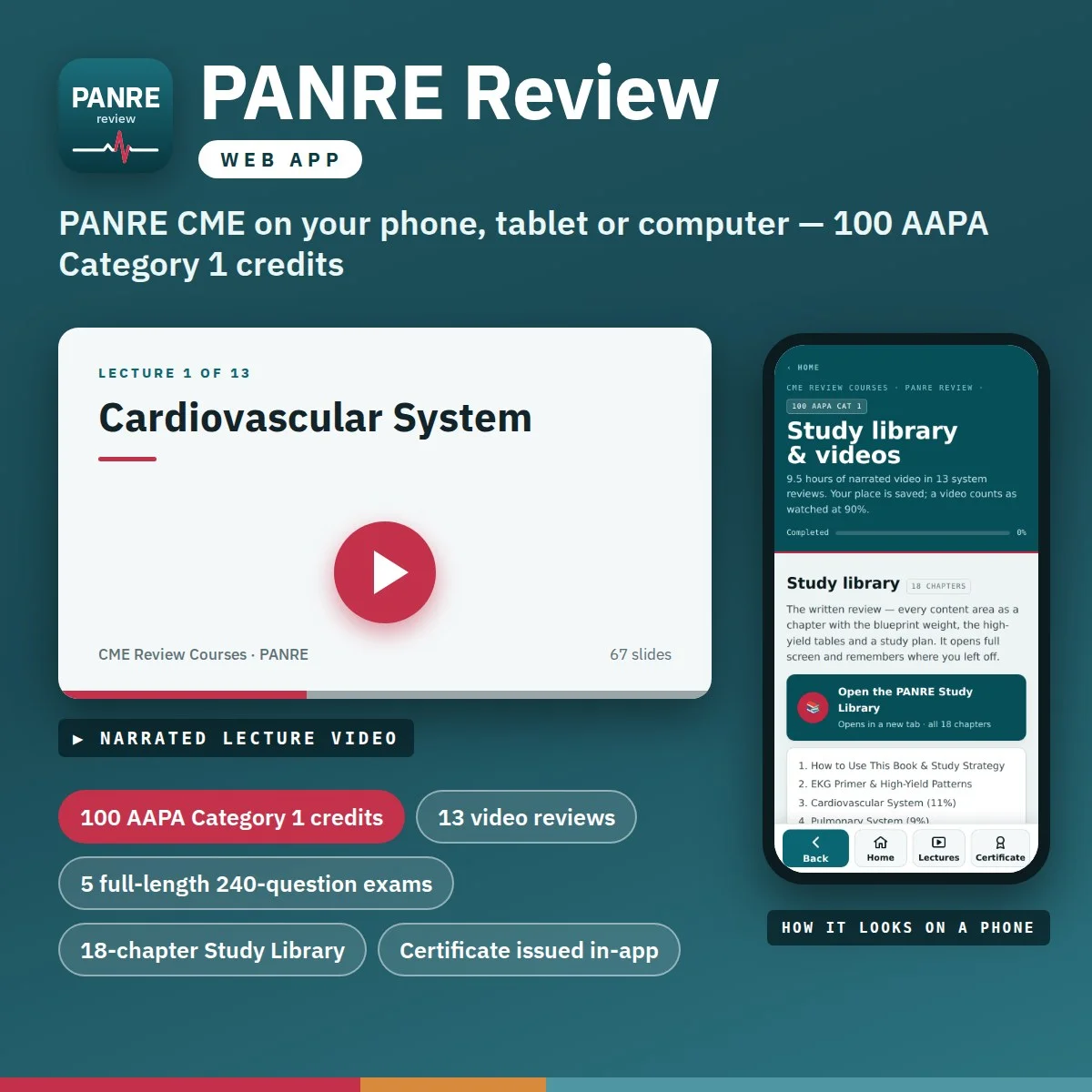
The PANRE Review Course with Gift Card combines exam preparation and an AAPA-accredited CME activity in one purchase. It includes 15 body-system question modules mapped to the NCCPA PANRE content blueprint, five full-length mock exams, lectures with downloadable slides, and a PANRE Readiness Dashboard. The dashboard tracks attempted-versus-correct questions, performance by topic, flagged questions, unlimited retakes, and an “on track to pass” indicator at 75% or higher.
The course’s PANRE Clinical Review Module awards up to 100 AAPA Category 1 CME credits. Approval is valid from August 26, 2026, to August 26, 2027; AAPA reference number CME-2016187. To earn credit, review all module content, score at least 70% on the post-test (missed questions may be retaken), and complete the activity evaluation. Your certificate states the precise credit earned. These credits apply to this PANRE Review Course only, not the Pharmacology course.
Mistake 1: Treating one mock score as a verdict instead of a map
A full-length mock contains 240 questions, but one percentage cannot summarize everything you know across the PANRE content areas. A strong overall result can hide a consistent weakness in a specific system. A lower score may reflect a cluster of unfamiliar topics, timing issues, or a few missed questions, not a definitive prediction of your exam outcome.
The NCCPA describes its practice exams as educational tools, not predictors of PANRE performance. Use the headline score as one data point, then look at the topic breakdown. Ask: Which areas account for most of my misses? Were they knowledge gaps, misread stems, or errors in choosing the next diagnostic or management step?
That is where the PANRE Readiness Dashboard’s per-topic performance breakdown is useful. Let it help direct your study time. If your cardiovascular performance is lagging while other systems are steady, schedule targeted cardiovascular review and fresh questions rather than spending equal time on every topic.
Keep a simple error log: topic, why you missed the question, the clinical rule you needed, and what you will do differently next time. This turns a test result into a practical study plan.
Mistake 2: Retaking a mock too soon after reviewing it
A score can rise because your knowledge improved, or because the questions are familiar. If you retake the same mock shortly after studying its explanations, you may recognize the stem or remember the answer. That can inflate your result without showing how you would perform on an unseen question.
Give yourself time between full-length mock exams. In the meantime, study the concepts behind your missed questions and use fresh question sets to test recall and application. When you do return to an earlier exam, treat it as review rather than a clean measure of readiness.
The course offers 2,500+ board-style questions: 1,810 across 15 body-system modules, plus 1,200 questions in five full-length 240-question mock exams. Its question bank and unlimited retakes give you opportunities to practice across the content without relying only on repeated exposure to one exam.
This approach applies whether you are comparing PANRE-specific review with other options or searching broadly for PANCE prep courses. The exams differ, so choose materials that fit your certification assessment and use new questions to check whether you can apply the clinical concept, not just recall an answer.
Mistake 3: Treating “on track to pass” as a finish line
A 75% “on track to pass” indicator is a checkpoint, not a stop sign. It helps summarize performance in the course; it is not an official NCCPA result or a guarantee that you will pass. Your next step is still to examine the weaker topics, revisit flagged items, and continue practicing.
If the indicator turns green, check whether your performance is consistent across systems and across questions you have not seen before. If one area remains weak, continue drilling it. If you have several weeks before exam day, use that time for targeted review, mixed-question practice, and another fresh mock when appropriate. Avoid coasting because one dashboard threshold has been reached.
Use the course’s lectures and downloadable slides to revisit difficult material, then return to questions to check your understanding. The purpose is not to chase a percentage. It is to build repeatable clinical reasoning across the exam’s content areas.
Practice question: Flag it, review it, and apply the concept
You are reviewing a mock-exam question about a 68-year-old patient with CKD who takes lisinopril. The patient reports generalized weakness. HR is 54/min, BP is 138/82 mm Hg, and SaO₂ is 98% on room air. The ECG shows peaked T waves. Which electrolyte abnormality best explains the ECG finding?
A. Hypokalemia
B. Hypocalcemia
C. Digoxin effect
D. Hyperkalemia
Correct answer: D. Hyperkalemia. In a patient with CKD taking an ACE inhibitor, impaired potassium excretion and medication effect raise concern for hyperkalemia. Peaked T waves are a classic ECG finding.
Hypokalemia more commonly causes flattened T waves and U waves. Hypocalcemia is associated with QT prolongation. Digoxin effect can produce characteristic ST-segment changes, but it does not best explain this presentation.
Real-world note: In clinical care, obtain a serum potassium level promptly and assess for ECG progression; severe hyperkalemia can require urgent treatment. On a mock exam, flag the question if needed, then record why the risk factors and ECG point to the correct answer.
Put your exam plan and CME plan together
For many PAs, a PANRE review course can make study time serve two purposes: exam preparation and CME completion. The same question bank used to identify knowledge gaps is part of the PANRE Clinical Review Module, which offers up to 100 AAPA Category 1 credits, covering a substantial portion of a two-year CME cycle in one purchase.
At checkout, you can add a paid Amazon or Apple gift card in $100–$1,500 tiers. The add-on cost is included in the total package price, so the course and gift card go through in one transaction. Gift cards are emailed within 2–3 business days; you do not have to finish the course first. Gift card packages are nonrefundable, and CME policies vary, so check your employer’s policy before purchasing. CME Review Courses is not affiliated with Amazon or Apple.
Buy two or more CME courses and save 20% automatically; gift card add-ons remain at face value. Total Program Access, which includes all 14 modules, is $2,999.99. Group discounts are available for 15 or more; email for a quote. The full-course money-back guarantee applies if you purchase the full course and do not pass on your first attempt; see the terms and conditions.
PAs should confirm their own CME requirements. For physicians, the activity meets AAPA Category 1 requirements, while credit is Category 2 for physicians’ own reporting. NP acceptance of AAPA Category 1 credit varies by state; verify with your state board of nursing.
To review course details or add a gift card at checkout, visit the PANRE Review Course product page. You can also try the free PANRE Review test drive.
About the author
Jeremy Boroff, MPAS, PA-C, is an Emergency Medicine PA with 24 years of clinical experience, a PA educator, author, and CME developer. He is the sole faculty member for this activity and has no relevant financial relationships to disclose.