Price: $499.99 for the PANRE Review Course
Access: 30 months
Question bank: 2,500+ board-style questions, including five 240-question mock exams
CME: Up to 100 AAPA Category 1 credits through the PANRE Clinical Review Module
Choosing PANRE-LA gives you a different path to recertification. It does not remove the need to plan for your CME, and it does not turn quarterly questions into a full review curriculum. A structured PANRE review course can help you turn each quarter’s feedback into a practical study plan while supporting your CME goals.
PANRE-LA and CME are separate parts of your plan
PANRE-LA is a longitudinal assessment: you receive 25 questions per quarter over 12 quarters and must complete at least eight quarters. References are allowed while you answer. NCCPA also provides feedback and rationale, giving you information you can use to identify gaps and review the material.
That process supports recertification, but it does not replace your separate CME responsibilities. For certification maintenance, PAs generally need 100 CME credits in each two-year cycle, including at least 50 Category 1 credits. Check the current NCCPA CME requirements for your cycle and reporting details.
PANRE-LA questions can help you discover what needs attention. They are not a substitute for systematically reviewing clinical content. Even with references available, answering a question is different from recalling and applying the material without looking it up. That distinction matters if you later change assessment formats or want to reinforce knowledge for clinical practice.
Use each quarter’s results to set the next study target
The quarterly format gives you repeated opportunities to check your knowledge. Treat each quarter’s topic-level feedback as a weakness map:
- Review the results and rationales. Identify the topics where your answers were uncertain or incorrect.
- Choose a focused study target. Match those topics to the corresponding sections in a structured review.
- Practice retrieval. Work through questions before checking the explanations, rather than relying only on reading or looking up answers.
- Reassess next quarter. Use new results to adjust your plan instead of repeating the same study routine regardless of performance.
A comprehensive course can support this cycle by organizing material across body systems and giving you a larger bank of questions for deliberate practice. The PANRE Review Course includes 15 body-system question modules mapped to the NCCPA PANRE content blueprint. Its largest module is Dermatology, with 218 questions.
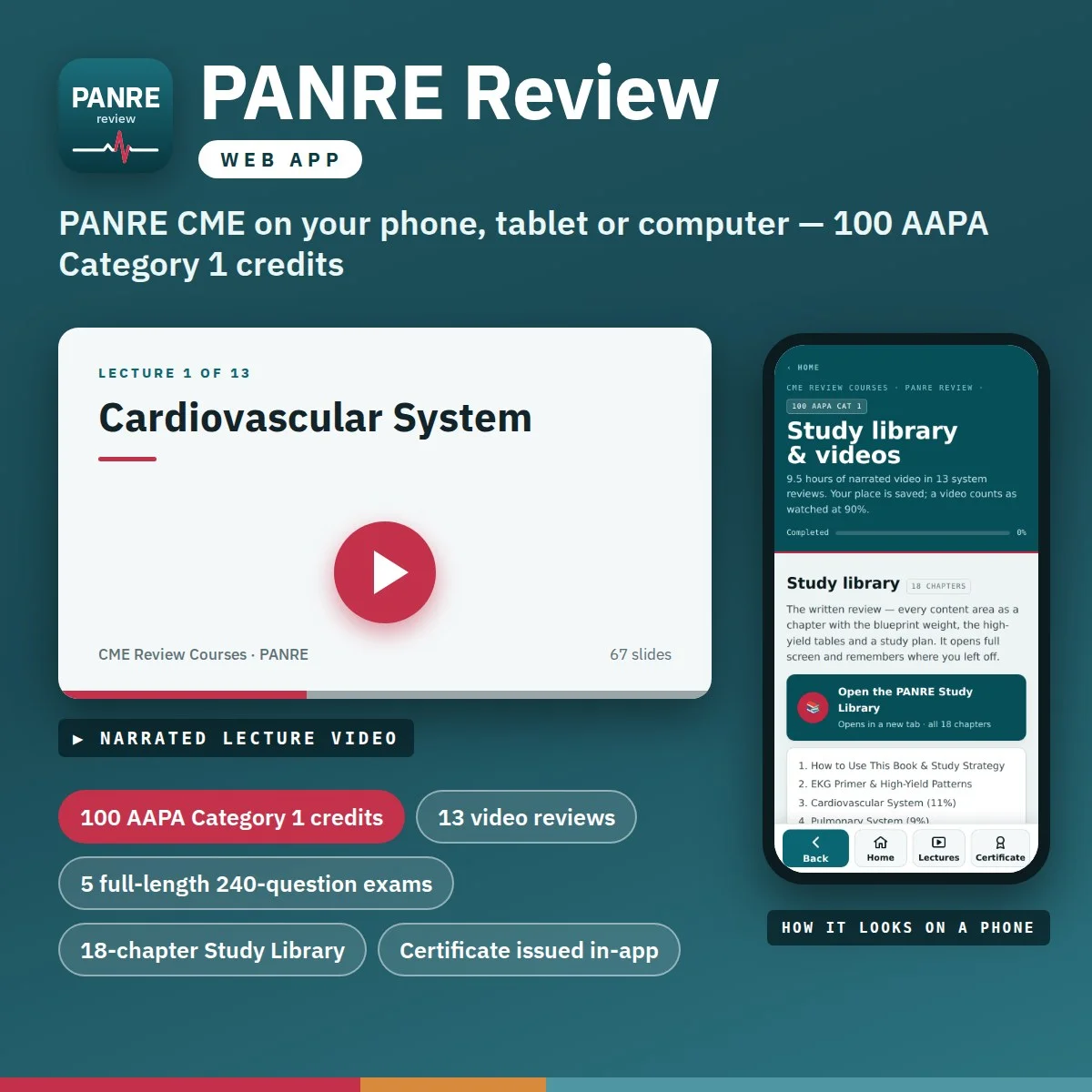
The course also includes five full-length 240-question mock exams, with a rationale and cited sources for each question. The PANRE Readiness Dashboard tracks attempted and correct questions, provides per-topic performance breakdowns, allows question flagging and unlimited retakes, and displays an “on track to pass” indicator at 75% or higher. Downloadable slides accompany the course lectures.
This is a different role from PANRE-LA-format practice. The review course helps you study content and identify areas for additional work; a mock exam gives you a longer, structured practice session. If you specifically want dedicated PANRE-LA exam-format practice, CME Review Courses also offers PANRE/PANRE-LA Review Exams with Gift Card Add-On.
What the course offers for CME
The PANRE Clinical Review Module is an enduring material activity that awards up to 100 AAPA Category 1 CME credits. Those credits apply to the PANRE Review Course, not the Pharmacology course. The activity’s AAPA reference number is CME-2016187, with approval valid from August 26, 2026, to August 26, 2027.
To earn credit, review all module content, complete the post-test with a score of 70% or higher, and complete the activity evaluation. Missed questions may be retaken. A certificate stating your precise credit is issued after completing the requirements. Claim only credit that reflects your participation.
The course comes with a money-back guarantee for full-course purchasers who do not pass on their first attempt; see the course terms for details.
The paid gift card add-on: what to know
At checkout, you can select a paid Amazon or Apple gift card add-on from $100 to $1,500. The add-on is not free: its cost is added to the course price, and the full package is processed as one transaction through your CME funds.
The gift card is emailed within 2–3 business days of purchase; you do not need to finish the course first. Gift card packages are nonrefundable, and CME Review Courses is not affiliated with Amazon or Apple. Check your employer’s CME policy before purchasing to confirm that the package and add-on are eligible.

If you buy two or more courses, 20% is automatically deducted from each course. Gift card add-ons remain at face value. For a broader option, Total Program Access includes all 14 modules and 468.75 credits for $2,999.99.
Nurse practitioners should verify with their state board of nursing whether AAPA Category 1 credit is accepted for renewal. For physicians, the activity meets AAPA Category 1 requirements; it counts as Category 2 CME for physicians’ own reporting.
Practice question: dermatology
Your patient is a 68-year-old with several weeks of intense pruritus and tense bullae on the flexural surfaces and lower abdomen. The Nikolsky sign is negative. Which diagnostic test is most appropriate to confirm the suspected condition?
A. Tzanck smear of the blister base
B. Serum anti-desmoglein 1 and 3 antibodies
C. Direct immunofluorescence of a perilesional skin biopsy
D. Gram stain and bacterial culture of blister fluid
Correct answer: C. Direct immunofluorescence of a perilesional skin biopsy.
Linear IgG and C3 deposition along the basement membrane zone supports bullous pemphigoid, which commonly presents with pruritic, tense bullae and a negative Nikolsky sign. Pemphigus vulgaris more often causes flaccid bullae, mucosal involvement, a positive Nikolsky sign, and intercellular staining; anti-desmoglein testing may support that diagnosis. A Tzanck smear and bacterial culture do not establish bullous pemphigoid.
Real-world note: If disease is widespread, systemic corticosteroids may be considered; assess infection risk and comorbidities when planning treatment.
Choose the right study support
The PANRE-LA quarterly rhythm can help you identify topics to revisit, while a structured review course gives you organized content and practice across systems. Pairing the two lets you use each quarter’s performance to make the next study block more targeted, and address CME requirements separately from the assessment process.
Explore the PANRE Review Course with Gift Card, where you can select a paid gift card add-on at checkout. You can also try the free PANRE Review test drive or review the dedicated PANRE/PANRE-LA practice exam option. If you are comparing pance prep courses, confirm that the product’s exam focus, access period, and CME terms match your needs.
About the author
Jeremy Boroff, MPAS, PA-C, is an Emergency Medicine PA with 24 years of clinical experience, a PA educator, author, and CME developer. He is the sole faculty member for this activity and has no relevant financial relationships to disclose.