PANRE Review Course: $399.99 · 30 months of access · 1,200+ questions across five 240-question exams · 100 AAPA Category 1 CME credits through the PANRE Clinical Review Module.
Optional paid gift card add-on: $100–$1,500. Choose an Amazon or Apple Gift Card at checkout if it fits your plans and your employer’s CME policy. The card is an added purchase, not a free gift, and it does not increase the course’s 100 CME credits.
A CME allowance can be easy to underuse when its deadline is close. The useful question is not just “How much is left?” but “What combination of exam preparation and practical spending makes sense for me?” With this package, the PANRE course provides the review materials and CME activity. The optional gift card gives you another way to use part of your remaining budget, subject to your organization’s rules.
Plan the add-on around your actual needs
Start with the course, not the card. If PANRE prep and Category 1 CME are your priorities, the PANRE Review Course is the central purchase. It includes 30 months of access and five 240-question exams-1,200 questions total. The 100 AAPA Category 1 credits come from the PANRE Clinical Review Module, not from the gift card.
Then look at the balance of your available CME funds and the time remaining before they expire. Choose a card amount only if the combined purchase fits your budget and is permitted under your employer’s policy. Check the policy before checkout; reimbursement and allowance rules vary.
| Optional add-on | Course plus add-on* |
|---|---|
| $100 gift card | $499.99 |
| $500 gift card | $899.99 |
| $1,500 gift card | $1,899.99 |
*Totals use the stated $399.99 course price and do not include any applicable taxes or other charges.
The card amount is a separate, paid addition. Selecting a larger amount does not earn more CME or change your course access.
What could you use the card for?
Think of the card as a way to direct leftover allowance toward purchases that suit your routines, not as a guaranteed list of study materials or a required part of the course.

An Amazon Gift Card might help with general exam-day logistics, study-adjacent resources, or personal purchases you already planned to make. For example, you could consider practical items that support your study setup or travel to an exam. These are examples, not included course materials or specific product recommendations. Check the card’s terms and your organization’s rules before deciding.

An Apple Gift Card may suit you if you expect to use eligible Apple purchases or services. Consider whether it aligns with your plans before choosing it. The add-on is optional; you can purchase the course without selecting a card.
A simple way to decide:
- Confirm the budget deadline and rules. Find out how much remains and what your CME allowance permits.
- Prioritize your learning goal. If recertification is the priority, select the review course first.
- Choose a card amount you can use. Match the add-on to a realistic plan, not just the maximum balance available.
- Keep the credit calculation clear. The PANRE Clinical Review Module provides the 100 AAPA Category 1 credits; the gift card provides no additional credits.
What the course gives you for exam preparation
The course pairs the PANRE Clinical Review Module with board-style practice: 1,200+ questions across five 240-question exams and 30 months of access. You can use the time to build a study schedule, work through exam questions, and revisit areas that need more attention.
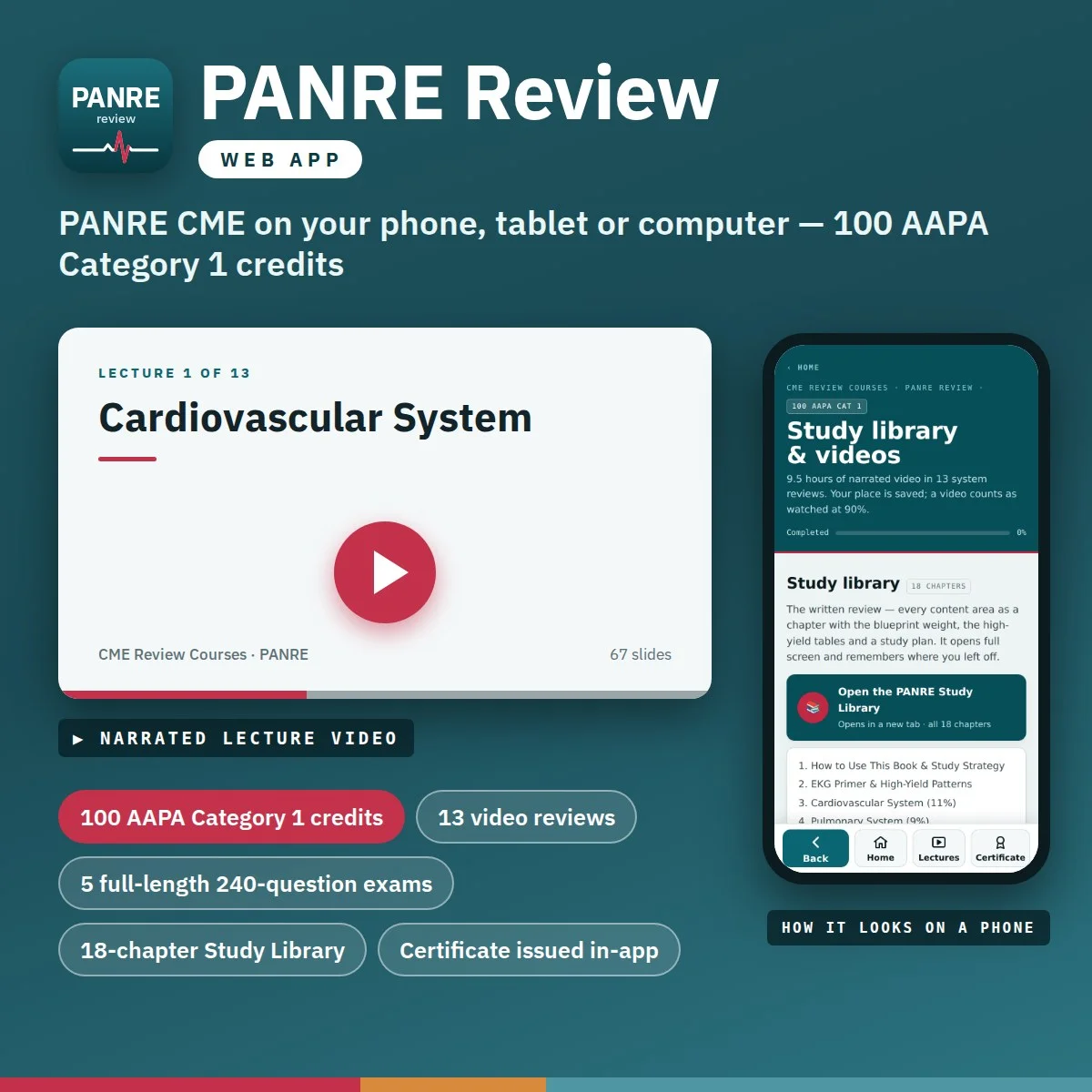
If you are comparing pance prep courses, check whether a resource is designed for initial certification or for PANRE recertification. Your study plan should match the exam you are preparing to take. For course details and the optional add-on choices, see the PANRE Review Course with Gift Card.
PANRE Practice: Two Quick Cases
Case 1: Chest pain
Your patient is a 58-year-old with 30 minutes of substernal pressure radiating to the left arm. HR 104, BP 148/88, RR 20, SaO₂ 97% on room air. The initial ECG shows ST-segment elevation in leads II, III, and aVF. What is the most appropriate next step?
A. Discharge with outpatient cardiology follow-up
B. Activate the STEMI pathway for urgent reperfusion
C. Schedule an exercise stress test
D. Repeat the ECG in 24 hours before treatment
Correct answer: B. Activate the STEMI pathway for urgent reperfusion. The symptoms and inferior ST elevation indicate acute STEMI; urgent reperfusion is time-sensitive. Outpatient follow-up and stress testing are inappropriate for an acute STEMI, and delaying care to repeat the ECG risks harm.
Case 2: Suspected pulmonary embolism
Your patient is a 34-year-old with pleuritic chest pain and dyspnea after a recent long-haul flight. HR 112, BP 126/78, RR 24, SaO₂ 93% on room air. The patient has no signs of shock. Which diagnostic approach is most appropriate?
A. Use clinical probability to guide testing; obtain CT pulmonary angiography if indicated
B. Order a chest radiograph alone to exclude PE
C. Begin outpatient antibiotics without further evaluation
D. Use a normal oxygen saturation threshold to rule out PE
Correct answer: A. Use clinical probability to guide testing; obtain CT pulmonary angiography if indicated. Assess pretest probability and select testing accordingly; in a patient whose risk warrants imaging, CT pulmonary angiography is a standard diagnostic option. A chest radiograph does not rule out PE, and neither antibiotics nor oxygen saturation alone resolves the diagnostic question.
Make the add-on a deliberate choice
A gift card add-on is most useful when it fits both your remaining CME budget and something you realistically plan to purchase. It is an optional paid addition, not a discount or a source of extra credit. Keep the core value in view: the PANRE review materials, extended access, and 100 AAPA Category 1 credits through the PANRE Clinical Review Module.
Review the PANRE Review Course page to explore the course and select an optional Amazon or Apple Gift Card add-on at checkout.