





If you teach in a clinical program, you already know EKGs are a scheduling problem as much as a teaching problem.
The content is not optional. Every student needs it, the standard is not negotiable, and the consequences of a graduate who cannot read a tracing are not academic. But the hours available for it are finite and already spoken for, so EKG instruction tends to get compressed into a lecture block, a lab, and a hope that it holds. Then students hit clinicals and the faculty on the receiving end report, year after year, that it did not hold evenly.
The uneven part is the interesting part. A third of the cohort picks it up quickly and would have regardless of how it was taught. A third gets there with ordinary effort. And a third does not get there at all during the block, and arrives at rotations unable to reliably call anything past the obvious — not because they are weak students, but because EKG interpretation is a volume skill and the block did not contain enough volume for them specifically.
You cannot fix that by lecturing harder. Volume is the variable, and the students who need more of it need it outside your contact hours.
What a cohort license actually solves
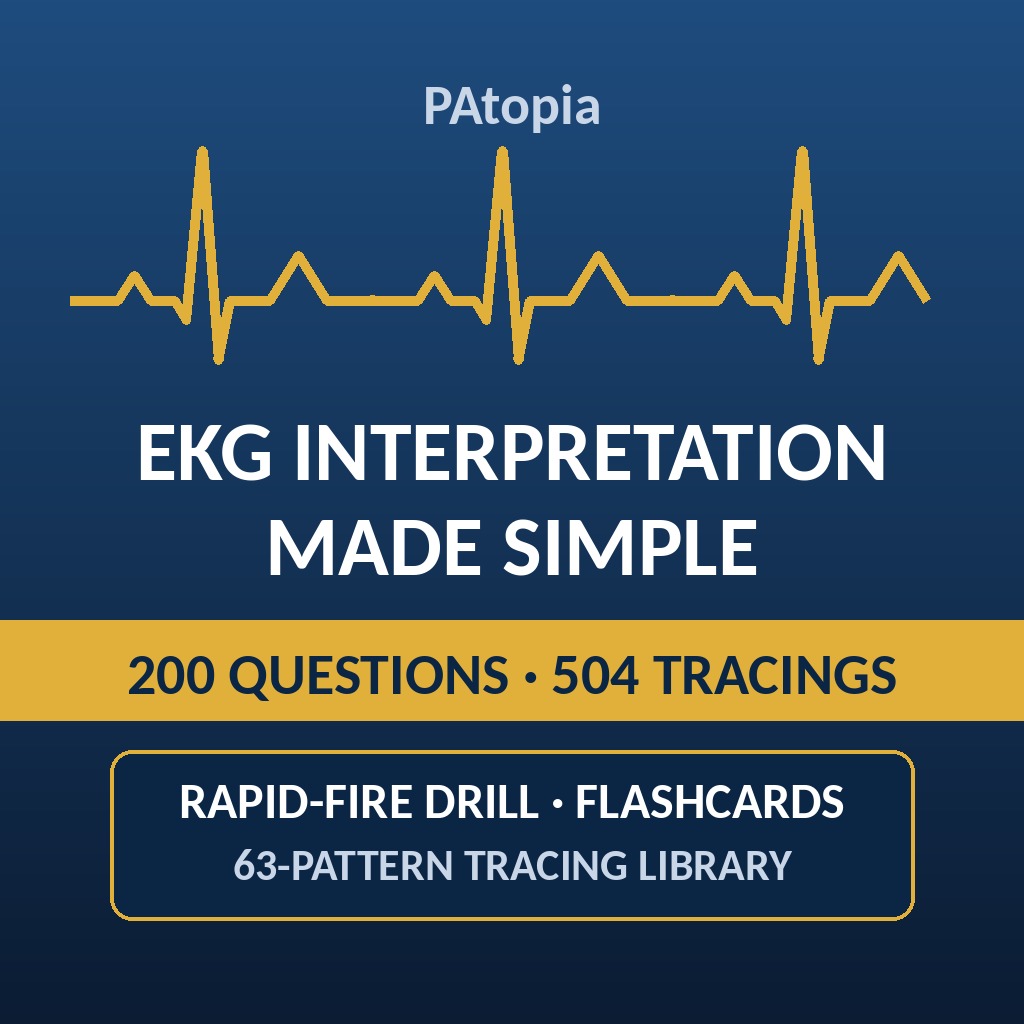
That is the gap EKG Interpretation Made Simple was built to fill, and it is the reason programs have started asking about it for whole classes rather than leaving it to individual students to buy.
The course is a browser-based question bank and drill: 200 board-style questions in four 50-question tests, 161 of them built around an actual tracing, plus a rapid-fire drill that tracks which patterns each student keeps missing and serves them more of those. There are spaced-repetition flashcards for the numbers and rules, and a 63-pattern reference library with criteria, pearls, and — the part that matters most pedagogically — the look-alikes placed next to each other, since nearly all student errors are confusions rather than blanks.
Explanations are sourced to AHA, ACC, and ESC guidelines, so what students read on their own time does not contradict what you taught them in the block. The Premium tier adds 11 narrated lectures running five hours and thirty-eight minutes, which some programs use as assigned pre-work so the in-person session can be spent on tracings instead of fundamentals.
The practical effect for faculty is that the third of the class that needs more volume can get it without consuming more of your hours, and the students who are already solid are not held to the pace of the slowest.
This is not a PA-only question
We built the course inside PAtopia, so PA programs found it first. But the tracings do not care which program a student is enrolled in, and the inquiries we are getting make that obvious.
Nursing programs — especially those feeding critical care, telemetry, and emergency placements — have the same compression problem and arguably higher stakes on early rhythm recognition, since the nurse is often the first person to see the change. Paramedic programs face it sharply: their students will be acquiring and interpreting 12-leads in the field, frequently alone, with transport destination riding on the call. Respiratory therapy programs sit next to all of this; in a code, the person at the head of the bed is reading the monitor too. And medical schools have the same uneven-third pattern we see everywhere else.
The course does not need to be rebuilt for any of them, because EKG interpretation is one standard taught to many professions, not several different standards. What does need to change program to program is the packaging — which tier, how many seats, what term length, and whether the lectures are included or assigned.
Tell us what you need and we will build the package
We do not publish a single cohort price for this course, because the useful version of the answer depends on things we do not know until you tell us: cohort size, whether you want Standard or Premium for everyone or a mix, how the term lines up with your curriculum calendar, whether faculty need their own access to see the material, and whether EKG is the only piece you want or part of a larger package alongside our other PAtopia courses.
Programs that are already running a PAtopia Program License are usually better served by folding EKG into that rather than buying it separately, and we would tell you so.
So the honest path is a short conversation. Use the form below, tell us the shape of what you need, and we will come back with a package and a number rather than a brochure. It reaches us directly and we answer it ourselves.
Tell us about your program or group
We’ll send a proposal within two business days. Custom packages are welcome — tell us what you need and we’ll build it.
Faculty who would rather evaluate before talking to anyone are welcome to do exactly that. The free Test Drive gives you 10 questions, part of the pattern library, a sample of the drill and flashcards, and the first lecture in full — enough to judge whether the question quality and the explanations meet the standard you would be comfortable putting in front of your students. If you want a fuller look than the Test Drive allows, email us and we will arrange faculty access.
Individual students can buy either tier directly, of course — Standard is $49.99 and Premium is $99.99, both with 27 months of access, which is deliberately long enough to carry through a program, a board exam, and the first stretch of practice.
Questions, or want to talk it through before filling anything out? Email info@cmereviewcourses.com or call 419-203-8154.
Jeremy Boroff, MPAS, PA-C
Program Director, CME Review Courses