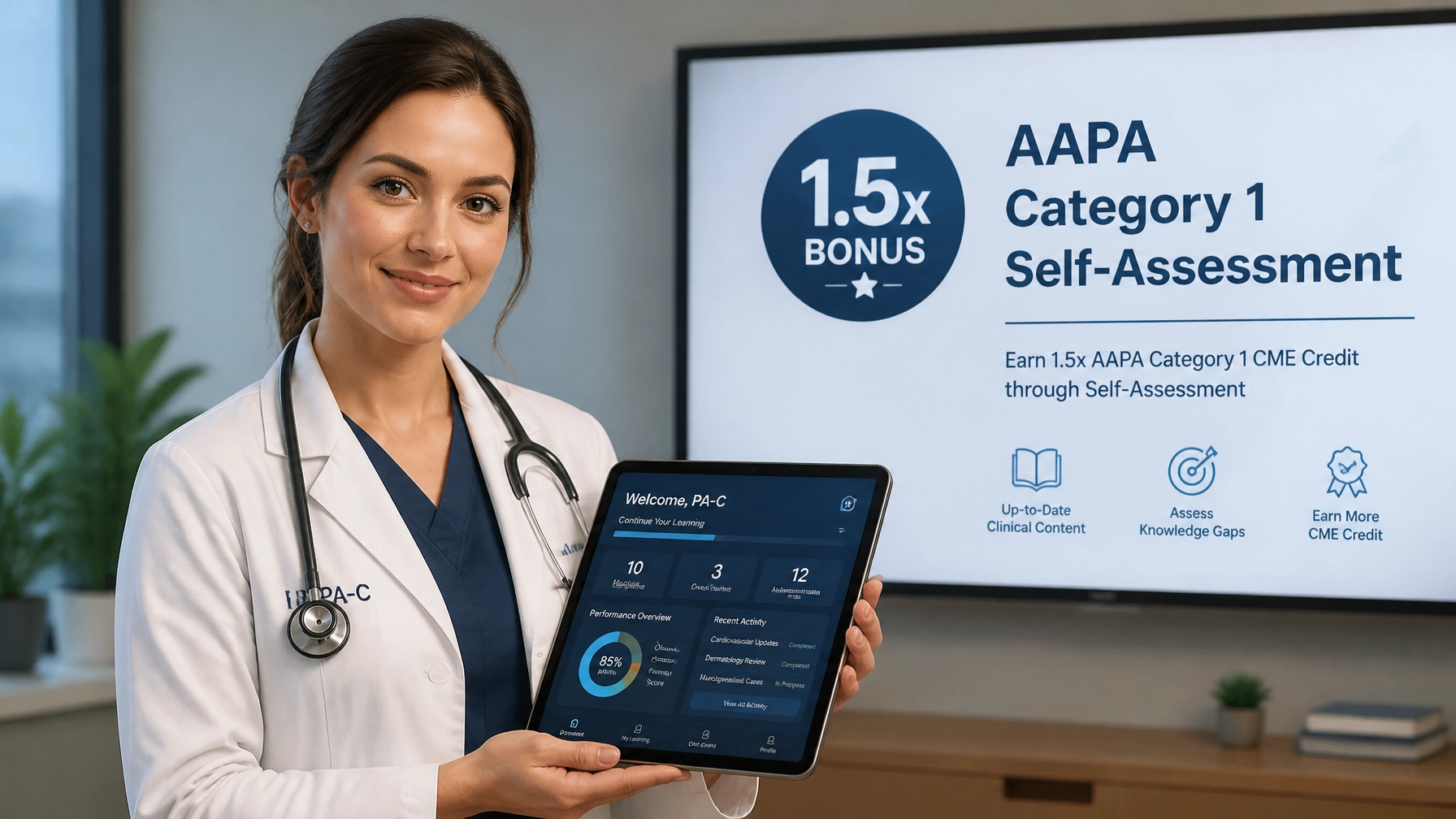
Physician Assistants (PAs) managing a high-volume clinical schedule often struggle to balance patient care with the mandatory 100 hours of continuing medical education (CME) required every two years. One of the most efficient strategies to meet these requirements is to leverage the NCCPA 50% bonus for self-assessment activities. By selecting the correct type of CME, you can effectively earn 1.5 credits for every hour spent studying.
The NCCPA Self-Assessment Multiplier
The National Commission on Certification of Physician Assistants (NCCPA) provides a unique incentive for PAs who participate in self-assessment activities. For every AAPA Category 1 Self-Assessment CME credit logged, the NCCPA applies a 50% weighting bonus.
In practical terms, this means:
- 20 credits of Self-Assessment = 30 credits toward your total.
- 100 credits of Self-Assessment = 150 credits toward your total.
This multiplier is applied automatically within the NCCPA logging system. There is no additional paperwork required from the provider; you simply log the credits as self-assessment, and the system adjusts your total. This is a significant advantage for PAs preparing for the PANRE or PANRE-LA, as it allows for the completion of a single comprehensive review course to cover a massive portion of the five-year or two-year cycle requirements.
CME Review Courses: Maximize Your Time
At CME Review Courses, we design our curriculum to meet these specific regulatory needs while providing high-yield clinical content. Our courses are written by physician assistants for physician assistants, ensuring the material is relevant to daily practice and board exams.
PANRE Review Course Details:
- Price: $499.99 (optional Amazon or Apple gift card add-on, $100–$1,500)
- Credit: 100 hours of AAPA Category 1 Self-Assessment Credit
- NCCPA Value: 150 hours after the 50% bonus is applied
- Access: 30 months of unlimited access
- Deliverables: Over 1,000 practice questions and comprehensive organ-system modules
Pharmacology Review Course Details:
- Price: $499.99 (optional Amazon or Apple gift card add-on, $100–$1,500)
- Credit: 12-20 hours of AAPA Category 1 Self-Assessment Credit
- Duration of Access: 30 months

Leveraging Your CME Budget with Gift Card Add-ons
Many clinical employers provide a fixed CME allowance. To help you further enrich your education and obtain the tools necessary for your practice, we offer CME packages with Amazon and Apple Gift Card add-ons. These options allow you to add a gift card ranging from $100 to $1,500 to your purchase. This approach allows you to use your CME funds efficiently, acquiring both top-tier educational materials and the technology or resources needed to study them.

Clinical Review and Self-Assessment Questions
The following vignettes are designed to simulate the self-assessment format used in our courses. Use these questions to test your clinical knowledge in Cardiology and Internal Medicine.
Clinical Scenario 1: Cardiology
Your patient is a 64-year-old male presenting to the emergency department with a 2-hour history of substernal chest pressure that radiates to the left jaw. He appears diaphoretic and pale. His medical history includes hypertension and tobacco use (30 pack-years).
Vital Signs:
- BP: 162/94 mmHg
- HR: 105 bpm
- RR: 20 bpm
- SaO2: 94% on room air
An EKG is performed and shows 3mm ST-segment elevation in leads II, III, and aVF, with reciprocal ST-segment depression in leads I and aVL.
Question: What is the most appropriate next step in the management of this patient?
A) Administer 324 mg of aspirin and arrange for emergent percutaneous coronary intervention (PCI).
B) Order a stat CT angiography of the chest to rule out aortic dissection.
C) Obtain serial troponins and admit the patient to the telemetry unit for observation.
D) Administer intramuscular ketorolac for pain management and discharge with a follow-up stress test.
Correct Answer: A
Explanation: The EKG findings are diagnostic of an inferior wall ST-elevation myocardial infarction (STEMI). The immediate priority in STEMI management is reperfusion therapy. Aspirin (324 mg) should be administered immediately for its antiplatelet effects. Emergent PCI is the gold standard for reperfusion if available within 90 minutes of medical contact. Aortic dissection (Option B) is less likely given the classic EKG changes for STEMI. Admission for observation (Option C) is inappropriate for an active STEMI where "time is muscle." Ketorolac (Option D) is contraindicated in acute coronary syndrome due to the increased risk of adverse cardiovascular events.
Clinical Scenario 2: Internal Medicine / Nephrology
Your patient is a 52-year-old female with a 15-year history of Type 2 Diabetes Mellitus and poorly controlled hypertension. She presents for a routine follow-up. She reports no specific symptoms but notes occasional peripheral edema in her lower extremities.
Laboratory Results:
- Serum Creatinine: 1.8 mg/dL (Baseline 1.2 mg/dL)
- eGFR: 42 mL/min/1.73m²
- Urine Albumin-to-Creatinine Ratio (UACR): 450 mg/g
- HbA1c: 8.4%
Question: According to current clinical guidelines for Chronic Kidney Disease (CKD) in diabetic patients, which medication class is most indicated to reduce the risk of kidney disease progression?
A) SGLT2 Inhibitor (e.g., Empagliflozin)
B) Loop Diuretic (e.g., Furosemide)
C) Sulfonylurea (e.g., Glipizide)
D) Calcium Channel Blocker (e.g., Amlodipine)
Correct Answer: A
Explanation: SGLT2 inhibitors have been shown in major clinical trials to significantly reduce the progression of Chronic Kidney Disease (CKD) and reduce the risk of cardiovascular events in patients with Type 2 Diabetes and albuminuria. Furosemide (Option B) may assist with peripheral edema but does not provide renal protection. Sulfonylureas (Option C) lower blood glucose but do not offer independent renal or cardiovascular benefits. While Amlodipine (Option D) helps with hypertension, it is not the primary choice for renal protection compared to SGLT2 inhibitors or ACE inhibitors/ARBs in patients with significant albuminuria.
Optimize Your Certification Maintenance
For PAs, the "simple trick" is making your study time work harder for you. By choosing a course designated as AAPA Category 1 Self-Assessment, you are not just preparing for the PANRE; you are strategically fulfilling your NCCPA requirements in less time.
Whether you need 100 hours for a full certification cycle or specific credits for pharmacology, our packages provide high-yield content and the added value of gift card options.
Explore our courses today: