Official application deadline: December 18, 2026. NCCPA lists this deadline for PAs due to recertify in 2030 who are applying for PANRE-LA. The fourth-quarter 2026 question window ends earlier, on December 10, 2026.
PANRE Review Course: $499.99 · 30 months of access · 1,200+ questions across five 240-question exams · up to 100 AAPA Category 1 CME credits through the PANRE Clinical Review Module.
Dates and eligibility below are verified against NCCPA’s Key Dates page and PANRE-LA FAQs as of October 30, 2026. Check your NCCPA Portal and NCCPA’s official dates again before acting; deadlines can change.
1. December 18 is the application deadline, not the Q4 question deadline
NCCPA’s current schedule shows the 2026 PANRE-LA application window for PAs due to recertify in 2030 runs from July 1 through December 18, 2026. The fourth-quarter PANRE-LA question window runs from October 1 through December 10, 2026.
These are separate deadlines. If you are already participating in PANRE-LA, December 18 is not extra time to finish Q4 questions. NCCPA states that the quarterly question timeframe cannot be extended. Unanswered questions at quarter-end are scored as incorrect.
Check the NCCPA dates directly and note both dates in your calendar. Do not rely on an old email, a previous-year schedule, or a third-party page to determine your current deadline.
2. The December 18 application deadline applies to a specific recertification group
PANRE-LA applicants apply in the sixth year of their certification maintenance cycle. The December 18, 2026 application deadline applies to PAs due to recertify in 2030. It is not a universal deadline for every PA.
NCCPA says eligible PAs can confirm their application status in the Recertifying Exam Status section of their PA Portal dashboard. PAs seeking to regain certification are not eligible for PANRE-LA and must use the traditional PANRE route.
If you believe you qualify, verify your cycle year and eligibility in the NCCPA Portal. If your portal information appears inconsistent with your records, contact NCCPA rather than assuming you can apply under another cycle’s dates.
3. PANRE-LA is a multi-year assessment with minimum participation requirements
PANRE-LA is not a single appointment at a testing center. It is administered over 12 quarters, with 25 questions per quarter. NCCPA requires participation in at least one quarter in the first year and at least one quarter in the second year of the process. The score is based on eight quarters; after eight quarters, participants who have not reached the passing standard may continue through the remaining quarters.
Questions are completed online, and you may use printed or online reference materials. However, discussing or sharing exam content with other people is prohibited. NCCPA also notes that each question has a five-minute time limit. The format allows flexibility, but each quarterly window still has a firm closing date.
For the current dates and the full set of requirements, refer to NCCPA’s PANRE-LA FAQs. The official rules take precedence over any third-party study resource.
4. Missing the deadline is not a routine extension
NCCPA says PAs who miss the application deadline because of extenuating circumstances may request an exception to policy. The request must be submitted no later than April 30 of year seven of the certification cycle. If approved, the PA begins in the first available quarter after the decision and cannot make up earlier missed quarters.
That exception process is not a substitute for applying on time. If December 18 applies to you, complete the application through your NCCPA Portal before the posted deadline. Keep in mind that this is an application deadline, while the Q4 question window closes on December 10.
5. Keep your CME and certification maintenance requirements on track
Passing PANRE-LA addresses the recertification exam requirement, but it does not remove the separate requirement to maintain your certification. NCCPA says PANRE-LA participants must continue meeting CME and certification maintenance fee requirements during the process. Failure to do so can result in withdrawal from PANRE-LA.
NCCPA also says each completed PANRE-LA quarter earns two AAPA Category 1 Self-Assessment CME credits when all 25 questions are completed. That is distinct from CME earned through a review course. Review the requirements and credit details with NCCPA and track your own CME activity in your portal.
Prepare with a structured PANRE review course
A focused panre review course can help you refresh core medical knowledge across the systems and task areas covered by the NCCPA content blueprint. CME Review Courses’ PANRE Review Course is built for practicing PAs preparing for recertification.
Course details: $499.99 · 30 months of access · five 240-question practice exams · 1,200+ questions total. The five exams include answer rationales and cited sources. Completing the PANRE Clinical Review Module can provide up to 100 AAPA Category 1 CME credits, subject to the activity’s completion requirements. Those credits apply to the PANRE Clinical Review Module, not the Pharmacology course. Claim only the credit commensurate with your participation.
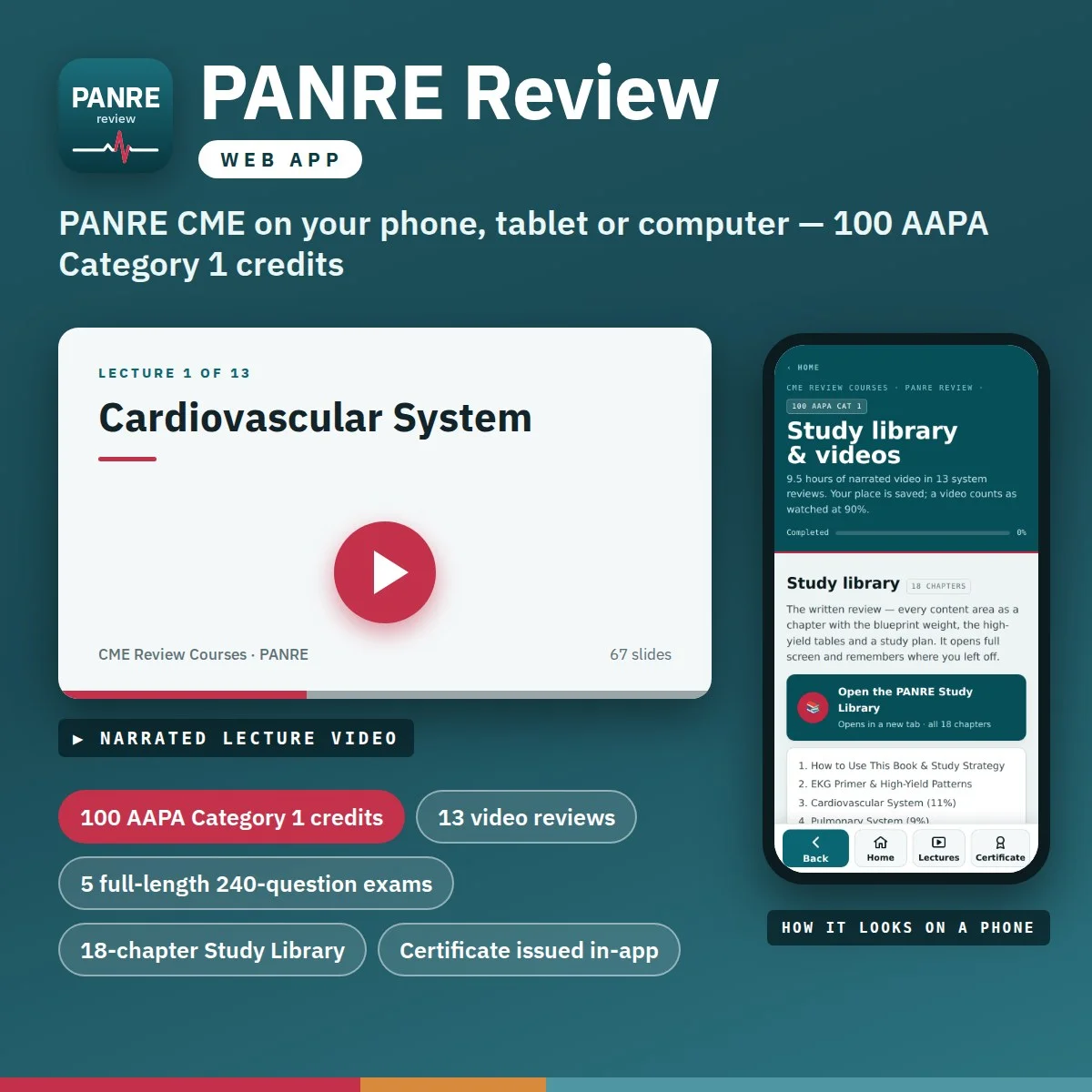
Explore the PANRE Review Course or try the PANRE Review app. Amazon and Apple gift card add-ons from $100 to $1,500 are available with eligible CME purchases; select an option on the product page and confirm the current total and terms at checkout.


Practice question
Your patient is a 62-year-old man with acute atraumatic right-knee pain and swelling for 24 hours. Temperature is 38.2°C (100.8°F), HR 104/min, and BP 128/76 mm Hg. The knee is warm, erythematous, and has a large effusion. He has no history of gout. What is the best next step?
A. Begin oral colchicine
B. Obtain arthrocentesis for synovial fluid analysis and culture
C. Order serum uric acid and treat if elevated
D. Start an intra-articular corticosteroid
E. Obtain MRI of the knee before treatment
Correct answer: B. Obtain arthrocentesis for synovial fluid analysis and culture.
Septic arthritis must be excluded urgently in a febrile patient with an acutely inflamed joint. Synovial fluid cell count, Gram stain, culture, and crystal analysis guide treatment. Do not inject corticosteroids before infection is excluded. Serum uric acid does not establish or rule out gout, and MRI is not the first diagnostic step when joint aspiration can provide key information promptly. If septic arthritis is suspected, begin empiric antibiotics after synovial fluid and blood cultures when clinically appropriate.
Take action before the relevant date
If your recertification year is 2030, check your NCCPA Portal now and confirm the December 18, 2026 application deadline. If you are already in PANRE-LA, make a separate plan for the December 10, 2026 Q4 close. NCCPA’s Key Dates page is the authoritative place to recheck current dates.
For a structured review of core exam content, see the PANRE Review Course. PA students and educators can also access the PAtopia web version, the iOS app, and the Android app.
About the author
Jeremy Boroff, MPAS, PA-C, is a physician assistant with 24 years of Emergency Medicine experience. He develops clinical review material for practicing PAs preparing for certification and recertification exams.