Preparing for the PANRE while working full-time creates two common problems: limited study time and a limited CME budget. The wrong review strategy can waste both.
The goal is not simply to purchase more study materials. The goal is to choose a structured PANRE review course that helps you prepare for the exam and use your CME allowance efficiently.
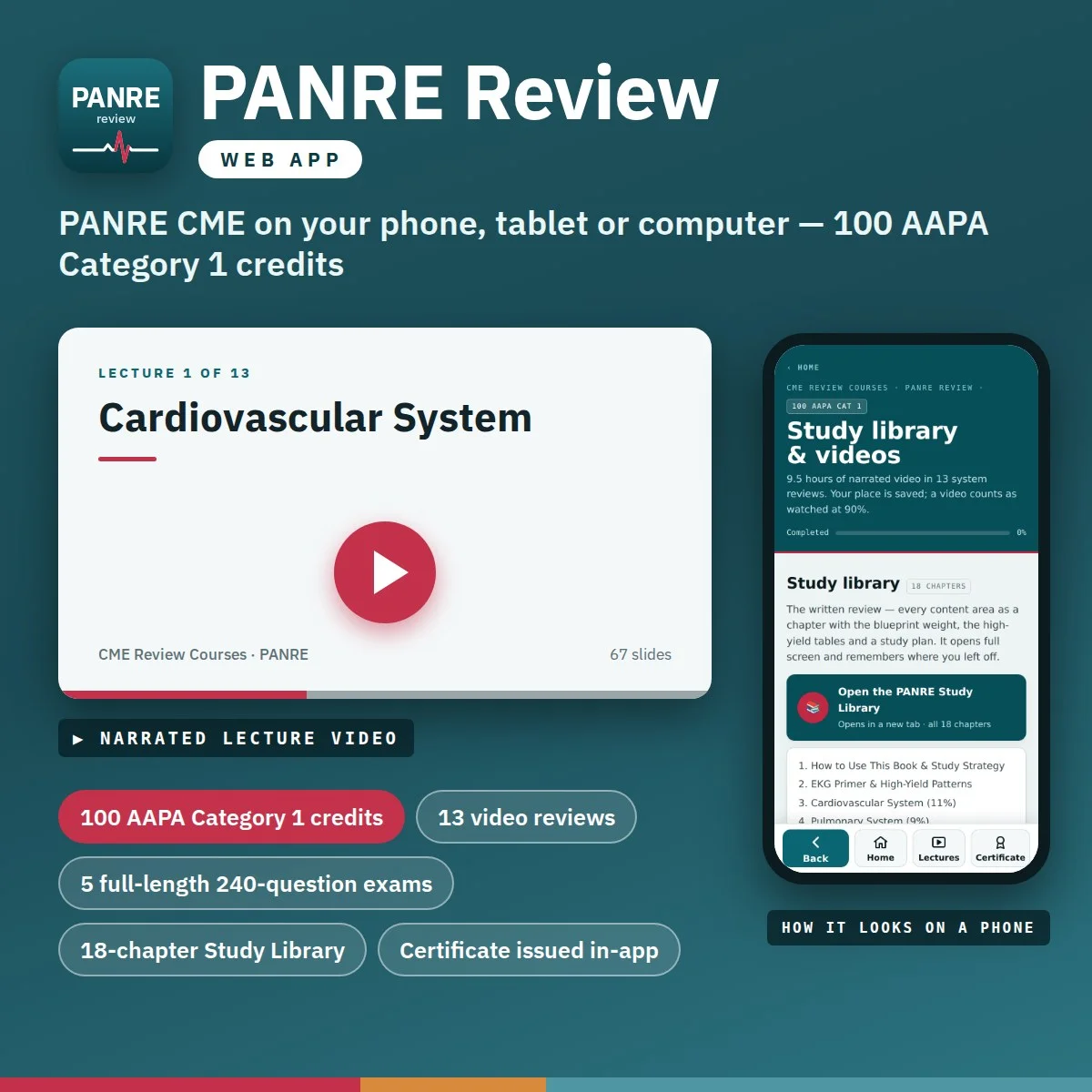
PANRE Review Course: Essential Details
- Price: $499.99
- Access: 30 months
- Practice questions: 1,200+ questions
- Exam format: Five 240-question practice exams
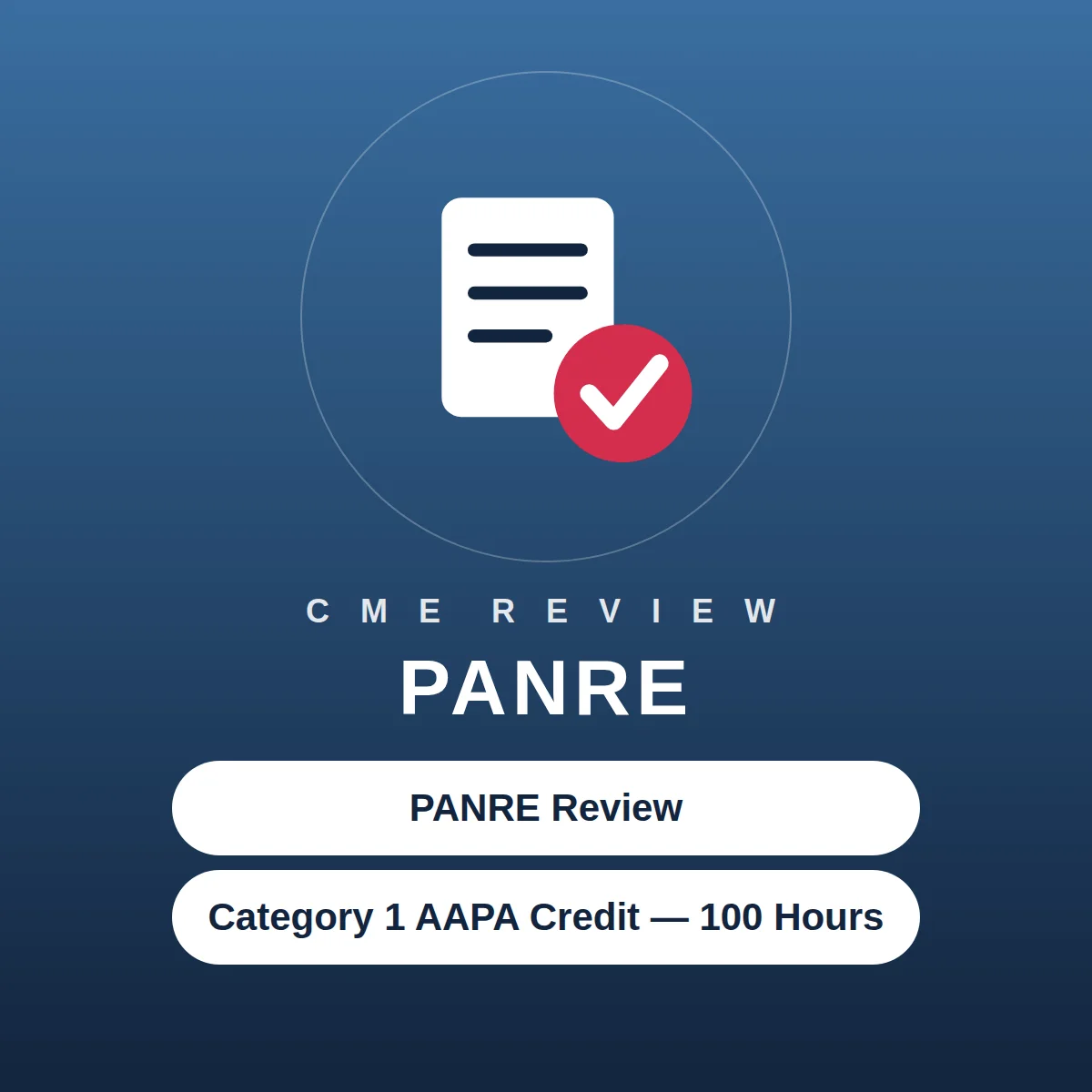
- CME: 100 AAPA Category 1 credits through the PANRE Clinical Review Module
- Optional paid add-ons: Amazon or Apple gift cards from $100 to $1,500
The 100 AAPA Category 1 credits apply to the PANRE Review Course and its PANRE Clinical Review Module only. They do not apply to the separate Pharmacology Course. As with any CME activity, complete the required content, post-test, and evaluation, and claim only the credit permitted by your participation and certification requirements.
Mistake 1: Waiting Until the Last Few Weeks
Many PAs treat PANRE preparation as a short-term task. They wait until their exam date is close, then attempt to review every organ system at once.
That approach creates predictable problems:
- Weak areas remain unidentified.
- High-yield topics compete with low-yield details.
- Practice questions become rushed rather than educational.
- CME completion is postponed until the end of the certification cycle.
A better approach is to begin with a baseline exam and establish a repeatable schedule. Use your first 240-question exam to identify deficits. Then divide your study time into manageable blocks by clinical system, task area, and error type.
The 30 months of access included with the PANRE Review Course supports this longer approach. You can begin reviewing before the final months of your cycle, use the course for ongoing reinforcement, and return to the practice exams as your test date approaches.
This also gives your 100 AAPA Category 1 credits a practical purpose. You are not buying a separate CME activity that sits apart from your exam preparation. You are using one course to support both requirements.
Mistake 2: Studying Random Topics Instead of the NCCPA Blueprint
A common study error is choosing topics based only on personal preference or daily clinical practice. An emergency medicine PA may overemphasize trauma and toxicology. A hospitalist may spend most of the available time on cardiopulmonary and infectious disease topics. A surgical PA may underprepare for dermatology, psychiatry, or reproductive health.
Your clinical experience matters, but the PANRE evaluates a broad range of medical knowledge. Your preparation should follow the current NCCPA Blueprint, not simply the patients you see most often.
Use a structured resource that exposes you to multiple organ systems and task areas. The PANRE Review Course provides five full-length exams with 240 questions each, for 1,200+ board-style questions across the course. The questions are designed to make you work through diagnosis, next-best-step management, pharmacology, prevention, and follow-up decisions.
This structure reduces the temptation to spend all of your study time in familiar territory. It also helps ensure that the CME you are completing is attached to a comprehensive clinical review rather than a narrow topic that has little relevance to your PANRE preparation.
Mistake 3: Rereading Instead of Practicing Active Recall
Reviewing notes can feel productive because the material looks familiar. Familiarity, however, is not the same as retrieval. On the exam, you must identify the key finding, interpret the clinical context, eliminate distractors, and choose an answer under time pressure.
Practice questions expose whether you can actually perform those steps.
When you answer a question, commit to an answer before reading the explanation. Then determine why your choice was correct or incorrect. Pay attention to the specific clue that changed the diagnosis or management decision.
Clinical Practice Question
Your patient is a 67-year-old man with a history of hypertension and tobacco use who presents with sudden, severe, tearing chest pain radiating between the scapulae. BP is 190/110 mmHg in the right arm and 160/94 mmHg in the left arm. HR is 108/min. A new diastolic murmur is heard along the right sternal border. Which diagnostic study is the most appropriate initial test?
A. Exercise stress test
B. CTA of the chest and abdomen
C. Routine chest radiograph only
D. Outpatient transthoracic echocardiogram
Correct answer: B. CTA of the chest and abdomen.
The presentation is concerning for acute aortic dissection: abrupt tearing pain, pulse or BP asymmetry, severe hypertension, and a new murmur consistent with aortic regurgitation. CTA is the appropriate initial study in a hemodynamically stable patient because it is rapidly available and evaluates the extent of the dissection.
The exercise stress test is inappropriate in suspected acute aortic pathology. A chest radiograph may show mediastinal widening but cannot exclude dissection. An outpatient transthoracic echocardiogram is too slow and does not provide adequate evaluation of the entire thoracic and abdominal aorta. If the patient were unstable or unable to undergo CTA, transesophageal echocardiography could be considered.
This is the value of active recall: you must select the immediate management step, not simply recognize the disease name.
Mistake 4: Tracking Only Your Overall Score
An overall percentage can conceal important weaknesses. A 72% score may reflect strong performance in cardiology and pulmonary medicine while masking serious deficits in neurology, dermatology, or hematology.
After each practice exam, track:
- Performance by organ system
- Questions missed because of knowledge gaps
- Questions missed because of misreading
- Questions missed because of changing a correct answer
- Management questions versus diagnosis questions
- Topics that remain weak after remediation
The five 240-question exams make it possible to monitor progress over time. Do not simply complete an exam and move on. Review the rationale for every missed question and flag questions that required guessing.
This process helps convert the course into a personalized study plan. It also increases the value of the 100 Category 1 AAPA credits because the educational activity is connected to deliberate clinical review rather than passive completion.
Mistake 5: Buying Disconnected CME Without Checking the Credit
Some PAs purchase several unrelated CME activities because they need credits and then buy a separate PANRE prep product. That can create duplicated expenses, multiple logins, different completion requirements, and no unified study plan.
Before purchasing, confirm:
- How many credits the activity offers
- Whether the credit is AAPA Category 1
- What content is included
- Whether the activity supports your exam preparation
- How long you have access
- What post-test and evaluation requirements apply
The PANRE Review Course addresses these logistical issues in one package. For $499.99, you receive 30 months of access, five 240-question exams, more than 1,200 practice questions, and access to the PANRE Clinical Review Module offering 100 AAPA Category 1 credits upon completion of the activity requirements.
The Pharmacology Course is a separate product. Do not assume that its credit is included in the PANRE Review Course, or that the PANRE Review Course’s 100 credits apply to the Pharmacology Course.

How the Paid CME Gift Card Add-Ons Work
If your employer provides a CME allowance, you can add an Amazon or Apple gift card to the course purchase. These are paid add-ons, not free gifts.
Available add-on amounts range from $100 to $1,500. The selected gift card increases the total purchase price by its face value: $499.99 for the course only, $599.99 with a $100 gift card add-on, and $999.99 with a $500 gift card add-on. Choose the amount that fits your employer’s CME policy and confirm that gift-card purchases are permitted before ordering.
The value is in combining relevant professional education with a practical option for using an approved CME budget. The gift card does not replace the educational component, and it does not increase the number of CME credits. The CME value comes from the PANRE Clinical Review Module; the gift card is a separate paid add-on.
Use Your CME Money Efficiently
A productive PANRE strategy should help you answer board-style questions, identify weak areas, and complete meaningful CME. Buying multiple resources without a plan can consume your budget without improving your preparation.
The PANRE Review Course provides a single, organized option:
- $499.99
- 30 months of access
- 1,200+ questions
- Five 240-question exams
- 100 AAPA Category 1 credits through the PANRE Clinical Review Module
- Optional paid Amazon or Apple gift card add-ons from $100 to $1,500
Review the PANRE Review Course and paid CME gift card options, and verify your employer’s reimbursement rules before selecting an add-on.
Continue Your PA Exam Preparation
For PA students preparing for the PANCE, PAtopia offers a separate exam-preparation platform with practice questions, full-length exams, progress tracking, and study libraries.
Try the PAtopia web version in your browser, or download the app through the Apple App Store or Google Play for Android.
To learn more about Jeremy’s clinical education work, visit CME Review Courses or his professional LinkedIn profile.
About the Author
Jeremy Boroff, MPAS, PA-C, is an Emergency Medicine PA with 24 years of clinical experience. He is a PA educator, author, and CME developer who created the PANRE, PANCE, EOR, and specialty review courses available through CME Review Courses.