

The landscape of continuing medical education (CME) has undergone a significant transformation in 2026. For physician assistants and nurse practitioners, the way you allocate your annual education stipend is now subject to tighter regulations following the 2026 ACCME rule updates regarding personal remuneration. Despite these changes, the need for high-quality, efficient, and flexible CME remains. At CME Review Courses, we provide a structured path for you to fulfill your educational requirements while maximizing the utility of your employer-provided budget.
Logistical Overview:
- Price: Starting at $399.99 (Course only)
- Gift Card Add-Ons: $100 to $1,500 (Amazon or Apple)
- Access Duration: 30 Months
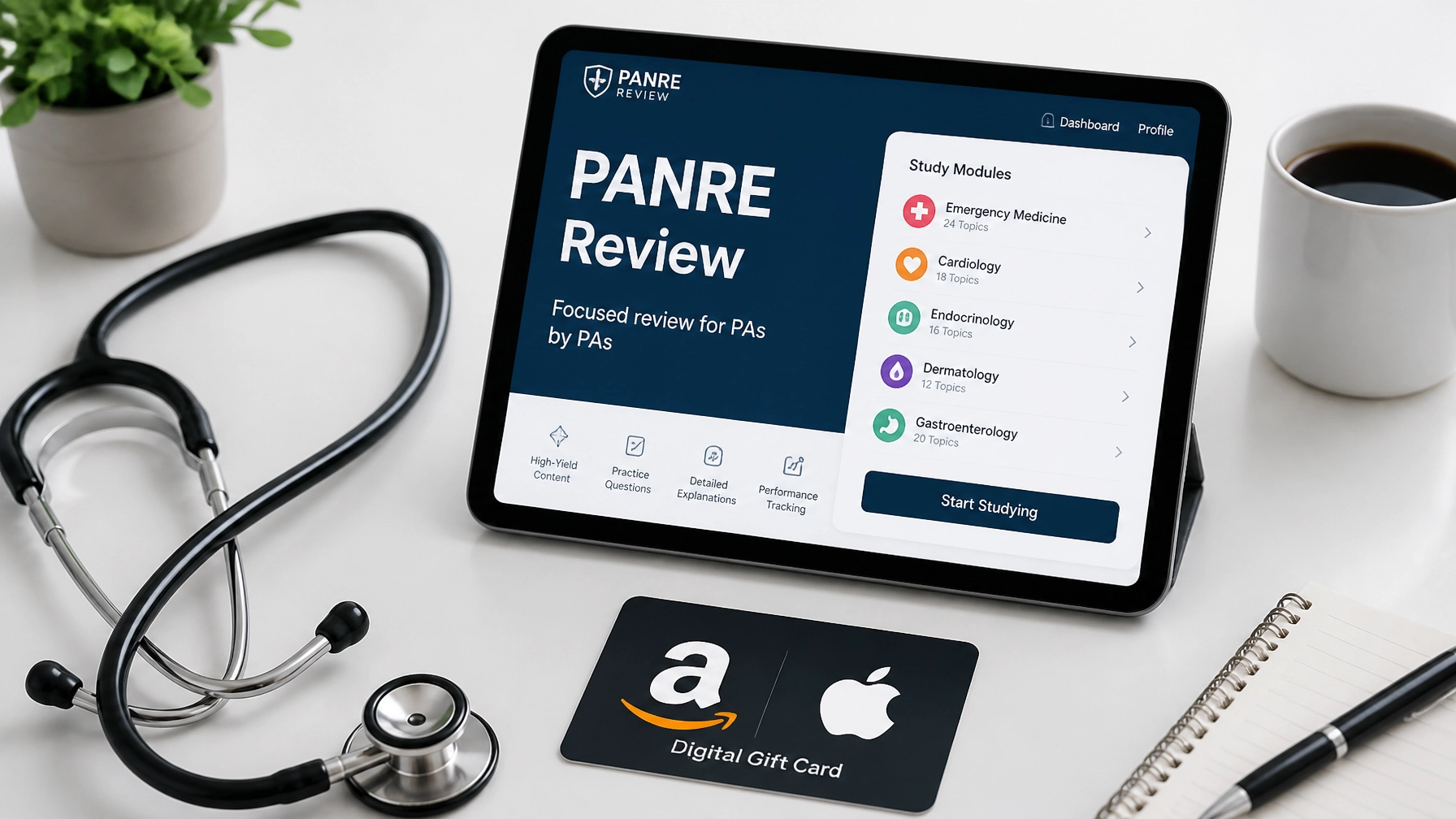
- Deliverables: 100 Hours of AAPA Category 1 CME Credit (PANRE Review Course)
- Content Coverage: Internal Medicine, Emergency Medicine, Family Medicine, Orthopedics, Dermatology, Psychiatry, Neurology, Cardiology, and OB/GYN.
Navigating the 2026 ACCME Rule Changes
The 2026 ACCME (Accreditation Council for Continuing Medical Education) policy changes have shifted how gift cards can be marketed alongside accredited medical education. The primary objective of these rules is to ensure that personal financial incentives do not overshadow the educational value of the content. Specifically, the rules prohibit gift cards from being included as a direct, inseparable "reward" for the purchase of ACCME-accredited CME.
However, the educational needs of PAs and NPs haven't changed. You still require a high volume of Category 1 credit to maintain your certification and licensure. For PAs, the NCCPA Blueprint for the PANRE remains the gold standard for study preparation. The challenge in 2026 is finding a provider that maintains strict compliance while still offering the flexibility that clinicians have come to expect from their education budgets.
The Solution: The CME Add-On Model
Our approach at CME Review Courses adheres to the shifting regulatory environment by offering a clear separation between our world-class educational content and the supplemental tools you use to access it. Instead of a "bundled" incentive, we offer Gift Card Add-Ons.
When you purchase the PANRE Review Course or our Pharmacology Course, you are investing in content written by physician assistants for physician assistants. These packages are designed to be an efficient use of your CME money. By selecting a gift card add-on ranging from $100 to $1,500, you are effectively choosing to use your education stipend to purchase the hardware (via Apple) or the secondary resources (via Amazon) required to facilitate your learning over the 30-month access period.

Why 100 Hours of AAPA Category 1 Credit Matters
For PAs, credit requirements are stringent. The PANRE Review Course provides 100 hours of AAPA Category 1 CME credit. This is specifically designed to meet the high-volume needs of clinicians preparing for recertification or those who need a large block of credit in a single cycle.
Unlike other courses that may offer generic credit, our PANRE Review is mapped directly to the clinical scenarios you face in daily practice and on the exam.
- Comprehensive Coverage: Whether you work in a specialty like Cardiology or as a Hospitalist in Internal Medicine, the course content covers the essential systems: Cardiovascular, Pulmonary, GI, Renal, and more.
- Pharmacology Focus: While the 100-hour PANRE course covers systemic management, we also offer a dedicated Pharmacology Course which provides Category 1 AAPA Credit. This is particularly valuable for NPs and PAs in states with specific pharmacology credit mandates for license renewal.
Maximizing Your 2026 Budget
With the 2026 changes, many providers have removed gift card options entirely, leaving clinicians with unused budget at the end of the fiscal year. Our CME with Gift Card packages allow you to fully utilize your allocated funds. If your employer provides a $2,000 annual budget, you can purchase the high-yield clinical content you need and add an Amazon or Apple gift card to ensure no portion of your professional development allowance goes to waste.
This model is not about "getting a bonus"; it is about the practical reality of modern medical education. To review 100 hours of content over 30 months, you need a reliable tablet or laptop. You need reference books. The add-on system facilitates this.

Clinical Vignette: Internal Medicine/Cardiology
To demonstrate the level of detail found in our PANRE Review Course, consider the following clinical scenario.
Patient Presentation:
Your patient is a 64-year-old male with a history of hypertension and Type 2 Diabetes who presents to the emergency department complaining of sudden onset of "tearing" chest pain that radiates to his back. On physical exam, he is diaphoretic. His blood pressure is 190/110 mmHg in the right arm and 165/90 mmHg in the left arm. A new early diastolic murmur is noted at the right sternal border.
Vital Signs:
- HR: 112 bpm
- BP: 190/110 mmHg (Right Arm)
- SaO2: 96% on room air
- Temp: 98.6°F
Question:
Which of the following is the most appropriate initial diagnostic study for this patient?
A. Transthoracic Echocardiogram (TTE)
B. CT Angiogram of the Chest and Abdomen
C. Chest X-ray
D. Electrocardiogram (ECG)
Explanation
Correct Answer: B. CT Angiogram of the Chest and Abdomen.
The clinical presentation of tearing chest pain radiating to the back, combined with a significant blood pressure differential between arms and a new aortic regurgitation murmur (early diastolic murmur), is highly suggestive of an Aortic Dissection. CT Angiogram is the gold standard for rapid and accurate diagnosis in hemodynamically stable patients due to its high sensitivity and specificity. While a Chest X-ray (Choice C) might show a widened mediastinum, it is not sensitive enough to rule out dissection. An ECG (Choice D) is necessary to rule out myocardial infarction but will not confirm the dissection. A TTE (Choice A) lacks the sensitivity of a CTA or a Transesophageal Echocardiogram (TEE) for identifying the extent of a dissection.
Clinical Vignette: Pharmacology
The following question represents the type of high-yield content found in our Pharmacology Course.
Patient Presentation:
Your patient is a 45-year-old female with a history of chronic kidney disease (Stage 3) and newly diagnosed hypertension. You are considering initiating ACE inhibitor therapy.
Question:
Which of the following laboratory findings would most likely require the discontinuation or dose adjustment of the ACE inhibitor?
A. Serum Potassium of 5.6 mEq/L
B. Serum Sodium of 134 mEq/L
C. Serum Creatinine increase of 10% from baseline
D. Hemoglobin of 11.2 g/dL
Explanation
Correct Answer: A. Serum Potassium of 5.6 mEq/L.
ACE inhibitors block the conversion of Angiotensin I to Angiotensin II, leading to decreased aldosterone secretion. This can result in hyperkalemia, especially in patients with pre-existing renal impairment. A potassium level of 5.6 mEq/L is above the normal range and warrants immediate intervention or discontinuation of the offending agent. A minor increase in serum creatinine (Choice C), typically up to 30%, is often expected and acceptable after initiating an ACE inhibitor due to changes in intraglomerular pressure. Mild hyponatremia (Choice B) and mild anemia (Choice D) are not primary contraindications for continuing ACE inhibitor therapy in this context.

Real-World Value for the Clinician
When you choose a CME package with a gift card, you are choosing a program developed by peers. We understand that your time is limited. Our content is structured to be "straight to the point," focusing on the "must-know" facts for the NCCPA Blueprint.
Target Audience Utility:
- Physician Assistants: Use the 100 hours of AAPA Category 1 credit for PANRE/PANRE-LA requirements.
- Nurse Practitioners: Claim AAPA credit in eligible states for licensure and certification.
- Physicians: While our courses count as Category 2 CME for physicians, many Internal Medicine physicians find the Internal Medicine Hospitalist package highly valuable for clinical updates.
Our courses are not just about checking a box. They are about maintaining a high standard of care. By offering a 30-month access period, we ensure that the information stays available to you long after you’ve earned your credits, serving as a reliable clinical reference tool.
Conclusion
The 2026 education budget year requires a more strategic approach to CME spending. By focusing on high-volume credit courses and utilizing the Gift Card Add-On model, you can ensure that you meet your professional requirements while maximizing the tools you need for success.
Visit CME Review Courses today to explore our PANRE Review, Pharmacology, and specialty CME packages.