If you are approaching recertification, choosing between PANRE-LA and the traditional PANRE should be based on your schedule, testing preferences, and ability to maintain a consistent study routine. The clinical content is closely aligned, but the testing experience is different.
Course Details at a Glance
- Price: $499.99 for the full PANRE Review Course
- Access: 30 months
- Deliverables: More than 2,500 practice questions, 15 body-system modules, three full-length mock exams, answer explanations, lectures, slides, and a readiness dashboard
- CME: 100 hours of AAPA Category 1 Self-Assessment CME through the PANRE Review Course
The PANRE Review Course is designed for practicing PAs who want structured review and a substantial amount of CME in the same purchase. The course addresses the NCCPA PANRE/PANRE-LA content areas and can support preparation for either assessment format.
You may also add an Amazon or Apple Gift Card in amounts from $100 to $1,500. These are paid add-ons, not free gifts. The selected amount is added to the purchase price. Check your employer’s CME policy before selecting an add-on, and choose an amount that fits your available CME budget.
PANRE-LA vs. Traditional PANRE: What Is Different?
The NCCPA describes PANRE-LA as an alternative, longitudinal assessment. The traditional PANRE remains a single, proctored examination at a testing center. Review the current NCCPA PANRE-LA information and official policies before making your final decision.
| Feature | Traditional PANRE | PANRE-LA |
|---|---|---|
| Format | One proctored examination at a Pearson VUE testing center | Online, longitudinal assessment completed through the NCCPA portal |
| Question volume | 240 multiple-choice questions in four 60-question blocks | 25 questions per quarter |
| Timing | Four 60-minute blocks | Five minutes per question |
| References | Closed-book | Open-book; printed or online references may be used |
| Schedule | Generally taken during years 9–10 of the certification cycle | Application begins in year 6; questions are delivered during years 7–9 |
| Participation | One scheduled testing event | Twelve quarters are available; at least eight quarters must be completed |
| Testing environment | Pearson VUE test center | Home or work using a compatible device |
| Scoring | Scaled score; the current passing standard should be confirmed with NCCPA | Cumulative scoring based on the best eight quarters; confirm the current passing standard with NCCPA |
Both pathways assess core medical knowledge using the applicable NCCPA PANRE/PANRE-LA content information. The difference is how and when you demonstrate that knowledge.
Who May Prefer PANRE-LA?
PANRE-LA may be a better fit if you:
- Prefer repeated, lower-stakes assessments over one high-stakes test day
- Can maintain a quarterly schedule for several years
- Like using clinical references to verify uncertain answers
- Want immediate feedback and rationales after answering questions
- Have an unpredictable clinical schedule but can protect short study periods throughout the quarter
The open-book format does not eliminate the need for preparation. Five minutes per question is limited when you must interpret a clinical vignette, identify the key issue, search a reference, and select the best answer. You need enough baseline knowledge to recognize what matters before opening a reference.
A practical PANRE-LA strategy is to divide the 25 quarterly questions into two or three planned sessions. Do not wait until the final days of the quarter. Complete questions early enough to review rationales and address knowledge gaps before the next assessment.
Who May Prefer the Traditional PANRE?
The traditional PANRE may be more appropriate if you:
- Want to complete recertification assessment in one planned event
- Prefer closed-book testing
- Perform well under timed conditions
- Do not want a multiyear quarterly commitment
- Can schedule a focused eight- to twelve-week study period
The traditional PANRE requires pacing and endurance. Your review must include timed blocks that approximate the actual testing structure. It is not enough to answer isolated questions while checking references. You must practice making decisions quickly without outside materials.

How a Focused PANRE Review Course Supports Both Options
A focused panre review course can support either exam because the underlying clinical domains overlap. The preparation emphasis changes, but the content review remains relevant.
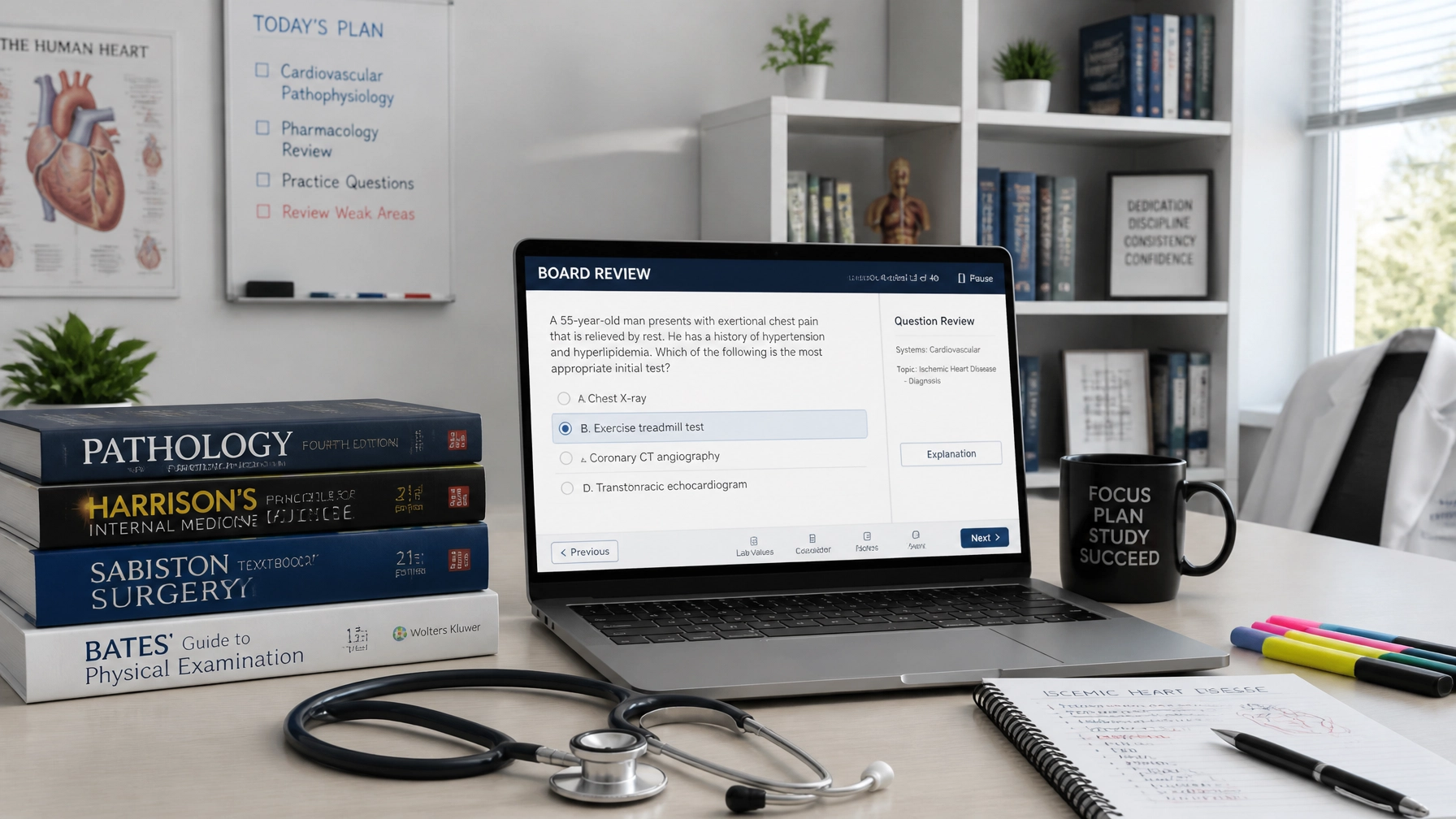
The CME Review Courses program includes:
- More than 2,500 board-style questions with detailed explanations
- 15 body-system modules, including cardiology, pulmonary, GI, neurology, dermatology, infectious disease, psychiatry, and emergency topics
- Three full-length mock exams with 240 questions each
- A performance dashboard showing attempted questions, correct responses, topic performance, and flagged items
- Downloadable slides and organized review material
- 30 months of access for flexible preparation
Use the course differently depending on your selected pathway. For PANRE-LA, work through short question sets and use the explanations to build a longitudinal knowledge log. For the traditional PANRE, use the modules to identify weaknesses, then complete timed mixed blocks without references.
Although pance prep courses are intended primarily for initial certification preparation, the same habits: content mapping, question-based learning, timed practice, and error analysis: are useful for PANRE preparation. A dedicated PANRE course remains more appropriate when the goal is recertification.
The Value of 100 AAPA Category 1 CME Credits
The PANRE Review Course is designated for 100 hours of AAPA Category 1 Self-Assessment CME. These credits apply specifically to the PANRE Review Course, not automatically to every CME Review Courses product.
You should claim credit only for the extent of your participation and complete the required course evaluation. NCCPA may apply its own certification-maintenance rules to self-assessment CME, so review the current NCCPA certification-maintenance requirements before logging credit.
For physicians, this activity may be claimed as Category 2 CME rather than Category 1. Nurse practitioner acceptance of AAPA Category 1 credit varies by state board and employer. NPs should verify requirements with their state board of nursing before purchase.
The course can also help you use an employer CME allowance efficiently. Optional cme gift cards from Amazon or Apple may be added in paid amounts from $100 to $1,500. They are not complimentary items or free gifts; they increase the total purchase price. Confirm that your organization permits this type of CME expenditure.

Common PANRE Review Mistakes
1. Treating PANRE-LA as an open-book shortcut
References are useful only when you can locate information quickly. Build familiarity with one primary clinical reference and practice searching it under the five-minute limit.
2. Waiting until the final year
Delayed preparation creates avoidable pressure. For PANRE-LA, late preparation can interfere with quarterly participation. For the traditional PANRE, it leaves insufficient time to complete enough practice questions and full-length simulations.
3. Reviewing only comfortable topics
A strong cardiology score does not compensate for repeated errors in infectious disease, renal medicine, psychiatry, or dermatology. Use performance data to direct study time toward weak systems.
4. Reading without answering questions
Passive review can create a false sense of competence. Questions reveal whether you can apply knowledge to diagnosis, management, contraindications, and next-best-step decisions.
5. Ignoring pacing
Traditional PANRE preparation requires timed 60-question blocks. PANRE-LA preparation requires five-minute decision-making. Practice the timing of the assessment you plan to take.
6. Confusing CME completion with exam readiness
Earning 100 CME credits is valuable, but completing CME does not guarantee PANRE or PANRE-LA success. Track both goals: the credit requirements and your clinical question performance.
A Practical Study Plan
- Confirm your timeline. Determine your certification-cycle year and whether you are eligible for PANRE-LA application.
- Choose your assessment format. Base the decision on schedule reliability, testing preference, and comfort with open- or closed-book conditions.
- Complete a baseline mixed question set. Record performance by organ system rather than relying only on an overall percentage.
- Create an error log. Label each missed question as a knowledge gap, misread stem, incorrect prioritization, or pacing problem.
- Review by system, then mix topics. Start with focused modules and transition to mixed blocks as the exam approaches.
- Simulate the actual format. Use open references and five-minute limits for PANRE-LA. Use closed-book 60-question blocks for traditional PANRE.
- Schedule CME work separately. Complete the PANRE Review Course evaluation and claim the 100 AAPA Category 1 Self-Assessment credits according to the course instructions.
- Verify administrative requirements. Confirm current NCCPA policies, testing deadlines, CME rules, and your employer’s policy for paid gift-card add-ons.
The best review strategy is the one you can execute consistently. PANRE-LA rewards steady quarterly participation. Traditional PANRE rewards structured preparation, rapid recall, and timed practice. In either case, a focused panre review course can provide the organized content review, question volume, and CME value needed to make your preparation more efficient.
About the Author
Jeremy Boroff, PA-C, is an emergency medicine physician assistant with 24 years of clinical emergency medicine experience and an additional seven years of experience as a registered respiratory therapist. He is a PA educator, CME developer, and author of PANRE, PANCE, EOR, and specialty review courses at CME Review Courses.
Educational content only. Always confirm current examination policies and certification requirements directly with NCCPA.