If you are preparing for your boards or managing a heavy rotation schedule, the last thing you need is another barrier to your study materials. Most medical apps require a credit card, a lengthy sign-up process, and an immediate commitment before you can see a single question.
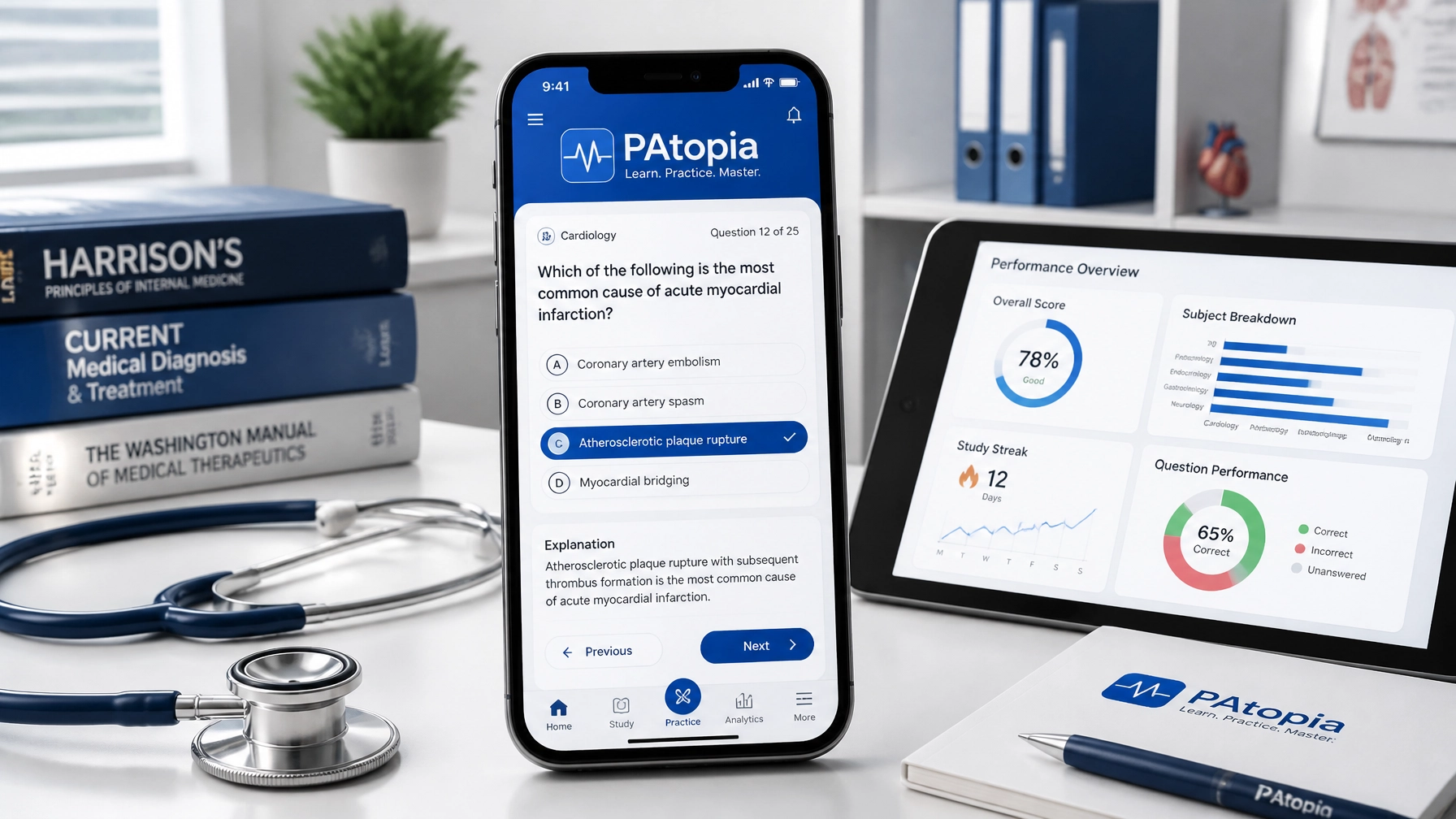
PAtopia has removed those barriers. You can now access the full suite of our clinical review tools for 72 hours with zero account creation and zero cost. You download the app and begin testing immediately.
PAtopia: Immediate Deliverables
- Price: $0.00 for the first 72 hours.
- Access Duration: Full feature access for 3 days.
- Content Volume: 11,000+ board-style questions.
- Exam Types: PACKRAT, EOR, EOC, and PANCE.
- Analytics: Instant system-by-system performance tracking.
Full Clinical Integration Without the Friction
The 3-day free trial is not a "lite" version of the software. It is the complete platform designed for the Physician Assistant student and the practicing clinician. Whether you are prepping for your first PACKRAT or refreshing your knowledge for the PANRE, PAtopia provides the data you need to identify clinical knowledge gaps.
Comprehensive Question Bank Breakdown
The PAtopia database is structured to follow the NCCPA Blueprint requirements across all major exam categories:
- PACKRAT Review: 5 full-length mock exams (225 questions each).
- End of Rotation (EOR) Exams: 35 mock exams total (120 questions each). This includes 5 exams for each of the 7 core rotations: Surgery, Emergency Medicine, Family Medicine, Internal Medicine, Pediatrics, Gynecologic Sexual and Reproductive Health (OB/GYN), and Psychiatry.
- End of Curriculum (EOC) Review: 5 full-length mock exams (300 questions each).
- PANCE Review: 15 full-length mock exams (300 questions each).
CME for the Practicing Physician Assistant
While PAtopia serves the student and board-prep market, CME Review Courses offers high-yield solutions for practicing PAs. Efficiency is the priority when managing a clinical schedule and state licensing requirements.
PANRE Review Course
- Credits: 100 hours of AAPA Category 1 CME Credit.
- Format: Efficient, high-yield content written by PAs for PAs.
- Focus: Core clinical competencies across Family Medicine, Internal Medicine, Cardiology, Neurology, and more.
Pharmacology Review Course
- Credits: AAPA Category 1 CME Credit in Pharmacology.
- Clinical Utility: Critical for meeting state-specific pharmacology requirements for NP/PA license renewal.
Maximizing Your CME Budget
Many clinicians have unused CME funds that expire at the end of the fiscal year. We offer an efficient way to utilize these funds by adding an Amazon or Apple Gift Card to your purchase. This allows you to secure your 100 hours of AAPA Category 1 Credit while receiving a gift card valued between $100 and $1500 to further support your professional education and equipment needs.
Clinical Practice: Board-Style Vignettes
To demonstrate the quality of the content found within PAtopia and our PANRE Review Course, review the following clinical scenarios. These represent the style of high-yield questioning found in our 11,000-question database.
Question 1: Cardiology
Your patient is a 68-year-old male presenting with a 2-hour history of crushing substernal chest pain. He is diaphoretic. Vital signs are: BP 90/60 mmHg, HR 110 bpm, SaO2 94% on room air. The EKG reveals ST-segment elevation in leads II, III, and aVF. Which of the following is the most appropriate next step in management?
A) Immediate administration of intravenous beta-blockers
B) Aggressive fluid resuscitation with normal saline
C) Administration of sublingual nitroglycerin
D) Application of a lidocaine drip for arrhythmia prophylaxis
Correct Answer: B) Aggressive fluid resuscitation with normal saline
Explanation: The EKG indicates an inferior wall myocardial infarction, which frequently involves the right ventricle. Right ventricular infarctions are highly preload-dependent. Hypotension in this setting should be treated with IV fluid boluses to maintain cardiac output. Nitroglycerin and beta-blockers (Choices A and C) are contraindicated in the acute phase of a right-sided or inferior MI presenting with hypotension, as they reduce preload and can worsen the shock. Lidocaine (Choice D) is no longer used routinely for prophylaxis.
Question 2: Infectious Disease
Your patient is a 24-year-old female complaining of a "fishy" vaginal odor that is more noticeable after intercourse. She denies pruritus or dysuria. Physical exam reveals a thin, grayish-white discharge. The pH of the discharge is 5.0. Whiff test is positive. What is the most appropriate treatment?
A) Oral Fluconazole 150mg single dose
B) Intramuscular Ceftriaxone 500mg
C) Oral Metronidazole 500mg BID for 7 days
D) Oral Azithromycin 1g single dose
Correct Answer: C) Oral Metronidazole 500mg BID for 7 days
Explanation: This clinical presentation is consistent with Bacterial Vaginosis (BV), meeting Amsel’s criteria (grayish discharge, pH > 4.5, positive whiff test, and presence of clue cells on microscopy). Metronidazole (oral or vaginal) or Clindamycin are the recommended treatments. Fluconazole (Choice A) is for candidiasis, which typically presents with a "cottage cheese" discharge and low pH. Ceftriaxone and Azithromycin (Choices B and D) are for Gonorrhea and Chlamydia, which usually present with mucopurulent cervicitis.
Question 3: Emergency Medicine / Orthopedics
Your patient is a 19-year-old male who was brought to the ED after a motor vehicle collision (MVC). He complains of severe pain in his left leg. On exam, the left lower leg is tense, pale, and exquisitely tender to passive stretch of the toes. Distal pulses are present but weak. What is the definitive management?
A) Elevation of the extremity above the level of the heart
B) Application of a rigid cast for stabilization
C) Immediate surgical fasciotomy
D) CT Angiography to assess for arterial injury
Correct Answer: C) Immediate surgical fasciotomy
Explanation: This patient is presenting with classic signs of Compartment Syndrome. Pain out of proportion to exam and pain with passive stretch are early and sensitive signs. Definitive management is a surgical fasciotomy to relieve the intracompartmental pressure. Elevation (Choice A) is contraindicated as it reduces arterial inflow. Casting (Choice B) would further increase pressure. While CT Angiography (Choice D) might be useful if vascular injury is suspected, it should not delay the surgical intervention for confirmed or highly suspected compartment syndrome.
The PAtopia Advantage
The PAtopia app is built for speed. When you are in the clinical setting, you do not have time to troubleshoot login issues or navigate complex menus. Our interface is streamlined for the NCCPA Blueprint content areas.
- PANCE/PANRE Review: 15 mock exams allow you to simulate the actual board experience multiple times.
- EOR Success: Specialized exams for Internal Medicine, Family Medicine, and Pediatrics ensure you are prepared for the nuances of each rotation.
- Real-Time Analytics: After every exam, the app breaks down your performance by organ system (e.g., Cardiology, Pulmonology, GI). This allows you to focus your 72-hour trial on your weakest subjects.
Access the 3-Day Free Trial Now
You can experience the most comprehensive PA study tool on the market today without spending a dime.
- Download the PAtopia app from the App Store or Google Play.
- Open the app.
- Start your 72-hour trial: no account or sign-in required.
For practicing PAs looking for Category 1 credit, explore our PANRE Review Course and Pharmacology Review CME packages. Don't forget to utilize your CME budget with our Amazon/Apple Gift Card add-ons.