
For Physician Assistant students, the PACKRAT (Physician Assistant Clinical Knowledge Rating and Assessment Tool) is the first major hurdle that signals the transition from the classroom to the clinic. It is an objective measure of your clinical knowledge, but taking the exam is often a stressful experience because students lack a resource that truly mimics the official PAEA format.
When preparing for this 225-question self-assessment, you have two choices: rely on fragmented resources and old "keyword" lists, or use a dedicated simulation tool. Below is the breakdown of the PAtopia PACKRAT Review Course.
Price: One-time payment (No subscriptions)
Duration of access: Permanent
Quantifiable Deliverables: 1,125 Board-Style Questions, 5 Full-Length Practice Exams
Additional Features: 11,000+ total questions in the PAtopia App (EOR, EOC, PANCE)
The Traditional PACKRAT Experience vs. PAtopia
The traditional PAEA PACKRAT is a 225-question exam designed to identify your strengths and weaknesses. However, the biggest complaint from students is the feedback. After the exam, you receive "keyword" feedback: a list of concepts you missed: rather than the actual questions or explanations. This makes it difficult to understand why you missed a point.
PAtopia changes this dynamic by providing a PACKRAT Review Course built directly into an all-in-one app. Instead of just testing you, it trains you.
1. Real-World Simulation
The PAtopia PACKRAT module includes 1,125 board-style questions divided into 5 full-length practice exams. Each exam mirrors the 225-question format of the actual PACKRAT. This builds the mental stamina required for a multi-hour examination, which is a critical factor in performance that textbooks cannot replicate.
2. Immediate Scoring and Granular Analytics
While the official PACKRAT takes time to process and report, PAtopia provides immediate feedback. You receive an instant score and a system-by-system breakdown. This allows you to see exactly where your knowledge gaps lie: whether it’s Cardiology, Pulmonology, or OB/GYN: so you can pivot your study plan immediately.
3. The PAtopia Advantage: All-In-One Ecosystem
Most students buy one app for EORs, another for the PACKRAT, and a third for the PANCE. PAtopia centralizes your entire PA journey. By downloading the app, you gain access to a library of over 11,000 total questions covering:
- 7 EOR Rotations (Surgery, EM, Family Medicine, Internal Medicine, Pediatrics, Psychiatry, and Women's Health)
- Physician Assistant End of Curriculum (EOC) Review
- 15 Full-Length Mock PANCE Exams

Why the 3-Day Free Trial is the Standard
We understand that PA students are often "broke and busy." This is why PAtopia offers a 3-day free trial with no account, no login, and no email required. You simply download the app and start testing. This allows you to verify the quality of the 1,125 PACKRAT questions before you spend a single dollar.
Beyond the PACKRAT: Preparing for your Career
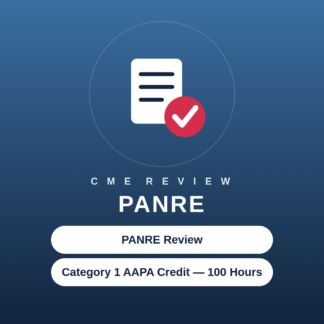
For those moving beyond the student phase, CME Review Courses provides the necessary tools for professional maintenance. While PAtopia handles the student journey, our PANRE Review Course offers 100 hours of AAPA Category 1 CME credit. This is an efficient way to fulfill your recertification requirements while staying sharp on clinical content.
We also offer specialized Pharmacology Courses that provide Category 1 AAPA Credit. To maximize your educational budget, many of our packages include Amazon or Apple Gift Card add-ons ranging from $100 to $1,500. This allows you to purchase the high-quality review content you need while receiving a gift card to further enrich your medical library or upgrade your technology.
Clinical Assessment: Psychiatry & Behavioral Health
Your patient is a 24-year-old male brought to the emergency department by his roommate. The roommate states the patient has not slept in four days and has been "talking non-stop" about a new business venture involving deep-sea mining. On physical exam, the patient is pressured in his speech, easily distracted, and highly energetic. He denies any previous medical history or drug use. Vital signs show a HR of 105 bpm, BP 138/88 mmHg, and SaO2 99% on room air.
Which of the following is the most appropriate initial pharmacological treatment for this patient?
A. Fluoxetine
B. Lithium carbonate
C. Lorazepam
D. Haloperidol
Correct Answer: B. Lithium carbonate
Lithium carbonate is a first-line mood stabilizer for the treatment of acute mania in Bipolar I Disorder. It is highly effective in reducing the symptoms of pressured speech, grandiosity, and decreased need for sleep.
- Fluoxetine is an SSRI and is contraindicated as monotherapy in patients with suspected Bipolar Disorder, as it can precipitate a manic switch.
- Lorazepam is a benzodiazepine that may be used as an adjunct for agitation or insomnia but does not treat the underlying mood disorder.
- Haloperidol is a first-generation antipsychotic. While it may be used for acute psychosis or severe agitation, Lithium or second-generation antipsychotics are generally preferred for long-term stabilization due to the side effect profile of older neuroleptics.
Clinical Assessment: Cardiovascular System
Your patient is a 68-year-old female with a history of hypertension and tobacco use who presents with sudden onset of substernal chest pain that radiates to her left jaw. She appears diaphoretic and pale. Her vitals are HR 112 bpm, BP 155/95 mmHg, RR 22, and SaO2 94% on room air. An EKG is performed and shows 3mm ST-segment elevation in leads V1 through V4.
What is the most immediate and appropriate next step in management?
A. Administer 324mg of chewed Aspirin
B. Obtain a chest X-ray
C. Order a Stat Troponin level
D. Perform a bedside echocardiogram
Correct Answer: A. Administer 324mg of chewed Aspirin
Administering chewed Aspirin is the most immediate intervention required for a patient with an ST-elevation myocardial infarction (STEMI). Aspirin inhibits platelet aggregation and has been shown to significantly reduce mortality in the setting of an acute MI.
- Chest X-ray is useful to rule out other causes of chest pain like aortic dissection or pneumonia but should not delay the initial treatment of a confirmed STEMI.
- Stat Troponin will be ordered, but in the presence of clear ST-segment elevation on EKG, you do not wait for lab confirmation before initiating therapy.
- Echocardiogram may be used later to assess wall motion abnormalities but is not the priority over stabilization and preparation for reperfusion.

Summary of Benefits
The PAtopia app and the CME Review Courses ecosystem provide a comprehensive solution for the PA career:
- PACKRAT Review: 1,125 questions to simulate the PAEA exam.
- PANCE Review: 15 mock exams with 300 questions each.
- EOR Success: Specialized reviews for all 7 major rotations.
- Career Longevity: 100 hours of AAPA Category 1 CME credit for the PANRE.
- Educational Value: CME packages with $100-$1500 Amazon or Apple Gift Cards.
For students and PAs who demand efficient, authoritative, and clinical-focused review, PAtopia is the definitive tool. Download the app today and utilize the 72-hour free trial to experience the difference.