


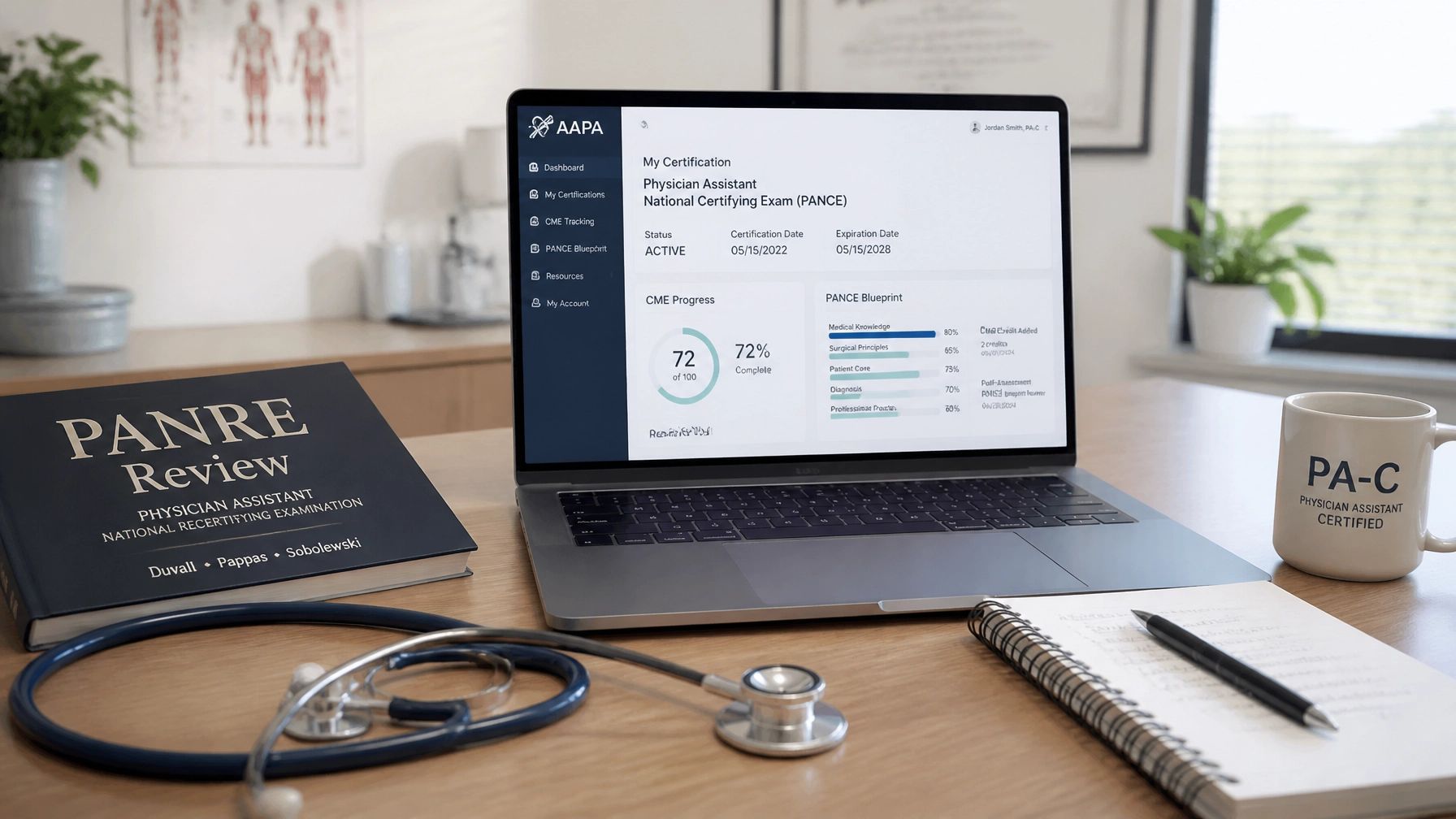
Course Title: PANRE Review Course (100 Hours of Category 1 AAPA CME)
Price: $399.99
Access Duration: 30 Months
Deliverables: 100 Hours of Category 1 AAPA CME Credit, Comprehensive PANRE/PANRE-LA Review, Gift Card Add-on Options ($100 – $1500)
The landscape of Physician Assistant recertification has shifted significantly with the permanent implementation of the Physician Assistant National Recertification Examination-Longitudinal Assessment (PANRE-LA). For PAs entering their tenth year of certification, the choice between the traditional one-day PANRE and the multi-year PANRE-LA requires an understanding of both the administrative requirements and the clinical depth of the NCCPA Blueprint.
Successfully navigating these assessments demands a structured review of core medical knowledge. CME Review Courses provides a comprehensive PANRE Review Course that aligns with current clinical standards while offering the most efficient use of your CME budget through our CME with gift card packages.
Understanding the PANRE-LA Transition
The PANRE-LA is designed to remove the "high-stakes" pressure of a single-day exam. It is a longitudinal assessment delivered online over 12 quarters. PAs typically apply for this option in the sixth year of their certification cycle.

Key PANRE-LA Parameters:
- Scoring: Performance is measured on a scale of 1000 to 1500.
- Passing Standard: A scaled score of 1150 is required to maintain certification.
- Format: 25 questions are released each quarter. You have three minutes to answer each question.
- Remediation: The longitudinal format allows you to identify knowledge gaps early and adjust your study focus in subsequent quarters.
While the format is more flexible, the clinical content remains rigorous. Whether you choose the traditional exam or the longitudinal assessment, your preparation must cover the full breadth of the NCCPA Blueprint.
Clinical Vignette 1: Cardiology
Your patient is a 64-year-old male with a history of hypertension and type 2 diabetes mellitus. He presents for a routine follow-up. His blood pressure today is 152/94 mmHg. His previous two readings over the last month were 148/92 mmHg and 150/96 mmHg. His current medications include Metformin 1000mg BID. Physical exam is unremarkable. Laboratory results show a serum creatinine of 1.2 mg/dL and an albumin-to-creatinine ratio of 45 mg/g (normal <30 mg/g).
According to current clinical guidelines, which of the following is the most appropriate initial antihypertensive therapy for this patient?
A. Amlodipine
B. Hydrochlorothiazide
C. Lisinopril
D. Metoprolol
Correct Answer: C. Lisinopril
Lisinopril is the correct choice because this patient has both hypertension and evidence of early diabetic nephropathy (albuminuria). ACE inhibitors (like Lisinopril) or Angiotensin II Receptor Blockers (ARBs) are first-line agents in patients with diabetes and albuminuria due to their renoprotective effects and ability to slow the progression of chronic kidney disease.
- Amlodipine is a calcium channel blocker and a viable first-line agent for essential hypertension, but it does not offer the same degree of renoprotection as an ACE inhibitor in the setting of albuminuria.
- Hydrochlorothiazide is a thiazide diuretic often used as first-line therapy, but it is less preferred than ACE inhibitors for patients with proteinuric kidney disease.
- Metoprolol is a beta-blocker and is generally not considered first-line for uncomplicated hypertension unless there is a specific indication such as heart failure or post-myocardial infarction.
Clinical Vignette 2: Pulmonology
Your patient is a 22-year-old female with no significant past medical history who presents with a 3-day history of productive cough, fever, and pleuritic chest pain. Vital signs: Temp 102.1°F, HR 105, BP 118/76, RR 20, SaO2 96% on room air. On auscultation, you note rales and increased tactile fremitus in the right lower lobe. A chest X-ray confirms a right lower lobe infiltrate.
Which of the following is the most appropriate outpatient treatment for this patient, assuming she has no known drug allergies and no recent antibiotic use?
A. Amoxicillin
B. Ciprofloxacin
C. Gentamicin
D. Vancomycin
Correct Answer: A. Amoxicillin
Amoxicillin (1g three times daily) is currently recommended as a first-line monotherapy for outpatient community-acquired pneumonia (CAP) in healthy adults without comorbidities or risk factors for MRSA or Pseudomonas. Doxycycline or a macrolide (if local resistance is <25%) are also options.
- Ciprofloxacin is a fluoroquinolone but is not a "respiratory fluoroquinolone" because it has poor activity against Streptococcus pneumoniae. Levofloxacin or Moxifloxacin would be the appropriate choices in this class.
- Gentamicin is an aminoglycoside used primarily for gram-negative infections in inpatient settings and is not appropriate for outpatient CAP.
- Vancomycin is used for MRSA coverage in severe, complicated, or inpatient pneumonia and is not indicated for this healthy outpatient.
Strategic Review with CME Review Courses
Effective PANRE Review requires more than just reading textbooks. It requires active engagement with practice questions that mirror the style and difficulty of the NCCPA Blueprint. Our PANRE Review Course is specifically designed to provide this experience.

This course is written by physician assistants for physician assistants. It provides 100 hours of Category 1 AAPA CME credit, making it an ideal solution for meeting your triennial CME requirements while preparing for recertification.
Leveraging Your CME Budget
One of the most popular features of our program is the CME with gift card add-on. We understand that educational resources extend beyond our video modules. By adding a $100 to $1500 Amazon or Apple gift card to your purchase, you can acquire the hardware or additional reference materials you need to succeed.
For those focusing specifically on pharmacological updates, we also offer a Pharmacology CME Package. This course also provides Category 1 AAPA credit and is essential for PAs looking to stay current with the latest medication management guidelines, though it is important to note that the 100 hours of Category 1 AAPA credit is specific to the full PANRE Review Course.
Clinical Vignette 3: Gastroenterology
Your patient is a 45-year-old female who presents to the emergency department with a 12-hour history of constant, sharp pain in the right upper quadrant that radiates to her right scapula. She reports nausea and two episodes of non-bilious emesis. She has a history of biliary colic. Vital signs: Temp 101.4°F, HR 108, BP 130/85, RR 18. Physical exam reveals tenderness and guarding in the right upper quadrant. A positive Murphy's sign is noted.
Which of the following is the initial diagnostic study of choice for this patient?
A. Abdominal CT with contrast
B. Hepatobiliary iminodiacetic acid (HIDA) scan
C. Right upper quadrant ultrasound
D. Magnetic resonance cholangiopancreatography (MRCP)
Correct Answer: C. Right upper quadrant ultrasound
Right upper quadrant ultrasound is the initial diagnostic study of choice for suspected acute cholecystitis. It is highly sensitive and specific, cost-effective, and does not involve ionizing radiation. Expected findings include gallbladder wall thickening (>4mm), pericholecystic fluid, and the presence of gallstones or sludge.
- Abdominal CT with contrast can show gallbladder inflammation but is less sensitive for gallstones and involves radiation exposure; it is generally reserved if the diagnosis is unclear or complications like perforation are suspected.
- HIDA scan is the most sensitive test for acute cholecystitis and is used when the ultrasound is inconclusive but the clinical suspicion remains high.
- MRCP is used primarily to evaluate for choledocholithiasis (stones in the common bile duct) and is not the first-line test for simple acute cholecystitis.
Maximizing Success on the PANRE-LA
The transition to the PANRE-LA provides a unique opportunity to integrate learning into your daily practice. Because you receive immediate feedback on the questions you answer, you can use those insights to direct your study.

When using our PANRE Review Course, we recommend the following strategy:
- Identify Weakness: Use our practice exams to find your lowest-performing categories within the NCCPA Blueprint.
- Targeted Review: Focus on the specific chapters in our course that address those gaps, such as Cardiology, Emergency Medicine, or Internal Medicine.
- Utilize Gift Cards: Use your Amazon or Apple gift card add-on to purchase high-yield medical apps or tablets to keep your review materials accessible during your shifts.
The goal of our content is not just to help you pass an exam, but to enhance your clinical competence. While the course was written for PAs, nurse practitioners and physicians also find significant value in our Internal Medicine and Hospitalist packages. Note that for nurse practitioners, AAPA Category 1 credit acceptance varies by state board, and for physicians, this content typically counts as Category 2 CME.
By choosing CME Review Courses, you are choosing a practical, clinician-led approach to your professional development.