

Price: Starting at $499 (Depending on Gift Card Add-On)
Duration of Access: 1 Year of Unlimited Access
Deliverables: Comprehensive Video Modules, Practice Question Bank, and AAPA Category 1 CME Credit
Staying current with the rapidly evolving landscape of obesity pharmacology is no longer optional for the modern clinician. Whether you are prepping for your PANRE or managing a high-volume primary care panel, understanding the nuances of GLP-1 receptor agonists and GIP/GLP-1 dual agonists is critical for 2026 practice.
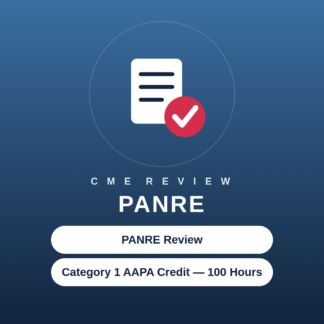
Our Pharmacology Course provides a deep dive into these agents, offering AAPA Category 1 CME Credit. This course was written by PAs specifically for PAs, though nurse practitioners and physicians also find immense value in the clinically focused content. For those nearing their recertification cycle, our PANRE Review Course offers a full 100 hours of AAPA Category 1 Credit, making it the most efficient way to meet your requirements.
We also offer an efficient way to maximize your CME budget. Our CME with Gift Card packages allow you to add an Amazon or Apple Gift Card (ranging from $100 to $1500) to your purchase. This allows you to further enrich your professional education while receiving a "clean" receipt for reimbursement.
The Current State of GLP-1 Pharmacology
Obesity management has shifted from a "lifestyle-first" paradigm to a "biologically-driven" approach. As of April 2026, the FDA-approved roster for chronic weight management includes several key agents that every PA must master.
Mechanism of Action: Beyond Appetite Suppression
Glucagon-like peptide-1 (GLP-1) and Glucose-dependent insulinotropic peptide (GIP) are incretin hormones. While GLP-1 primarily slows gastric emptying and increases postprandial satiety via the hypothalamus, GIP adds a layer of metabolic regulation, specifically improving insulin sensitivity and potentially reducing the nausea associated with GLP-1 monotherapy.

High-Yield Agent Profiles for 2026
- Wegovy (semaglutide 2.4 mg): The established injectable standard. In the STEP 1 trials, it demonstrated roughly 15% weight loss over 68 weeks.
- Wegovy Oral (semaglutide 25 mg): Approved in late 2025, this daily tablet offers a non-injectable alternative for patients with needle phobia, though it requires strict fasting and water restrictions for absorption.
- Zepbound (tirzepatide): A dual GIP/GLP-1 agonist. Clinical data (SURMOUNT-5) shows superiority over semaglutide monotherapy, with weight loss reaching 20-22% over 72 weeks.
- Foundayo (orforglipron): The newest addition to the 2026 toolkit. As a non-peptide, small-molecule oral GLP-1, it does not require the strict fasting conditions of oral semaglutide, allowing for much higher patient adherence.

Clinical Application and Eligibility
When evaluating a patient for these therapies, use the standard BMI benchmarks. A patient is eligible for pharmacological intervention if their BMI is ≥30 kg/m² or ≥27 kg/m² with at least one weight-related comorbidity such as hypertension, T2DM, or dyslipidemia.
PAs should monitor for common side effects: nausea, vomiting, and diarrhea: which are usually transient during the dose-escalation phase. More serious but rare risks include pancreatitis and biliary disease.

Clinical Vignette: Practical Assessment
Your patient is a 44-year-old male presenting for a follow-up on his obesity management. He has a BMI of 34 kg/m² and a history of hypertension. He has been on Wegovy (semaglutide 2.4 mg) for six months but reports "plateauing" and is frustrated by the weekly injections. He asks about "the new dual-action shot" he heard about. His labs are unremarkable, and he has no history of medullary thyroid carcinoma or MEN 2.
Which of the following is the most appropriate pharmacological transition for this patient?
A) Transition to Wegovy Oral 25 mg daily
B) Transition to Zepbound (tirzepatide)
C) Add phentermine 15 mg daily to the current regimen
D) Discontinue semaglutide and start Foundayo (orforglipron)
Explanation:
The correct answer is B. Zepbound (tirzepatide) is a dual GLP-1/GIP receptor agonist that has shown superior weight loss efficacy compared to semaglutide monotherapy in head-to-head trials (SURMOUNT-5). It remains a weekly injection, but its dual mechanism addresses the patient's plateau more effectively than switching to an oral version of the same drug (Option A). While adding phentermine (Option C) is a possibility, the dual-agonist profile of tirzepatide is the next logical step in high-yield obesity management for patients failing monotherapy. Foundayo (Option D) is an oral option, but the patient specifically asked about the "dual-action shot."
Practice Questions
Question 1:
A 52-year-old female with a BMI of 31 kg/m² and controlled Type 2 Diabetes is interested in the new oral medication Foundayo (orforglipron). What is the primary pharmacological advantage of this agent over Wegovy Oral (semaglutide)?
A) It is a dual GLP-1/GIP agonist.
B) It has a higher percentage of weight loss than injectable tirzepatide.
C) It is a small-molecule non-peptide that does not require strict fasting for absorption.
D) It is administered once monthly rather than once daily.
Explanation:
The correct answer is C. Foundayo (orforglipron) is a small-molecule GLP-1 receptor agonist. Unlike oral semaglutide, which is a peptide requiring a large dose and specific fasting conditions to be absorbed, small molecules like orforglipron can be taken with or without food. Option A is incorrect as it is a monotherapy. Option B is incorrect; injectable tirzepatide still holds the lead in weight loss percentage. Option D is incorrect; it is a daily oral medication.
Question 2:
Which of the following is a contraindication for the initiation of GLP-1 receptor agonists in a patient with a BMI of 35 kg/m²?
A) Personal or family history of Medullary Thyroid Carcinoma (MTC).
B) History of Cholelithiasis.
C) BMI between 27 and 30 kg/m².
D) History of Gastroesophageal Reflux Disease (GERD).
Explanation:
The correct answer is A. A personal or family history of Medullary Thyroid Carcinoma (MTC) or Multiple Endocrine Neoplasia syndrome type 2 (MEN 2) is a boxed warning and absolute contraindication for GLP-1 and dual agonists due to risks identified in rodent studies. While cholelithiasis (Option B) and GERD (Option D) require cautious monitoring as these drugs can exacerbate these conditions via delayed gastric emptying, they are not absolute contraindications. Option C describes the eligibility range for patients with comorbidities.
Maximize your 2026 CME experience by choosing a program that respects your time and your budget. Visit CME Review Courses today to explore our PANRE Review and Pharmacology packages. Don't forget to take advantage of our CME with Gift Card options to get the most out of your employer-provided CME funds.