Description
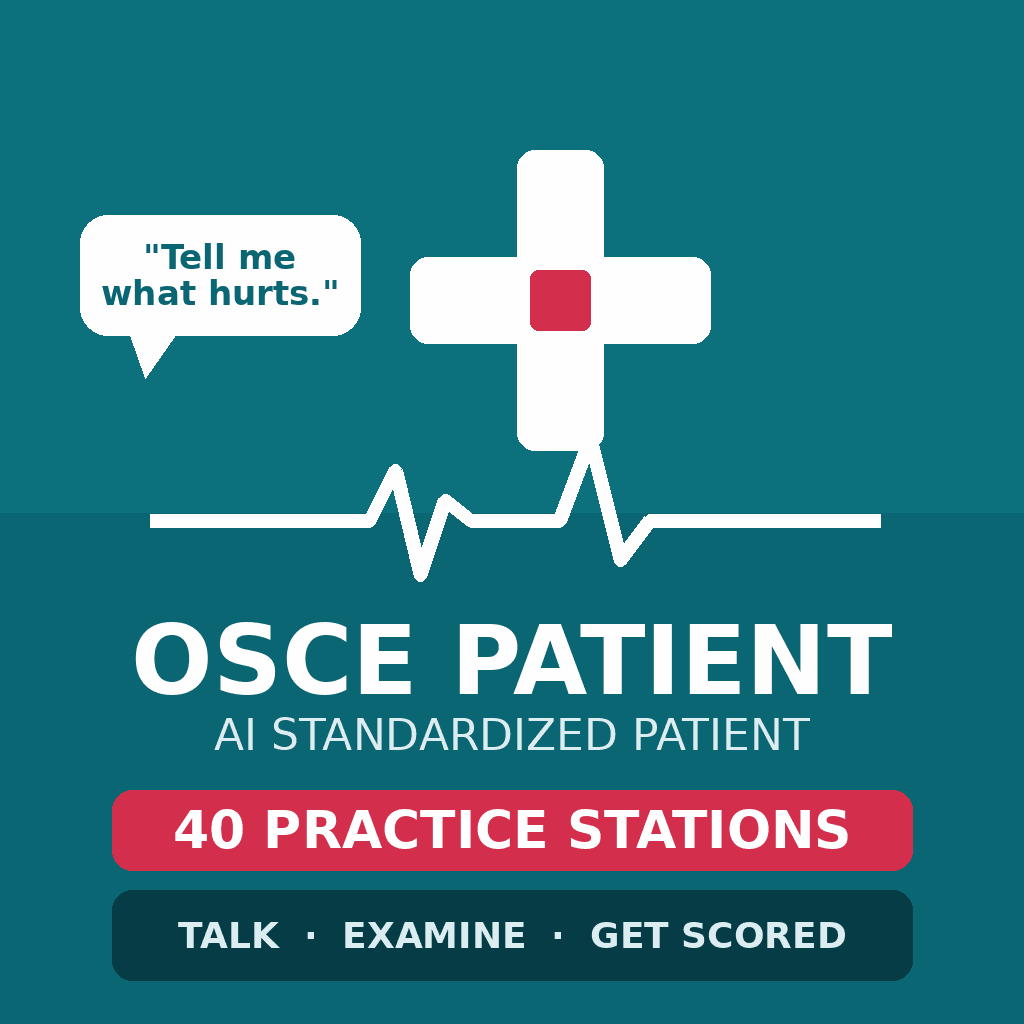
An OSCE is the one exam you cannot study for alone. You need a patient to talk to, an examiner to score you, and the honest feedback that neither your roommate nor a checklist PDF can give. The PAtopia OSCE Patient gives you all three, on your phone, as many times as you want.
Try it before you buy it. Station 1 (chest pain in the emergency department) is free, no account needed.
Talk to Your First Patient Free
Or get it included with All-Access
OSCE practice exams that talk back
Most OSCE practice exams are a list of cases and a checklist you grade yourself against. That tells you what you should have asked, but not whether you would have asked it with a real patient in front of you. Every PAtopia station is a live OSCE practice exam: a standardized patient who answers in character, an examiner who scores you against the station checklist, and a timed 30-minute clock. You practice the encounter, not just read about it.
OSCE review materials built into every station
When the encounter ends, each station opens into a full set of OSCE review materials written by a practicing emergency medicine PA-C:
- The examiner checklist, item by item, with the line from your own transcript that earned or missed each point
- A model performance showing how a strong student runs the same encounter, from the opening to the closing summary
- Teaching points on the guideline, red flag, or communication skill the station is built to test
- Exam findings on the physical-exam stations, so you can see every maneuver you could have performed and what it would have shown
Together that is 40 OSCE practice exams and 40 sets of OSCE review materials in one place, covering history taking, focused exams, counseling, and difficult conversations.
How an encounter works
You pick a station and read the door note, exactly as you would outside a real OSCE room: the setting, the patient’s name and age, the vitals, and your task. When you enter the room, the clock starts and the patient is waiting. You type what you would say out loud. The patient answers only what you ask, volunteers what a real patient would volunteer, and holds back what a real patient would hold back until you ask the right question. Every station has a hidden agenda, the fear or belief underneath the chief complaint, and you only find it if you ask.
On exam stations you say what you are doing (“I’m going to press on your lower right side”) and the patient tells you what you find. When you end the encounter, an examiner scores the transcript against the station’s checklist, item by item, with a quote from your own words as evidence for each one, and writes you three to five sentences of feedback naming the single most important thing to fix first. Then you read the model performance and the teaching points, and you can run the station again.
40 OSCE stations across every rotation
The bank covers the four station types PA programs actually use, tagged by rotation so you can drill the one you have next.
- Focused history (10 stations): chest pain, thunderclap headache, COPD exacerbation, low back pain with a work-note agenda, recurrent dysuria, palpitations, fatigue, upper GI pain with weight loss, early-pregnancy bleeding, a febrile six-week-old, and more.
- History plus focused exam (12 stations): ACL tear, rotator cuff, Ottawa-rules ankle, mono with a palpable spleen, otitis in a toddler, orthostatic dizziness, acute stroke with a last-known-well problem, pneumonia, DVT, a flexor tendon laceration, and a breast lump.
- Counseling (10 stations): new type 2 diabetes, smoking cessation, contraception with migraine with aura, an abnormal Pap, starting a statin, an incidental lung nodule, a vaccine-hesitant parent, pre-op consent, new hypertension, and an opioid taper.
- Communication (8 stations): the angry patient after a three-hour wait, the antibiotic demand, a depression screen with a suicide risk assessment, alcohol use found during a heartburn visit, delivering a cancer diagnosis, disclosing a medication error, a capacity assessment, and a teenager with her mother in the room.
Every station was written and clinically reviewed by a practicing emergency medicine PA-C with 24 years of experience, against current guidelines: Ottawa rules, Wells, CURB-65, the US MEC, ASCCP, the 2022 CDC opioid guideline, the AAP febrile-infant criteria.
What you get
- All 40 stations, with the full examiner checklist, model performance, and teaching points unlocked after every encounter
- Up to 10 encounters a day, and you can repeat any station as often as you like; your best score on each station is saved
- A 30-minute practice clock per encounter, so you can slow down and learn before you speed up for the real exam
- Works on your phone as a web app: open the link, add it to your home screen, and practice between classes
- 27 months of access, the same term as every PAtopia course
Included with All-Access
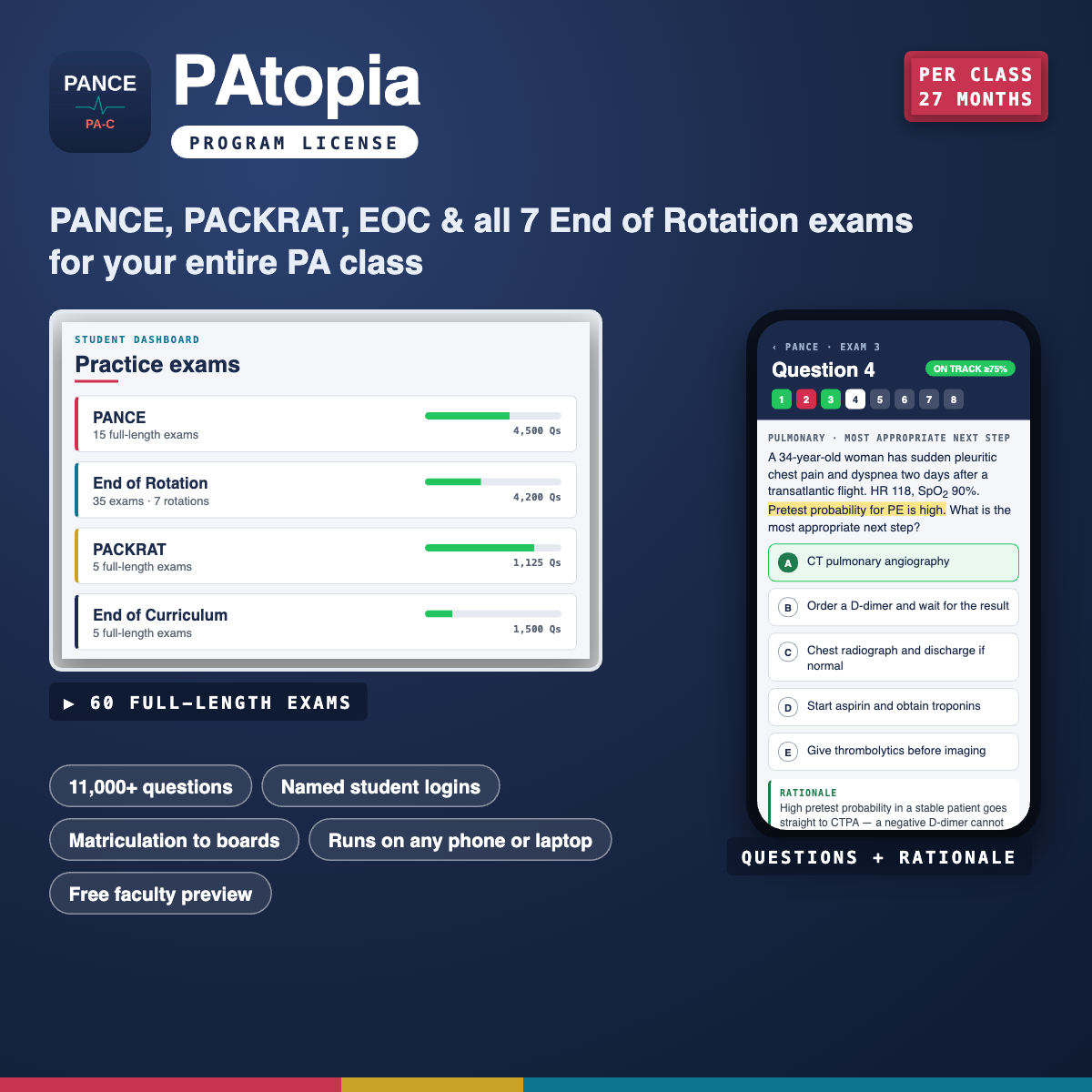
If you have, or are about to buy, the PAtopia All-Access Pass, the OSCE Patient is already included at no extra cost, alongside the PANCE, PACKRAT, EOC, and all seven EOR review courses. Every student under a PA Program License gets it too.
Who this is for
Didactic-year PA students facing their first OSCE, clinical-year students who want to stop losing points on structure (the summary, the closing, the question you forgot to ask), and anyone who has ever stood outside an exam room and wished they had practiced the conversation one more time.
Frequently asked questions
Is the patient a real person?
No. The patient is an AI playing a scripted standardized-patient role, written the same way a program writes its SP scripts: what the patient volunteers, what they reveal only if asked, their hidden agenda, and how they push back. The examiner scoring is also AI, against a fixed checklist, so it is consistent from attempt to attempt.
Will this match my program’s OSCE exactly?
Programs vary in station length and format, so these are written as generic clinical-skills stations. The skills they test (a complete focused history, a correctly ordered exam, red-flag screening, finding the hidden agenda, summarizing and closing) are the ones every OSCE scores.
Can I use it on my phone?
Yes. It is a web app: open your access link in Safari or Chrome and add it to your home screen. Nothing to install from an app store.
What happens when I hit 10 encounters in a day?
The counter resets at midnight Eastern. You can still read your past scores, the model performances, and the teaching points at any time.
Is there a free OSCE practice exam?
Yes. Station 1, chest pain in the emergency department, is free with no account. You get the full encounter, the examiner score, and the station’s review materials.
What OSCE review materials come with each station?
The examiner checklist with evidence from your transcript, a model performance, teaching points, and, on exam stations, the full list of exam findings. They unlock after every attempt, so you can review, fix one thing, and run the station again.
Who are these OSCE practice exams for?
Physician assistant students preparing for a program OSCE, a summative clinical skills exam, or end-of-rotation skills checks. The stations are generic clinical-skills encounters, so they also work for anyone practicing history taking and patient communication.
PAtopia is an independent study product and is not affiliated with or endorsed by the NCCPA, PAEA, or any PA program.


