Price: $9.99
Access: Permanent (No subscription, no login)
Deliverables: 240 full-length practice questions with detailed explanations
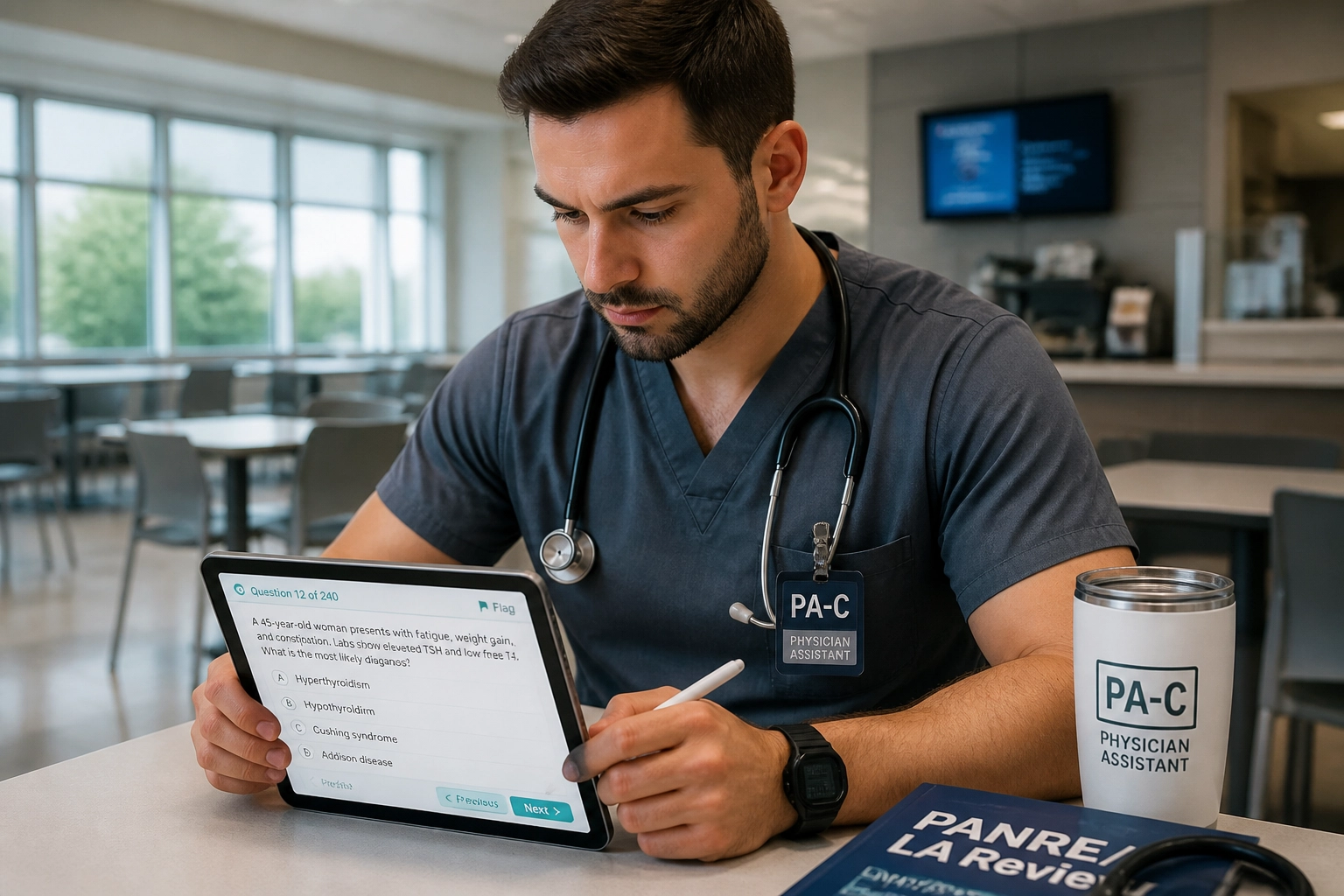
Preparing for the PANRE or PANRE-LA requires a shift from passive reading to active clinical reasoning. Most question banks encourage "answer-peeking" by placing the correct answer directly under the question or allowing a "show answer" button that is too easily clicked before the clinician has fully committed to a diagnostic or management path.
The PANRE/PANRE-LA Review Exam 1 eBook is designed specifically to disrupt this passive habit. By revealing the correct answer and the detailed explanations only after the five multiple-choice options, it forces a cognitive commitment. This method: known as retrieval practice: is the most effective way to identify knowledge gaps and ensure long-term retention of high-yield clinical facts.
High-Yield Content for the Working PA-C
This digital review is not a 2,000-question repository that takes months to navigate. It is a focused, high-yield tool for the working PA-C who needs to maximize study efficiency. Each question is written at the clinical complexity expected on the NCCPA Blueprint.
The eBook format provides portability, allowing you to review organ systems during a break in the clinic, between cases in the OR, or on a mobile device while commuting. Because there is no login or subscription required, you own the content permanently. This is especially valuable for those taking the PANRE-LA, where questions are spread over several years and a reliable, easy-access reference is required.

2025 NCCPA Blueprint Alignment
The exam is precisely weighted to reflect the NCCPA 2025 Content Blueprint. To pass the PANRE, you must master the proportions of the exam as much as the content itself. This exam distributes 240 questions across the 15 official categories to ensure you are spending the correct amount of time on high-stakes systems like Cardiovascular and Pulmonary medicine.
The question distribution for Exam 1 is as follows:
- Cardiovascular: 26 questions
- Pulmonary: 22 questions
- Gastrointestinal/Nutrition: 19 questions
- Musculoskeletal: 19 questions
- Infectious Diseases: 17 questions
- Neurology: 17 questions
- Psychiatry/Behavioral Science: 17 questions
- Reproductive: 17 questions
- Endocrine: 14 questions
- EENT: 14 questions
- Professional Practice: 14 questions
- Hematology: 12 questions
- Renal: 12 questions
- Dermatology: 10 questions
- Genitourinary: 10 questions
Clinical Vignette Assessment
Effective board preparation mimics the real-world clinical environment. Below are sample questions from the exam bank to demonstrate the required level of clinical reasoning.
Case 1: Cardiology
Your patient is a 68-year-old male presenting with a 3-day history of progressive dyspnea on exertion and a non-productive cough. He has a history of hypertension and a myocardial infarction four years ago. Physical exam reveals a HR of 105 bpm, BP of 155/92 mmHg, and SaO2 of 93% on room air. You note bilateral 2+ pitting edema and crackles in the lower lung fields. An S3 gallop is heard on auscultation.
Which of the following is the most appropriate initial diagnostic test to confirm the suspected diagnosis?
A. Chest X-ray
B. B-type natriuretic peptide (BNP)
C. Echocardiogram
D. 12-lead ECG
E. Cardiac Catheterization
Correct Answer: C. Echocardiogram
Explanation: The patient presents with classic signs and symptoms of congestive heart failure (CHF), likely an exacerbation of chronic heart failure. An echocardiogram is the definitive initial diagnostic test to assess left ventricular ejection fraction (LVEF) and differentiate between heart failure with reduced ejection fraction (HFrEF) and heart failure with preserved ejection fraction (HFpEF).
- A. Chest X-ray is helpful for identifying pulmonary edema (Kerley B lines) but does not provide functional data on the heart.
- B. BNP is useful in the ED to differentiate dyspnea caused by CHF from pulmonary causes but does not confirm the underlying cardiac structure or function as well as an echo.
- D. 12-lead ECG may show signs of prior MI or LV hypertrophy but is not confirmatory for CHF diagnosis.
- E. Cardiac Catheterization is an invasive procedure used to assess coronary artery disease or hemodynamics but is not the first-line diagnostic test for CHF.
Case 2: Infectious Disease
Your patient is a 24-year-old female presenting with a 2-day history of dysuria, frequency, and suprapubic pain. She denies fever, chills, or flank pain. Vital signs are HR 78 bpm, BP 120/80 mmHg, and Temp 98.6°F. Urinalysis shows positive nitrites and leukocyte esterase.
Which of the following is the first-line treatment for this patient, assuming no known allergies and low local resistance patterns?
A. Ciprofloxacin
B. Nitrofurantoin
C. Cephalexin
D. Azithromycin
E. Doxycycline
Correct Answer: B. Nitrofurantoin
Explanation: The patient has an uncomplicated urinary tract infection (UTI). Nitrofurantoin (Macrobid) 100 mg BID for 5 days is a first-line treatment recommended by current guidelines due to its efficacy and minimal impact on vaginal flora.
- A. Ciprofloxacin is effective but no longer recommended as first-line for uncomplicated UTIs due to concerns regarding side effects (tendon rupture) and increasing resistance.
- C. Cephalexin is an alternative but is typically reserved for cases where first-line agents cannot be used.
- D. Azithromycin and E. Doxycycline are used for urethritis (e.g., Chlamydia) but are not appropriate for bacterial cystitis.
Professional Practice and Ethics
A unique feature of the PANRE Review Exam is the inclusion of the Professional Practice category (14 questions). This section covers the "Legal and Ethical" portion of the NCCPA Blueprint, including topics such as:
- Informed consent
- Patient confidentiality (HIPAA)
- Medical errors and safety
- Physician-PA relationship
- End-of-life care and advanced directives
Understanding these concepts is critical for the 14 questions you will encounter on the 240-question exam.
Maximize Your CME Allowance
For many PA-Cs, the cost of board prep is covered by a yearly CME allowance. At cmereviewcourses.com, we offer advanced packages that allow you to bundle your learning with added value.
Our CME with Gift Card options are a popular way to utilize remaining CME funds. You can purchase a high-yield review course: such as the PANRE Review Course (which offers 100 hours of Category 1 AAPA Credit) or our Pharmacology Course: and add an Amazon or Apple gift card ($100 to $1,500) to your purchase. This allows you to purchase medical equipment, additional textbooks, or technology to further your professional development.
While physicians and nurse practitioners frequently find value in our content, it is important to note:
- The 100 hours of Category 1 AAPA Credit applies specifically to the PANRE Review Course on our website.
- Physicians can claim these credits as Category 2 CME.
- Nurse practitioners may claim Category 1 AAPA Credit in many states, though requirements vary by state board.
Start Your Review Today
Exam 1 is the first of a 3-exam series totaling 720 questions. You can choose to master one exam at a time or bundle them for a comprehensive review.
The eBook version offers the most cost-effective and portable way to begin your retrieval practice.
Buy PANRE/PANRE-LA Review Exam 1 on Amazon
For those seeking the full 100-hour Category 1 AAPA Credit experience with additional video content over Emergency Medicine, Family Medicine, Orthopedics, Cardiology, and more, visit our PANCE/PANRE Blueprint Review Course page.
Prepare with content written by physician assistants, for physician assistants. Stop passive studying and start committing to your clinical answers.