When preparing for the Physician Assistant National Certifying Exam (PANCE), the sheer volume of medical knowledge required is overwhelming. Most students default to passive review, rereading notes, highlighting textbooks, or watching hours of video. While these methods provide a temporary sense of familiarity, they fail to combat the "forgetting curve."
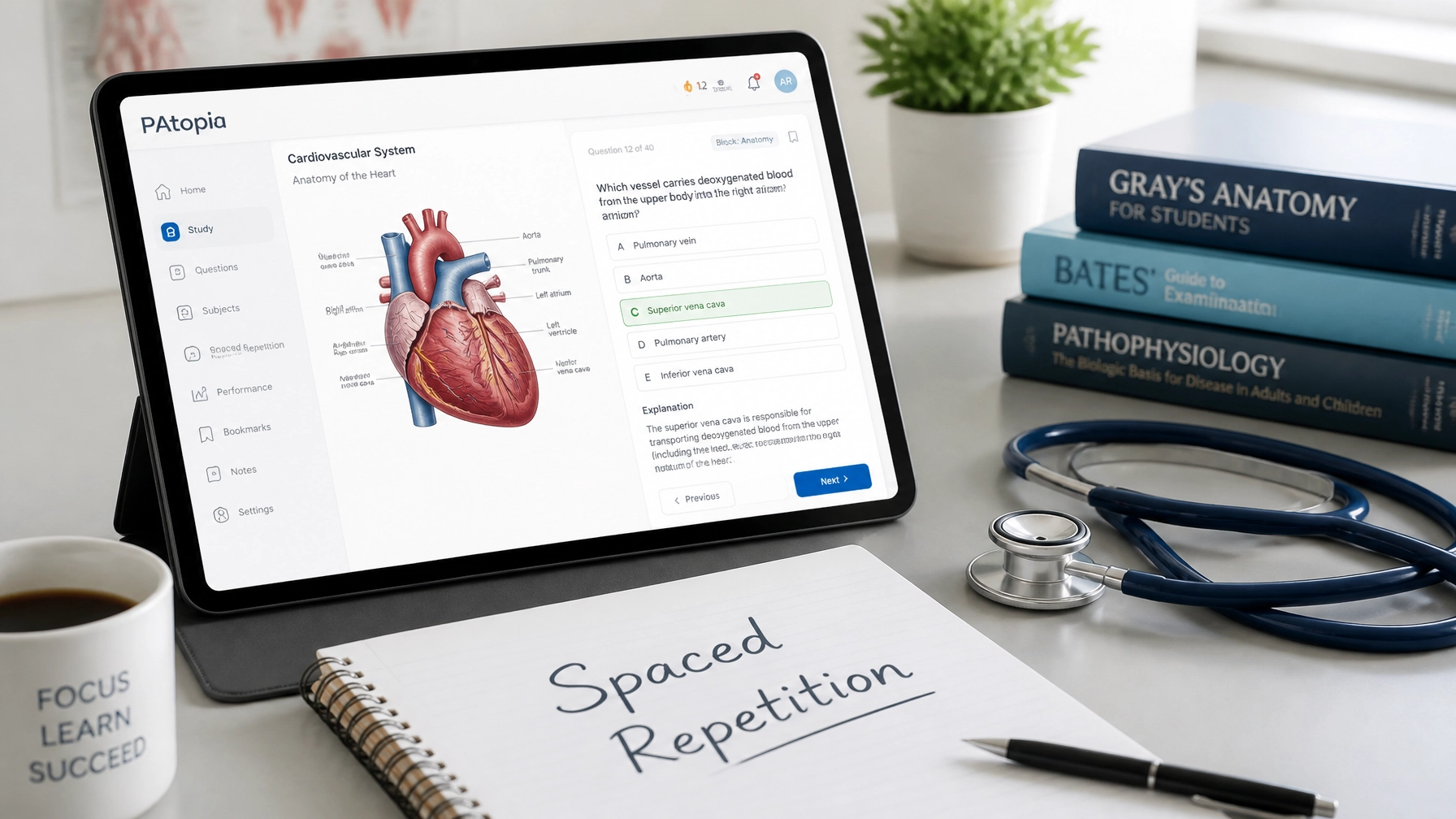
To achieve long-term retention and mastery of the NCCPA Blueprint, you need a system that forces active recall and schedules reviews based on your specific performance. This is why PAtopia was built with a robust Spaced Repetition System (SRS).
PAtopia All-Access Pass Details:
- Price: $229.99
- Access Duration: 27 Months
- Total Questions: 11,000+ board-style questions
- Content Includes: 15 PANCE Mock Exams, 5 PACKRAT Exams, 5 EOC Exams, and 35 EOR Exams (7 specialties)
- Free Trial: 72-hour free access on the App Store and Google Play
The Science of the Forgetting Curve vs. Spaced Repetition
Cognitive science demonstrates that human memory follows a predictable pattern of decay. Without intervention, you will likely forget up to 50% of what you studied within 24 to 48 hours. This is the "forgetting curve."
Spaced Repetition is the clinical antidote to this decay. Instead of cramming all your cardiology study into one weekend, SRS schedules reviews of that material at increasing intervals. By testing yourself right at the point where you are about to forget the information, you strengthen the neural pathways and move that knowledge from short-term to long-term memory.

Passive Review vs. Active Recall
Passive review (rereading) is inefficient because it doesn't challenge the brain to retrieve information. Active recall, facilitated by high-quality practice questions, requires your brain to work. PAtopia leverages this by integrating over 11,000 questions across all major PA school milestones, including:
- Internal Medicine
- Family Medicine
- Emergency Medicine
- Surgery
- Pediatrics
- Psychiatry
- GSR/Women's Health
How PAtopia’s Adaptive Algorithm Works
The PAtopia app doesn't just give you a static list of questions. Its algorithm is designed to adapt to your performance in real-time. When you miss a question or flag a topic as "difficult," the system prioritizes those concepts in your upcoming review sessions.
1. Automated Scheduling of Missed Questions
In a traditional review book, once you finish a chapter, those questions are often forgotten. In PAtopia, missed questions are automatically cycled back into your queue. This ensures that your weakest areas, whether it's acid-base disorders or EKG interpretation, receive the most attention.
2. Reinforcing Weak Areas
The app provides detailed system analytics after every exam. If your score in Cardiovascular is 85% but your Neurology score is 60%, the PAtopia system identifies this delta. By focusing your spaced repetition on Neurology, the app maximizes your study efficiency.
3. Integrated Study Libraries
PAtopia includes an 18-chapter study library for PANCE prep and specific libraries for each of the 7 EOR rotations. These libraries are not meant for passive reading; they serve as a reference point for the active recall questions you face in the mock exams.

Clinical Practice Scenarios
To demonstrate the depth of the PAtopia question bank, review the following clinical vignettes. These represent the style and difficulty of the 11,000+ questions included in the PAtopia All-Access Pass.
Question 1: Cardiology
Your patient is a 68-year-old male with a history of hypertension and tobacco use who presents with sudden onset of substernal chest pain radiating to his left jaw. On physical exam, his BP is 158/92, HR is 98, and SaO2 is 96% on room air. An EKG shows ST-segment elevation in leads II, III, and aVF. Which of the following is the most appropriate next step in management?
A) Administer IV beta-blockers
B) Immediate referral for primary percutaneous coronary intervention (PCI)
C) Order a stat chest X-ray to rule out aortic dissection
D) Start high-dose aspirin and observe for 4 hours
Correct Answer: B) Immediate referral for primary percutaneous coronary intervention (PCI)
Explanation: The patient is presenting with an inferior wall ST-elevation myocardial infarction (STEMI). The standard of care is revascularization via primary PCI within 90 minutes of first medical contact. Choice A is contraindicated in the acute phase of an inferior MI if there is concern for right ventricular involvement or bradycardia. Choice C would delay definitive care for a clear STEMI. Choice D is insufficient for an occlusive MI.
Question 2: Emergency Medicine
Your patient is a 24-year-old female who was brought to the ED after a motor vehicle collision (MVC). She is conscious but confused. Vital signs show HR 122, BP 88/54, and RR 26. On physical exam, you note muffled heart sounds and jugular venous distension (JVD). What is the most likely diagnosis?
A) Tension pneumothorax
B) Cardiac tamponade
C) Hypovolemic shock
D) Pulmonary embolism
Correct Answer: B) Cardiac tamponade
Explanation: This patient is presenting with Beck's Triad: hypotension, JVD, and muffled heart sounds. In the setting of trauma (MVC), this is highly suggestive of cardiac tamponade. While tension pneumothorax (Choice A) also causes hypotension and JVD, it would typically present with decreased breath sounds on the affected side and tracheal deviation. Hypovolemic shock (Choice C) would not typically cause JVD.
Question 3: OB/GYN (GSR)
Your patient is a 29-year-old female, G2P1, at 34 weeks gestation who presents with sudden onset of painful vaginal bleeding. She denies any recent trauma. On exam, her uterus is firm and tender to palpation. Fetal heart tones show a baseline of 140 bpm with occasional late decelerations. What is the most likely diagnosis?
A) Placenta previa
B) Placental abruption
C) Vasa previa
D) Uterine rupture
Correct Answer: B) Placental abruption
Explanation: Painful vaginal bleeding in the third trimester combined with a firm, tender uterus is the classic presentation for placental abruption. Placenta previa (Choice A) is typically painless. Vasa previa (Choice C) involves painless bleeding and rapid fetal distress following the rupture of membranes. Uterine rupture (Choice D) is more common during active labor in patients with prior uterine scars.
Maximize Your CME Allowance
For PAs in clinical practice, using your CME money effectively is critical. While PAtopia is designed primarily for students (PACKRAT, EOR, EOC, PANCE), CME Review Courses also offers dedicated options for practicing clinicians and those preparing for the PANRE.
- PANRE Review Course: Offers 100 hours of Category 1 AAPA credit. This is the most efficient way to fulfill your five-year CME cycle requirements while preparing for the exam.
- Pharmacology Review: Our Pharmacology Review CME Question Bank offers Category 1 AAPA Credit specifically in pharmacology. This is an excellent add-on for nurse practitioners and PAs looking to satisfy state-specific pharmacology requirements.
- CME with Gift Cards: We offer CME packages that include Amazon or Apple Gift Card add-ons ranging from $100 to $1500. This allow you to use your employer-provided CME allowance to purchase the tools you need for your education, such as a new iPad for the PAtopia app.
Note: AAPA Category 1 credit for nurse practitioners varies by state. Physicians can claim Category 2 credit for these courses.

Conclusion: Stop Cramming, Start Retaining
Relying on passive review is a gamble you cannot afford to take with the PANCE or your EOR exams. By utilizing PAtopia’s Spaced Repetition System, you ensure that every hour of study contributes to long-term mastery rather than short-term familiarity.
With 27 months of access to over 11,000 questions, PAtopia is the most comprehensive tool for your entire PA school journey, from your first rotation to your national certification.
About the Author
Jeremy Boroff, MPAS, PA-C is a practicing Emergency Medicine Physician Assistant with 24 years of clinical experience. He is the author of multiple PA exam review books including Emergency Medicine End Of Rotation (EOR) Exam Review and Test Prep, Ace the Psychiatry & Behavioral Health EOR: The Ultimate Study Guide & Question Bank, and Gynecologic, Sexual, and Reproductive Health End of Rotation (EOR) Exam Review. As an educator and content creator, Jeremy founded CME Review Courses to help PAs pass their certification and recertification exams with high-yield, blueprint-aligned content. He is also the creator of the PAtopia app.
Take the next step in your PANCE prep:
- Download PAtopia on the iOS App Store
- Get PAtopia on Google Play
- Start your 72-hour Free Trial (No sign-in or credit card required).