


Managing your continuing medical education (CME) budget is a critical part of your professional development as a physician assistant or nurse practitioner. Most healthcare employers provide a yearly stipend intended for board review, conferences, or educational materials. However, many clinicians find themselves with remaining funds at the end of the year or struggle to find a way to use those funds for tools that assist in daily clinical practice.
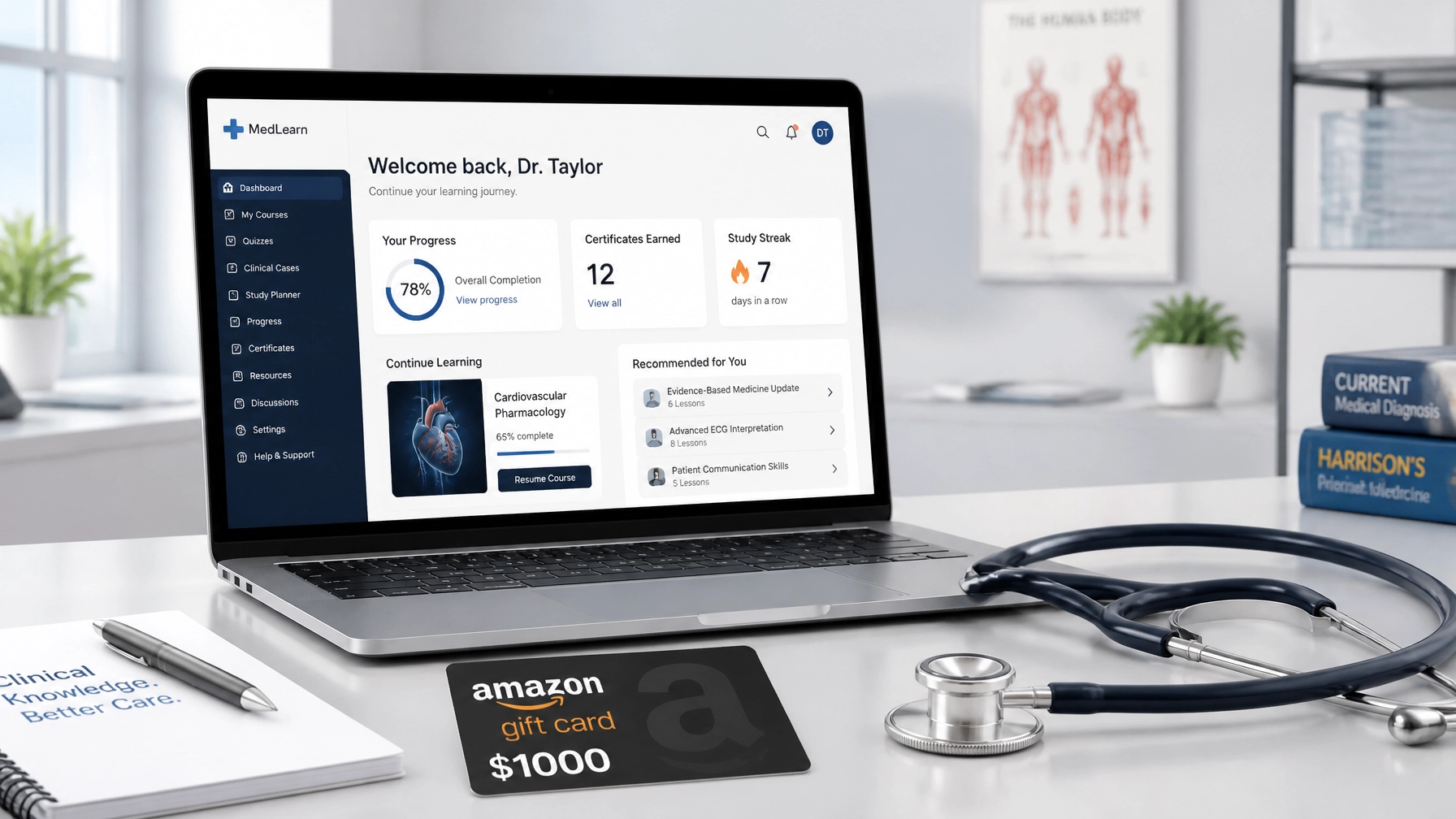
At CME Review Courses, we offer a solution that maximizes the utility of your educational allowance. By combining high-yield review content with Amazon or Apple gift card add-ons, you can fulfill your credit requirements while securing the resources you need for your practice.
Here are five essential things you should know about choosing a CME package with an Amazon gift card.
1. Flexibility: Add $100 to $1500 to Any Purchase
One of the primary benefits of our platform is the range of gift card options available. We understand that every clinician's budget and institutional requirements are different. To accommodate this, we allow you to add an Amazon or Apple gift card in denominations ranging from $100 to $1,500 to your CME purchase.
Whether you have a small amount of leftover funds or a significant annual stipend to utilize, you can scale your purchase to match your specific needs. This flexibility ensures that you do not leave money on the table at the end of the fiscal year.
2. Practicality: Using Your Stipend for Clinical Tools
A common challenge with traditional CME is that the funds are restricted to registration fees or textbooks. By choosing a CME with Gift Card package, you are effectively converting a portion of your stipend into a versatile tool for your practice.
Through the Amazon platform, your CME funds can be used to purchase:
- High-quality stethoscopes or diagnostic sets.
- Clinical reference books and journals.
- Tablets or laptops for charting and research.
- Comfortable clinical footwear for long shifts.
- Office supplies or ergonomic furniture for your workspace.
This approach allows you to enrich your education while simultaneously upgrading the physical tools you use to treat patients every day.

3. Separation of Gift Card and Course Access
It is important to understand the structure of these packages. When you purchase a course with a gift card add-on, the two components serve different professional functions. Your access to the educational material: such as our comprehensive PANRE Review Course: remains active for the full duration of your subscription (typically 30 months).
The gift card is delivered separately from your course credentials, allowing you to use the funds immediately for your needed supplies while you work through the educational content at your own pace. The gift card does not expire, providing a long-term benefit that extends beyond the initial purchase.
4. Maximizing Your Budget Before It Expires
Most clinical stipends operate on a "use it or lose it" basis. As the end of the year approaches, many PAs realize they have hundreds or even thousands of dollars remaining in their CME account.
Purchasing a CME package with an Amazon gift card is a smart strategy to ensure your hard-earned benefits are fully utilized. Instead of rushing to find a last-minute conference that may not fit your schedule, you can invest in a high-yield board review course and secure a gift card that you can use whenever a need arises in your practice. This ensures that 100% of your employer-provided benefit goes toward your professional advancement and clinical efficiency.
5. Choosing the Right Gift Card Amount
When selecting your package, evaluate your remaining stipend balance and your upcoming educational needs. If you are preparing for the NCCPA PANRE, the PANRE Review Course is the logical choice.
If you have a $2,000 stipend and the course costs $399.99, adding a $1,500 gift card allows you to maximize the reimbursement from your employer. If you are a nurse practitioner in a state that accepts AAPA Category 1 credits, or a physician assistant looking for specific pharmacology hours, you can tailor the gift card amount to precisely match your available budget.

Featured CME Review Courses
PANRE Review Course (100 Hours of Category 1 AAPA CME)
Price: $399.99 (Base price without gift card)
Duration of Access: 30 months
Deliverables: 1672 PANCE/PANRE-style questions, 17 hours of video content
Credits: 100 Hours of AAPA Category 1 CME
Link: View PANRE Review Course

Pharmacology Category 1 AAPA CME Credit Course
Price: $399.99 (Base price without gift card)
Duration of Access: 30 months
Credits: 12.0 AAPA Category 1 CME credit hours in Pharmacology
Target Audience: PAs and NPs needing concentrated pharmacology credits for state licensure or recertification.
Link: View Pharmacology Course
Clinical Practice Question
Scenario:
Your patient is a 68-year-old male with a history of chronic heart failure (HFrEF) and hypertension. He presents to the clinic complaining of increasing shortness of breath over the last three days, particularly when lying flat at night. On physical exam, his BP is 155/92 mmHg, HR is 94 bpm, and SaO2 is 92% on room air. You note 2+ bilateral pitting edema in the lower extremities and crackles at the lung bases bilaterally.
Question:
Which of the following is the most appropriate initial pharmacological intervention for rapid volume reduction in this patient?
A) Spironolactone
B) Furosemide
C) Hydrochlorothiazide
D) Metolazone
Correct Answer:
B) Furosemide
Explanation:
Furosemide is a loop diuretic and the first-line treatment for acute decompensated heart failure with signs of volume overload (pulmonary edema, peripheral edema, orthopnea). Loop diuretics inhibit the Na-K-2Cl cotransporter in the thick ascending limb of the loop of Henle, leading to potent natriuresis and diuresis.
- Spironolactone (Choice A) is an aldosterone antagonist used for long-term mortality benefit in HFrEF but is not potent enough for rapid volume reduction in an acute setting.
- Hydrochlorothiazide (Choice C) is a thiazide diuretic that acts on the distal convoluted tubule; it is significantly less potent than loop diuretics and is generally insufficient for acute heart failure management.
- Metolazone (Choice D) is a thiazide-like diuretic often used in combination with loop diuretics for "sequential nephron blockade" in cases of diuretic resistance, but it is not used as monotherapy for initial volume reduction.
Maximize Your Career and Your Budget
Don't let your CME stipend go to waste. Secure high-yield education and the clinical tools you need to succeed. Visit CME Review Courses today to explore our full range of packages with Amazon and Apple gift card add-ons.
