Maximizing your annual Continuing Medical Education (CME) allowance is a critical component of professional career management for Physician Assistants and Nurse Practitioners. As the fiscal year concludes for many hospital systems, the search for high-yield educational content that includes tangible rewards: such as Amazon or Apple gift cards: becomes a priority. At CME Review Courses, we provide an efficient mechanism to convert your educational budget into both high-level clinical knowledge and flexible gift card add-ons.
The PANRE Review Course is available for $499.99 and provides 100 Hours of AAPA Category 1 CME credit. Access to all course materials is granted for a duration of 30 months from the date of purchase. Purchasers can opt to add Amazon or Apple gift cards in denominations ranging from $100 to $1,500 to their order.
1. Accreditation Matters for Your Certification
When selecting a CME package with a gift card, the accreditation of the educational content is the primary factor. For Physician Assistants, the NCCPA requires 100 hours of CME every two years, with at least 50 of those being Category 1. Our PANRE Review Course provides 100 Hours of AAPA Category 1 CME credit, which satisfies your entire Category 1 requirement for an entire cycle in one comprehensive package.
2. Gift Card Flexibility for Educational Tools
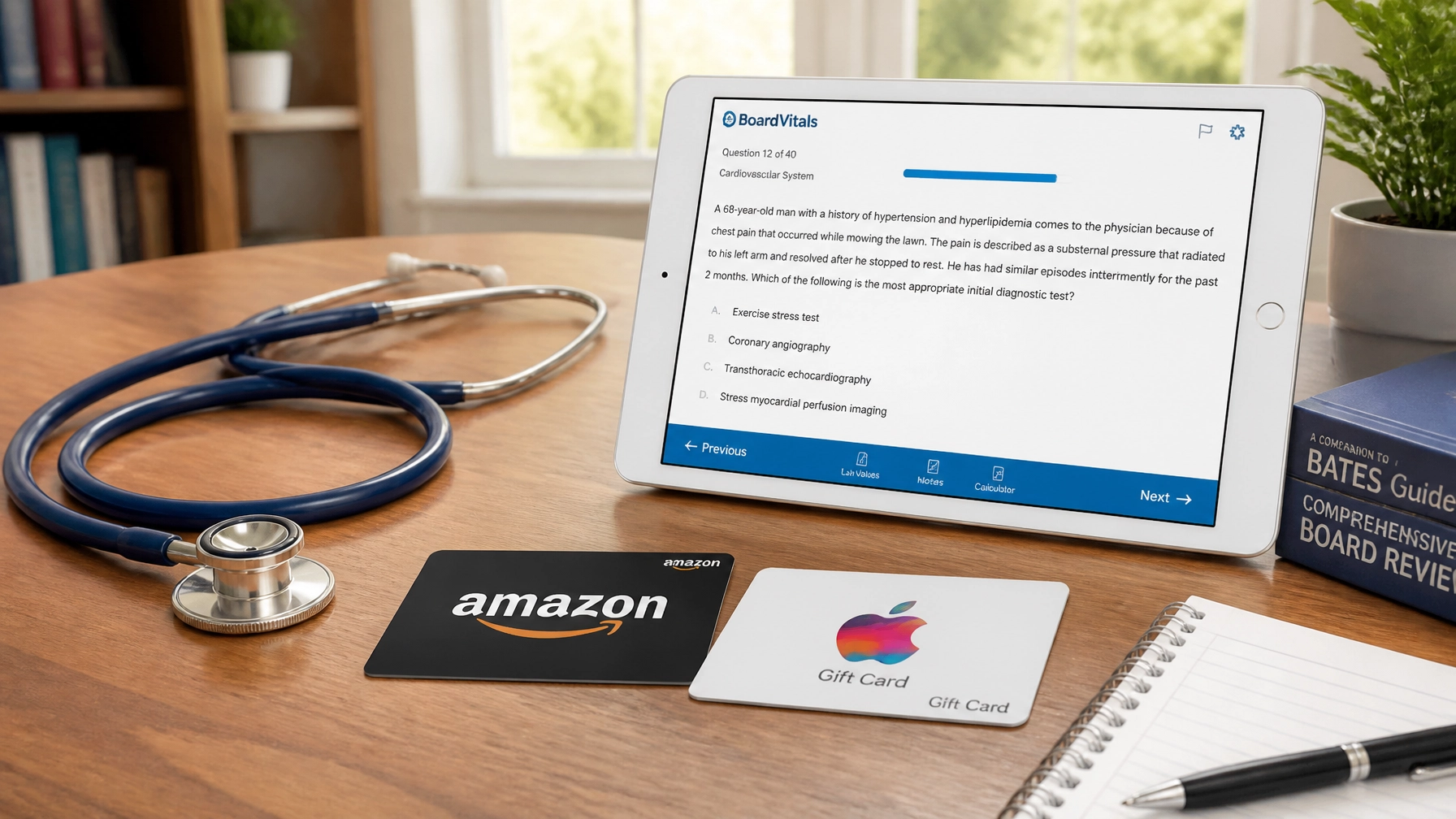
The Amazon and Apple gift card add-ons are designed to help you further enrich your clinical practice. Whether you need to purchase new medical equipment, diagnostic tools, or reference texts, these gift cards allow you to acquire the resources you need through major retailers. The flexibility of $100 to $1,500 in add-on value ensures that you can utilize your full employer allowance effectively.
3. High-Yield Specialty Content
Beyond the gift card, the quality of the content determines the value of the course. Our packages cover essential medical domains including Cardiology, Emergency Medicine, Family Medicine, Internal Medicine, Orthopedics, and OB/GYN. This content is specifically engineered by Physician Assistants for Physician Assistants, ensuring that the clinical pearls and diagnostic algorithms are relevant to your daily practice.

4. Long-Term Access and Utility
Medical knowledge is not static, and your access to review materials shouldn't be either. All of our CME packages, including the Family Medicine CME Package, come with 30 months of access. This allows you to revisit the material as clinical questions arise in your practice or as you prepare for upcoming recertification windows.
5. Nurse Practitioners and State-Specific Rules
While our courses are primarily accredited through the AAPA, Nurse Practitioners often find significant value in our content. However, the acceptance of AAPA Category 1 credit for NP certification can vary by state and certifying body (such as the AANP or ANCC). We recommend that Nurse Practitioners verify their specific state board requirements before purchase to ensure the credits apply toward their licensure.
6. Physician Value: Category 2 Credit
Physicians often utilize our CME packages to supplement their clinical knowledge in specific areas like Pharmacology. It is important to note that for physicians, these courses count as Category 2 CME credit, not Category 1. Despite this distinction, many physicians find the pragmatic, clinical vignette-based approach to be a superior review for day-to-day patient management.
7. Efficient Use of CME Funds
Many hospital contracts include a "use it or lose it" CME fund. Choosing a package with a gift card add-on is a strategic way to ensure that your total compensation package is fully realized. By selecting a gift card value that matches your remaining budget, you maximize the utility of your professional development funds.

8. Navigating the NCCPA Blueprint
Preparation for the PANRE or PANRE-LA requires a deep understanding of the NCCPA Blueprint. Our courses are structured to mirror the NCCPA Blueprint content areas, focusing on the high-weight organ systems like Cardiology and Pulmonology. This ensures that your study time is spent on the topics most likely to appear on your exam.
9. Comprehensive Pharmacology Review
Pharmacology is a core component of the PANRE and a daily reality in clinical practice. Our Pharmacology Review Course provides specialized training in drug mechanisms, contraindications, and prescribing patterns. This course also carries AAPA Category 1 credit and is an excellent option for those needing to bolster their prescribing confidence while utilizing their CME budget.
10. Simple and Direct Purchasing Process
We understand that clinicians are busy. Our purchasing instructions are streamlined to allow for a quick transaction. You select your core CME course, choose your gift card amount, and complete the process in one efficient session. This clinical focus on efficiency extends from our purchasing process to our educational delivery.

Practice Assessment
Question 1
Your patient is a 64-year-old male presenting with a 3-hour history of sudden-onset, "tearing" chest pain that radiates to his back. His blood pressure in the right arm is 185/105 mmHg, and in the left arm, it is 155/90 mmHg. His HR is 110 bpm. An EKG shows sinus tachycardia with no ST-segment elevations. What is the most appropriate next step in the diagnostic workup?
A. Emergent Cardiac Catheterization
B. CT Angiography of the Chest and Abdomen
C. Transthoracic Echocardiogram (TTE)
D. D-dimer and Troponin series
Explanation:
The correct answer is B. CT Angiography of the Chest and Abdomen. This patient’s presentation: sudden "tearing" pain with a significant blood pressure differential between arms: is highly suggestive of an aortic dissection. CTA is the gold standard for rapid and definitive diagnosis in a hemodynamically stable patient. A (Catheterization) is indicated for STEMI, which is not suggested by the EKG. C (TTE) has low sensitivity for visualizing the descending aorta. D (D-dimer) is non-specific and should not delay definitive imaging in a high-suspicion case.
Question 2
Your patient is a 28-year-old female with a history of asthma who presents with acute shortness of breath and wheezing. On examination, she is using accessory muscles, has a respiratory rate of 28, and a SaO2 of 91% on room air. You initiate nebulized Albuterol and Ipratropium. After three treatments, she remains tachypneic with persistent wheezing. Which of the following is the most appropriate next intervention?
A. Intravenous Magnesium Sulfate
B. Oral Prednisone 60mg
C. Intravenous Methylprednisolone
D. Racemic Epinephrine nebulizer
Explanation:
The correct answer is C. Intravenous Methylprednisolone. In an acute asthma exacerbation that is not responding to initial SABA/SAMA therapy, systemic corticosteroids are indicated. While oral steroids (B) are effective for mild-to-moderate cases, the presence of accessory muscle use and hypoxia warrants IV administration for more rapid systemic onset in a severe exacerbation. A (Magnesium Sulfate) is typically reserved for life-threatening exacerbations that fail to respond to steroids and bronchodilators. D (Racemic Epinephrine) is used for croup, not adult asthma.
Question 3
Your patient is a 45-year-old male presenting with acute, severe pain in his right first metatarsophalangeal (MTP) joint. The joint is erythematous, swollen, and exquisitely tender. He recently started a new medication for hypertension. Arthrocentesis reveals negatively birefringent, needle-shaped crystals. Which of the following medications most likely contributed to this presentation?
A. Lisinopril
B. Hydrochlorothiazide
C. Amlodipine
D. Metoprolol
Explanation:
The correct answer is B. Hydrochlorothiazide. The patient is presenting with an acute gout flare, confirmed by the presence of negatively birefringent crystals. Thiazide diuretics, such as Hydrochlorothiazide, are well-known to cause hyperuricemia by increasing renal urate reabsorption, which can precipitate gouty arthritis. A, C, and D do not have a significant clinical association with elevated uric acid levels or gout flares.