As a Physician Assistant, your annual or biannual CME stipend is one of your most valuable professional benefits. However, if you are not strategic about how you spend it, you risk leaving money on the table or spending hours on disjointed, low-yield credits. The most efficient way to maximize this budget is by choosing a comprehensive package that combines high-volume Category 1 credit with practical financial incentives.
At CME Review Courses, we have designed our PANRE Review Course with Gift Card to be the definitive solution for PAs who need to meet strict NCCPA requirements while extracting the most value from their employer-provided funds.
The Logistics: What You Get
- Price: $499.99 (Base Course)
- Credits: 100 AAPA Category 1 Self-Assessment CME Credits
- NCCPA Value: 150 Credits (via the 50% self-assessment weighting)
- Questions: 1,672 Board-Style Questions with Detailed Explanations
- Duration: 17 Hours of NCCPA Blueprint Video Content
- Access: 30 Months of Unlimited Online Access
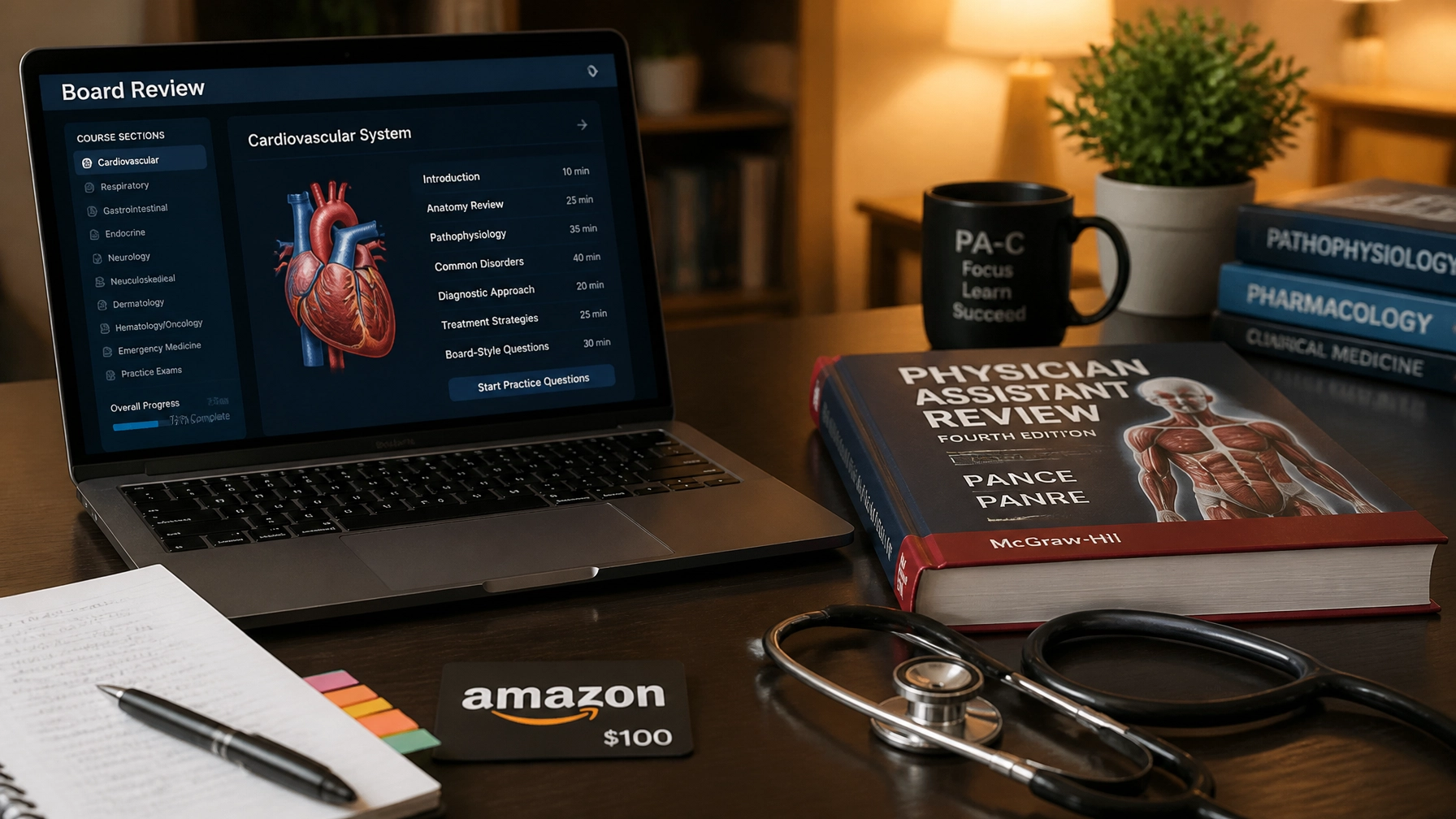
- Add-On Options: Amazon or Apple Gift Cards ranging from $100 to $1,500
1. Maximize the Utility of Your Educational Stipend
Most clinical contracts include a dedicated CME allowance. If you don’t use it by the end of the fiscal year, that money is often forfeited. By selecting a package that allows for an Amazon or Apple gift card add-on, you are converting your educational budget into a versatile tool for professional enrichment.
Whether you need a new Littmann stethoscope, the latest medical reference books, or upgraded hardware like a tablet for your clinical rotations, the Amazon gift card add-on provides the liquidity to purchase exactly what you need for your practice. It ensures that every dollar of your stipend is utilized rather than wasted.

2. The NCCPA Self-Assessment Credit Multiplier
Efficiency is the cornerstone of a busy clinician's life. Our PANRE Review Course offers 100 AAPA Category 1 Self-Assessment credits. For NCCPA certification maintenance, these credits are uniquely valuable.
The NCCPA applies an automatic 50% additional weighting to self-assessment credits. This means when you log your 100 hours from our course, the NCCPA system records it as 150 credits. This single purchase can effectively satisfy a massive portion of your 10-year cycle requirements in one efficient block, freeing up your future time for other pursuits.

3. Comprehensive Board Prep That Actually Works
This isn't just about the credits; it's about clinical competence. The course features 17 hours of high-yield video lectures meticulously mapped to the NCCPA Blueprint. We cover every organ system, from Cardiology to Psychiatry.
With 1,672 board-style questions, you aren't just reading: you are applying knowledge. Each question includes a detailed explanation that focuses on why the correct answer is right and why the distractors are wrong. This "active recall" method is the gold standard for long-term retention, whether you are preparing for the traditional PANRE or the PANRE-LA.
4. Extended 30-Month Access for Long-Term Reference
Many CME courses restrict your access to a few months or a single year. We understand that medical knowledge is not static and that exam prep often spans multiple seasons. Our Premium CME Package provides 30 months of access.
This duration is particularly beneficial for PAs who want to use the content as a clinical reference tool long after their credits have been earned. If you encounter a complex case in Psychiatry or Dermatology, you can simply log back in and review the blueprint-specific video or question bank section to refresh your clinical reasoning.

5. Specialized Content for Your Specific Needs
While our main course covers the broad spectrum of the NCCPA Blueprint, we also offer specialized modules that can be added or purchased separately. For example, our Pharmacology Review CME provides 20 hours of Category 1 AAPA credit specifically focused on pharmacological interventions.
For PAs working in specialty clinics, having access to focused packages in Internal Medicine, Emergency Medicine, or Family Medicine ensures that your CME isn't just a "check-the-box" activity, but a targeted improvement of your daily practice skills.
Clinical Practice Assessment
Test your clinical reasoning with these board-style vignettes.

Question 1
Your patient is a 64-year-old male with a history of hypertension and tobacco use who presents with a sudden onset of "tearing" chest pain that radiates to his back between the scapulae. His blood pressure is 190/110 mmHg in the right arm and 160/95 mmHg in the left arm. His heart rate is 105 bpm. A chest X-ray reveals a widened mediastinum. What is the most appropriate immediate pharmacological management for this patient?
A. Intravenous Nitroprusside
B. Intravenous Esmolol
C. Sublingual Nitroglycerin
D. Oral Amlodipine
Correct Answer: B. Intravenous Esmolol
Explanation: This patient is presenting with a classic clinical picture of an aortic dissection. The immediate goal of management is to reduce "shear stress" on the aortic wall by lowering both the heart rate and the blood pressure. A short-acting beta-blocker like Esmolol is the first-line choice because it reduces the heart rate (negative chronotropy) and the force of contraction (negative inotropy). Nitroprusside (Choice A) is often used as an adjunct but should never be used alone, as it can cause reflex tachycardia, which increases shear stress. Nitroglycerin (Choice C) is less effective for the rapid, titrated control required here, and Amlodipine (Choice D) is an oral medication with too slow an onset for an acute aortic emergency.
Question 2
Your patient is a 28-year-old female who presents with a 3-day history of increased vaginal discharge, pelvic pain, and fever of 101.4°F. On physical examination, you note significant cervical motion tenderness and adnexal tenderness. A pregnancy test is negative. You suspect Pelvic Inflammatory Disease (PID). Which of the following is the most appropriate outpatient antibiotic regimen?
A. Azithromycin 1g orally once
B. Ceftriaxone 500mg IM once plus Doxycycline 100mg BID for 14 days
C. Levofloxacin 500mg daily for 7 days
D. Metronidazole 500mg BID for 7 days
Correct Answer: B. Ceftriaxone 500mg IM once plus Doxycycline 100mg BID for 14 days
Explanation: The CDC-recommended outpatient treatment for PID is a combination of a parenteral cephalosporin (like Ceftriaxone) and an oral tetracycline (like Doxycycline), with or without Metronidazole. This covers the most common pathogens, including Neisseria gonorrhoeae and Chlamydia trachomatis. Azithromycin alone (Choice A) is used for uncomplicated Chlamydia but is insufficient for PID. Levofloxacin (Choice C) is no longer first-line due to increasing resistance patterns. Metronidazole alone (Choice D) does not provide adequate coverage for the primary causative organisms in PID.
Conclusion
Investing your CME stipend wisely is about balance. You need high-quality, blueprint-aligned education to maintain your certification and clinical edge, but you also want to ensure your professional budget is utilized to its full potential. The CME with Amazon Gift Card option provides the best of both worlds: 150 NCCPA-weighted credits and the flexibility to purchase the tools you need for your career.
Don't let your stipend expire or settle for low-yield credits. Maximize your time and money with CME Review Courses today.