



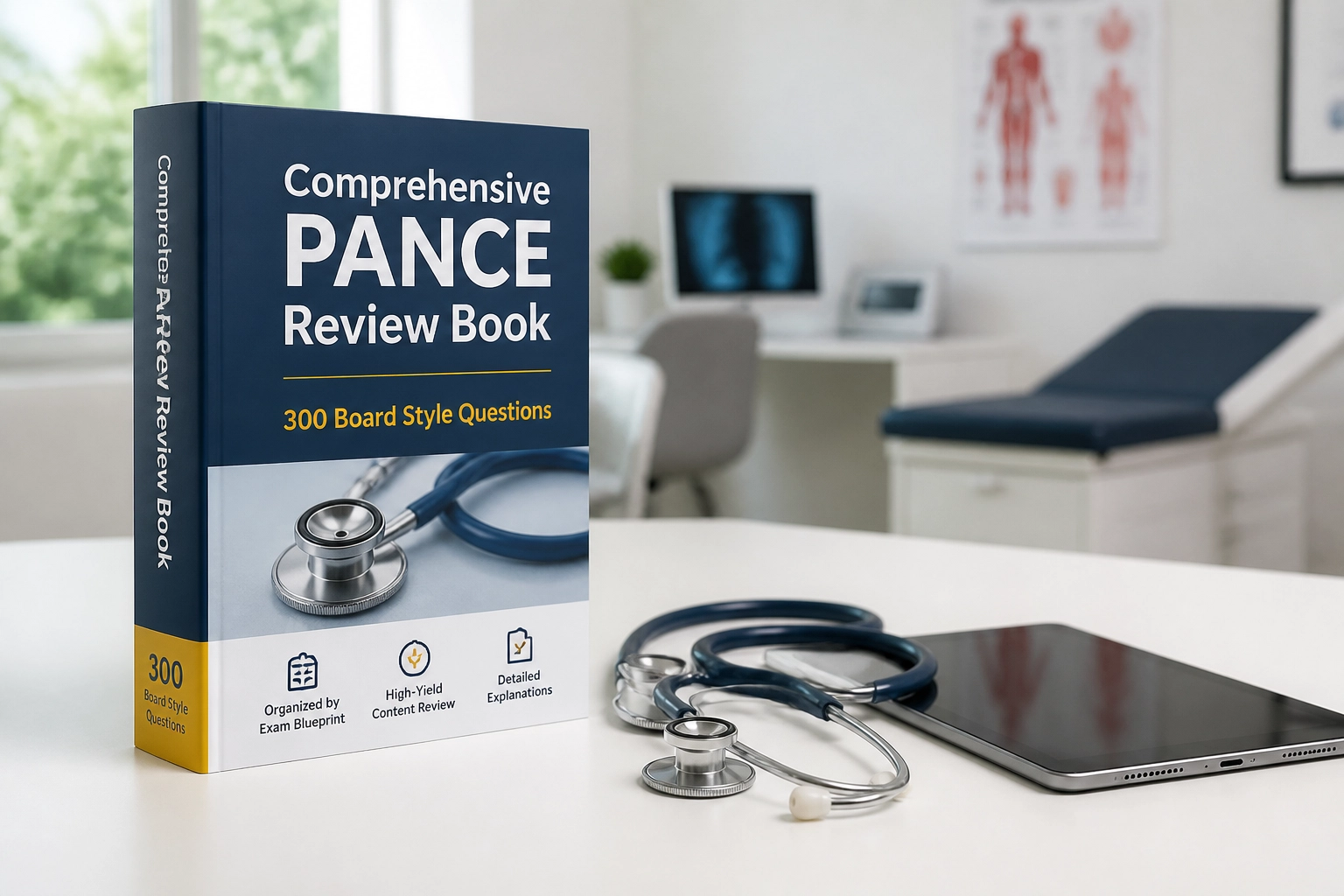
Title: Comprehensive PANCE Review Book: Follows NCCPA Topic List
Author: Jeremy Boroff PA-C
Format: Paperback / Digital
Deliverables: 300 Board Style Questions & Answers
Purchase Link: Amazon Link
Physician assistants and students preparing for the Physician Assistant National Certifying Examination (PANCE) require streamlined, high-yield study materials that align strictly with the NCCPA Topic List. The Comprehensive PANCE Review Book by Jeremy Boroff PA-C is designed to meet this demand by providing 300 board-style questions that mirror the complexity and content distribution of the actual exam. This resource is engineered for efficiency, allowing candidates to identify knowledge gaps and master clinical concepts without the distractions of extraneous information.
While this book is a primary tool for PANCE preparation, established physician assistants often find it a valuable refresher for maintaining clinical competency. For those moving into the recertification phase, we offer a comprehensive PANRE Review Course that provides 100 hours of AAPA Category 1 CME credit. This course is specifically designed for the PANRE and PANRE-LA, ensuring you remain compliant with NCCPA requirements while gaining practical, clinical knowledge.
Maximizing Your CME Budget
Education is a significant investment. We offer an efficient way to utilize your employer-provided CME funds. Our programs allow the addition of Amazon or Apple Gift Cards ranging from $100 to $1500 to your purchase. This "CME with gift card" model enables you to acquire the necessary educational credits while also obtaining tools to further enrich your professional development.
Our course catalog includes specialized content in:
- Emergency Medicine
- Family Medicine
- Internal Medicine / Hospitalist
- Orthopedics
- Dermatology
- Psychiatry
- Neurology
- Cardiology
- OB/GYN
For those requiring specialized pharmacology credits, our Pharmacology Course provides AAPA Category 1 CME Credit. Note that while our content is written by PAs for PAs, nurse practitioners and physicians also find value in these packages. Physicians should note that our courses count for Category 2 CME credit rather than Category 1.

Clinical Assessment: Cardiovascular and Pulmonary Systems
The following clinical vignettes represent the style and depth of questions found in the Comprehensive PANCE Review Book and our pa board review course.
Scenario 1
Your patient is a 64-year-old male with a history of hypertension and tobacco use who presents to the emergency department complaining of sudden onset, tearing chest pain that radiates to his back between the scapulae. His blood pressure is 185/110 mmHg in the right arm and 155/95 mmHg in the left arm. A chest X-ray reveals a widened mediastinum.
Which of the following is the most appropriate initial diagnostic study of choice in a hemodynamically stable patient?
A. Transeophageal Echocardiogram (TEE)
B. Computed Tomography Angiography (CTA)
C. Magnetic Resonance Angiography (MRA)
D. Aortography
Explanation:
The correct answer is Computed Tomography Angiography (CTA). In a hemodynamically stable patient with suspected aortic dissection, CTA is the preferred initial diagnostic study due to its high sensitivity, specificity, and rapid availability. It accurately identifies the presence of an intimal flap and the extent of the dissection. A TEE (Choice A) is highly accurate and is the preferred study for patients who are hemodynamically unstable or have renal failure where IV contrast is contraindicated. MRA (Choice C) is highly accurate but time-consuming and often not practical in an acute setting. Aortography (Choice D) was historically the gold standard but has been largely replaced by non-invasive imaging.
Scenario 2
Your patient is a 28-year-old female presenting with a 3-day history of non-productive cough, low-grade fever, and malaise. Physical examination reveals diffuse wheezing and crackles. A chest X-ray shows patchy interstitial infiltrates in the lower lobes. Laboratory results show an elevated cold agglutinin titer.
What is the most likely causative organism?
A. Streptococcus pneumoniae
B. Klebsiella pneumoniae
C. Mycoplasma pneumoniae
D. Legionella pneumophila
Explanation:
The correct answer is Mycoplasma pneumoniae. This is a classic presentation of "walking pneumonia" or atypical pneumonia, which is common in young adults. The presence of interstitial infiltrates on X-ray rather than lobar consolidation, combined with elevated cold agglutinins, is highly suggestive of Mycoplasma. S. pneumoniae (Choice A) typically presents with high fever, productive cough, and lobar consolidation. Klebsiella (Choice B) is more common in alcoholics and presents with "currant jelly" sputum. Legionella (Choice C) often involves gastrointestinal symptoms and hyponatremia.

Clinical Assessment: Gastrointestinal and Renal Systems
Scenario 3
Your patient is a 45-year-old female who presents with severe right upper quadrant pain that radiates to her right shoulder. She reports the pain began shortly after eating a large meal. On physical exam, there is an arrest of inspiration upon deep palpation of the right upper quadrant.
What is the initial diagnostic study of choice for this condition?
A. Ultrasound of the Right Upper Quadrant
B. Hepatobiliary Iminodiacetic Acid (HIDA) Scan
C. Computed Tomography (CT) of the Abdomen
D. Endoscopic Retrograde Cholangiopancreatography (ERCP)
Explanation:
The correct answer is Ultrasound of the Right Upper Quadrant. The patient’s presentation is consistent with acute cholecystitis (positive Murphy's sign). Ultrasound is the initial test of choice due to its high sensitivity for gallstones, gallbladder wall thickening, and pericholecystic fluid. A HIDA scan (Choice B) is the most sensitive test and is indicated if the ultrasound is inconclusive. CT scans (Choice C) are less sensitive for gallstones but may be used to rule out other pathology. ERCP (Choice D) is a therapeutic and diagnostic tool for choledocholithiasis, not primary cholecystitis.
Scenario 4
Your patient is a 72-year-old male with a history of chronic kidney disease and heart failure who presents with generalized weakness and palpitations. An EKG is performed and shows peaked T waves, a widened QRS complex, and a prolonged PR interval.
Which of the following is the most appropriate immediate step in the management of this patient?
A. Sodium Polystyrene Sulfonate (Kayexalate)
B. Calcium Gluconate
C. Intravenous Insulin and Glucose
D. Hemodialysis
Explanation:
The correct answer is Calcium Gluconate. The EKG findings are pathognomonic for severe hyperkalemia. Calcium gluconate (or calcium chloride) is the immediate priority to stabilize the cardiac membrane and prevent life-threatening arrhythmias. It does not lower the potassium level but provides cardioprotection. Insulin and glucose (Choice C) or inhaled albuterol are used to shift potassium into the cells. Kayexalate (Choice A) and hemodialysis (Choice D) are used to remove potassium from the body, but they do not act fast enough to address immediate cardiac instability.

Clinical Assessment: Behavioral Health and Endocrinology
Scenario 5
Your patient is a 24-year-old male brought to the clinic by his family because of a 1-month history of decreased sleep, rapid speech, and excessive spending. He recently quit his job, claiming he has developed a "secret formula for infinite wealth" and has been seen dancing on top of his car at 3:00 AM. He has no prior psychiatric history.
What is the most likely diagnosis?
A. Major Depressive Disorder with Psychotic Features
B. Schizoaffective Disorder
C. Bipolar I Disorder
D. Cyclothymic Disorder
Explanation:
The correct answer is Bipolar I Disorder. The patient is experiencing a manic episode, characterized by grandiosity, decreased need for sleep, pressured speech, and impulsive behavior (spending). A single manic episode is sufficient for the diagnosis of Bipolar I Disorder. Schizoaffective disorder (Choice B) requires a period of at least two weeks of delusions or hallucinations in the absence of a major mood episode. Cyclothymic disorder (Choice D) involves milder swings (hypomania and mild depression) over at least two years.
Scenario 6
Your patient is a 52-year-old female with Type 2 Diabetes Mellitus who presents for a routine follow-up. Her hemoglobin A1c is 8.4% despite adherence to metformin at maximum dose. She has a history of atherosclerotic cardiovascular disease (ASCVD).
Which of the following classes of medication should be added next to her regimen?
A. Sulfonylurea
B. GLP-1 Receptor Agonist
C. DPP-4 Inhibitor
D. Thiazolidinedione
Explanation:
The correct answer is GLP-1 Receptor Agonist. Current clinical guidelines recommend the addition of a GLP-1 receptor agonist or an SGLT2 inhibitor in patients with Type 2 Diabetes and established ASCVD, regardless of A1c levels, due to their proven cardiovascular benefits. Sulfonylureas (Choice A) increase the risk of hypoglycemia and weight gain without providing cardiovascular protection. DPP-4 inhibitors (Choice C) and Thiazolidinediones (Choice D) are generally considered later-line or in specific patient populations without the same level of ASCVD benefit.
Strategic Study for PANCE Success
Utilizing resources that strictly follow the NCCPA Topic List is the most effective way to prepare for the PANCE and PANRE exams. The Comprehensive PANCE Review Book provides the necessary volume of practice questions to build clinical stamina and diagnostic accuracy.
As you progress through your career, remember that CME Review Courses is your partner in maintaining professional excellence. Whether you need the 100 hours of AAPA Category 1 credit from our PANRE Review Course or specific pharmacology credits, we provide high-quality content developed by physician assistants.
Enhance your education today and maximize your CME funds by selecting a package with an Amazon or Apple Gift Card add-on.
Explore our courses:
Invest in your clinical knowledge and your career with tools designed for the modern medical professional.