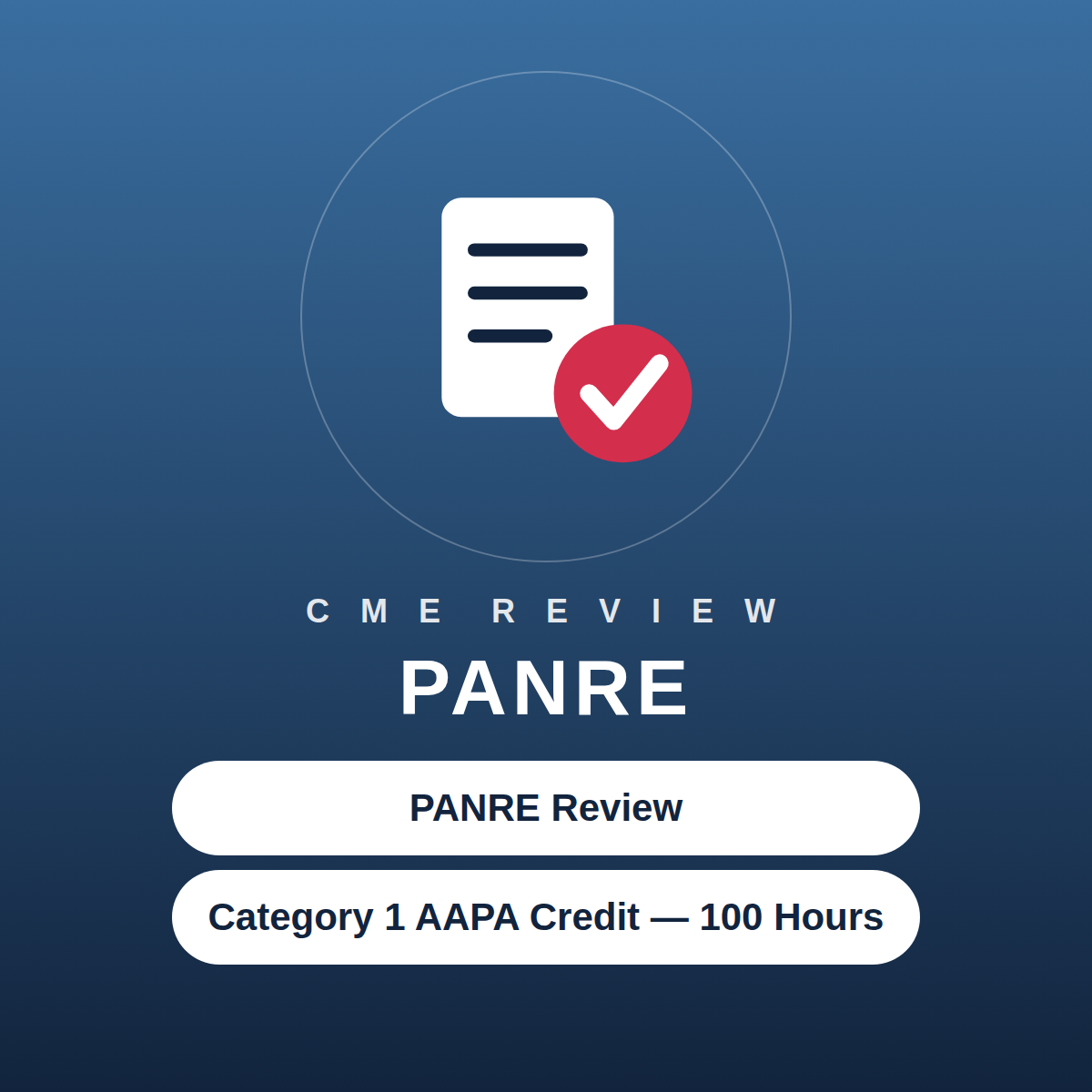
Course: $499.99 for 30 months of access
Practice: 2,500+ board-style questions
CME: Up to 100 AAPA Category 1 credits through the PANRE Review Course
Gift card option: Amazon or Apple add-ons are paid, not free gifts, and increase the package price.
Treat CME as a reservoir, not a sprint
A course offering up to 100 Category 1 AAPA CME credits can sound like a project you need to finish in one push. A more practical approach is to think of it as a credit reservoir: plan your study and completion steps around your schedule and your CME needs, rather than assuming you must do everything at once.
The key distinction is between pacing your work and claiming credit. You can organize your study sessions over time, but you should not assign yourself credit for a session or claim the full amount just because you purchased the course. AAPA’s direction is clear: PAs should only claim credit commensurate with the extent of their participation.
For this activity, the completion process is to review the PANRE Clinical Review Module content, complete its post-test with a score of 70% or higher, and complete the activity evaluation. Missed questions may be retaken to reach the passing score. Once the requirements are complete, a certificate states your precise credit. Use the certificate amount; don’t calculate or claim an amount on your own.
In practical terms, build a pace that works for your cycle: schedule time for the content, post-test, and evaluation, then report the credit shown on your certificate. If you are unsure how your cycle dates or reporting process apply, check your NCCPA CME requirements, your NCCPA account, and your employer’s policy.
Know which activity the credit applies to
The up-to-100-credit award applies to the PANRE Clinical Review Module in the PANRE Review Course, not to the Pharmacology course. The activity, Comprehensive Clinical Review for Practicing PAs: 2026–27 Enduring CME Activity, has AAPA reference number CME-2016187. Its approval is valid from August 26, 2026, through August 26, 2027.
That approval window matters: complete the content review, passing post-test, and evaluation before the activity expires for a certificate to issue under this activity. The course’s 30-month access period is a separate product access detail; it does not extend the activity approval period.
The activity’s approval information also includes a program-level statement covering the full 14-module program. That program-level total is not the credit amount for this PANRE module. For this purchase, refer to the PANRE Clinical Review Module’s stated award of up to 100 credits and the precise amount on your completion certificate.
For physicians: The activity meets AAPA Category 1 requirements, but physicians report it as Category 2 CME for their own reporting. For nurse practitioners: acceptance of AAPA Category 1 credit for NP renewal varies by state. Verify with your state board of nursing before purchase.
What the PANRE review course includes
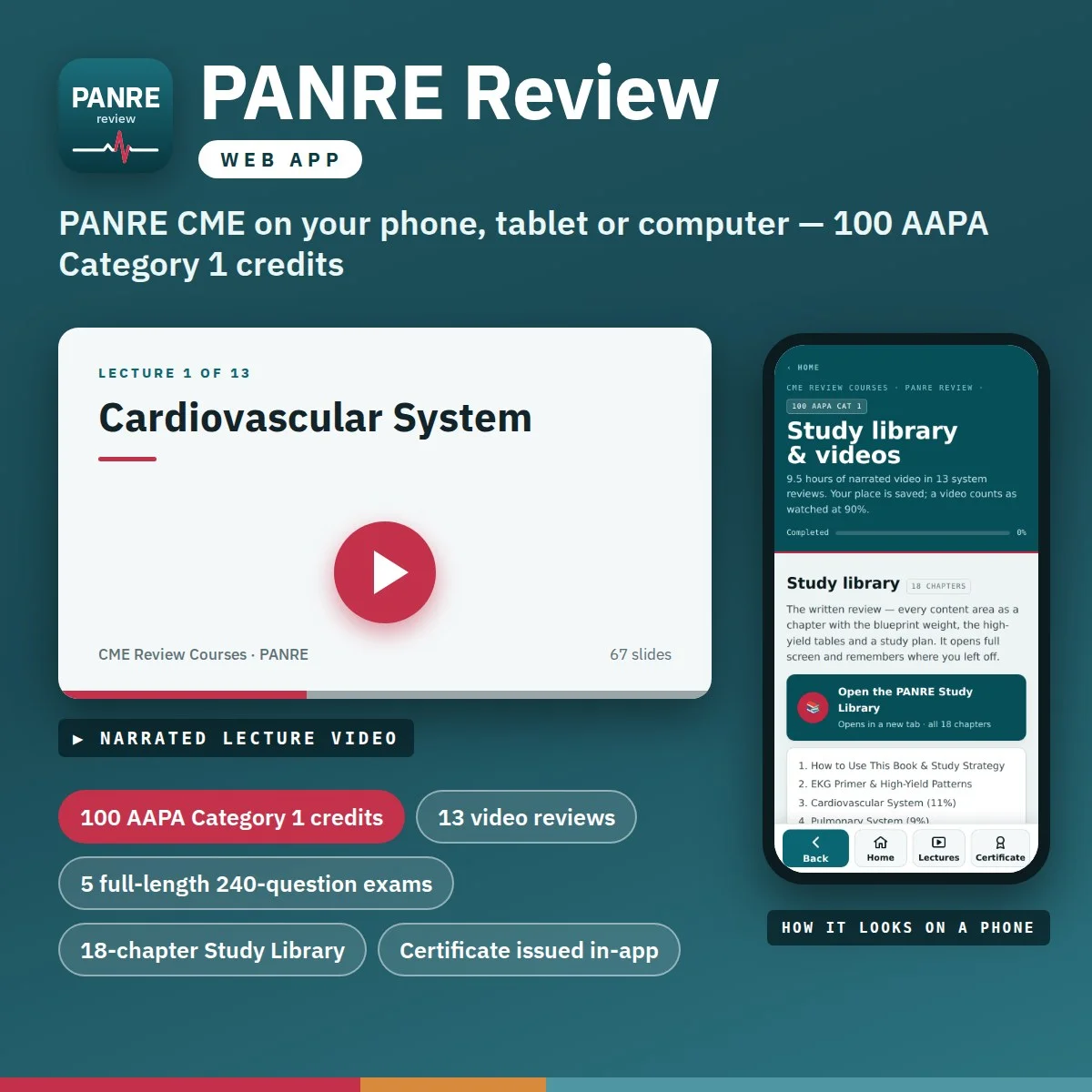
The online, self-paced course works as a study resource as well as a CME activity. It includes more than 2,500 board-style practice questions, with question modules mapped to the NCCPA PANRE blueprint, plus five full-length 240-question mock exams with rationales and cited sources. The answer explanations have been rewritten to current 2023–2025 clinical guidelines.
A PANRE Readiness Dashboard tracks attempted and correct questions, provides a per-topic breakdown, and lets you flag questions and retake them. The course also includes high-yield lectures and downloadable slides. It is delivered as a web app, so you can work from a phone, tablet, or computer without downloading an app.
For PAs who are earlier in training, the focus is different: students and new grads comparing pance prep courses are preparing for an initial certification attempt, while this course is designed around PANRE review and CME for practicing PAs.
Clinical practice question: DKA
Your patient is a 24-year-old with type 1 diabetes who arrives while you are covering an urgent care/ED shift. They report two days of polyuria, polydipsia, nausea, and vomiting. HR is elevated. Your exam shows dry mucous membranes and deep, rapid Kussmaul breathing with a fruity odor. Glucose is 480 mg/dL, urine ketones are positive, venous pH is 7.15, bicarbonate is 12, and the anion gap is elevated.
What is the best next step?
Admit for DKA management with IV fluids and IV insulin infusion.
- Admit for DKA management with IV fluids and IV insulin infusion.
- Start subcutaneous basal-bolus insulin at home and recheck in the morning.
- Treat as hyperglycemia from missed doses with oral hydration alone.
- Obtain a CT abdomen to explain the vomiting before starting treatment.
Option 2 is unsafe in DKA, which requires monitored acute management. Option 3 misses the significant acidosis and elevated anion gap. Option 4 delays definitive treatment without addressing the immediate metabolic emergency.
Exam note: Kussmaul respirations plus an elevated anion gap with ketonemia or ketonuria signal DKA management, not outpatient diabetes adjustment. The course’s Endocrine module includes 65 questions that test this type of decision-making.
Amazon and Apple gift card add-ons are paid
These cme gift cards are one of the reasons the package stretches a CME budget so well. At checkout, you can add an Amazon or Apple gift card in $100–$1,500 tiers, in $100 increments. These are paid add-ons, not free gifts: the selected amount is added to the package price, so the course and add-on are included in the total purchase through CME funds in one transaction. Gift cards are emailed within 2–3 business days of purchase; you do not need to finish the course first.


Gift card packages are nonrefundable, and CME Review Courses is not affiliated with Amazon or Apple. Check your employer’s CME policy before purchasing. If you buy two or more CME courses, 20% comes off each course automatically; the discount does not apply to gift card add-ons, which remain at face value. You can add a gift card to each course you buy.
Choose your pace and confirm your requirements
Use the PANRE Review Course as a reservoir by planning when you will complete its content and assessment steps, then claim only the credit stated on your certificate. Don’t wait until the activity’s approval expires, and consult your own NCCPA account, the NCCPA CME requirements page, and your employer when you have questions about cycle dates or reporting.
Visit the PANRE Review Course product page to review the course and choose a paid gift card add-on at checkout. You can also explore the course using the free test drive.
About the author
Jeremy Boroff, MPAS, PA-C is an Emergency Medicine PA with 24 years of clinical experience, a PA educator, author, and CME developer. He is the sole faculty member for this activity and has no relevant financial relationships to disclose.