Price: $499.99 for 30 months of access
Content: 2,500+ board-style practice questions, including five full-length 240-question mock exams
CME: Up to 100 AAPA Category 1 CME credits through the PANRE Clinical Review Module
Gift card add-ons: Optional Amazon or Apple cards are paid add-ons, not free gifts. Choose a $100–$1,500 tier at checkout; the amount is added to the purchase price.
A PANRE Readiness Dashboard is most useful when you read beyond its headline percentage. The PANRE Review Course tracks attempted versus correct questions, breaks performance down by topic, lets you flag questions, offers unlimited retakes, and displays an “on track to pass” indicator at 75% or higher. Each feature can guide your next study step, but only if you use it deliberately.
The course includes 15 body-system question modules mapped to the NCCPA PANRE blueprint, with 1,810 questions across those modules. It also includes five full-length mock exams of 240 questions each. Here are three common dashboard mistakes and what to do instead.
Mistake 1: Trusting your overall percentage instead of checking topic performance and sample size
An overall score summarizes your attempts. It does not show whether your performance is consistent across content areas. For example, a 75% overall result can conceal a weak system at 45%. If that system is one you need to strengthen, the aggregate score can make your readiness look more uniform than it is.
Check the attempted-versus-correct counts alongside each topic percentage. A high rate based on a small number of attempts may not represent a reliable trend. If you answered only 10 questions in a topic, that result is a limited sample, not proof that the topic is mastered or a definitive measure of your ability.
What to do instead:
- Review the per-topic breakdown, not just the overall score.
- Look at how many questions you attempted in each topic as well as how many you answered correctly.
- Treat a low topic score as a reason to review and practice that system.
- Treat a strong score from a small sample as an early signal. Continue practicing before concluding that the topic is secure.
The dashboard’s topic-level view helps you identify where to direct your next study session. Its value depends on acting on the pattern, not just noting the percentage.
Mistake 2: Flagging questions without returning to answer them from scratch
Flagging is a triage tool. It marks questions for later review, but it does not correct a knowledge gap on its own. If you flag a difficult item and move on without returning to it, you have created a list, not a learning loop.
Use the flagging feature to build a re-do queue. When you revisit a flagged question, answer it cold: hide the rationale, select your answer, and then review the explanation. That makes the retake a check of your recall and reasoning rather than a recognition exercise.
What to do instead:
- Flag a question when you are unsure, make a careless error, or need to revisit the reasoning.
- After working through the set, return to the flagged questions.
- Re-answer each one without the rationale open.
- Read the explanation after committing to an answer, including when you answered correctly.
- Also review weak topics identified in the dashboard. Flagging individual questions does not automatically cover every weakness in that topic.
The course provides unlimited retakes, so you can use flagged items to revisit concepts and check whether your reasoning has improved. Its answer explanations are individually cited and rewritten to current (2023–2025) clinical guidelines.
Mistake 3: Stopping at “on track to pass” instead of treating it as a checkpoint
The dashboard’s “on track to pass” indicator appears at 75% or higher. Reaching it is a useful checkpoint, not a reason to stop studying. A single indicator does not tell you that every topic is strong or that performance will hold across a full-length exam.
Continue drilling your weakest topics after the indicator appears. Then use the course’s five full-length, 240-question mock exams as checkpoints under exam-length conditions. Review both the overall result and the topic breakdown after each exam. If a weakness remains, return to that content and test yourself again.
What to do instead:
- Use the 75%+ indicator as a prompt to verify your progress, not as your finish line.
- Recheck topic-level performance after continued practice.
- Use the five full-length mock exams to see whether your performance holds across a larger, mixed set of questions.
- Review missed and flagged questions, then retake them without the rationale open.
This is the intended cycle: identify a gap, review the relevant material, retest, and check whether the improvement carries into a full-length mock exam. The course’s up-to-100 AAPA Category 1 CME credits are tied to the PANRE Clinical Review Module, giving your structured review an additional educational benefit.
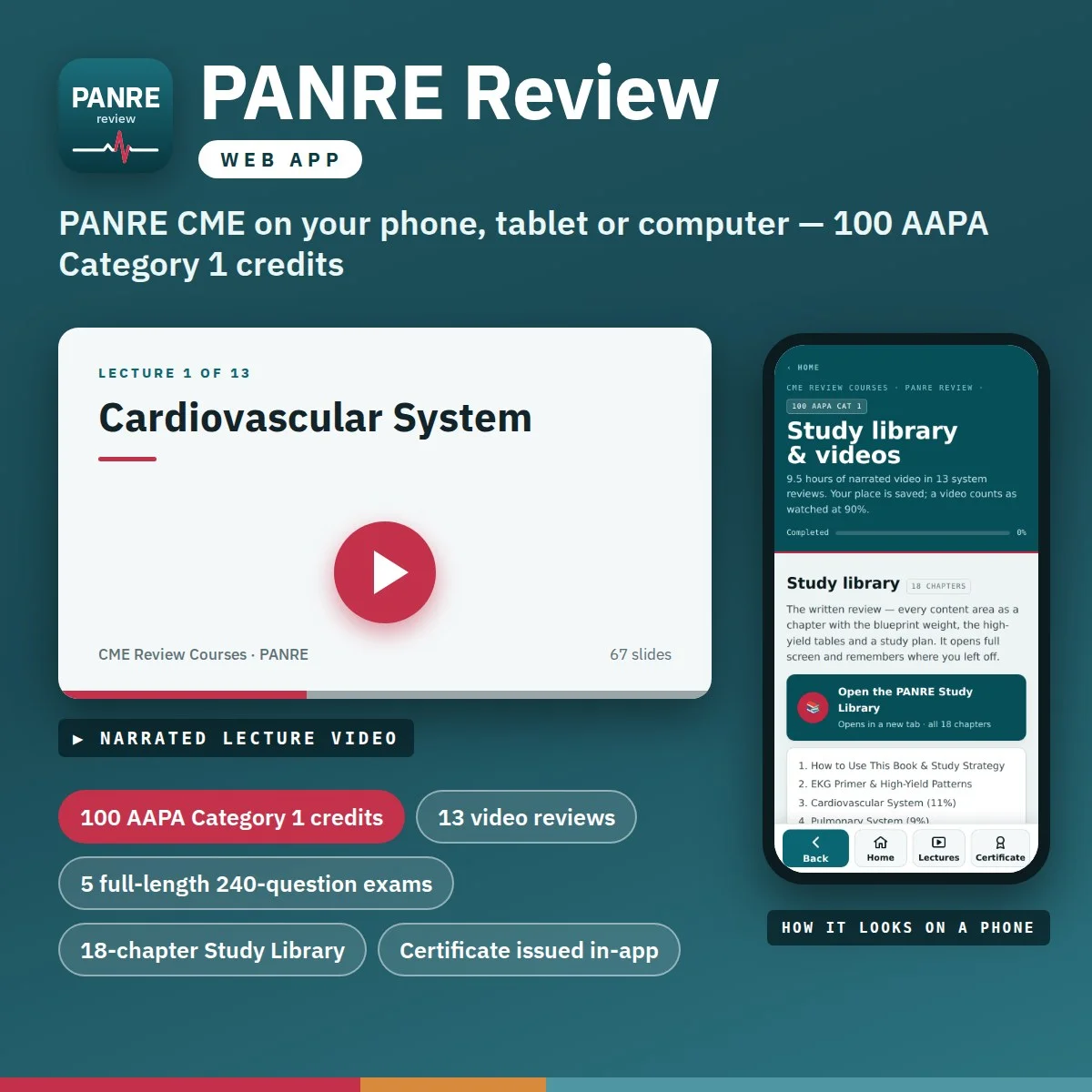
The course is available as a web app on phone, tablet, or computer, with no download required. To earn CME credit, review all module content, complete the post-test with a score of 70% or higher, and complete the activity evaluation. Missed post-test questions may be retaken. A certificate stating your precise credit is issued when both requirements are complete. Claim only credit commensurate with your participation.
Genitourinary practice question
You are evaluating a young man with sudden, severe unilateral scrotal pain. His affected testis is high-riding, and the cremasteric reflex is absent. What is the most appropriate next step?
Correct answer: Immediate urologic/surgical evaluation for suspected testicular torsion.
A. Immediate urologic/surgical evaluation for suspected testicular torsion
B. Scrotal ultrasound before contacting urology
C. Antibiotics for epididymitis
D. NSAIDs and reassurance for torsion of the appendix testis
Why: The sudden onset, high-riding testis, and absent cremasteric reflex are concerning for testicular torsion, which requires urgent evaluation. Epididymitis more often presents with gradual-onset pain and may be accompanied by fever or urinary symptoms. Torsion of the appendix testis more often has a preserved cremasteric reflex and may show a blue-dot sign. Imaging can be useful when the diagnosis is uncertain, but it should not delay urgent evaluation when clinical suspicion for torsion is high.
Real-world exam note: Sudden pain and a negative cremasteric reflex in a young patient should move you toward urgent urologic/surgical evaluation, not an “image and see” answer when that would delay care.
The course’s Genitourinary module includes 104 questions, allowing you to apply the same review method to a defined topic: examine performance, revisit weak areas, and retest.
Choose your next step
- Explore the PANRE Review Course and add a paid Amazon or Apple gift card add-on at checkout. These cme gift cards range from $100 to $1,500, are emailed within 2–3 business days, and are nonrefundable. Check your employer’s CME policy before purchasing; the site is not affiliated with Amazon or Apple.
- Try the free PANRE Review Course test drive.
- Check current exam administration information on the NCCPA Key Dates page.
The PANRE module awards up to 100 AAPA Category 1 CME credits; those credits apply to the PANRE Review Course, not the Pharmacology course. Nurse practitioners should verify credit acceptance with their state board of nursing. For physicians, the activity meets AAPA Category 1 requirements, which counts as Category 2 CME for their own reporting.
If you are earlier in your training and comparing pance prep courses, review the course details and available test drive to determine whether the content fits your study needs.
About the author
Jeremy Boroff, MPAS, PA-C is an Emergency Medicine PA with 24 years of clinical experience, a PA educator, author, and CME developer. He is the sole faculty member for this activity and has no relevant financial relationships to disclose.