The hardest academic conversations in a PA program are the late ones: a student who fails an EOR, or who reaches the end of the program with a readiness gap nobody saw coming. Most of those students gave off signals months earlier. The challenge is having a consistent way to see them.
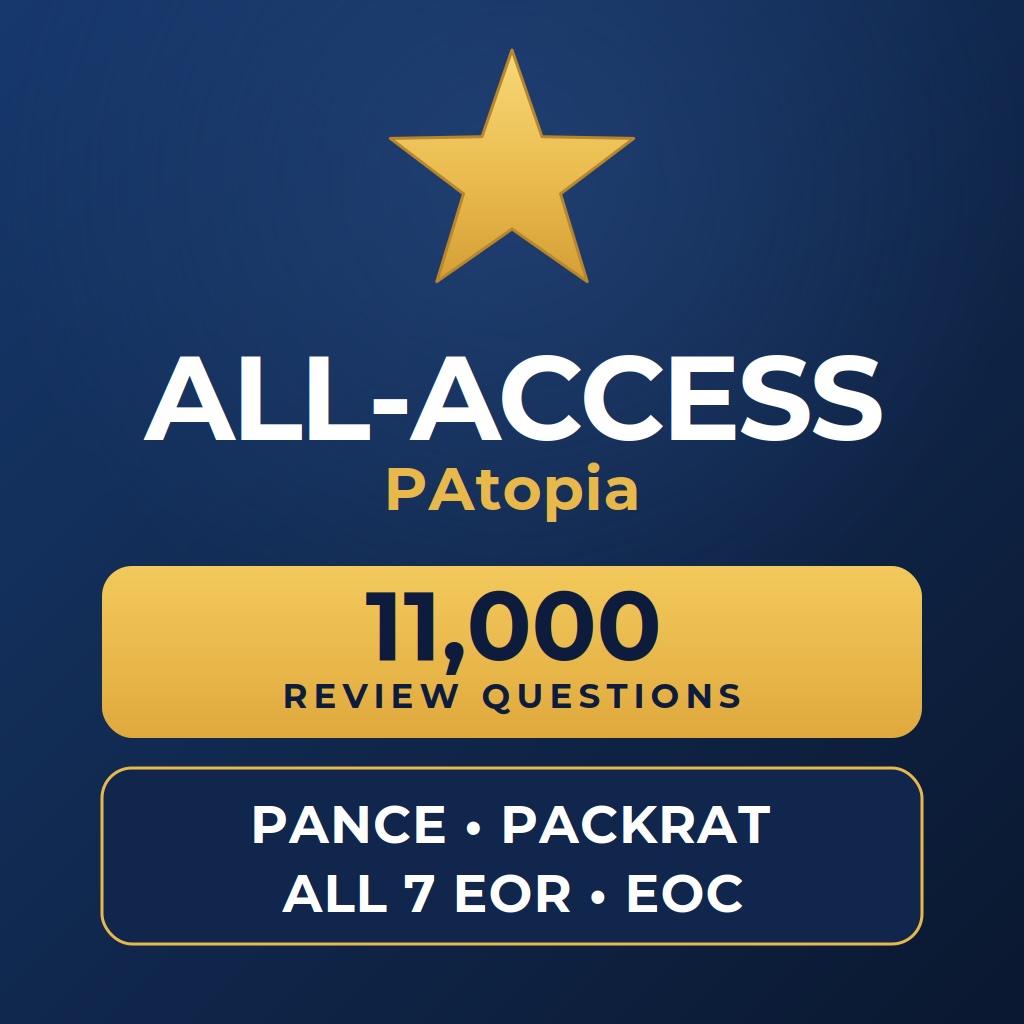
Scheduled full-length practice exams are one of the simplest early-warning tools a program can use, and they work best when every student is practicing on the same material. That is exactly what the PAtopia Program License provides.
Why a shared platform makes the signal clearer
When students use different question banks, their practice scores are hard to compare. A 70% on one product and a 70% on another may mean very different things. When the whole cohort uses PAtopia, a practice exam score means the same thing for every student, and faculty can talk about readiness in shared terms.
A simple checkpoint plan
Programs do not need new software to put this into practice. A few scheduled checkpoints, with students reporting their scores to their advisor, are enough to surface concerns early:
- End of didactic year. Every student takes a full-length PACKRAT practice exam and shares the result with their advisor.
- First week of each rotation. Students take one full-length EOR practice exam for that specialty, so weak areas show up before the real EOR, not after.
- Midpoint of the clinical year. A full-length PANCE practice exam gives a broad, cross-system view of where each student stands.
- Before the End of Curriculum exam. A full-length EOC practice exam confirms readiness for the program’s summative evaluation.
A student who scores well below classmates at any checkpoint is a candidate for an early advising conversation, while there is still time to change course.
Turning a flag into a plan
Identifying a struggling student is only useful if there is somewhere to send them next. Because every PAtopia question includes a detailed rationale and references, and each exam area has a matching study library, a student can move straight from a weak practice score to focused review of the same material. Advisors can then check progress with a follow-up practice exam a few weeks later.
With five full-length exams for each rotation, 15 for the PANCE and five each for PACKRAT and EOC, students have enough fresh exams to retest without simply repeating questions they have already seen.
Support that reaches every student
The students most likely to need help are often the least likely to buy extra resources on their own. A program-wide license removes that barrier entirely. Every student on the roster gets full access with a named login, from the day their logins are set up.
See the material for yourself
Faculty can request preview access at info@cmereviewcourses.com to evaluate the question quality and rationales before building a checkpoint plan around them. The free sample quiz and library preview is open to anyone.
Give every student the same early-warning system. View the PAtopia Program License.
PAtopia is an independent exam-preparation resource and is not affiliated with or endorsed by the NCCPA or PAEA.