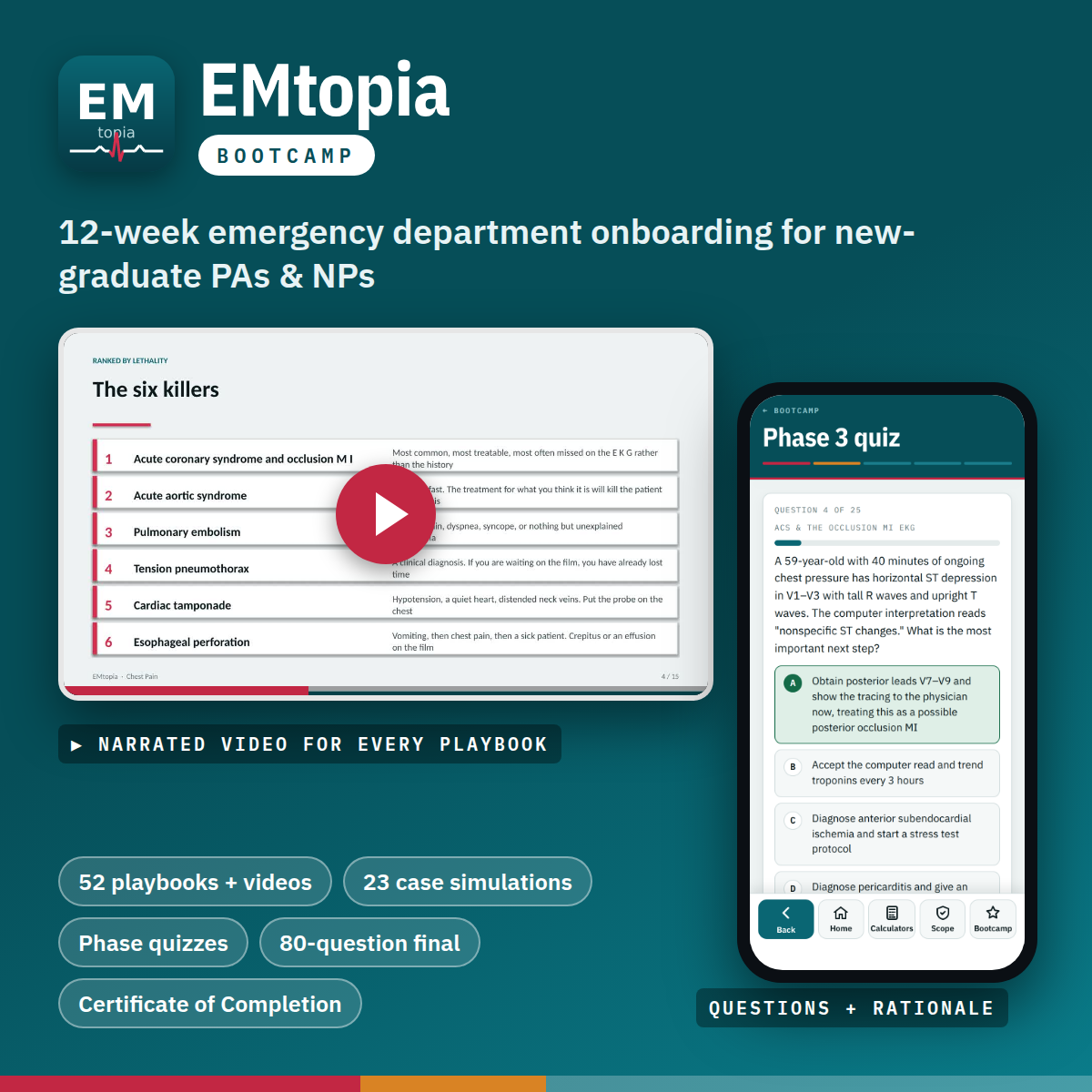
New PAs and NPs usually graduate knowing the names of the major clinical decision rules. What they have had less practice with is the harder skill: knowing when a rule applies, when it does not, and what to do with the answer. Used well, these tools make a new clinician safer and more efficient. Misused, they create false reassurance or a cascade of unnecessary testing. EMtopia includes 17 working calculators, placed inside the playbooks where they are needed. Here is how a few of the most common ones fit into real decisions.
PERC: only for the patient you already think is low risk
The PE Rule-out Criteria are meant for patients whose pretest probability of pulmonary embolism is already low based on clinical judgment. In that group, a patient who meets all eight criteria does not need a D-dimer. The common mistake is applying PERC to a patient you are actually worried about. A negative PERC does not make a moderate-risk patient low risk. The rule assumes the gestalt comes first.
Wells for PE: deciding the next test
The Wells score sorts patients into groups that determine the next step. For lower-risk patients, a D-dimer, including an age-adjusted cutoff in older adults where your pathway uses one, can safely end the workup. For higher-risk patients, the D-dimer is the wrong test, and the next step is imaging. New clinicians sometimes send a D-dimer on everyone and then feel obligated to chase every positive result. The playbook shows where the rule fits so that does not happen.
Hestia: who can be treated for PE at home
Once a pulmonary embolism is diagnosed, the question shifts to disposition. Hestia is a checklist that helps identify patients who may be appropriate for outpatient treatment. It is a disposition aid, not a license to discharge, and outpatient treatment still depends on reliable follow-up and a discussion with the physician.
PECARN: children with head injuries
The PECARN head injury rules help decide which children need a CT after minor head trauma, with separate criteria for children under 2 and those 2 and older. They are among the most useful tools a new clinician can learn, because they reduce radiation exposure in children who do not need imaging while flagging the ones who do. Many sites expect a new APC to staff young children with the physician regardless, and the playbook’s local block is where your department records that expectation.
Rules support judgment; they do not replace it
Every decision rule was derived in a specific population with specific exclusions. The EMtopia playbooks say who each rule was built for, who it excludes, and what to do when your patient falls outside it. They also pair the rules with the red flags that override any score. A patient with a reassuring number and a worrying story still gets the workup the story calls for.
Where the calculators live
Rather than sitting in a separate app, each calculator appears inside the playbook where it is used. The chest pain, shortness of breath, and PE playbooks link to the tools that matter for them, and the head injury playbook links to PECARN. That keeps a new clinician thinking about the patient in front of them instead of searching for the right tool.
UCtopia uses the same approach for urgent care, with the added question of whether the answer means the patient should be transferred. You can try several of the calculators in the free test drive.