Total Credits: 100 Category 1 AAPA Credits
Access Duration: 30 Months
Gift Card Add-ons: $100 – $1,500 (Amazon or Apple)
Primary Goal: Pass the PANRE/PANRE-LA and Maximize CME Dollars
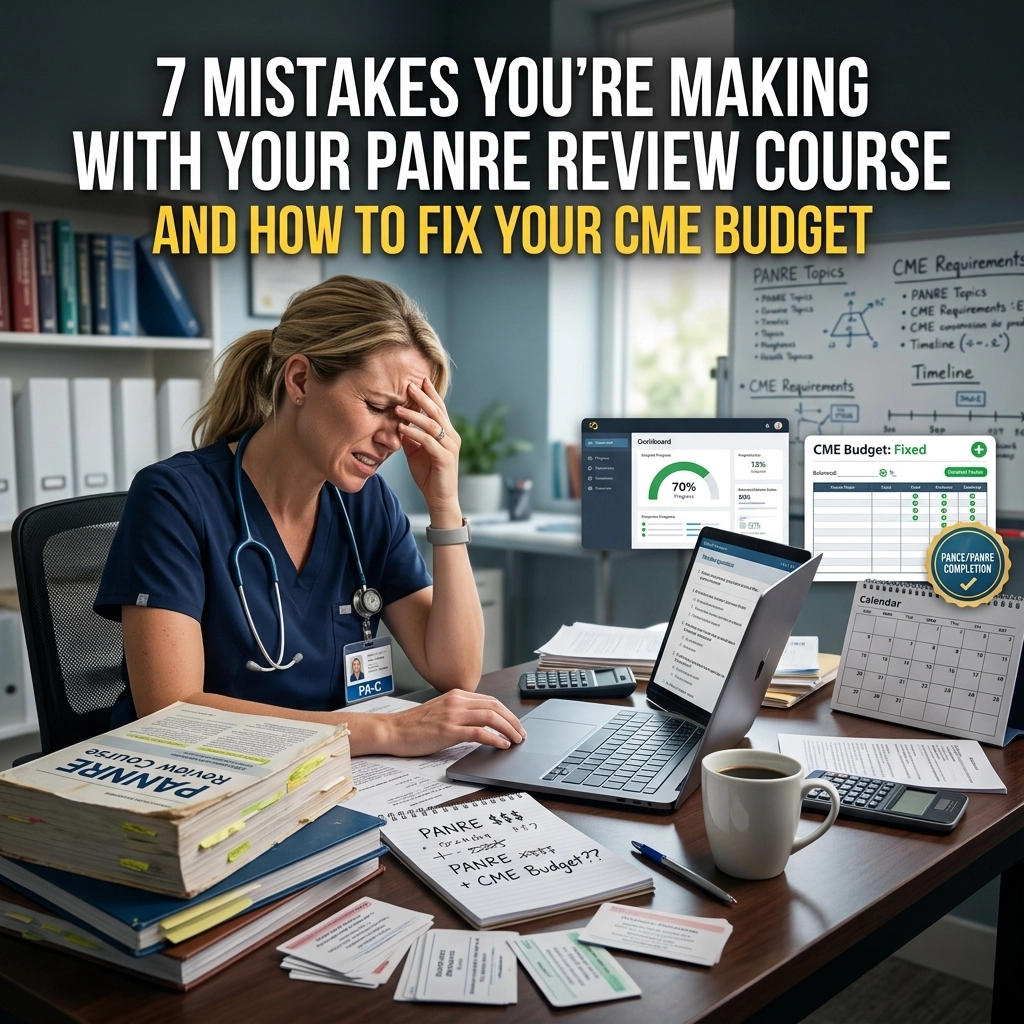
Choosing a PANRE review course is more than just a box to check for your recertification; it is a strategic clinical and financial decision. Many Physician Assistants wait until the last minute or choose a course based on brand recognition alone, often leading to wasted CME funds and inadequate preparation.
At CME Review Courses, we see PAs making the same errors every cycle. If you want to walk into your exam: or tackle your PANRE-LA quarters: with confidence, you need to avoid these seven common pitfalls.
1. Engaging in Passive Review Instead of Active Practice
The most common mistake is spending your entire study window watching lectures or reading through massive texts without testing your knowledge. Passive learning feels productive because you are "doing something," but it doesn't translate to exam success.
The Fix: Your preparation should be centered on the NCCPA Blueprint. Use a high-yield QBank as your primary tool. If you identify a gap in your knowledge regarding valvular heart disease or acid-base disorders, then go back to the review material. Active recall through practice questions is the only way to ensure the information sticks.
2. Failing to Maximize the CME Gift Card Strategy
Many PAs leave money on the table because they don't understand how cme gift cards work. They either pay for a course out of pocket or let their employer-provided CME budget expire at the end of the fiscal year.
The Fix: Utilize a PANRE review course with gift card options. It is important to note that these Amazon or Apple Gift Cards (ranging from $100 to $1,500) are NOT free gifts. They are add-ons that you purchase as part of a bundle. This allows you to utilize your full CME allowance in one transaction, securing your 100 Category 1 AAPA credits while also obtaining a gift card to purchase necessary medical equipment, books, or technology for your practice.
3. Buying More Resources Than You Can Actually Use
It is tempting to buy three different pance prep courses, a physical textbook, and two different QBank subscriptions. This usually results in "resource paralysis," where you jump from one tool to another without mastering any of them.
The Fix: Pick one comprehensive course that offers 100 Category 1 AAPA credits and stick to it. Consistency with one high-quality resource is better than superficial exposure to five. If you are focusing on specific weaknesses, you can supplement with targeted materials like a Pulmonary Blueprint review or a Reproductive Blueprint review.

4. Ignoring the 100 Category 1 AAPA Credit Requirement
Every PA knows the "50/50" rule for CME cycles, but why settle for piecemeal credits? Many PAs spend their budget on small 5-hour or 10-hour courses throughout the year, only to realize they are still short on Category 1 credits when the deadline looms.
The Fix: Choose a PANRE review course that offers a full 100 hours of Category 1 AAPA credit in a single package. This fulfills your entire Category 1 requirement for the cycle in one go. This efficiency saves you time and ensures you aren't scrambling to find credits at 11:00 PM on December 31st.
5. Selecting the Wrong Format for PANRE vs. PANRE-LA
The traditional PANRE is a high-stakes, one-day event. The PANRE-LA is a longitudinal assessment spread over years. Using a "cram" style review for a longitudinal assessment is a tactical error.
The Fix: For the PANRE-LA, you need a resource that is available long-term and easily searchable. Since you have access to your resources during the PANRE-LA, having a well-organized, digital review course that follows the NCCPA Blueprint is essential. If you are taking the one-day PANRE, you need a structured, high-intensity review. Make sure your course access matches your timeline. Our courses provide 12 months of access to ensure you are covered regardless of your chosen path.
6. Overlooking Medical Specialty Specifics
If you work in a specialty like Emergency Medicine or Surgery, you might feel comfortable in those domains but completely lost in Psychiatry or Pediatrics. A common mistake is "studying what you know" because it feels good to get questions right.
The Fix: Be honest about your clinical gaps. If you haven't seen a pediatric patient in five years, you need to spend extra time on the Pediatric sections of the blueprint. We offer specific reviews for those in specialized practice, such as the Emergency Medicine EOR review tools, which can help bridge the gap between specialty practice and generalist board requirements.

7. Waiting Until the "End of the Year" to Purchase
Many employers operate on a "use it or lose it" CME budget policy that resets on January 1st. Waiting until late December to find a cme gift card option can lead to rushed decisions and potential issues with budget approval.
The Fix: Plan your purchase at least 60 days before your budget expires. This gives you time to ensure the course meets your needs and that the Amazon or Apple Gift Card add-on amount is correctly calculated to maximize your remaining funds.
Practice Questions
To keep your clinical skills sharp, review the following vignettes.
Question 1
Your patient is a 45-year-old male with a history of HTN and DM who presents with a sudden onset of "the worst headache of my life." He is nauseated and has vomited twice. Physical exam reveals nuchal rigidity. Vital signs are: BP 170/100, HR 92, RR 18, SaO2 98% on room air. A non-contrast CT of the head is negative. What is the next most appropriate step in management?
A) Repeat CT with contrast
B) Perform a lumbar puncture
C) Start IV mannitol
D) Admit for observation
Answer: B. Perform a lumbar puncture.
In a patient with a clinical history highly suggestive of subarachnoid hemorrhage (SAH) and a negative non-contrast CT, a lumbar puncture (LP) is the next mandatory step to look for xanthochromia or RBCs. CT sensitivity decreases after the first 6-12 hours. Repeat CT with contrast is not indicated for SAH diagnosis, and mannitol is used for increased intracranial pressure but is not a diagnostic step.
Question 2
Your patient is a 28-year-old female complaining of a "racing heart" and heat intolerance. On exam, you note a fine tremor of the hands and exophthalmos. Labs show a suppressed TSH and elevated Free T4. Which of the following is the most likely diagnosis?
A) Hashimoto's thyroiditis
B) Graves' disease
C) Subacute thyroiditis
D) Toxic multinodular goiter
Answer: B. Graves' disease.
Graves' disease is the most common cause of hyperthyroidism and is characterized by the clinical triad of hyperthyroidism, exophthalmos, and pretibial myxedema. Hashimoto's typically presents with hypothyroidism. Subacute thyroiditis is usually post-viral and painful. Toxic multinodular goiter would present with palpable nodules rather than the diffuse enlargement and eye findings seen in Graves'.
Question 3
Your patient is a 68-year-old male presenting with exertional chest pain that is relieved by rest. He has a history of smoking and hyperlipidemia. His EKG shows no acute ST-segment changes. You suspect stable angina. Which of the following is the first-line medication for the rapid relief of symptoms during an acute anginal attack?
A) Metoprolol
B) Lisinopril
C) Nitroglycerin
D) Atorvastatin
Answer: C. Nitroglycerin.
Sublingual nitroglycerin is the first-line treatment for the rapid relief of acute anginal symptoms due to its vasodilatory effects on the coronary arteries. Metoprolol is used for long-term management to reduce myocardial oxygen demand but does not provide immediate relief. Lisinopril and Atorvastatin are for long-term risk factor modification.
Maximize Your Career and Your Budget
Don't let your CME budget go to waste on sub-par resources. By choosing a panre review course that aligns with the NCCPA Blueprint and offers the logistical advantages you need, you set yourself up for clinical success.
Quick Summary of Benefits:
- 100 Category 1 AAPA Credits: Fulfills your cycle requirements.
- CME Gift Cards: Add-on options from $100 to $1,500 (Amazon or Apple).
- 12-Month Access: Plenty of time for both PANRE and PANRE-LA prep.
- Blueprint Focused: Direct alignment with exam topics.
Ready to secure your credits and your gear? Explore our CME with gift card options today and take the stress out of your recertification cycle.
