As a Physician Assistant, your annual or biennial CME allowance is one of your most valuable professional benefits. However, many PAs leave money on the table or find themselves in hot water with their compliance departments because they don't understand how modern CME delivery works. Specifically, the "gift card" market has changed significantly.
If you are looking for a panre review course or pance prep courses that offer more than just a certificate, you need to understand the add-on model. At CME Review Courses, we provide high-yield clinical content that helps you pass your boards while allowing you to maximize your employer-provided funds.
Course Details:
- Price: $499.99 (varies based on gift card add-on selection)
- Access: 12 months of unlimited online access
- Deliverables: 100 Category 1 AAPA credits, 2,000+ board-style practice questions, and comprehensive video modules.
- Add-On Options: Amazon or Apple Gift Cards ranging from $100 to $1500.
Mistake 1: Assuming the Gift Card is a "Free Gift"
The biggest mistake PAs make is searching for "free" gift cards. In the world of professional medical education, there is no such thing as a free $1,500 Apple card.
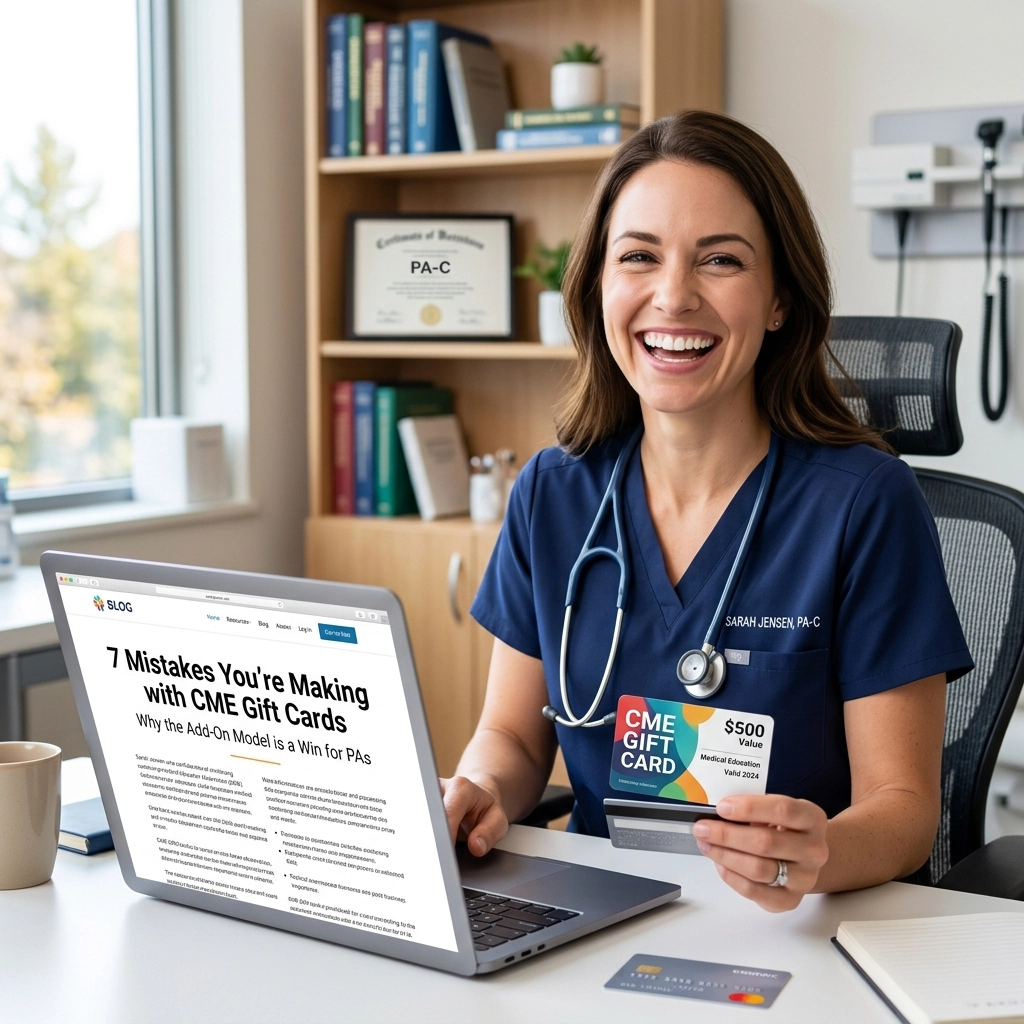
The industry has shifted to the Add-On Model. When you purchase a PANRE Review Course, the base price covers the educational content and the 100 Category 1 AAPA credits. You then choose to add a gift card to your total purchase price. This is a win for PAs because it allows you to utilize your full CME stipend from your employer in a single transaction, essentially converting your educational allowance into usable credit for professional tools like a new iPad or clinical reference books via Amazon.
Mistake 2: Not Meeting the 100-Hour Category 1 Requirement
The NCCPA requirements are strict. For PAs in their recertification cycle, earning 100 Category 1 AAPA credits is a non-negotiable milestone. Many PAs make the mistake of buying multiple small courses throughout the year, which makes tracking credits a logistical nightmare.
By choosing a comprehensive Family Medicine CME Package, you can knock out your entire 100-hour requirement in one go. This ensures you are fully prepared for the NCCPA Blueprint and avoids the last-minute scramble before the December 31st deadline.

Mistake 3: Ignoring the NCCPA Blueprint
Whether you are taking the PANCE for the first time or the PANRE for the third time, your study material must align with the NCCPA Blueprint. A common mistake is using outdated textbooks or generic "medical review" sites that don't weigh topics based on the actual exam distribution.
Our pance prep courses are specifically mapped to the current blueprint, ensuring you spend more time on high-weight areas like Cardiology (13%) and Pulmonology (10%) and less time on lower-weight niches.
Clinical Vignette 1: Emergency Medicine
Your patient is a 64-year-old male presenting to the ED with acute onset of "tearing" chest pain that radiates to his back between the scapulae. His medical history includes long-standing hypertension and tobacco use. On physical exam, his BP is 190/110 mmHg in the right arm and 165/95 mmHg in the left arm. A new diastolic murmur is noted at the right sternal border. HR is 105 bpm, and SaO2 is 96% on room air.
Which of the following is the most appropriate initial pharmacological intervention?
A. Intravenous Bolus of Heparin
B. Intravenous Labetalol
C. Sublingual Nitroglycerin
D. Intravenous Nitroprusside alone
Correct Answer: B. Intravenous Labetalol
Explanation: This patient is presenting with classic signs of an aortic dissection (tearing pain, BP discrepancy, history of HTN). The immediate goal of management is "anti-impulse" therapy to reduce the heart rate and blood pressure, thereby decreasing the shear stress on the aortic wall. Intravenous Labetalol is a preferred first-line agent because it provides both alpha- and beta-adrenergic blockade, effectively lowering both HR and BP. Intravenous Nitroprusside (Choice D) should only be used after a beta-blocker has been administered, as it can cause reflex tachycardia, which increases aortic wall stress. Heparin (Choice A) is contraindicated if dissection is suspected, and Nitroglycerin (Choice C) is less effective for the rapid, controlled BP reduction required here.
Mistake 4: Leaving Money on the Table
If your employer gives you a $2,500 annual CME allowance and you only spend $600 on a basic course, you are effectively giving $1,900 back to the company. This is a common oversight.
With our CME with Gift Card options, you can scale your purchase to match your allowance. By adding an Amazon or Apple Gift Card ranging from $100 up to $1500, you maximize your benefit. You get the 100 Category 1 AAPA credits you need, and you get a gift card to purchase the hardware or software necessary to stay current in your practice.

Mistake 5: Choosing the Wrong Gift Card Provider
Not all gift cards are created equal. Some CME providers offer cards to obscure retailers or "travel vouchers" that are difficult to redeem. We focus on Amazon and Apple Gift Cards because they offer the most utility for a medical professional. Whether you need a new stethoscope, medical scrubs, or the latest MacBook for your telemedicine shifts, these cards cover everything.
Mistake 6: Forgetting the Value of Practice Questions
Many PAs focus entirely on watching videos or reading transcripts. This is a mistake. Active recall through practice questions is the only way to ensure the information sticks. Our panre review course includes over 2,000 practice questions that mimic the style and difficulty of the actual NCCPA exam.
If you aren't testing yourself daily, you aren't truly preparing.
Clinical Vignette 2: Internal Medicine
Your patient is a 45-year-old female with a history of Type 2 Diabetes Mellitus who presents for a routine follow-up. Her current medications include Metformin 1000mg BID. Her A1c today is 8.2%. Her BMI is 34 kg/m². Physical exam is unremarkable, and her renal function is normal (eGFR >90). She expresses a strong desire to lose weight and is concerned about cardiovascular risks, as her father had an MI at age 50.
Which of the following medications is the best next step to add to her regimen?
A. Glyburide
B. Pioglitazone
C. Semaglutide
D. Sitagliptin
Correct Answer: C. Semaglutide
Explanation: For patients with Type 2 Diabetes and obesity (BMI >30) who are not meeting A1c targets on Metformin, a GLP-1 receptor agonist like Semaglutide is an excellent choice. It provides significant A1c reduction, promotes weight loss, and offers cardiovascular benefits, which addresses the patient's specific concerns. Glyburide (Choice A) causes weight gain and carries a risk of hypoglycemia. Pioglitazone (Choice B) also causes weight gain and is associated with edema. Sitagliptin (Choice D) is weight-neutral and generally has lower glycemic efficacy compared to GLP-1 agonists.

Mistake 7: Failing to Document Credits Correctly
When you complete a PANCE/PANRE Blueprint Review Course, you receive a certificate for 100 Category 1 AAPA credits. A common mistake is losing this documentation or failing to upload it to the NCCPA portal immediately.
We provide a streamlined dashboard where you can access your certificate at any time. Our course is designed to be a one-stop shop for your educational requirements, making the administrative side of being a PA as painless as possible.
Why the Add-On Model is a Win for PAs
The add-on model used for cme gift cards is designed with transparency and professional utility in mind. By allowing you to choose the amount of the add-on, we empower you to customize your education package.
- Transparency: You know exactly what you are paying for the credits and what you are paying for the add-on.
- Flexibility: Whether you have $100 or $1,500 left in your budget, there is an option that fits.
- Quality: Our content is developed by experts focused on helping you pass your exams and improve your clinical practice.
Clinical Vignette 3: Family Medicine
Your patient is a 28-year-old female who presents with a 3-day history of increased vaginal discharge and a "fishy" odor. She denies pruritus or dysuria. On pelvic exam, you note a thin, off-white, homogenous discharge adhering to the vaginal walls. The pH of the discharge is 5.0. A "whiff test" using 10% KOH is positive.
What is the most likely finding on wet mount microscopy?
A. Multinucleated giant cells
B. Clue cells
C. Hyphae and spores
D. Flagellated protozoa
Correct Answer: B. Clue cells
Explanation: The patient’s presentation (homogenous discharge, pH >4.5, positive whiff test) is diagnostic of Bacterial Vaginosis (BV) based on the Amsel criteria. The hallmark finding on wet mount is clue cells, which are vaginal epithelial cells coated with coccobacilli, giving them a granular appearance with obscured borders. Multinucleated giant cells (Choice A) are associated with HSV. Hyphae and spores (Choice C) indicate Candidiasis. Flagellated protozoa (Choice D) indicate Trichomoniasis.
Don't make the mistake of choosing a CME provider that doesn't understand your needs as a PA. Maximize your benefits today by exploring our CME with Gift Card 2025 options and secure your 100 Category 1 AAPA credits while staying within your employer's budget.