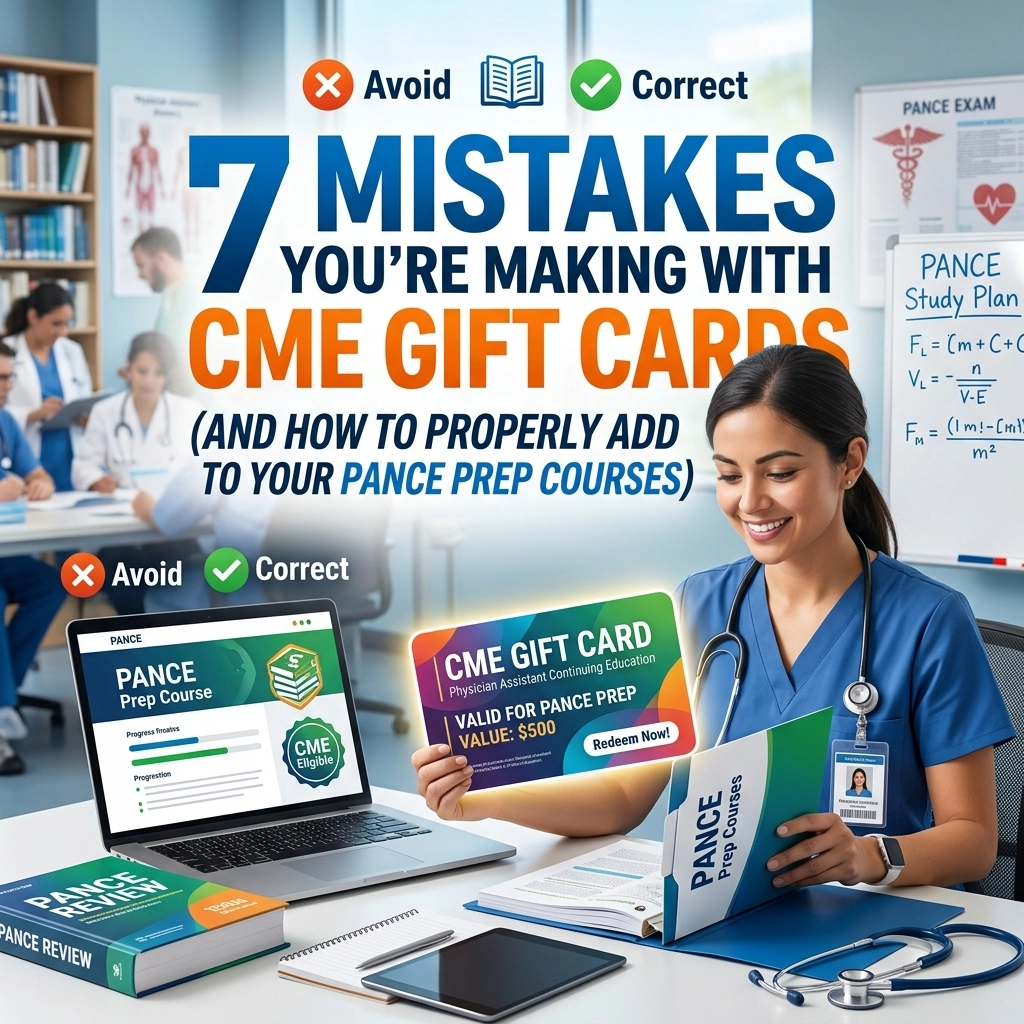
Navigating the world of Continuing Medical Education (CME) can be complex, especially when trying to maximize your employer-provided stipend. Many Physician Assistants (PAs) look for ways to streamline their study process while gaining extra value through cme gift cards. However, several common pitfalls can lead to frustration or missed educational opportunities. Whether you are preparing for the PANCE or looking for a comprehensive panre review course, understanding how to utilize these options is essential.
At CME Review Courses, we provide high-yield educational content designed to help you pass your boards while fulfilling your professional requirements.
Course Logistical Details
- Product Name: PANRE Review Course (100 Credits)
- Price: $499.99 (Base Course)
- Gift Card Add-ons: $100 to $1500 (Amazon or Apple)
- Access Duration: 30 Months of unlimited access
- Deliverables: Over 3,000 practice questions, 100 Category 1 AAPA Credits, and comprehensive organ system modules.
Mistake 1: Assuming the Gift Card is a "Free Gift"
The most significant misunderstanding regarding cme gift cards is the belief that they are free incentives or "bonuses" included at no extra cost. This is incorrect. At CME Review Courses, we prioritize transparency. An Amazon or Apple gift card is a paid add-on. For example, if you purchase a panre review course for your certification maintenance, you can choose to add a $500 gift card to your order. Your total purchase price will increase by $500. The value of the gift card is added to the total cost of the educational package, allowing you to utilize your full CME allowance in one transaction.
Mistake 2: Choosing the Wrong Gift Card for Your Needs
When adding an incentive to your pance prep courses, you must decide between Amazon and Apple. A common mistake is selecting a card without considering your professional needs.
- Amazon Gift Cards: Ideal for purchasing medical equipment, reference books, or clinical office supplies.
- Apple Gift Cards: Best for PAs who need to upgrade their clinical technology, such as an iPad for patient education or a new MacBook for telemedicine.
Make sure the add-on you choose aligns with how you intend to use your professional development funds.

Mistake 3: Failing to Secure 100 Category 1 AAPA Credits
Many PAs mistakenly buy shorter courses that do not provide enough credits to meet their NCCPA requirements in one go. If you are taking a panre review course, your goal should be maximum efficiency. Our primary review package offers 100 Category 1 AAPA credits. This is a critical distinction. Some providers offer Category 2 credits or a lower number of Category 1 credits, which leaves you scrambling to find more hours later in the year.
Mistake 4: Not Aligning the Course with the NCCPA Blueprint
Studying random medical topics is a mistake. Your pance prep courses should be strictly aligned with the NCCPA blueprint content areas. We structure our curriculum based on the NCCPA blueprint by organ system to ensure you are not wasting time on low-yield information. Using cme gift cards to purchase a course that isn't blueprint-focused is a poor investment of both time and money.
Mistake 5: Buying Only for the Incentive
While the gift card add-on is a great way to utilize your budget, the quality of the education must come first. A mistake many clinicians make is choosing a provider solely based on the highest gift card amount available without vetting the content. Our courses are developed by experienced PAs and clinicians who understand the rigors of the PANCE and PANRE. The gift card is a secondary benefit to the high-quality Pharmacology Review CME and specialty modules we provide.
Mistake 6: Ignoring Specialty-Specific Content
If you work in a specialty like Emergency Medicine or Family Medicine, you shouldn't just take a generic review. You should look for packages that allow you to dive deeper into your daily practice. For instance, our Family Medicine CME Package or Psychiatry and Behavioral Health CME Package provide targeted learning. A common mistake is thinking you can't add a gift card to these specialty-specific modules; however, add-ons are available across our product line.
Mistake 7: Waiting Until the End of the CME Cycle
Procrastination is the ultimate mistake. Waiting until December to purchase your panre review course or pance prep courses limits your study time and increases stress. By purchasing early in your cycle and adding your desired gift card amount, you get your study materials immediately and can use your gift card for necessary equipment throughout the year.

Clinical Practice Questions
To help you prepare for your upcoming boards, review the following clinical vignettes. These represent the type of high-yield questions found in our Pharmacology Review CME Question Bank.
Question 1: Cardiology
Your patient is a 64-year-old male with a history of hypertension and DM2 who presents for a routine follow-up. His BP today is 152/94 mmHg. Current medications include Metformin and Lisinopril 20mg daily. Laboratory results show a serum potassium of 4.8 mEq/L and a CrCl of 45 mL/min. Which of the following is the most appropriate next step in managing his hypertension?
A. Increase Lisinopril to 40mg daily
B. Add Amlodipine 5mg daily
C. Add Spironolactone 25mg daily
D. Discontinue Lisinopril and start Losartan
Correct Answer: B. Add Amlodipine 5mg daily.
Explanation: For patients with persistent hypertension despite ACE inhibitor therapy, adding a Calcium Channel Blocker (CCB) like Amlodipine is a standard next step. Increasing the ACE inhibitor (Choice A) may increase the risk of hyperkalemia and renal dysfunction in a patient with an already reduced CrCl. Spironolactone (Choice C) carries a high risk of hyperkalemia given the current potassium level and renal function. Switching from an ACE to an ARB (Choice D) is generally only indicated if the patient develops a cough or angioedema.
Question 2: Endocrinology
Your patient is a 32-year-old female complaining of unintended weight loss, heat intolerance, and palpitations. On exam, her HR is 112 bpm, and you note a diffuse, non-tender enlargement of the thyroid gland with an audible bruit. Laboratory findings show TSH <0.01 uIU/mL and elevated Free T4. What is the most likely underlying pathophysiology?
A. Autoimmune destruction of thyroid follicles
B. TSH-secreting pituitary adenoma
C. Stimulatory antibodies against the TSH receptor
D. Viral infection of the thyroid gland
Correct Answer: C. Stimulatory antibodies against the TSH receptor.
Explanation: This clinical presentation (weight loss, tachycardia, diffuse goiter with bruit) is classic for Graves’ Disease. The underlying mechanism involves Thyroid-Stimulating Immunoglobulins (TSI) that bind to and activate the TSH receptor. Choice A describes Hashimoto’s thyroiditis, which leads to hypothyroidism. Choice B would present with an elevated or inappropriately normal TSH. Choice D refers to De Quervain's (subacute) thyroiditis, which usually presents with a painful thyroid gland and following a viral prodrome.
Question 3: Gastroenterology
Your patient is a 45-year-old female presenting with severe, steady pain in the right upper quadrant that radiates to her right scapula. The pain began after a large meal. On exam, she has a positive Murphy's sign. Vitals include a Temp of 101.2°F and HR 105 bpm. What is the initial diagnostic study of choice?
A. CT Scan of the abdomen and pelvis
B. HIDA Scan
C. Ultrasound of the right upper quadrant
D. ERCP
Correct Answer: C. Ultrasound of the right upper quadrant.
Explanation: Ultrasound is the initial imaging modality of choice for suspected acute cholecystitis due to its high sensitivity for gallstones and gallbladder wall thickening. A HIDA scan (Choice B) is used if the ultrasound is inconclusive but is not the first-line study. CT scan (Choice A) is less sensitive for gallstones. ERCP (Choice D) is an invasive procedure used primarily for the management of choledocholithiasis, not the initial diagnosis of cholecystitis.

How to Properly Add a Gift Card to Your Purchase
Adding cme gift cards to your order at CME Review Courses is a straightforward process designed to maximize your benefits.
- Select Your Base Course: Choose between the PANRE Review Course, the PANCE Prep, or specialty modules like Hematology or Gastrointestinal.
- Navigate to the Add-On Section: On the product page, you will see an option to "Add a Gift Card."
- Choose the Amount: Select the value that fits your remaining CME budget. We offer increments from $100 up to $1500.
- Select the Type: Choose between an Amazon or Apple gift card.
- Complete Your Purchase: The total price will reflect the base course plus the gift card amount. Remember, this is an add-on and not a free gift.
- Receive Your Credits: Once completed, you will have immediate access to your study materials and can begin earning your 100 Category 1 AAPA credits.
Final Thoughts for the Practicing PA
Certification maintenance and initial board prep are stressful enough without worrying about how to manage your CME budget. By avoiding these 7 common mistakes, you can ensure that you are getting the highest quality education while effectively utilizing your employer's funds.
Focus on the NCCPA Blueprint, prioritize Category 1 credits, and use cme gift cards as a strategic add-on to enhance your professional toolkit. Whether you need to brush up on Endocrine or EENT, we have the resources to help you succeed.
Ready to get started? Visit our product-sitemap to view all available courses and add-on options.