Course Name: Pharmacology CME Review Package
Price: $499.99 (Base Price)
Access Duration: 30 Months
Deliverables: 12 AAPA Category 1 Self-Assessment Credits, 120 Practice Questions, Pharmacology Lecture Videos
Gift Card Add-ons: $100 – $1500 (Amazon or Apple)
Staying current with pharmacology is not just a clinical necessity; it is a regulatory requirement for most practicing PAs and NPs. Whether you are maintaining your NCCPA certification or meeting state-specific requirements for prescriptive authority, the demand for high-quality, efficient pharmacology CME has never been higher.
Many states now mandate a specific number of pharmacology hours to maintain a license to prescribe controlled substances. Finding a course that fits into a busy clinical schedule while providing significant value for your CME budget is the primary challenge.
Clinical Scenario 1: Hypertension Management
Your patient is a 64-year-old African American male with a history of type 2 diabetes and newly diagnosed Stage 2 hypertension. His current blood pressure is 152/94 mmHg. His renal function is within normal limits (Cr 1.0, eGFR >60). You are initiating pharmacological therapy.
Which of the following is the most appropriate initial medication choice for this patient?
A) Lisinopril
B) Metoprolol
C) Amlodipine
D) Losartan
Correct Answer: C) Amlodipine
Amlodipine is a calcium channel blocker (CCB), which, along with thiazide-type diuretics, is recommended as first-line therapy for the African American population according to JNC 8 and AHA/ACC guidelines, even in patients with diabetes. While ACE inhibitors (Lisinopril) or ARBs (Losartan) are preferred for patients with chronic kidney disease (CKD) or albuminuria, they are less effective at reducing blood pressure in the African American population without those specific comorbidities compared to CCBs or diuretics. Beta-blockers like Metoprolol are no longer recommended as first-line therapy for uncomplicated hypertension.

The Efficiency of Self-Assessment Credits
The Pharmacology CME Review Package is specifically designed to provide 12 AAPA Category 1 Self-Assessment CME credits. For Physician Assistants, these credits are particularly valuable. The NCCPA currently applies an additional 50 percent weighting to self-assessment credits. This means that completing this 12-credit course actually results in 18 credits being applied to your NCCPA certification maintenance total.
This course serves as a targeted review of essential pharmacological principles, focusing on drug-drug interactions, prescribing safety, and the management of common chronic conditions. It was written by physician assistants for physician assistants, ensuring the content is practical and relevant to daily practice.
Clinical Scenario 2: Endocrine Emergencies
Your patient is a 42-year-old female with a known history of Graves' disease who presents to the emergency department with tachycardia (HR 145), agitation, and hyperthermia (103.2°F). You suspect thyroid storm.
In addition to supportive care, which medication should be administered first to block the peripheral effects of thyroid hormone?
A) Propylthiouracil (PTU)
B) Propranolol
C) Methimazole
D) Lugol’s solution
Correct Answer: B) Propranolol
Propranolol is the correct initial choice to provide immediate symptomatic relief by blocking the peripheral adrenergic effects of the thyroid hormone, such as tachycardia and agitation. While Propylthiouracil (PTU) and Methimazole are used to stop the synthesis of new hormones, and Lugol’s solution blocks the release of stored hormones, the immediate life-threatening peripheral symptoms must be addressed first. Propranolol also has the added benefit of inhibiting the peripheral conversion of T4 to T3.

Maximizing Your CME Budget with Gift Card Add-ons
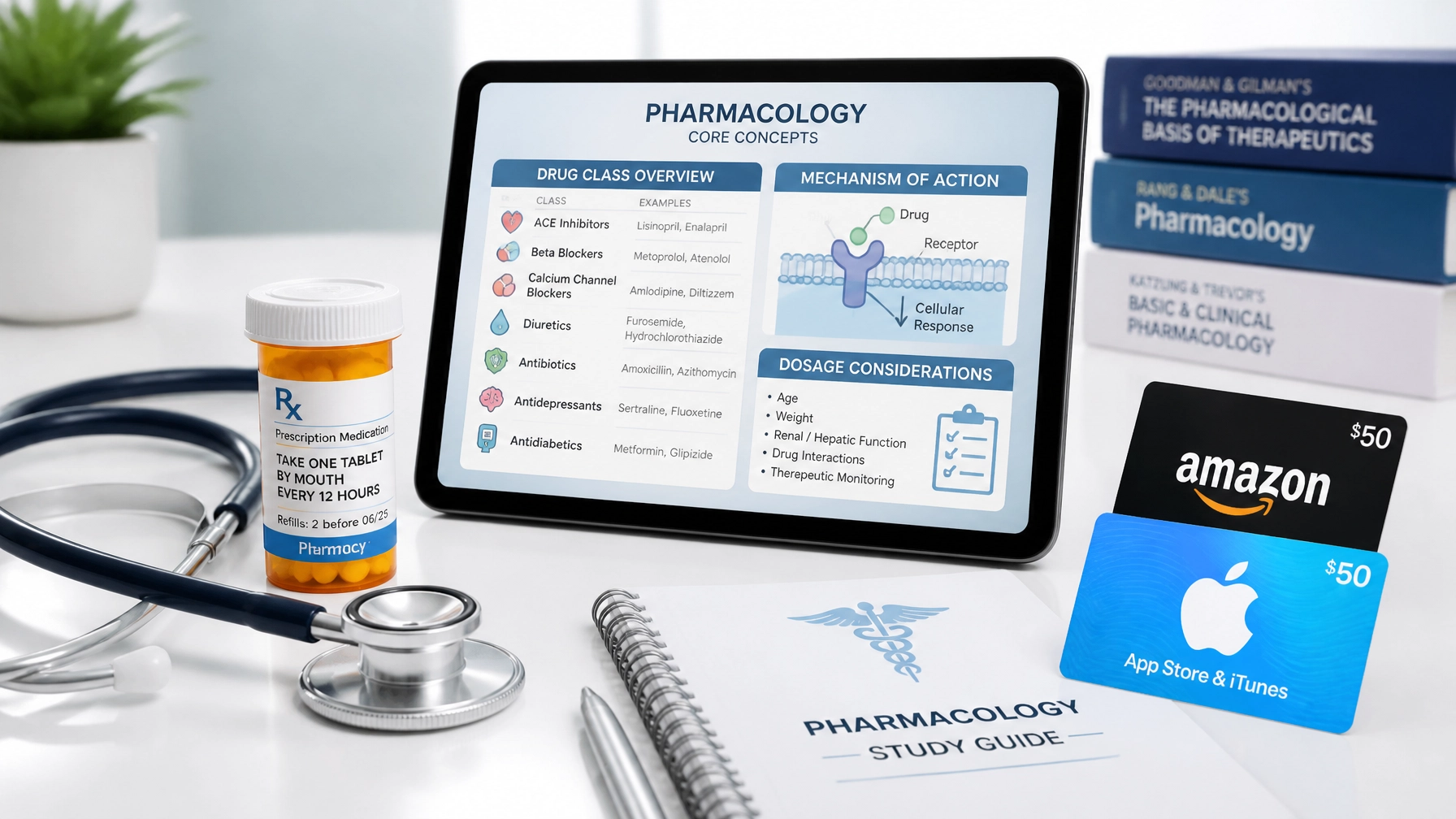
One of the most efficient ways to utilize your employer-provided CME allowance is through the use of CME with Amazon and Apple Gift Card add-ons. This allows you to combine your educational purchase with a gift card ranging from $100 to $1500.
- Amazon Gift Cards: These are processed within 2-3 business days and delivered via email. They allow you to purchase additional educational materials, medical equipment, or other resources to support your practice.
- Apple Gift Cards: Ideal for those looking to upgrade their clinical hardware, such as a new iPad or MacBook, to facilitate on-the-go learning and EMR access.
The price of the gift card is included in the total package price. This provides a streamlined way to enrich your education while ensuring you get the most out of your professional development funds.
Who is This Course For?
While the content was created by PAs, it provides significant value across the healthcare spectrum:
- Physician Assistants: Earn 12 AAPA Category 1 Self-Assessment credits (weighted to 18 NCCPA credits).
- Nurse Practitioners: The AANP typically accepts AAPA Category 1 credits. NPs often use this course to meet their pharmacology-specific contact hour requirements for license renewal.
- Physicians: Physicians can claim this course as Category 2 CME. It is frequently utilized by Internal Medicine and Family Medicine physicians for high-yield pharmacology updates.
Clinical Scenario 3: Cardiology and Anti-Coagulation
Your patient is a 72-year-old female with a history of non-valvular atrial fibrillation and a CHA2DS2-VASc score of 4. She is currently taking Dabigatran (Pradaxa). She presents to the ER with significant gastrointestinal bleeding.
Which agent is the specific reversal agent for Dabigatran?
A) Protamine sulfate
B) Idarucizumab
C) Andexanet alfa
D) Vitamin K
Correct Answer: B) Idarucizumab
Idarucizumab (Praxbind) is a monoclonal antibody fragment specifically designed to reverse the effects of Dabigatran. Protamine sulfate is used for heparin reversal. Andexanet alfa is the reversal agent for factor Xa inhibitors like Rivaroxaban and Apixaban. Vitamin K is used for Warfarin reversal.

Comprehensive Learning Options
If you are looking for more than just pharmacology, the PANRE Review Course offers 100 hours of AAPA Category 1 credit. This course covers a broad range of topics including Emergency Medicine, Family Medicine, Internal Medicine, Orthopedics, Dermatology, Psychiatry, Neurology, Cardiology, and OB/GYN. Like the Pharmacology course, the PANRE Review also offers the option to add on Amazon or Apple gift cards.
The Pharmacology CME Review includes:
- 120 High-Yield Questions: Designed to test application, not just rote memorization.
- Lecture Videos: Focused, expert-led content covering key pharmacology topics.
- 30-Month Access: Plenty of time to complete the course at your own pace.
Investing in your pharmacology knowledge is essential for patient safety and professional competence. By choosing a course that offers both high-quality accreditation and the added value of a gift card, you are making the most of your time and your CME budget.