Price: Starting at $499.99
Duration: 30 months of access
Deliverables: 1,672 board-style review questions with detailed explanations and 100 AAPA Category 1 Self-Assessment CME Credits.
If you are a Physician Assistant (PA) preparing for the PANCE or your upcoming PANRE recertification, efficiency is your highest priority. You need a program that doesn't just help you pass, but also helps you maximize your annual CME stipend. At CME Review Courses, we specialize in high-yield content that satisfies both your educational needs and your certification requirements.
The 100-Hour AAPA Category 1 Credit Advantage
The PANRE Review Course is uniquely designed to provide 100 hours of AAPA Category 1 Self-Assessment CME credit. This is a significant distinction for PAs. When you log these 100 credits for your NCCPA certification maintenance, the NCCPA applies an additional 50% weighting. This means your 100 hours effectively count as 150 hours toward your requirement, making this one of the most efficient ways to stay compliant with the NCCPA Blueprint.
While the pharmacology course also offers Category 1 AAPA credit, the full 100-hour package is specific to the PANRE review. This content is developed by physician assistants for physician assistants, ensuring the clinical vignettes and questions mirror the real-world challenges you face in practice.
Maximizing Your Stipend: CME Gift Cards
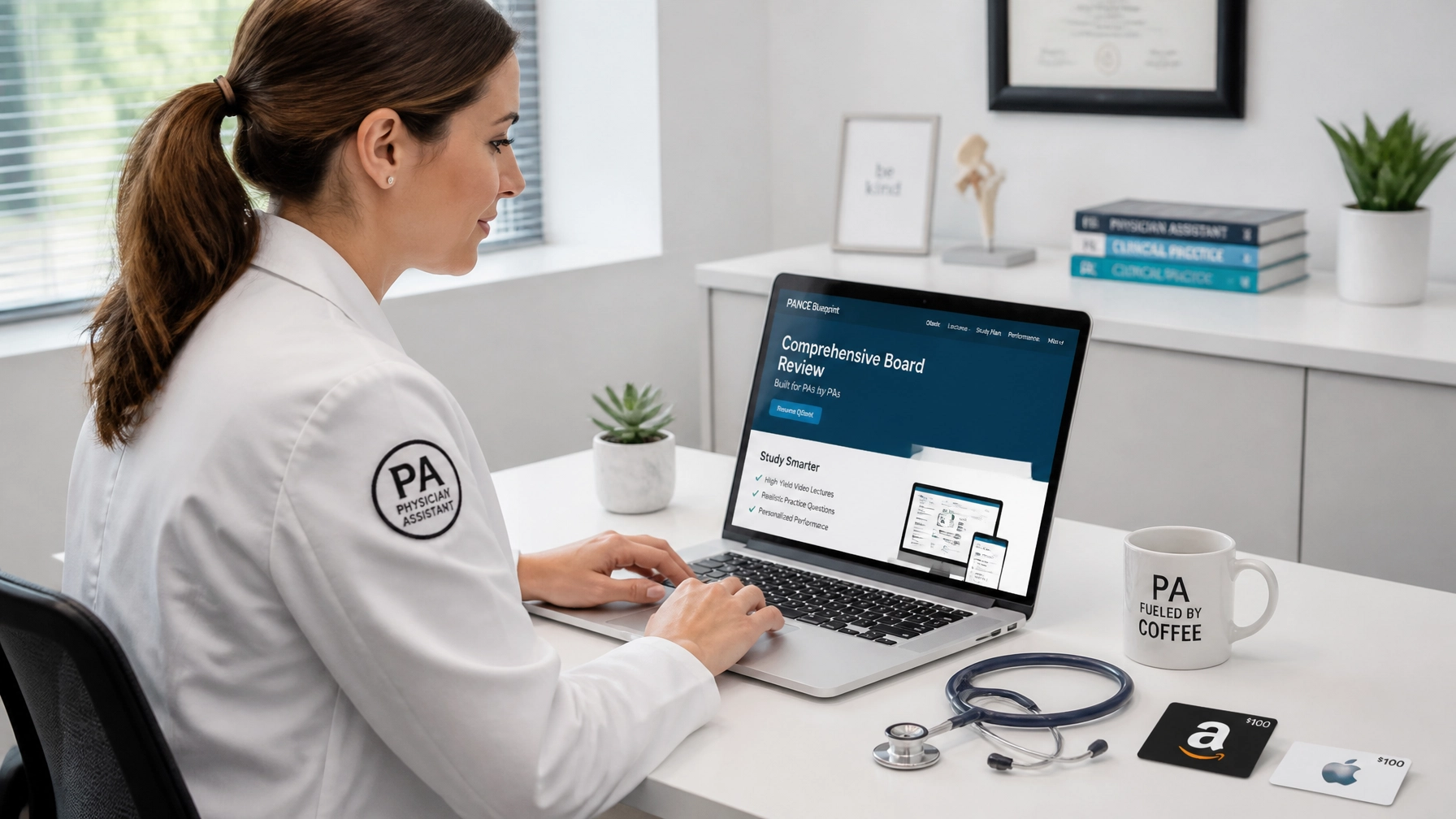
Many PAs find themselves at the end of the fiscal year with remaining CME funds. Our CME with Amazon gift card and CME with Apple gift card options allow you to further enrich your professional resources.
It is important to understand that these gift cards are NOT free gifts. They are add-ons ranging from $100 to $1,500 that are bundled into the total purchase price of your CME package. This allows you to use your employer-provided education budget to secure a gift card that can be used for medical equipment, textbooks, or other educational tools on Amazon or Apple platforms.

Internal Medicine Clinical Review
To give you a feel for the depth of our material, let's look at a common clinical scenario you might encounter on the PANCE/PANRE or in a hospitalist setting. Our content covers various specialties including Emergency Medicine, Family Medicine, Internal Medicine, Orthopedics, and Cardiology.
Clinical Vignette: The 55-Year-Old with Progressive Dyspnea
Your patient is a 55-year-old male with a history of hypertension and a 30-pack-year smoking history who presents to the clinic complaining of progressive shortness of breath over the last six months. He notes a persistent cough productive of clear sputum, most prominent in the mornings. On physical exam, you note a barrel-chested appearance and decreased breath sounds globally. His vitals are as follows:
- HR: 88 bpm
- BP: 138/86 mmHg
- Temp: 98.6°F
- SaO2: 91% on room air
He is currently using an albuterol inhaler PRN but finds it less effective than before. You suspect Chronic Obstructive Pulmonary Disease (COPD).
Practice Question 1:
Which of the following is the most appropriate next step to confirm the diagnosis in this patient?
A) Chest X-ray
B) Sputum culture
C) Spirometry (PFTs)
D) Arterial Blood Gas (ABG)
Explanation:
The correct answer is C) Spirometry (PFTs). According to the NCCPA Blueprint guidelines for pulmonary disease, spirometry is the gold standard for diagnosing COPD. A post-bronchodilator FEV1/FVC ratio of less than 0.70 confirms the presence of persistent airflow limitation. While a Chest X-ray (A) may show hyperinflation or a flattened diaphragm, it is not diagnostic. Sputum culture (B) is used during acute exacerbations if an infection is suspected, and ABG (D) is typically reserved for severe cases or when monitoring for hypercapnia.
Practice Question 2:
Your patient's PFT results confirm COPD with an FEV1 of 65% of predicted. He continues to have daily symptoms. Which of the following is the most appropriate long-acting maintenance therapy to add to his regimen?
A) Oral Prednisone
B) Long-acting Beta-Agonist (LABA) or Long-acting Muscarinic Antagonist (LAMA)
C) Theophylline
D) Short-acting Beta-Agonist (SABA) only
Explanation:
The correct answer is B) Long-acting Beta-Agonist (LABA) or Long-acting Muscarinic Antagonist (LAMA). For patients with symptomatic COPD and moderate airflow limitation, maintenance therapy with a long-acting bronchodilator is recommended. LAMAs and LABAs are superior to regular SABA use for improving lung function and reducing exacerbations. Oral Prednisone (A) is not for maintenance due to systemic side effects. Theophylline (C) is a third-line therapy with a narrow therapeutic index.

Why Choose Our PANCE Prep Courses?
Whether you are in Family Medicine or a specialized field like Internal Medicine, the breadth of our 1,672 questions ensures you are prepared for any section of the exam.
- Peer-to-Peer Education: This content is written by PAs who have sat for these exams multiple times. We understand the specific pressure of the recertification cycle.
- Flexible Learning: With 30 months of access, you can study at your own pace without the pressure of a looming expiration date.
- Broad Utility: While our primary focus is Physician Assistants, Nurse Practitioners can claim AAPA Category 1 credit in many states (though this varies, so check your state board). Internal Medicine Physicians also find high value in our Internal Medicine CME packages, though it counts as Category 2 credit for physicians.
- Specialty Focus: We offer dedicated content for Emergency Medicine, Orthopedics, Dermatology, Psychiatry, Neurology, Cardiology, and OB/GYN.
Practical Tips for the PANCE and PANRE
When approaching the NCCPA Blueprint, don't just memorize facts. Focus on the "Most Likely Diagnosis" and "Initial Management" questions, as these make up the bulk of the exam. Our PANRE Review Course prioritizes these high-yield areas.
- Practice with Purpose: Don't just do questions; read the explanations for the incorrect answers. Our program provides exclusionary reasoning to help you understand why a distractor is wrong, which is essential for narrowing down choices on the actual exam.
- Time Management: Utilize your study time efficiently. Since our course offers 100 hours of credit, you can earn your required CME while simultaneously prepping for the boards.
Conclusion
Staying certified shouldn't be a logistical nightmare. By choosing a panre review course that bundles high-quality clinical education with flexible cme gift cards, you are making a smart investment in your career and your budget.
Ready to get started? Explore our CME with gift card options today and take the stress out of your next certification cycle.