It’s that time of year again. Your CME budget is sitting there, and the deadline is looming. You need credits, you need a solid panre review course, and let’s be honest: you probably need a new pair of scrubs, a high-end stethoscope, or some tech gear from Amazon or Apple.
As a Physician Assistant, managing your Continuing Medical Education (CME) requirements can feel like a full-time job on top of your actual full-time job. Between patient rounds and charting, finding the time to source high-quality Category 1 credits that actually prepare you for the PANRE can be a headache.
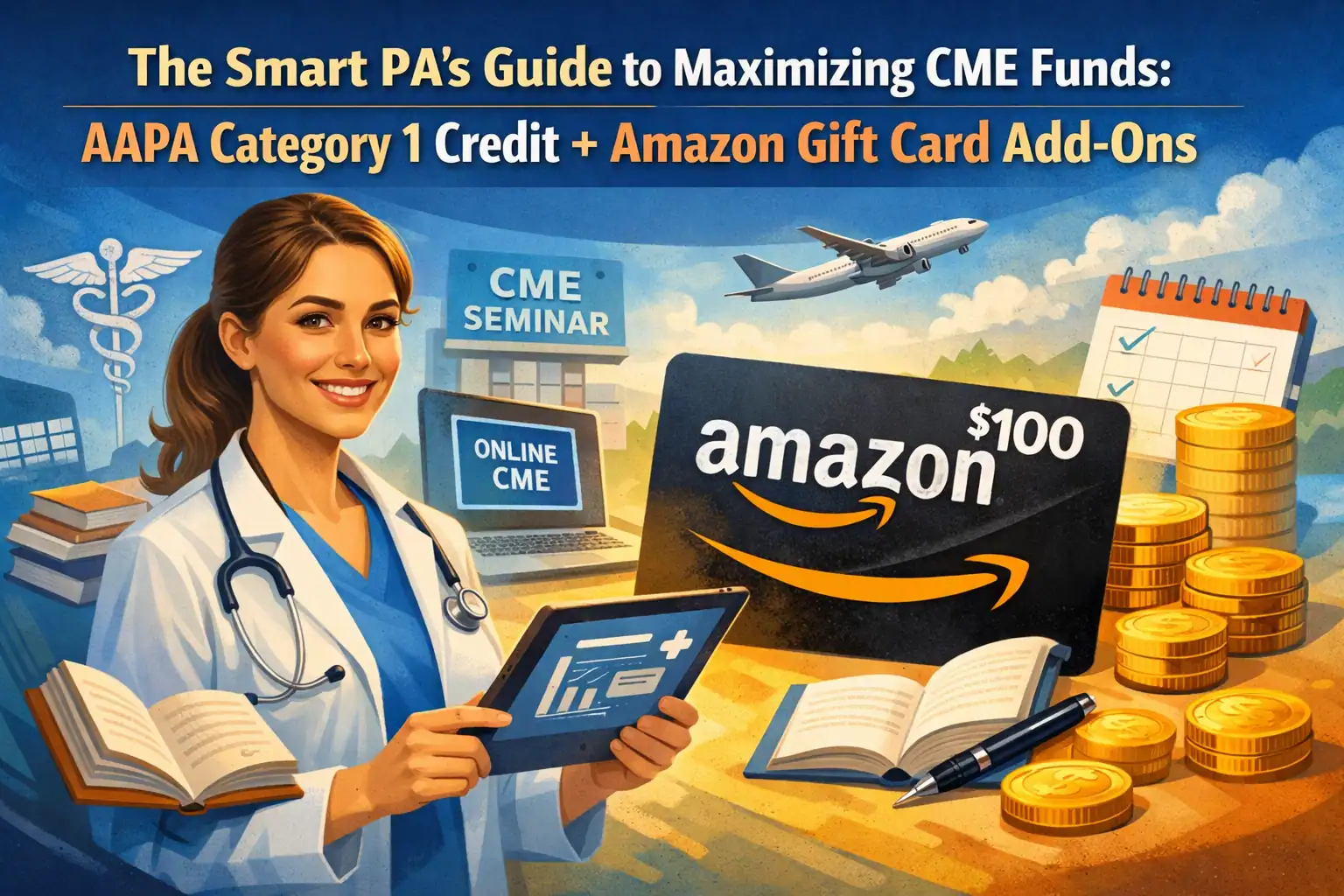
At CME Review Courses, we’ve designed a system that solves both problems at once. You can earn the full 100 AAPA Category 1 CME credits required for your two-year cycle while also including a gift card add-on to your purchase to help you get the gear you need for your practice.
The 100-Credit Solution: Knock Out Your Requirements in One Go
The NCCPA requires PAs to earn 100 CME credits every two years, at least 50 of which must be Category 1. However, many PAs prefer to knock out the entire 100-credit requirement with Category 1 credits to ensure there is no doubt about their certification maintenance.
Our PANRE Review Course with Gift Card is specifically built for this purpose. It provides a comprehensive review of the PANCE/PANRE blueprints while delivering the high-volume credit count you need.
Why Category 1 AAPA Credits Matter
AAPA Category 1 CME credits are the gold standard for PA professional development. They are pre-approved by the American Academy of Physician Associates and are accepted by the NCCPA. When you invest in a course that offers these credits, you are ensuring that your time spent studying translates directly into maintained certification.

Understanding the Gift Card Add-On: It’s All About Utility
Let’s talk about the cme gift cards. We receive a lot of questions about how this works. To be absolutely clear: the Amazon or Apple gift cards available through our site are add-ons to the purchase, not "free gifts."
When you select a package like the CME with Gift Card, you are purchasing a comprehensive educational bundle. The gift card is an integrated component of that bundle. This allows you to use your employer-provided CME funds to not only secure the best board review materials but also to acquire the tools (like a new tablet for charting or clinical reference books) that you need to be an effective clinician.
Key Logistics:
- Price: Varies based on the gift card add-on amount selected.
- Access: Immediate digital access upon purchase.
- Deliverables: 100 AAPA Category 1 CME Credits, comprehensive video curriculum, and practice questions.
- Gift Card Options: Amazon or Apple add-ons available.
Why Choose a PANRE Review Course?
The PANRE (Physician Assistant National Recertification Exam) is evolving. Whether you are taking the traditional high-stakes exam or the PANRE-LA (Longitudinal Assessment), the breadth of knowledge required remains the same. You need to be proficient in everything from Cardiology to Infectious Disease.
Our courses are structured around the NCCPA blueprints to ensure no topic is left unaddressed. We focus on high-yield facts and clinical reasoning.
For those looking for specific area deep-dives, we offer specialized blueprint reviews:

Clinical Review: Putting Knowledge into Practice
To give you a taste of the educational depth provided in our panre review course, let’s look at a few clinical vignettes. This is the same logic-based approach we use throughout our curriculum.
Case Study 1: Pulmonology
Your patient is a 64-year-old male with a 40-pack-year smoking history presenting with progressive dyspnea on exertion and a chronic productive cough. On physical exam, he is barrel-chested and has decreased breath sounds bilaterally. Pulse oximetry shows an SaO2 of 89% on room air. Pulmonary function testing (PFT) reveals an FEV1/FVC ratio of 0.62.
Question: According to the GOLD criteria, what is the most appropriate next step in the long-term management of this patient’s condition?
Answer: Initiate a Long-Acting Muscarinic Antagonist (LAMA) or Long-Acting Beta-Agonist (LABA).
Explanation: This patient’s PFT results (FEV1/FVC < 0.70) confirm the diagnosis of COPD. For patients with significant symptoms (Group B or higher), a long-acting bronchodilator is the first-line maintenance therapy. LAMAs are often preferred for their superior reduction in exacerbation rates compared to LABAs. Short-acting agents (SABAs) should be used only for rescue, and inhaled corticosteroids (ICS) are typically reserved for patients with high eosinophil counts or frequent exacerbations despite dual bronchodilator therapy.
Case Study 2: Gastroenterology
Your patient is a 45-year-old female complaining of intense, steady pain in the right upper quadrant (RUQ) that began after eating a cheeseburger. The pain radiates to her right scapula. She has a temperature of 101.4°F, a HR of 105, and a positive Murphy’s sign on exam. Labs show a WBC of 14,000.
Question: What is the most sensitive initial imaging modality for the suspected diagnosis?
Answer: Ultrasound of the RUQ.
Explanation: The clinical presentation is classic for acute cholecystitis (fever, RUQ pain, leukocytosis, and positive Murphy’s sign). RUQ ultrasound is the preferred initial test because it is highly sensitive for detecting gallstones, gallbladder wall thickening (>4mm), and pericholecystic fluid. If the ultrasound is equivocal but clinical suspicion remains high, a HIDA scan (cholescintigraphy) is the most sensitive confirmatory test.

Case Study 3: Neurology
Your patient is a 72-year-old female brought in by her daughter for "shuffling" when she walks. On exam, you note a resting "pill-rolling" tremor in the right hand, bradykinesia, and masked facies. When you test her muscle tone, you notice a "cogwheel" rigidity.
Question: The primary pathophysiology of this condition involves the depletion of neurotransmitters in which brain region?
Answer: Substantia nigra.
Explanation: This patient presents with the hallmark symptoms of Parkinson’s disease: tremor, rigidity, and bradykinesia. The disease is caused by the loss of dopaminergic neurons in the substantia nigra pars compacta, which leads to a decrease in dopamine levels in the striatum. Treatment is focused on restoring dopamine levels, typically with Levodopa/Carbidopa.
Maximizing Your Professional Development
When you choose an PANRE-LA Review Course, you aren't just checking a box for the NCCPA. You are refining your clinical judgment. The use of medical terminology and abbreviations (like MVC, PID, and HR) in our practice questions prepares you for the "shorthand" of the boards and real-world practice.
Efficient Use of Funds
Many PAs find themselves with $1,000 to $2,500 in annual CME funds. If you don't use it, you lose it. By selecting a course that includes an Amazon gift card add-on, you ensure that 100% of that budget is utilized. You get:
- Top-tier board review to ensure you pass the PANRE or PANRE-LA.
- 100 Category 1 Credits to satisfy your two-year NCCPA cycle.
- A gift card add-on to purchase clinical tools, textbooks, or office hardware.
How to Get Started
Navigating your CME requirements shouldn't be a source of stress. Whether you need a deep dive into the Psychiatry Blueprint or the Reproductive Blueprint, we have the resources to help you succeed.
Visit our product-sitemap to see the full list of available courses and gift card add-on tiers. Stop worrying about the credits and start focusing on your patients. We’ve got the educational side covered.

Final Thoughts for the Smart PA
The "Smart PA" knows that efficiency is the key to longevity in this profession. Don't waste dozens of hours hunting for individual credits. Don't leave money on the table at the end of the fiscal year.
By bundling your panre review course with a cme gift cards add-on, you are making a strategic move for your career and your wallet. You get high-yield, blueprint-specific education that respects your time and your professional standing.
Ready to knock out your 100 credits? Check out the PANRE Review Course with Gift Card today and get back to what matters( practicing medicine.)