Price: $499.00 – $1,999.00 (depending on gift card add-on)
Access: 12 months from date of purchase
Deliverables: 100 hours of AAPA Category 1 Credit, over 1,000 practice questions, and comprehensive subject-specific modules.
Physician assistants currently enrolled in the PANRE-LA (Longitudinal Assessment) have a unique opportunity to maximize their CME efficiency. While the PANRE-LA format is designed to be lower-stress and more spread out than the traditional high-stakes exam, it also offers a significant "hidden" benefit regarding your 100-hour CME requirement. By understanding how the NCCPA and AAPA handle self-assessment credits, you can earn more credit while doing the same amount of work.
The 1.5x Multiplier: Understanding AAPA Category 1 Self-Assessment Credit
The NCCPA recognizes the additional value of self-assessment and performance improvement activities. For PAs participating in the PANRE-LA, every quarter you complete the required 25 questions, you earn 2 AAPA Category 1 Self-Assessment CME credits.
However, the NCCPA applies a 1.5x multiplier to these credits. This means those 2 AAPA credits automatically count as 3 credits toward your 100-hour NCCPA biennial cycle requirement. Over the course of 12 quarters (3 years), those 24 AAPA credits become 36 credits in the eyes of the NCCPA.
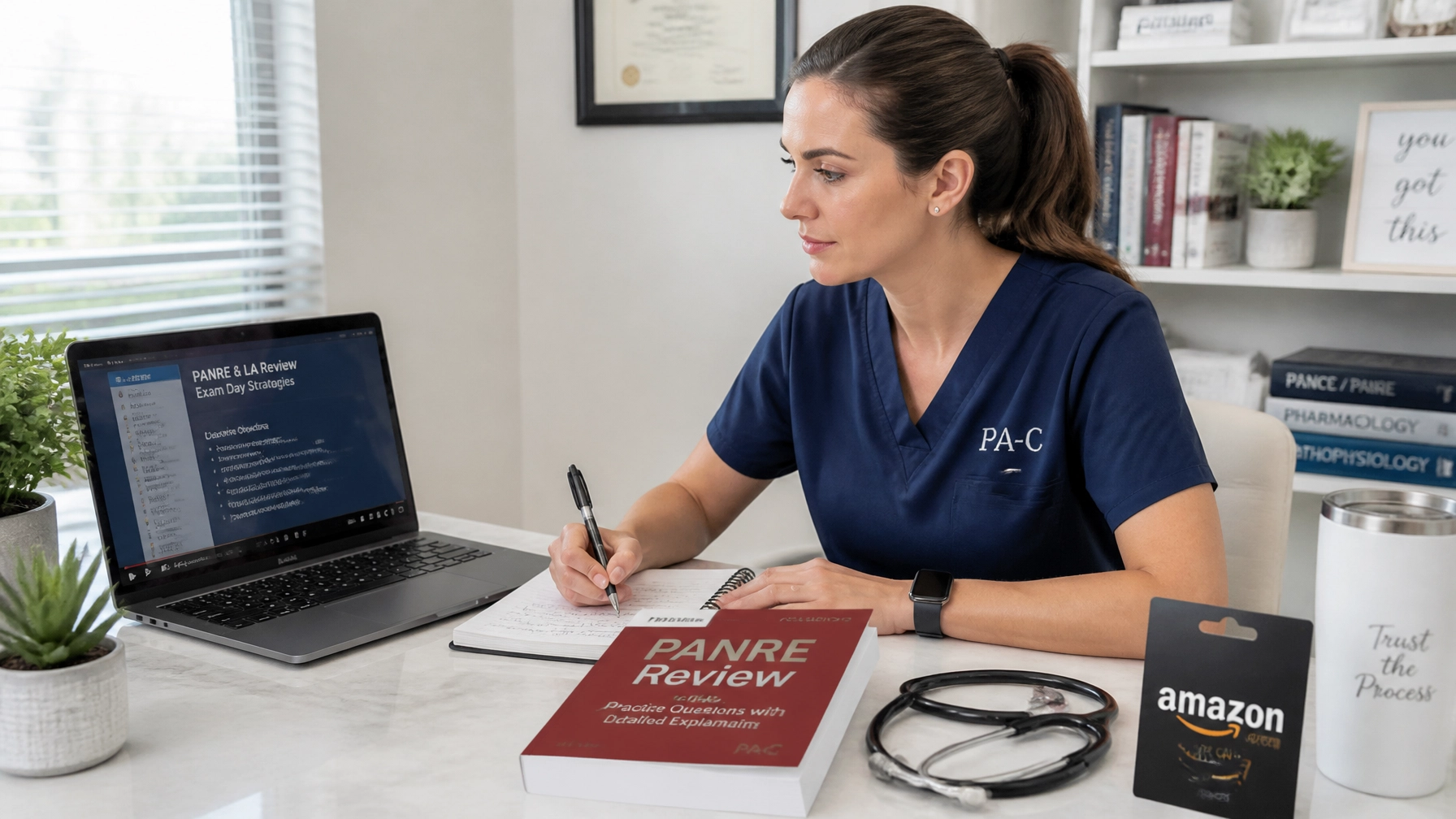
To bridge the remaining gap in your 100-hour requirement and ensure you are prepared for the quarterly PANRE-LA questions, our PANRE Review Course provides 100 hours of AAPA Category 1 Credit. This allows you to fulfill your entire biennial requirement while reinforcing the clinical knowledge needed to answer PANRE-LA questions accurately and efficiently.

Strategic Preparation for PANRE-LA
The PANRE-LA is an open-resource assessment, but the time limit of five minutes per question means you cannot afford to look up every single answer from scratch. You need a foundational knowledge base that allows you to identify the core clinical issue quickly.
Our course is designed by physician assistants for physician assistants. It covers the essential clinical pillars, including Cardiology, Pulmonology, Orthopedics, and Emergency Medicine. By utilizing our PANRE Review Course, you are not just checking a box for your CME hours; you are building the rapid-recall skills necessary to navigate the NCCPA Blueprint topics with confidence.
Clinical Vignette: Cardiology
Your patient is a 68-year-old male with a history of hypertension and Type 2 Diabetes who presents to the clinic for a routine follow-up. He reports occasional "fluttering" in his chest that lasts for several minutes but denies chest pain, syncope, or shortness of breath. His HR is 112 bpm (irregularly irregular), BP is 134/82 mmHg, and SaO2 is 98% on room air. An EKG confirms atrial fibrillation.
What is the most appropriate next step in determining this patient's long-term stroke prevention strategy?
- Start Aspirin 81 mg daily.
- Initiate Warfarin with an INR goal of 2.0–3.0.
- Calculate the CHA2DS2-VASc score.
- Perform an urgent transesophageal echocardiogram (TEE).
The correct answer is: Calculate the CHA2DS2-VASc score.
For patients with non-valvular atrial fibrillation, the CHA2DS2-VASc score is the standard tool used to assess thromboembolic risk and guide the initiation of anticoagulation. Aspirin is no longer recommended as monotherapy for stroke prevention in AFib. A TEE would be indicated if the patient were undergoing immediate cardioversion, but it is not the first step in long-term risk assessment. Initiating Warfarin or a DOAC is dependent on the calculated score (typically a score of ≥2 in men or ≥3 in women warrants anticoagulation).

Maximizing Your CME Budget with Gift Card Add-ons
Most PAs receive a yearly CME allowance from their employers. Often, this money is "use it or lose it." We offer an efficient way to utilize these funds by providing CME with Amazon or Apple Gift Card add-ons.
When you purchase our PANRE Review Course, you can add a gift card ranging from $100 to $1,500. This allows you to purchase additional educational tools, such as medical tablets, reference books, or clinical equipment, to further your professional development. This is a pragmatic way to ensure your entire CME budget is used to its full potential while you earn your 100 hours of AAPA Category 1 credit.
Mastery of High-Yield Clinical Topics
Success on the PANRE-LA requires a broad understanding of Internal Medicine, Family Medicine, and the subspecialties. Our course content is updated to reflect the current standard of care and the NCCPA Blueprint requirements. We focus on the "must-know" information that frequently appears in clinical practice and on certification exams.

Clinical Vignette: Emergency Medicine / Orthopedics
Your patient is a 24-year-old female who presents to the Urgent Care after falling onto an outstretched hand (FOOSH) while rollerblading. She complains of severe pain in her right wrist. On physical exam, there is no obvious deformity, but she has significant tenderness over the anatomical snuffbox. X-rays of the wrist (AP, lateral, and oblique) show no visible fracture.
What is the most appropriate management for this patient?
- Discharge with a removable wrist brace and follow up in 4 weeks.
- Apply a thumb spica splint and repeat X-rays in 10-14 days.
- Order an immediate MRI of the wrist.
- Apply a volar splint and refer to Physical Therapy.
The correct answer is: Apply a thumb spica splint and repeat X-rays in 10-14 days.
Tenderness in the anatomical snuffbox is highly suggestive of a scaphoid fracture, even if initial X-rays are negative. Scaphoid fractures are notorious for being radiographically occult in the acute setting. Due to the risk of avascular necrosis (AVN) of the proximal pole, the patient must be immobilized in a thumb spica splint and re-evaluated with repeat imaging once the bone resorbs slightly at the fracture site, making it more visible. An MRI is a valid diagnostic tool but is usually reserved if a faster diagnosis is required or if repeat X-rays remain inconclusive despite persistent pain.
Clinical Vignette: Neurology
Your patient is a 45-year-old male who presents with a sudden onset of "the worst headache of my life." He is currently nauseated and has vomited twice since arrival. Vital signs show a BP of 170/105 mmHg, HR 92 bpm, and he is afebrile. Physical exam reveals mild nuchal rigidity but no focal neurological deficits. A non-contrast CT head is performed and is negative for acute intracranial hemorrhage.
What is the most appropriate next step in the diagnostic workup?
- Repeat the CT head with intravenous contrast.
- Perform a lumbar puncture (LP).
- Discharge home with high-dose NSAIDs and primary care follow-up.
- Obtain an outpatient MRI of the brain.
The correct answer is: Perform a lumbar puncture (LP).
In the setting of a suspected subarachnoid hemorrhage (SAH) where the clinical suspicion remains high ("thunderclap headache") despite a negative non-contrast CT, a lumbar puncture is mandatory. The LP is used to look for xanthochromia or an elevated red blood cell count that does not diminish from tube 1 to tube 4. A contrast CT is not indicated for the initial diagnosis of SAH, and discharging the patient without excluding SAH would be a significant clinical error.

Pharmacology and Prescriptive Authority
In addition to the PANRE Review, we offer a dedicated Pharmacology Course which provides AAPA Category 1 Credit. For nurse practitioners and physician assistants in many states, specific pharmacology credit is required to maintain prescriptive authority. While the 100 hours of Category 1 credit for the PANRE Review course is the gold standard for recertification, our pharmacology modules provide the granular detail needed for safe prescribing in Family Medicine and Psychiatry.
Our content is written by PAs who understand the practicalities of the clinical floor. We skip the fluff and focus on the mechanism of action, contraindications, and black box warnings that you need to know for the PANRE-LA and your daily practice.
Clinical Vignette: Pulmonology
Your patient is a 55-year-old male with a 40-pack-year smoking history who presents with increasing shortness of breath and a chronic productive cough. His FEV1/FVC ratio is 0.62. He is currently using a short-acting beta-agonist (SABA) as needed but continues to have symptoms more than twice a week.
According to the GOLD criteria, what is the most appropriate long-acting maintenance therapy to add first for this patient?
- Inhaled corticosteroid (ICS) monotherapy.
- Long-acting muscarinic antagonist (LAMA) or Long-acting beta-agonist (LABA).
- Oral Prednisone.
- Theophylline.
The correct answer is: Long-acting muscarinic antagonist (LAMA) or Long-acting beta-agonist (LABA).
For patients with COPD, maintenance therapy begins with long-acting bronchodilators (LAMA or LABA). Unlike in asthma, inhaled corticosteroids are not used as monotherapy in COPD and are typically reserved for patients with frequent exacerbations or high eosinophil counts. Oral steroids are used for acute exacerbations, not long-term maintenance. Theophylline is rarely used today due to its narrow therapeutic index and side effect profile.
Conclusion
Preparing for the PANRE-LA does not have to be a burden. By leveraging the 1.5x multiplier for AAPA Category 1 Self-Assessment credit and enrolling in our 100-hour PANRE Review Course, you can meet your professional requirements with ease. Our course provides the structured, high-yield content you need to succeed on the exam and provide excellent care to your patients.
Don't forget to maximize your CME budget by selecting one of our Amazon or Apple Gift Card add-ons to help you get the tools you need for another successful cycle.