





Every EMtopia playbook has a section called Landmines. It exists because the cases that go wrong for new emergency department clinicians rarely involve an obscure disease. They involve a common complaint, a reassuring first impression, and one detail that did not get the weight it deserved. Experienced clinicians carry these traps around in their heads. New graduates usually learn them the hard way. Here are seven that come up again and again.
1. Pelvic pain, a positive pregnancy test, and no confirmed intrauterine pregnancy
Until an intrauterine pregnancy is confirmed, the working diagnosis is ectopic pregnancy. Mild pain, stable vital signs, and a low hCG do not change that. A new clinician who treats this as a routine early-pregnancy visit can miss a rupture that is hours away.
2. Abdominal pain in older adults
Older patients with abdominal pain carry far more risk than their appearance suggests. Pain out of proportion to the exam should raise concern for mesenteric ischemia. Normal labs do not exclude serious pathology, and a “kidney stone” in an older patient deserves a hard look for an abdominal aortic aneurysm.
3. Ovarian torsion with normal Doppler flow
Documented flow on ultrasound does not rule out torsion. When the story fits, with sudden unilateral pain, nausea, and an adnexal mass, the concern belongs with gynecology even if the images look reassuring.
4. Testicular pain and the clock
Testicular torsion is a time-sensitive diagnosis. When the clinical suspicion is high, waiting on imaging before involving urology can cost the testicle. The playbook is explicit about when to escalate first and image second.
5. The well-appearing febrile neonate
Young infants with fever can look remarkably well while harboring a serious bacterial infection. Age-based pathways exist for a reason, and a reassuring exam is not a substitute for following them. New clinicians should staff these infants with the physician early.
6. The headache that is “the usual migraine”
A patient with a migraine history can still have a subarachnoid hemorrhage, a dissection, or meningitis. A thunderclap onset, a change in pattern, fever, neck stiffness, or a new neurologic finding moves the headache out of the routine category no matter what the triage note says.
7. The bounce-back and the triage label
A patient returning within a few days is telling you something. So is a triage diagnosis that seems a little too neat. Anchoring on a prior visit or a chief complaint label is one of the most common thinking errors in emergency medicine, and new clinicians are especially prone to it because they are working hard just to keep up.
Why the landmines are written down
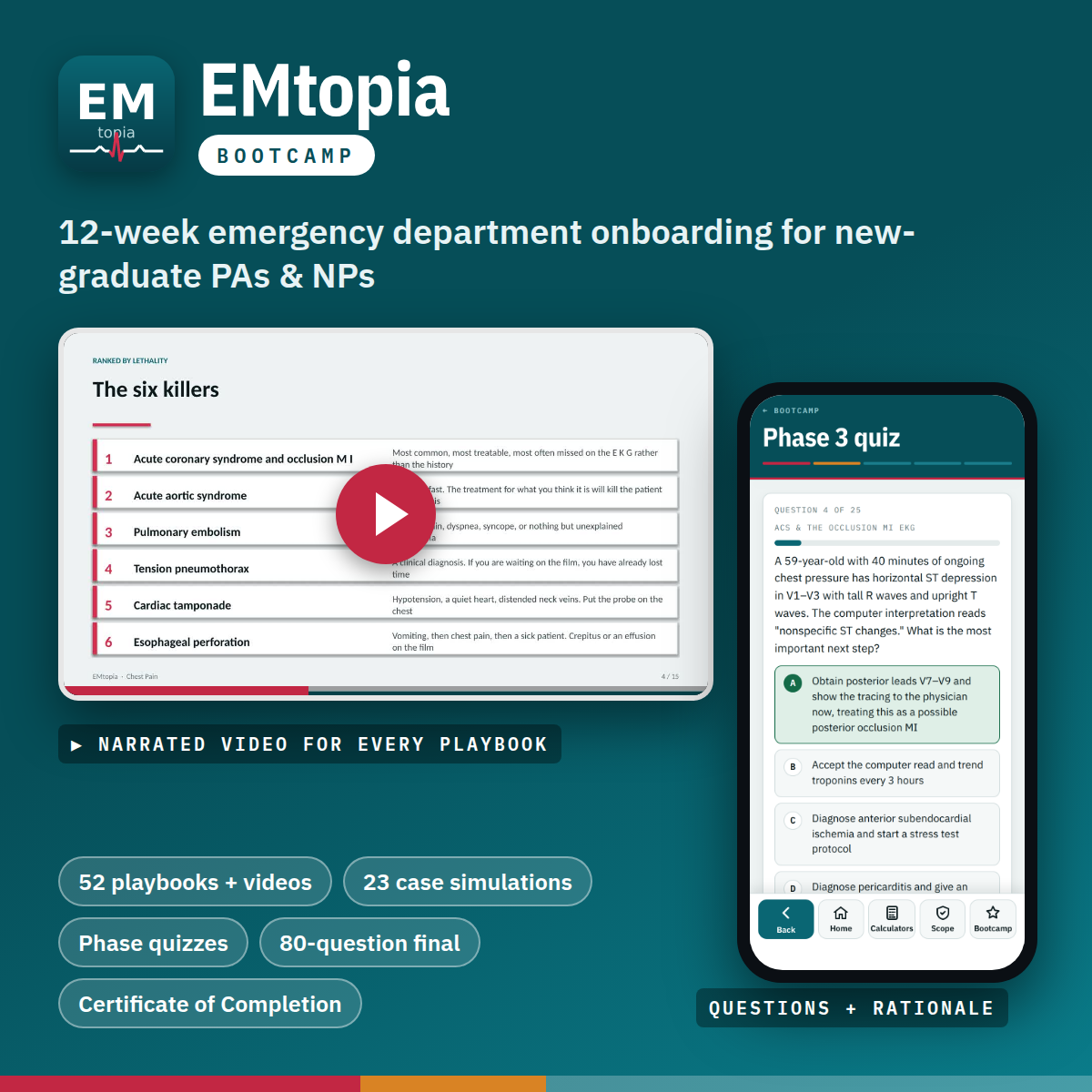
In most departments, these lessons are passed along informally, from whichever senior clinician happens to be on shift. EMtopia writes them down for every one of its 52 playbooks, next to the red flags, the order guidance, and clear direction on when to call the physician. The Bootcamp tier goes a step further with landmine drills that use spaced repetition, so a new clinician sees the ones they missed until they stick.
UCtopia does the same for urgent care, with extra emphasis on recognizing the patient who needs the emergency department. You can see sample Landmines sections in the free test drive of either app.