





Course Title: PANRE Review Course
Quantifiable Deliverables: 100 Hours of AAPA Category 1 CME Credit
Access Duration: 12 Months
Practice Questions: 1,000+ NCCPA-style questions
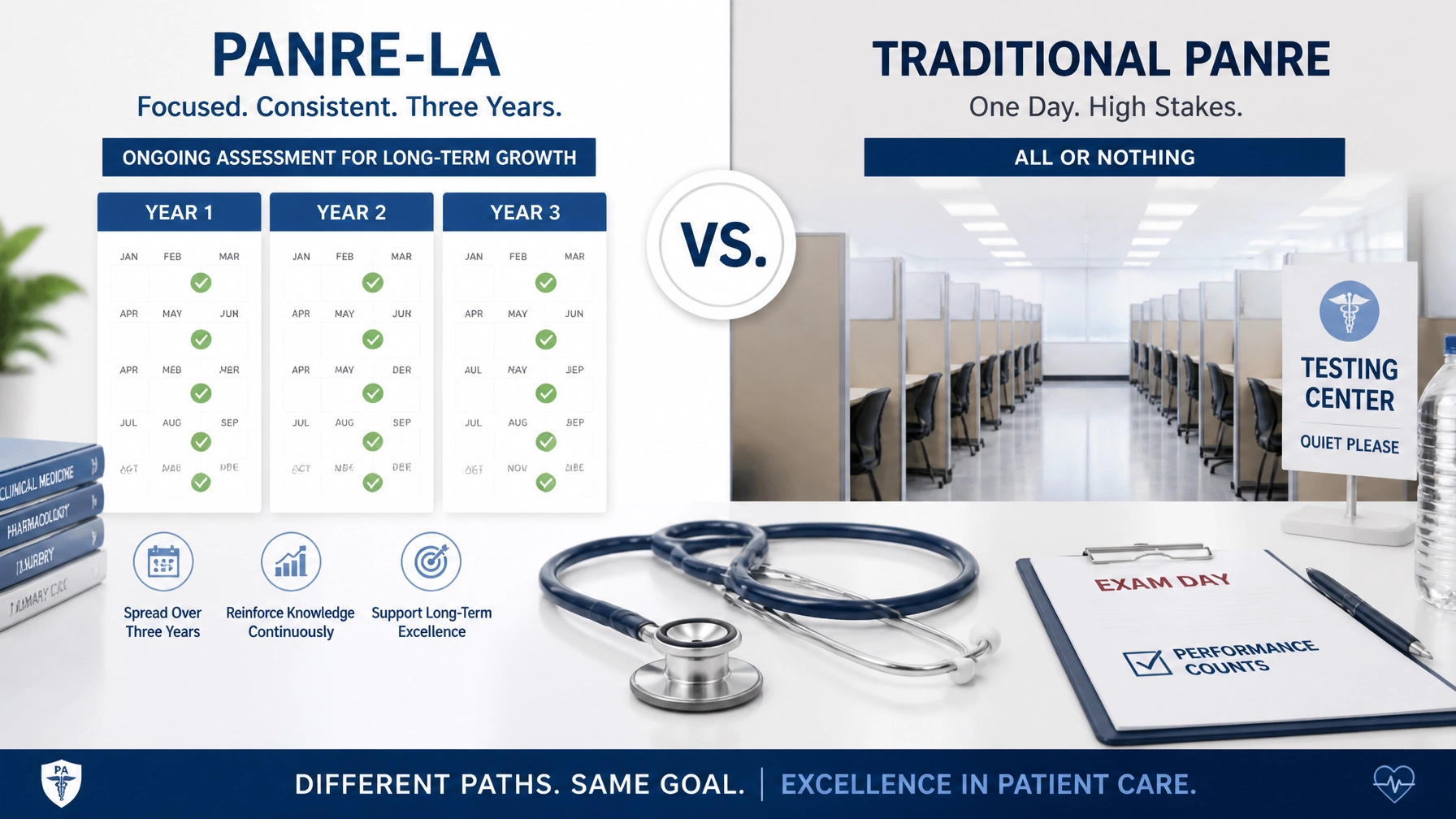
The decision between the traditional Physician Assistant National Recertifying Examination (PANRE) and the Physician Assistant National Recertifying Examination-Longitudinal Assessment (PANRE-LA) is primarily a matter of logistics and stress management. For Physician Assistants (PAs) nearing the end of their 10-year recertification cycle, the choice dictates how they will allocate their study time and professional energy over several years. Both pathways lead to the same result: maintenance of NCCPA certification: but the timelines are fundamentally different.
The Traditional PANRE: The One-Day Sprint
The traditional PANRE is the legacy pathway. It is a proctored, four-hour examination administered at Pearson VUE testing centers. This option is designed for PAs who prefer to consolidate their preparation into a single high-intensity window.
Timeline Logistics
PAs are eligible to take the traditional PANRE during years nine or ten of their maintenance cycle. You have up to three opportunities to pass the exam, provided you do not exceed the December 31 deadline of your tenth year. The schedule is rigid: once you apply, you have a 180-day window to schedule and complete the exam.
Pros and Cons
- Pros: The primary advantage is speed. Once the exam is passed, the requirement is fulfilled for another decade. There is no ongoing obligation to participate in quarterly assessments.
- Cons: The "high-stakes" nature of a single exam day can be a significant stressor. It requires a dedicated block of study time, often involving several weeks of intensive review of the NCCPA Blueprint.

The PANRE-LA: The Three-Year Marathon
The PANRE-LA is a longitudinal assessment that moved out of its pilot phase to become a permanent option. It is designed to move away from the "cram and pass" model toward a more continuous learning experience.
Timeline Logistics
The PANRE-LA spans three years (12 quarters). PAs must apply for this pathway in year six of their cycle. The assessment officially begins in year seven and continues through year nine.
- Quarterly Requirement: You are given 25 questions every quarter.
- Participation: You must complete at least 8 out of 12 quarters.
- Flexibility: You can skip up to 4 quarters if your clinical or personal schedule becomes overwhelming.
Pros and Cons
- Pros: The exam is "open resource," meaning you can use clinical references while answering questions. It reduces the acute anxiety associated with a proctored exam center.
- Cons: It requires a long-term commitment. Forgetting to log in or missing too many quarters can result in being withdrawn from the program, forcing a late-cycle pivot back to the traditional PANRE.
Choosing Your Path Based on Your Clinical Schedule
If you work in a high-volume specialty like Emergency Medicine or Internal Medicine, your ability to sit for a four-hour exam may be limited. Conversely, if you prefer to "get it over with," the three-year duration of the PANRE-LA might feel like an unnecessary lingering chore.
For those choosing the traditional route, efficiency is paramount. Utilizing a PANRE Review Course that provides 100 hours of AAPA Category 1 CME Credit allows you to satisfy your biennial CME requirements while simultaneously preparing for the exam.

Clinical Practice Assessment: Cardiology
Your patient is a 64-year-old male with a history of hypertension and hyperlipidemia who presents to the clinic for a routine follow-up. He reports occasional palpitations but denies chest pain or shortness of breath.
Vitals:
- HR: 105 bpm (Irregular)
- BP: 138/88 mmHg
- SaO2: 98% on room air

Question: Which of the following is the most appropriate next step in the diagnostic workup for this patient?
A) 12-lead Electrocardiogram (ECG)
B) Exercise Stress Test
C) Cardiac Catheterization
D) Echocardiogram
Correct Answer: A) 12-lead Electrocardiogram (ECG)
Explanation: A 12-lead ECG is the gold standard for the initial evaluation of an irregular heart rate or palpitations. It is necessary to differentiate between atrial fibrillation, premature atrial contractions (PACs), or other arrhythmias. An exercise stress test (B) is used for ischemia evaluation, while cardiac catheterization (C) is an invasive procedure for definitive coronary artery disease diagnosis. An echocardiogram (D) evaluates structural heart disease but does not serve as the primary tool for rhythm identification.
Maximizing Your CME Budget
Regardless of which path you choose, you must manage your CME funds effectively. Many employers provide an annual stipend that must be used or lost. At CME Review Courses, we offer a way to maximize this benefit by adding an Amazon or Apple Gift Card to your purchase.
You can add a gift card ranging from $100 to $1,500 to your order. This allows you to purchase the educational content you need: such as our Pharmacology Review (which also offers Category 1 AAPA Credit) or our comprehensive PANRE Review: while receiving a gift card that can be used for further educational materials, hardware like an iPad for clinical use, or other professional resources.
Clinical Practice Assessment: Dermatology
Your patient is a 42-year-old female who presents with a painful, red, and swollen area on her right lower leg that has progressed over the last 48 hours. She remembers a small insect bite in the area prior to the onset of symptoms.
Vitals:
- Temp: 100.8°F
- HR: 92 bpm
- BP: 122/78 mmHg

Question: What is the most likely diagnosis?
A) Cellulitis
B) Deep Vein Thrombosis (DVT)
C) Contact Dermatitis
D) Erythema Nodosum
Correct Answer: A) Cellulitis
Explanation: Cellulitis presents as a spreading area of red, swollen, tender, and warm skin, often accompanied by systemic symptoms like fever. The history of a skin break (insect bite) provides a portal of entry for bacteria. A DVT (B) would typically lack the intense surface erythema and warmth. Contact dermatitis (C) is usually pruritic (itchy) and lacks systemic fever. Erythema nodosum (D) presents as painful, nodules typically on the shins, but is usually bilateral and not associated with an acute portal of entry.
Final Decision: Sprint or Marathon?
If you are a PA who thrives under pressure and wants to clear your schedule for the next nine years, the traditional PANRE is your choice. If you prefer a lower-stress, incremental approach and can commit to quarterly check-ins, the PANRE-LA is superior.
Our PANRE Review Course is designed to support both pathways. With 100 hours of AAPA Category 1 CME credit, you can complete your entire two-year credit requirement in one go. For those focused on specific weaknesses, our Pharmacology Review provides a deep dive into the 18% of the NCCPA Blueprint dedicated to pharmaceutical therapeutics.
Clinical Practice Assessment: Internal Medicine
Your patient is a 55-year-old male with Type 2 Diabetes Mellitus who presents for a six-month check-up. His recent laboratory results show a fasting blood glucose of 145 mg/dL and an HbA1c of 8.2%. He is currently taking Metformin 1000mg twice daily.
Question: According to the current standard of care, which class of medication should be considered next if the patient also has a history of heart failure with reduced ejection fraction (HFrEF)?
A) SGLT2 Inhibitor
B) Sulfonylurea
C) DPP-4 Inhibitor
D) Meglitinide
Correct Answer: A) SGLT2 Inhibitor
Explanation: SGLT2 inhibitors (e.g., Empagliflozin) are the preferred second-line agents for patients with Type 2 Diabetes and HFrEF, as they have been proven to reduce the risk of heart failure hospitalization and cardiovascular death. Sulfonylureas (B) can cause hypoglycemia and weight gain without cardiovascular benefits. DPP-4 inhibitors (C) are generally neutral, though some (like saxagliptin) are contraindicated in heart failure. Meglitinides (D) have a short duration of action and do not provide the long-term cardioprotective benefits seen with SGLT2 inhibitors.
For more information on preparing for your recertification and maximizing your CME stipend, visit CME Review Courses.