Price: $499.99 (starting)
Duration of Access: 30 months
Deliverables: 100 hours of AAPA Category 1 CME Credit, 1,672+ board-style questions.
The choice between the Traditional PANRE and the PANRE-LA (Longitudinal Assessment) is more than just a preference for how you take an exam; it is a strategic decision regarding how you manage your recertification cycle and your professional development budget. While both pathways fulfill the NCCPA requirement for recertification, they offer vastly different experiences and credit-earning potential.
When you enroll in the PANRE Review Course, you are not just preparing for an exam. You are securing 100 hours of AAPA Category 1 CME credit that can be applied to your certification requirements, regardless of which testing path you choose.
PANRE-LA vs. Traditional PANRE: The Core Differences
The Traditional PANRE remains a single, high-stakes, four-hour proctored exam taken at a Pearson VUE testing center. It consists of 240 questions and is a closed-book assessment. For PAs who prefer to "get it over with" in one day, this remains the standard.
In contrast, the PANRE-LA is an open-book, longitudinal assessment spread over two to three years. You answer 25 questions per quarter for 8 to 12 quarters. This format is designed for "assessment for learning," allowing you to use references to close knowledge gaps in real-time.
5 Facts About AAPA Category 1 Credit That Every PA Needs to Know
Understanding how credits work is essential for maintaining your certification without last-minute stress.
- PANRE-LA Earning Potential: Completing a quarter of the PANRE-LA typically earns you 2 AAPA Category 1 Self-Assessment CME credits. Over 12 quarters, this can total 24 credits. However, this is rarely enough to satisfy your total cycle requirements.
- Traditional PANRE Does Not Award Credit: Simply sitting for and passing the Traditional PANRE awards zero CME credits. You must obtain your 100 required credits through external courses.
- The 50/50 Split: You are required to log at least 100 CME credits every two years, at least 50 of which must be Category 1. The PANRE Review Course provides the full 100 Category 1 credits in one package, effectively covering your requirements for two cycles or ensuring a massive surplus.
- Self-Assessment Bonuses: AAPA Category 1 Self-Assessment credits (like those earned in the PANRE-LA) are often weighted more heavily by the NCCPA (currently a 50% bonus). However, "regular" Category 1 credits remain the bedrock of your logging.
- Audit Protection: Keeping a clear record of high-quality Category 1 credits from a reputable source like CME Review Courses is the best defense against an NCCPA audit.

How to Maximize Your CME Budget with Amazon Gift Card Add-ons
Most PAs receive a yearly CME allowance from their employers. If you do not use this money, you lose it. A common strategy to maximize this benefit is using CME gift cards as part of your purchase.
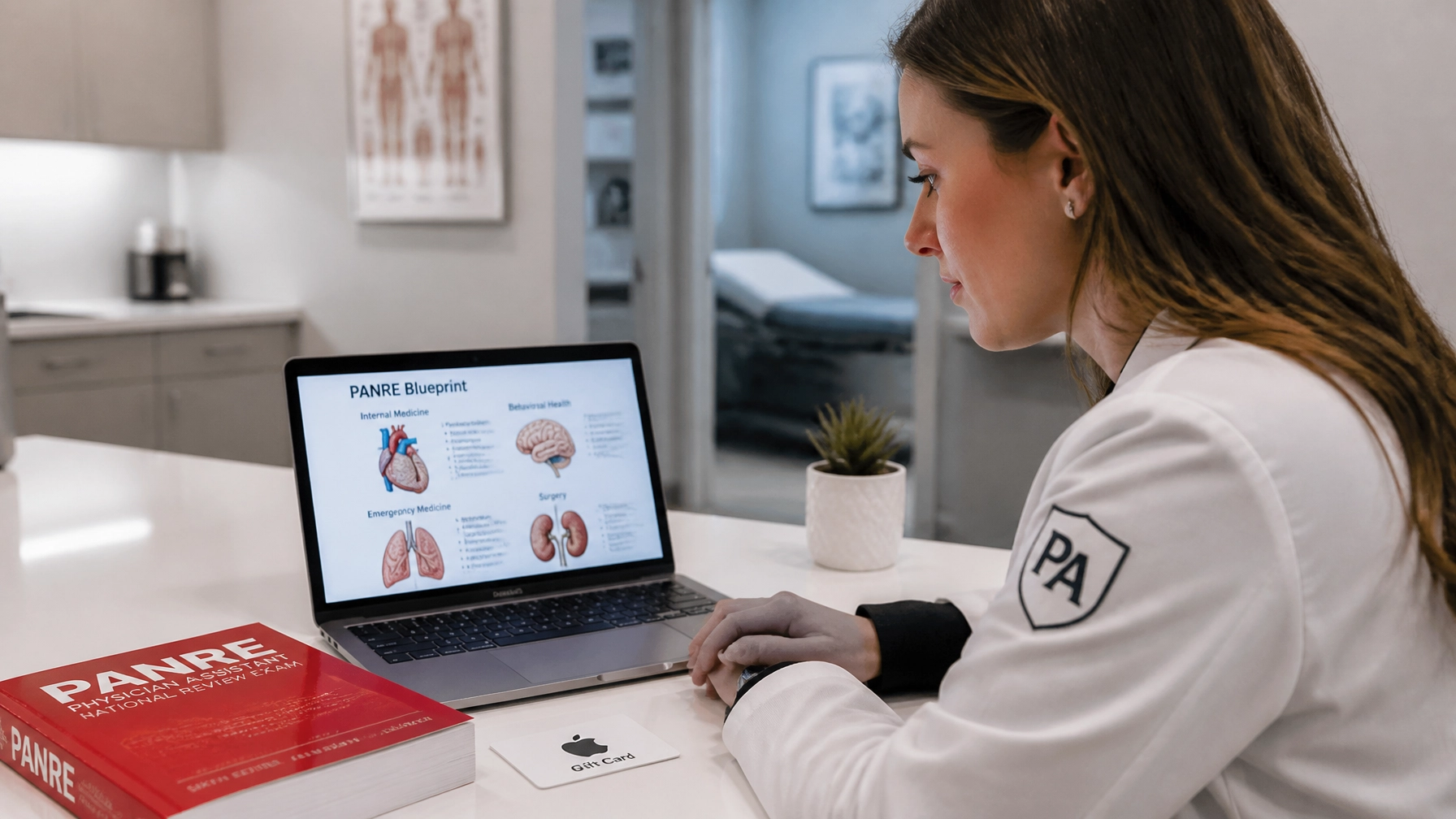
At CME Review Courses, we offer the ability to add an Amazon or Apple Gift Card ($100 – $1,500) to your PANRE Review Course purchase. It is important to note that these are NOT free gifts. They are add-ons that increase the total price of the package, allowing you to use your employer’s CME fund to purchase both the educational materials and a gift card that can be used for further educational resources, such as medical equipment, books, or technology.
By bundling the 100 hours of AAPA Category 1 credit with a gift card, you efficiently utilize your professional allowance while preparing for the NCCPA Blueprint content you will face on exam day.
7 Mistakes You’re Making with PANRE Review
Many PAs fail to optimize their study time, leading to unnecessary stress. Avoid these common pitfalls:
- Relying Solely on Clinical Experience: Daily practice is specific; the PANRE is broad. You must review systems you don’t see every day.
- Ignoring the NCCPA Blueprint: The exam is structured around specific percentages. Spending too much time on rare conditions while ignoring high-yield Cardiology or Pulmonology is a strategic error.
- Waiting Until Year 9: Whether taking the PANRE-LA or the Traditional PANRE, waiting until the last possible moment to start your review limits your ability to earn and log credits comfortably.
- Neglecting Practice Questions: Passive reading is inferior to active recall. Our course includes over 1,600 questions to sharpen your test-taking skills.
- Underestimating the Pharmacology Component: Pharmacology makes up a significant portion of the exam. We offer a specific Pharmacology Course that also provides AAPA Category 1 Credit.
- Not Factoring in Time Per Question: In the Traditional PANRE, you have 60 seconds per question. If you haven't practiced under timed conditions, you will struggle.
- Thinking "Open Book" Means "No Study": PAs taking the PANRE-LA often fail questions because they spend too much time looking up answers. You only have 5 minutes per question; you must still know the core material.

Clinical Practice Questions
To succeed on either the Traditional PANRE or the PANRE-LA, you must be able to apply clinical knowledge to vignettes. Review the following scenarios.
Scenario 1
Patient Demographics: 58-year-old female.
Symptoms: Acute onset of severe retrosternal chest pain radiating to the back, described as "tearing."
Vital Signs: HR: 110 bpm, BP: 185/105 mmHg (Right Arm), 155/90 mmHg (Left Arm), SaO2: 96% on RA.
Question: What is the most appropriate initial diagnostic study for this patient?
A) Transthoracic Echocardiogram (TTE)
B) CT Angiography of the Chest and Abdomen
C) Chest X-ray
D) Electrocardiogram (ECG)
Explanation: B) CT Angiography of the Chest and Abdomen is the correct answer. The patient's presentation: sudden tearing chest pain radiating to the back and a significant blood pressure discrepancy between arms: is highly suggestive of an aortic dissection. CT angiography is the gold standard for rapid and accurate diagnosis in a hemodynamically stable patient. While an ECG (D) should be performed to rule out MI, it is not the definitive diagnostic study for dissection. A Chest X-ray (C) may show a widened mediastinum but lacks sufficient sensitivity. TTE (A) is less sensitive than CT for the descending aorta.
Scenario 2
Patient Demographics: 32-year-old male.
Symptoms: Recurrent episodes of wheezing and shortness of breath, worse at night and during exercise.
Vital Signs: HR: 82 bpm, RR: 16, SaO2: 98% on RA. Physical exam reveals mild end-expiratory wheezing.
Question: Which of the following findings on spirometry would most strongly support a diagnosis of asthma?
A) FEV1/FVC ratio > 0.80
B) Increase in FEV1 of >12% after bronchodilator inhalation
C) Flattening of the inspiratory limb of the flow-volume loop
D) Total Lung Capacity (TLC) < 80% of predicted
Explanation: B) Increase in FEV1 of >12% after bronchodilator inhalation is the correct answer. Reversibility of airflow obstruction is a hallmark of asthma. An increase in FEV1 of at least 12% (and at least 200 mL) following a short-acting beta-agonist is diagnostic. An FEV1/FVC ratio > 0.80 (A) is typically normal and does not suggest obstructive disease. Flattening of the inspiratory limb (C) suggests an extra-thoracic upper airway obstruction. A low TLC (D) is indicative of restrictive lung disease, not asthma.

Conclusion: Secure Your 100 Category 1 Credits Today
Whether you are preparing for the quarterly challenges of the PANRE-LA or the single-day hurdle of the Traditional PANRE, your preparation should yield more than just a passing score. By choosing our PANRE Review Course, you earn 100 hours of AAPA Category 1 Credit while mastering the NCCPA Blueprint.
Don't let your CME budget go to waste. Use the CME gift card add-on options to maximize your employer's investment in your education. Secure your access for 30 months and ensure you have the tools to remain certified and clinically sharp.
