Course Name: PANRE Review Course
Price: $499.99 (Varies by Gift Card Add-on)
Deliverables: 100 Hours of AAPA Category 1 CME Credit
Access: Immediate On-Demand Access
Gift Card Options: $100 to $1,500 Amazon or Apple Gift Cards Available
The NCCPA’s Physician Assistant National Recertifying Examination Longitudinal Assessment (PANRE-LA) has transformed the recertification landscape. The transition from a high-stakes, single-day proctored exam to a multi-year, open-book format is often perceived as a "easier" path. However, the open-book nature of the PANRE-LA is a double-edged sword. Without a strategic approach, the "open-book" feature can lead to time mismanagement, cognitive fatigue, and unexpected failures.
To succeed, you must understand that the PANRE-LA is not a test of what you know: it is a test of how efficiently you can verify what you don't know while maintaining clinical accuracy under a ticking clock.
The 5-Minute Barrier: Why "Open-Book" is a Trap
The most significant secret of the PANRE-LA is the strict five-minute time limit per question. While five minutes sounds generous for a single clinical scenario, it evaporates quickly when you are navigating complex medical databases. If you do not have a pre-determined search hierarchy, you will find yourself three minutes into a search with four browser tabs open and no clear answer.
Experts know that the PANRE-LA is designed to test "core medical knowledge." This means if you are searching for basic diagnostic criteria for common conditions like Heart Failure or Community-Acquired Pneumonia, you are already behind. The open-book resource should only be used to confirm specific nuances: such as second-line antibiotic choices in penicillin-allergic patients or the specific timeframe for a diagnostic "window."

Two Devices: The Logistical Secret
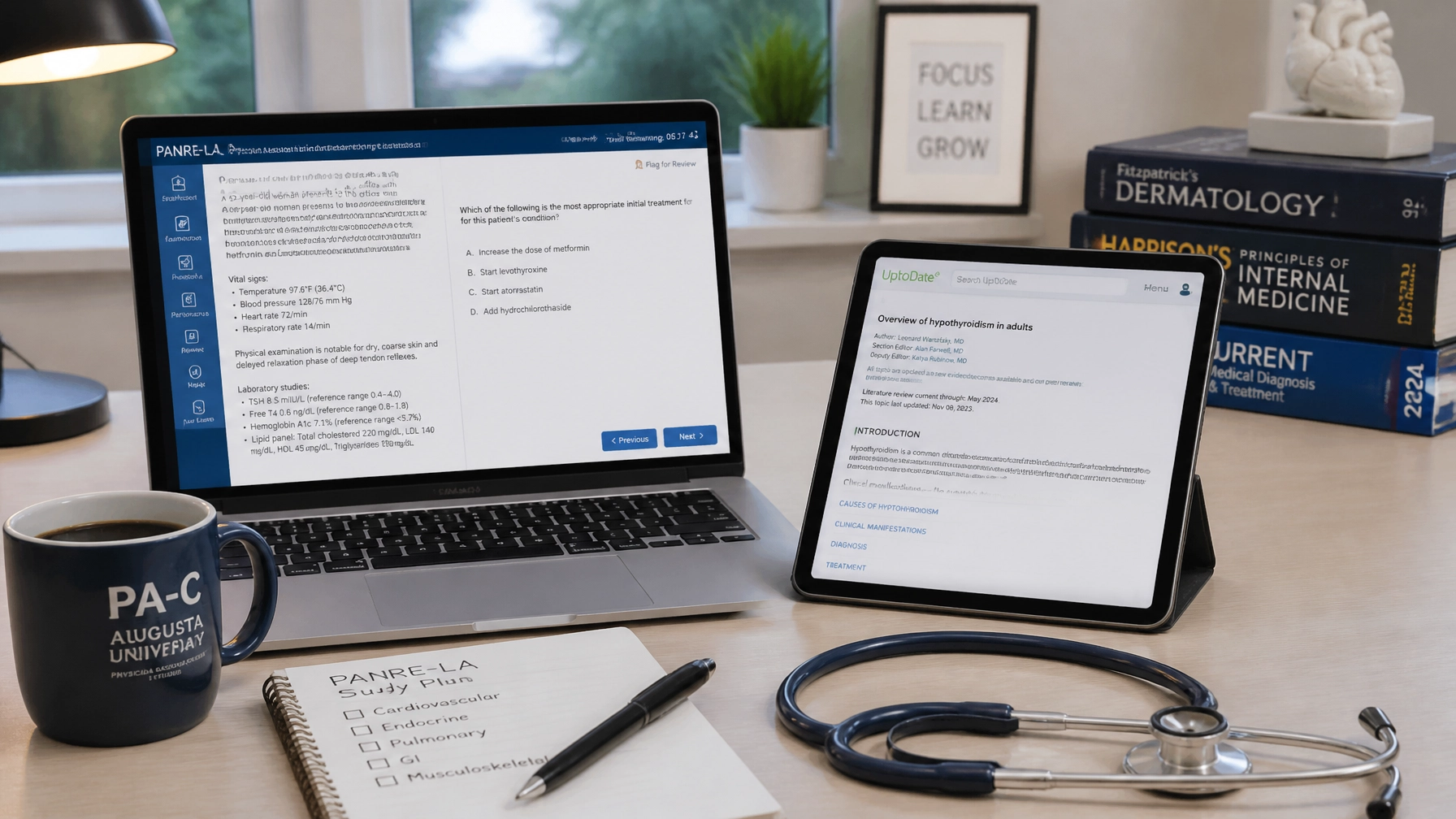
The NCCPA requires you to take the exam on one device. However, there is no rule against having a second device, such as a tablet or a separate laptop, open to your primary medical references. Toggling between tabs on a single screen is a recipe for technical lag and accidental browser closures.
By using a dedicated second device for your references, you keep the exam interface clear and minimize the risk of a "time-out" error. Your primary reference should be a robust, searchable database like UpToDate, Medscape, or your PANRE Review Course materials. Having a physical copy of a trusted review book can also serve as a fast backup if your internet connection fluctuates.
The Remediation Loophole: Feedback is Your Best Friend
One of the least discussed "secrets" is how the PANRE-LA handles incorrect answers. Unlike the traditional PANRE, the PANRE-LA provides immediate feedback. If you miss a question, you are told immediately. More importantly, the NCCPA will re-test you on that same topic in a subsequent quarter.
The "secret" here is that your higher score on the follow-up question counts toward your final performance. This means you should keep a dedicated log of every topic you miss. Immediately after completing a 25-question block, use your 100 hours of AAPA Category 1 CME credits to deep-dive into those specific areas. If you missed a question on the management of chronic kidney disease, that topic is guaranteed to reappear. Prepare for it.

Curating Your Search Skills: Search Strings over Sentences
To maximize the open-book advantage, you must master the art of the clinical search string. Typing "What is the best treatment for a patient with a UTI who is pregnant?" into a search bar takes too long.
Instead, practice using Boolean operators and medical keywords: "UTI pregnancy first-line treatment" or "nitrofurantoin pregnancy contraindication." You must be able to navigate to the "Management" or "Treatment" section of a clinical monograph within 30 seconds. If your current reference tool doesn't allow for rapid navigation, it is the wrong tool for the PANRE-LA.
Clinical Practice Scenarios
To prepare for the type of rapid-fire clinical reasoning required for the PANRE-LA, review the following vignettes.
Case Study 1: Cardiology
Your patient is a 64-year-old male presenting with a 2-day history of worsening dyspnea on exertion and orthopnea. He has a history of hypertension and a previous myocardial infarction. On physical exam, you note a heart rate of 102 bpm, BP 148/92 mmHg, and 2+ bilateral pitting edema to the mid-calf. Auscultation reveals an S3 gallop and crackles at the lung bases.
Which of the following is the most appropriate initial diagnostic test to confirm the suspected diagnosis?
A. Chest X-ray
B. B-type natriuretic peptide (BNP)
C. Echocardiogram
D. 12-lead EKG
Explanation:
The correct answer is B. B-type natriuretic peptide (BNP). In the setting of suspected acute heart failure, BNP or NT-proBNP is the most appropriate initial laboratory test to differentiate cardiac from non-cardiac causes of dyspnea. While a Chest X-ray (A) can show pulmonary congestion and an Echocardiogram (C) is necessary for determining the ejection fraction, the BNP provides immediate biochemical evidence of myocardial wall stress. An EKG (D) is useful for identifying underlying ischemia but is not diagnostic for heart failure.
Case Study 2: Endocrinology
Your patient is a 32-year-old female with a known history of Type 1 Diabetes Mellitus. She is brought to the emergency department by her husband, who states she has been "acting confused" and "breathing deeply." Her fingerstick glucose is 450 mg/dL. Her vitals show a BP of 100/60 mmHg and a HR of 115 bpm. An arterial blood gas reveals a pH of 7.20 and a bicarbonate of 12 mEq/L. Ketones are present in the urine.
After initiating aggressive fluid resuscitation, what is the next most critical step in management?
A. Start an insulin drip at 0.1 units/kg/hr
B. Administer intravenous bicarbonate
C. Check the serum potassium level
D. Administer a 10-unit bolus of regular insulin
Explanation:
The correct answer is C. Check the serum potassium level. In Diabetic Ketoacidosis (DKA), initiating insulin (A and D) will cause potassium to shift intracellularly, which can lead to life-threatening hypokalemia. You must ensure the serum potassium is >3.3 mEq/L before starting insulin therapy. Bicarbonate (B) is generally reserved for patients with a pH <6.9 and is not the next most critical step here.

Integrating the NCCPA Blueprint
Success on the PANRE-LA requires alignment with the NCCPA Blueprint. You should not waste time studying "zebras" that fall outside the core content areas. Our PANRE Review Course is specifically structured around the NCCPA Blueprint, ensuring that your study time is spent on the topics most likely to appear in your quarterly question sets.
By purchasing the course with a gift card add-on, you can utilize your employer's CME budget to its fullest extent. You receive high-yield, PA-led instruction plus an Amazon or Apple gift card ($100-$1500) that can be used for further educational resources, such as high-resolution monitors for your two-device setup or a premium tablet for mobile referencing.

Summary for Success
The PANRE-LA is an exercise in efficiency. To master the open-book format:
- Curate your references before the quarter begins.
- Utilize two devices to minimize technical friction.
- Log your misses to capitalize on the remediation re-tests.
- Practice timed searches using high-yield question banks.
Our PANRE Review Course provides the foundation you need to answer 80% of the questions from memory, leaving your five-minute "open-book" window available for the remaining 20% that require precise verification.