Course: PANRE Review Course & Pharmacology Course
Credits: 100 Hours of AAPA Category 1 Credit (PANRE Review Course)
Duration: 30 Months of Access
Deliverables: 1,672+ Board-Style Questions, Video Lectures, and PDF Slides
Price: Starting at $399.99 (Customizable with Gift Card Add-Ons up to $1,500)
Managing a Continuing Medical Education (CME) budget requires a strategic approach to balance high-quality educational content with the practicalities of professional expenses. For many Physician Assistants (PAs), the annual CME stipend is a "use it or lose it" resource. If you do not maximize these funds by the end of your fiscal year, the remaining balance effectively disappears. This makes efficient spending a priority.
At CME Review Courses, we provide a solution that allows you to fulfill your educational requirements while also leveraging your stipend for future resources. By offering cme gift cards as add-ons to our core curriculum, we enable healthcare professionals to bundle their board preparation with additional purchasing power for clinical tools, reference books, or technology.
Maximizing the 100-Hour AAPA Category 1 Requirement
The NCCPA recertification process is rigorous, and the PANRE (Physician Assistant National Recertification Exam) demands comprehensive preparation. Our panre review course is specifically designed to meet this need. This course is not just a study tool; it is a significant professional investment that provides 100 hours of AAPA Category 1 CME credit.
It is important to note that the 100-hour Category 1 credit designation applies specifically to the PANRE Review course. This substantial block of credit allows a PA to satisfy a massive portion of their biennial requirement in a single, focused program. The curriculum is built around the NCCPA Blueprint, covering essential topics such as Cardiology, Pulmonology, Gastroenterology, and Orthopedics.
The content was developed by physician assistants who have successfully navigated these exams. This peer-led approach ensures that the material is high-yield and focused on the nuances of the boards rather than extraneous clinical details that are not tested.

Understanding the Gift Card Add-On System
One of the most frequent questions we receive from clinicians involves our gift card packages. To be clear: these are not free gifts. They are add-ons that are integrated into the total purchase price of your CME package.
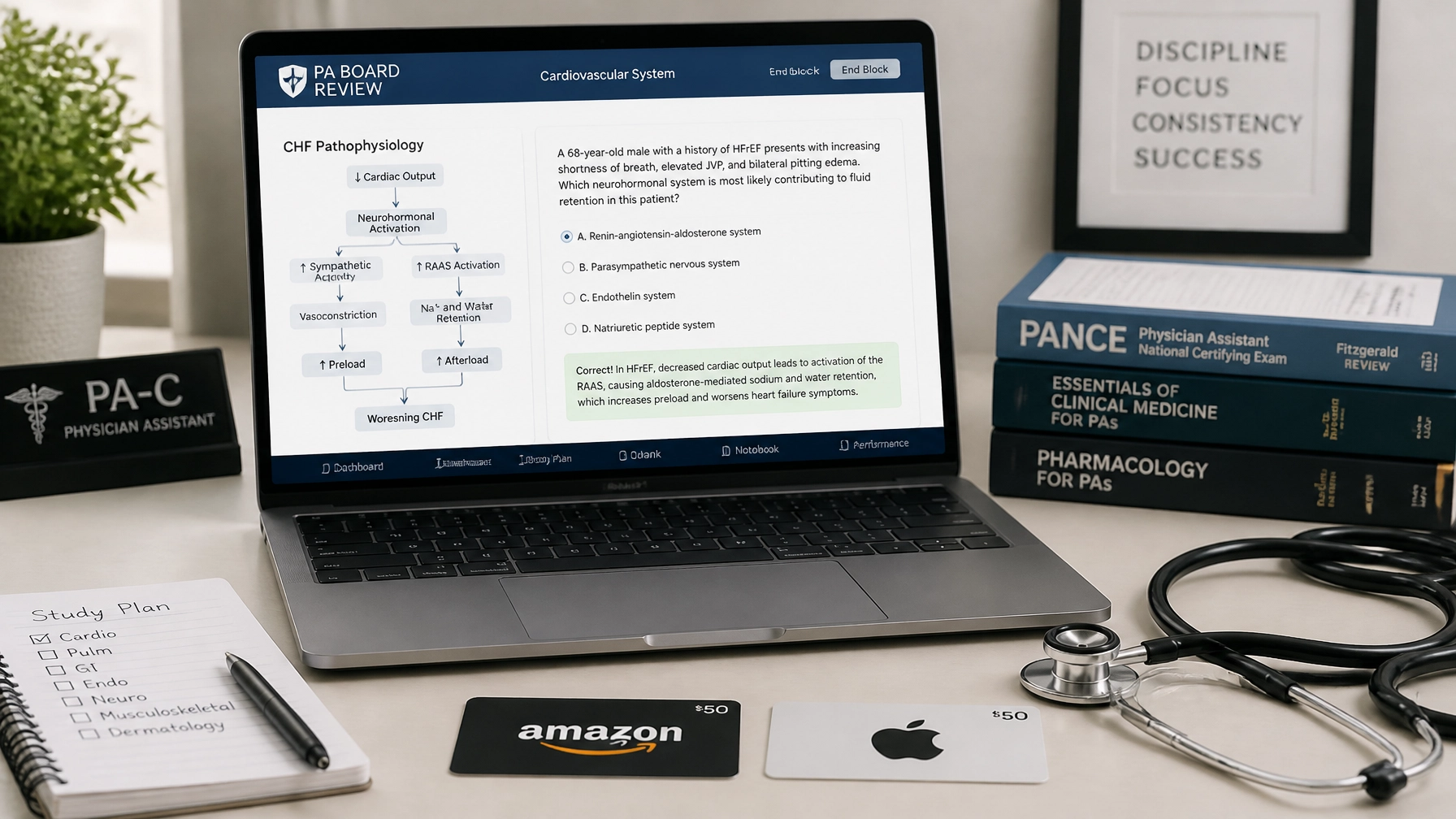
When you select a CME with Gift Card package, you choose a base course: such as the PANRE Review or the Pharmacology Course: and then select an Amazon or Apple gift card value ranging from $100 to $1,500.
Why Use a Gift Card Add-On?
- Consolidated Billing: The gift card and the educational course are bundled into a single transaction. This allows you to utilize your full CME stipend efficiently.
- Resource Enrichment: An Amazon or Apple gift card can be used to purchase medical equipment, specialized apps, or the latest editions of clinical references like Harrison’s Principles of Internal Medicine.
- Flexibility: We understand that every PA has different needs. Whether you need a new tablet for your rounds or a fleet of new medical texts, the gift card add-on provides the financial flexibility to acquire those tools using your professional development funds.
Our pharmacology course also offers Category 1 AAPA credit, though the 100-hour designation is exclusive to the PANRE course. Both options provide an excellent foundation for any PA or NP looking to sharpen their clinical skills while maximizing their budget.

Clinical Practice: PANCE/PANRE Question Bank
A core component of our pance prep courses and PANRE review is the high-volume question bank. We believe that active recall through practice questions is the most effective way to ensure long-term retention.
Below are clinical vignettes designed to test your diagnostic and management reasoning.
Clinical Vignette 1: Cardiology
Your patient is a 64-year-old male with a history of hypertension and tobacco use who presents to the emergency department with sudden onset substernal chest pressure that radiates to his left jaw. He appears diaphoretic. Vital signs: BP 155/92 mmHg, HR 102 bpm, SaO2 96% on room air. An EKG reveals 2mm ST-segment elevation in leads II, III, and aVF.
Which of the following is the most appropriate next step in management?
A) Administer sublingual nitroglycerin and monitor for symptom relief.
B) Activate the cardiac catheterization lab for immediate percutaneous coronary intervention (PCI).
C) Obtain a STAT chest X-ray to rule out aortic dissection.
D) Administer intramuscular morphine for pain control.
Explanation:
The correct answer is B) Activate the cardiac catheterization lab for immediate percutaneous coronary intervention (PCI). This patient is presenting with an inferior ST-elevation myocardial infarction (STEMI), as evidenced by the elevations in leads II, III, and aVF. In the setting of a STEMI, the goal is rapid reperfusion. While nitroglycerin (Choice A) is often used for chest pain, it must be used with extreme caution in inferior MIs due to the risk of profound hypotension if there is right ventricular involvement. Activation of the cath lab is the definitive treatment.
Clinical Vignette 2: Pulmonology
Your patient is a 28-year-old female with a history of mild persistent asthma who presents with worsening shortness of breath and wheezing for the past 24 hours. She has been using her albuterol inhaler every 2 hours without significant relief. On examination, she is using accessory muscles to breathe. Peak expiratory flow (PEF) is 55% of her predicted value.
What is the most appropriate medication to add to her immediate treatment regimen?
A) Inhaled corticosteroids
B) Long-acting beta-agonists (LABA)
C) Systemic corticosteroids (e.g., Prednisone)
D) Maintenance Theophylline
Explanation:
The correct answer is C) Systemic corticosteroids (e.g., Prednisone). This patient is experiencing an acute asthma exacerbation that is not responding adequately to SABA (albuterol). A PEF of 55% indicates a moderate-to-severe exacerbation. Systemic corticosteroids are indicated to reduce airway inflammation and prevent the progression of the attack. Inhaled corticosteroids (Choice A) are for long-term maintenance, not acute rescue. LABAs (Choice B) are contraindicated for monotherapy in asthma and are not used for acute rescue.

Why PAs Choose CME Review Courses
The landscape of pance prep courses is crowded, but our content stands out because it is written by practicing Physician Assistants. We understand the specific pressure of the NCCPA Blueprint and the practical realities of the clinical floor.
Our packages, including the Psychiatry CME with Gift Card, are tailored to provide value beyond just a certificate. We cover a broad spectrum of medical specialties:
- Internal Medicine & Hospitalist Medicine
- Emergency Medicine
- Orthopedics
- Dermatology
- Cardiology
- OB/GYN
Whether you are a PA-C preparing for your recertification or a nurse practitioner seeking to fulfill state-specific CME requirements (where AAPA Category 1 credit is accepted), our courses provide the clinical depth needed for high-level practice.
Finalizing Your Professional Development Strategy
As the end of the year approaches, review your remaining CME allowance. If you have a balance between $500 and $2,000, you can effectively secure your panre review course, earn 100 hours of Category 1 AAPA credit, and add an Amazon or Apple gift card to your purchase. This approach ensures that your employer's investment in your education provides the maximum possible benefit to your professional toolkit.
Remember that all our courses come with 30 months of access, providing you with a reliable clinical reference long after you have earned your credits. Visit our CME with Gift Card section to view the current package options and select the add-on that best suits your clinical needs.
